The best way to keep basil fresh after picking is to treat it like a bunch of cut flowers: trim the stems, stand them in a glass of water and leave it on the counter, out of direct sun. Basil is a warm-weather plant, and the cold of a normal refrigerator damages its leaves, which is why fridge-stored basil so often turns black.
That method buys you several days. For longer storage, freezing and drying both work, each with trade-offs in flavor and texture, and pesto or basil in oil needs a little food-safety care. Every option is laid out below.
Quick answer: Re-cut the stems and stand them in about 1 inch (2.5 cm) of water at room temperature, away from direct sun, changing the water daily. Basil keeps best at around 50 to 68°F (10 to 20°C), so avoid the cold fridge. For longer storage, freeze it in ice cube trays or dry it, and keep homemade pesto in the fridge for no more than 4 days or freeze it.
Why the fridge turns basil black
Basil is sensitive to cold even after it's picked. A Rutgers NJAES fact sheet on basil postharvest handling explains that basil is susceptible to chilling injury, with symptoms that include blackening of the leaves, stem discoloration and loss of aroma. It puts the optimal storage temperature at 55°F (13°C).
The same fact sheet cites University of California, Davis research showing that basil stored between 50 and 68°F (10 and 20°C) looked markedly better after 10 days than basil stored at 32°F (0°C). UC IPM gives the same 50 to 68°F range for short-term storage of harvested basil.
A home refrigerator is set much colder than that. Food-safety agencies such as Health Canada recommend keeping the fridge at 40°F (4°C) or lower, well below basil's comfort zone. That's why Illinois Extension says basil picked for the kitchen is best held in a glass of water at room temperature, and that refrigerating it results in discolored, unattractive leaves. The University of Kentucky agrees that basil doesn't store well in the fridge because it's sensitive to cold.
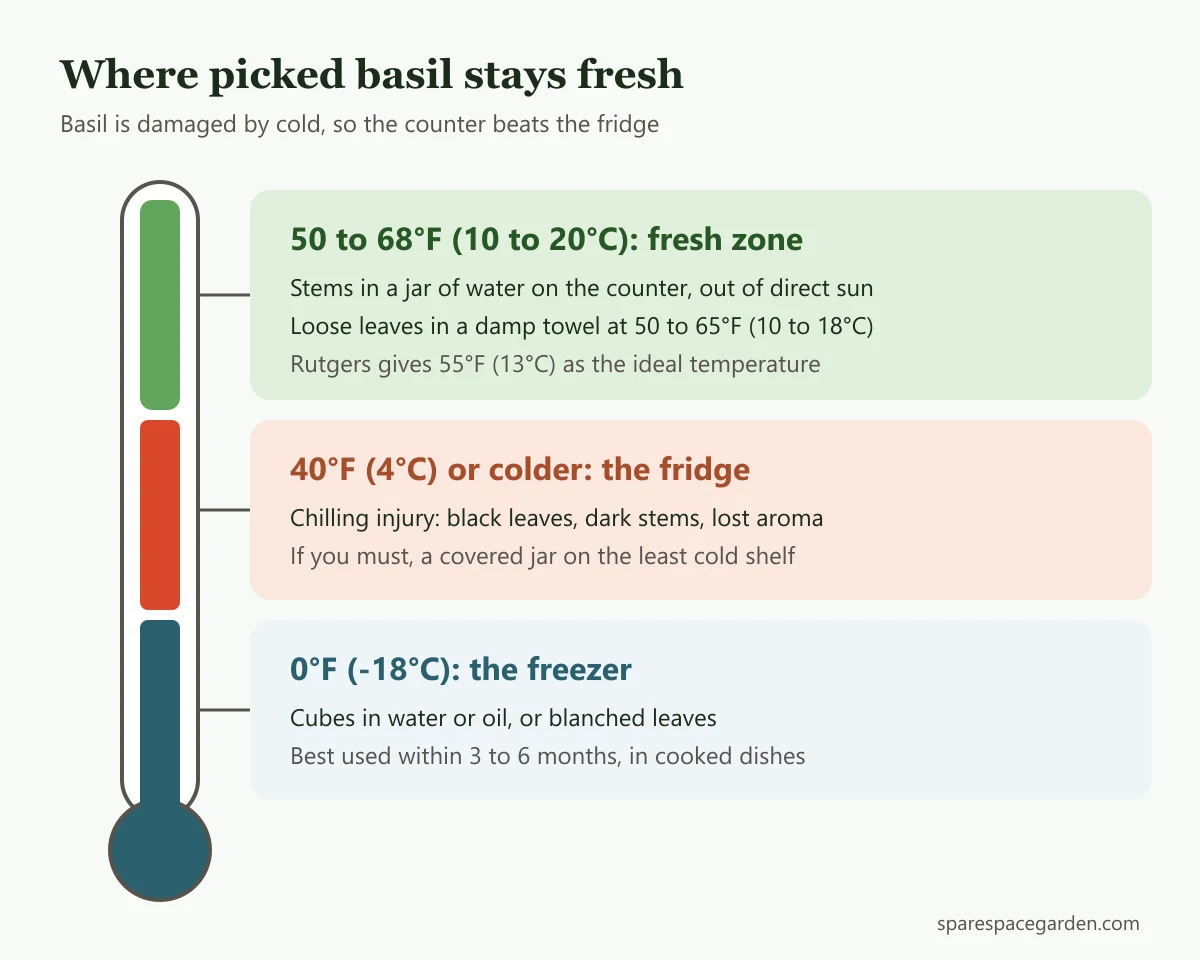 Fresh basil keeps best in the 50 to 68°F (10 to 20°C) range; a normal fridge is too cold.
Not every source rules the fridge out completely. Utah State University Extension suggests covering a jar of basil with a plastic bag and refrigerating it for longer storage of 7 to 10 days, and a Wisconsin Master Gardener article says basil doesn't refrigerate well but can be kept there for a few days. If you do use the fridge, keep the basil in a covered jar of water as Utah State describes, on the least cold shelf, since chilling damage gets worse the colder and longer basil is held.
Pick basil so it stays fresh longer
Your chance to keep basil fresh after picking starts at the plant. A few habits help:
- Pick only what you'll use soon. The University of Kentucky suggests picking just the amount you'll use within one or two days.
- Harvest when leaves are cool and dry. South Dakota State University Extension recommends mid-morning, after the dew has dried but before the heat of the day. Rutgers notes that a late-afternoon harvest can also give cool, dry leaves.
- Get it out of the sun fast. Rutgers advises cooling picked basil and moving it out of direct sunlight as quickly as possible.
- Handle gently. The National Center for Home Food Preservation advises avoiding bruising the leaves and discarding any that are bruised or soiled.
If you're still working out where to cut, our guide on how to harvest basil so it keeps growing covers that side, so the plant keeps producing while you store what you've picked. And if the pot sits on a kitchen windowsill, as in our guide to growing herbs in your kitchen, you can often pick minutes before cooking and skip storage altogether.
The jar-of-water method for basil stems
This is the method most extension sources recommend, and it works best for stems cut from the plant with a few leaves attached.
- Re-cut the stems with clean scissors as soon as you bring them inside, as Utah State suggests.
- Stand them in about 1 inch (2.5 cm) of water. Ohio State University Extension uses this depth for fresh herbs. Strip any leaves that would sit below the waterline.
- Cover loosely, if you like, with a plastic bag. Rutgers notes that standing stems in water and adding a non-sealed cover both raise the humidity around the leaves, and it gives 90 to 95 percent as the ideal relative humidity for basil.
- Keep the jar out of direct sunlight in a cool spot on the counter.
- Change the water daily. Both Ohio State and Purdue Extension give this advice.
How long does it last? The University of Kentucky says basil can keep for several days on the counter in a vase of water. Ohio State says fresh herbs stored in a covered glass of water may last up to a week, though its version goes in the fridge. Plan on a few days of best quality, and use the oldest stems first.
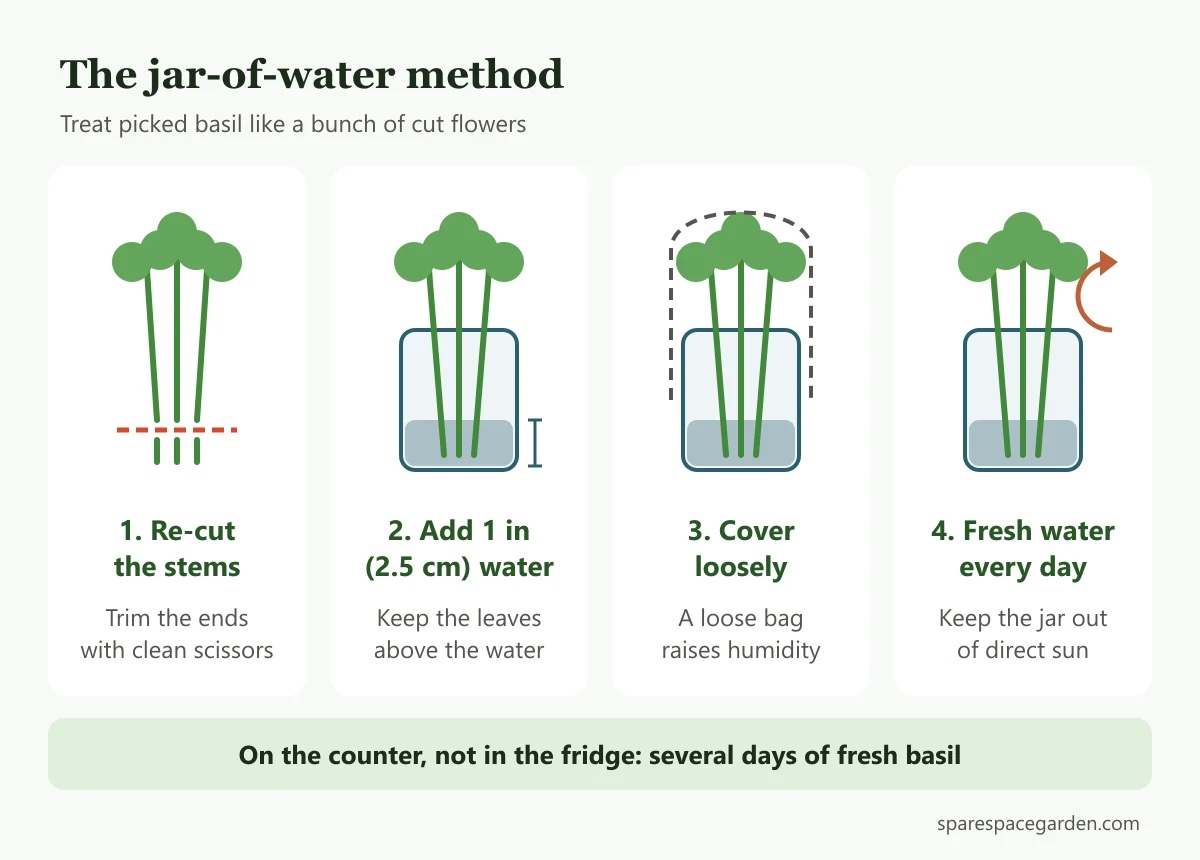 The jar method: re-cut, 1 inch (2.5 cm) of water, a loose cover, fresh water every day.
Tip: Don't wash basil you plan to store in a jar unless it's dirty. Rutgers says leaves that need washing should be dried before storage to prevent decay, so pat or spin them dry before they go into a bag or towel.
The paper towel method for loose leaves
If you've picked individual leaves, or the stems are too short for a jar, wrap them instead. Purdue Extension's FoodLink recommends wrapping basil in a damp paper towel, placing it in a loosely closed plastic bag and storing it at 50 to 65°F (10 to 18°C). It says basil keeps this way for several days.
The towel should be damp, not dripping, and the bag loose enough for some air to move. A cool room, pantry or the coolest part of the kitchen fits that temperature range better than the fridge does.
Here's how the short-term ways to keep basil fresh after picking compare:
| Method | Best for | Where to keep it | How long, per sources |
|---|---|---|---|
| Glass or jar of water | Stems with leaves | Counter, out of direct sun | Several days (Kentucky) |
| Damp paper towel in a loose bag | Loose leaves, short stems | 50 to 65°F (10 to 18°C) | Several days (Purdue) |
| Jar of water covered with a bag, in the fridge | Large bunches when the kitchen is hot | Least cold part of the fridge | Up to 7 to 10 days (Utah State); risk of chilling injury |
| Bare leaves in the fridge | Not recommended | None | Leaves blacken from chilling injury |
Watch out: A sealed container traps moisture against the leaves. Leave bags loosely closed so condensation can escape.
Freezing basil: cubes, oil and blanching
Freezing holds basil for months. The trade-off is texture: Ohio State notes that frozen herbs change texture once thawed, so they suit soups, sauces and other cooked dishes better than garnishes. Utah State adds that plain frozen leaves are mushy when thawed and lose flavor, and suggests freezing whole leaves in ice cubes to keep more of it.
There are three common ways to do it:
- In water cubes. Iowa State Extension suggests chopping the leaves, mixing with some water and freezing in ice cube trays, then moving the cubes to freezer bags. South Dakota State's version fills each tray compartment halfway with water, adds 1 tablespoon of herbs, freezes for 24 hours and then tops off with more water.
- In oil cubes. South Dakota State mixes 2 cups of herbs with 1/3 cup of oil, freezes the mixture in trays for 24 hours and then bags it. It specifically warns never to store herbs in oil at room temperature: freeze right away.
- Flat-frozen leaves. Ohio State describes laying whole leaves on a baking sheet with space between them, freezing, then packing them into freezer bags.
Blanching helps keep the color. South Dakota State says larger herbs such as basil can be blanched for 15 seconds, dropped into ice water and patted dry before freezing. The National Center for Home Food Preservation explains that blanching slows the enzymes that cause loss of flavor, color and texture in frozen produce.
For storage time, Ohio State recommends using frozen herbs within 3 to 6 months for best quality, and Utah State gives the same range. Keep the freezer at 0°F (-18°C). Use cubes straight from the freezer in hot dishes.
Drying basil, and why the flavor fades
Drying is the easiest preservation method, but basil is not the easiest herb to dry. The National Center for Home Food Preservation puts basil in its group of tender-leaf herbs with high moisture content that will mold if not dried quickly.
Methods that work:
- Paper bag hanging. The NCHFP suggests hanging small bunches inside paper bags with holes punched in the sides, where air can move through. Large bunches mold.
- Racks or trays. Iowa State prefers drying basil leaves on racks or trays in a warm, well-ventilated spot away from direct sun, rather than hanging bunches.
- Dehydrator. The NCHFP gives 95 to 115°F (35 to 46°C), up to 125°F (52°C) in humid areas, for about 1 to 4 hours. Clemson keeps it below 125°F (52°C).
Heat is what strips the flavor. Basil's aroma comes from volatile oils, and South Dakota State warns that oven drying can destroy an herb's color, flavor and oils. Iowa State notes that leaves turning brown during drying means they got too hot; well-dried basil should be brittle but still green. The NCHFP also advises against sun drying, which costs flavor and color.
Dried herbs are concentrated, so the NCHFP suggests using 1/4 to 1/3 of the fresh amount a recipe calls for. Store the crumbled leaves in airtight containers in a cool, dark place. Ohio State and Clemson both give up to a year for best quality, while South Dakota State gives about three months at room temperature and up to a year in the fridge or freezer.
Pesto and basil in oil: food safety
Pesto is one of the best ways to use a big basil harvest, and it freezes well. Clemson's Home & Garden Information Center says frozen pesto keeps good quality for up to six months, and suggests freezing it in ice cube trays, molds or freezer bags as single servings. Thaw it in the fridge.
The safety issue is botulism. Oregon State University Extension explains that garlic, herbs and vegetables are low-acid foods, and storing them in oil creates an oxygen-free environment suited to Clostridium botulinum. Its guidance:
- Refrigerate homemade pesto, basil oil or garlic-in-oil and use it within 4 days, or freeze it for long-term storage. Clemson is a little stricter for pesto and suggests using it within 3 days.
- Never store these mixtures at room temperature.
- Don't can pesto. Oregon State notes that no research has established safe canning times, and Clemson also warns that pesto and other herbs in oil should not be canned because of the botulism risk.
Health Canada adds that a fridge should run at 40°F (4°C) or lower for these products. Label containers with the date you made them, and freeze whatever you won't use in 4 days.
Frequently asked questions
How long can you keep basil fresh after picking?
At room temperature in a glass of water, the University of Kentucky says basil keeps for several days, and Purdue gives the same for leaves wrapped in a damp towel at 50 to 65°F (10 to 18°C). Utah State suggests a covered jar in the fridge can stretch storage to 7 to 10 days, though chilling injury is a risk. For anything longer, freeze or dry it.
Should you store basil in the fridge?
Generally no. Rutgers, Illinois Extension and the University of Kentucky all note that basil is sensitive to cold and blackens in the fridge. If your kitchen is very hot, a loosely covered jar in the least cold part of the fridge is a fallback for a few days.
Why did my frozen basil turn dark?
Enzymes in the leaves keep working unless they're inactivated, which is what blanching does. South Dakota State suggests blanching basil for 15 seconds, then cooling it in ice water before freezing. Utah State says freezing leaves in ice cubes keeps more of their flavor, and darkened leaves still work in cooked dishes.
Can you keep basil in a glass of water on the windowsill?
A bright windowsill is fine if it doesn't get direct sun on the jar. Utah State says to keep the jar away from direct sunlight, and Rutgers warns that picked basil should be kept out of the sun. A shady counter spot is the safer choice.
Is it safe to store fresh basil in olive oil?
Only in the fridge for up to 4 days, or in the freezer. Oregon State Extension warns that herbs in oil can support botulism bacteria at room temperature, and South Dakota State says herb-and-oil cubes should go straight into the freezer.