The right apartment balcony plants depend less on taste than on three facts about your balcony: how many hours of direct sun it gets, how hard the wind blows, and how cold it gets in winter. A south-facing fourth floor and a north-facing twentieth floor need completely different plant lists, even in the same city.
This guide sorts edible and ornamental options by those conditions, explains why plants in pots are less cold-hardy than the same plants in the ground, and flags which common balcony plants are toxic to cats and dogs.
Quick answer: Count your hours of direct sun first. With 6 or more hours, grow tomatoes, peppers, beans, rosemary and geraniums. With 4–6 hours, grow lettuce, kale, chard, peas, strawberries and parsley. With 2–4 hours, stick to spinach, bok choy, mustard greens and mint. Under 2 hours, grow shade foliage plants instead of food. On windy high-rises, choose plants with narrow, grey or waxy leaves in low, heavy pots.
Start by measuring your balcony's sun
Light decides almost everything, so measure it before you buy. On a clear day, note when direct sun first touches the spot where your pots will sit and when it leaves. Railings, balconies above and nearby buildings often cut the real number well below what the compass direction suggests.
Then match your hours to the categories extension services use. Purdue University Extension says most vegetables need at least 6 to 8 hours of direct sun for good production. Iowa State University Extension splits shade into three levels and lists which edibles cope with each.
| Light level | Direct sun per day | Edible picks | Ornamental picks |
|---|---|---|---|
| Full sun | 6–8+ hours | Tomatoes, peppers, eggplant, beans, rosemary | Geraniums, petunias, lavender, sedums |
| Light shade | 4–6 hours | Lettuce, kale, chard, peas, radishes, strawberries, parsley, chives | New Guinea impatiens (morning sun) |
| Moderate shade | 2–4 hours | Spinach, bok choy, mustard greens, mint | Impatiens, ferns |
| Heavy shade | Under 2 hours | None listed by Iowa State | Ferns, begonias, other foliage plants |
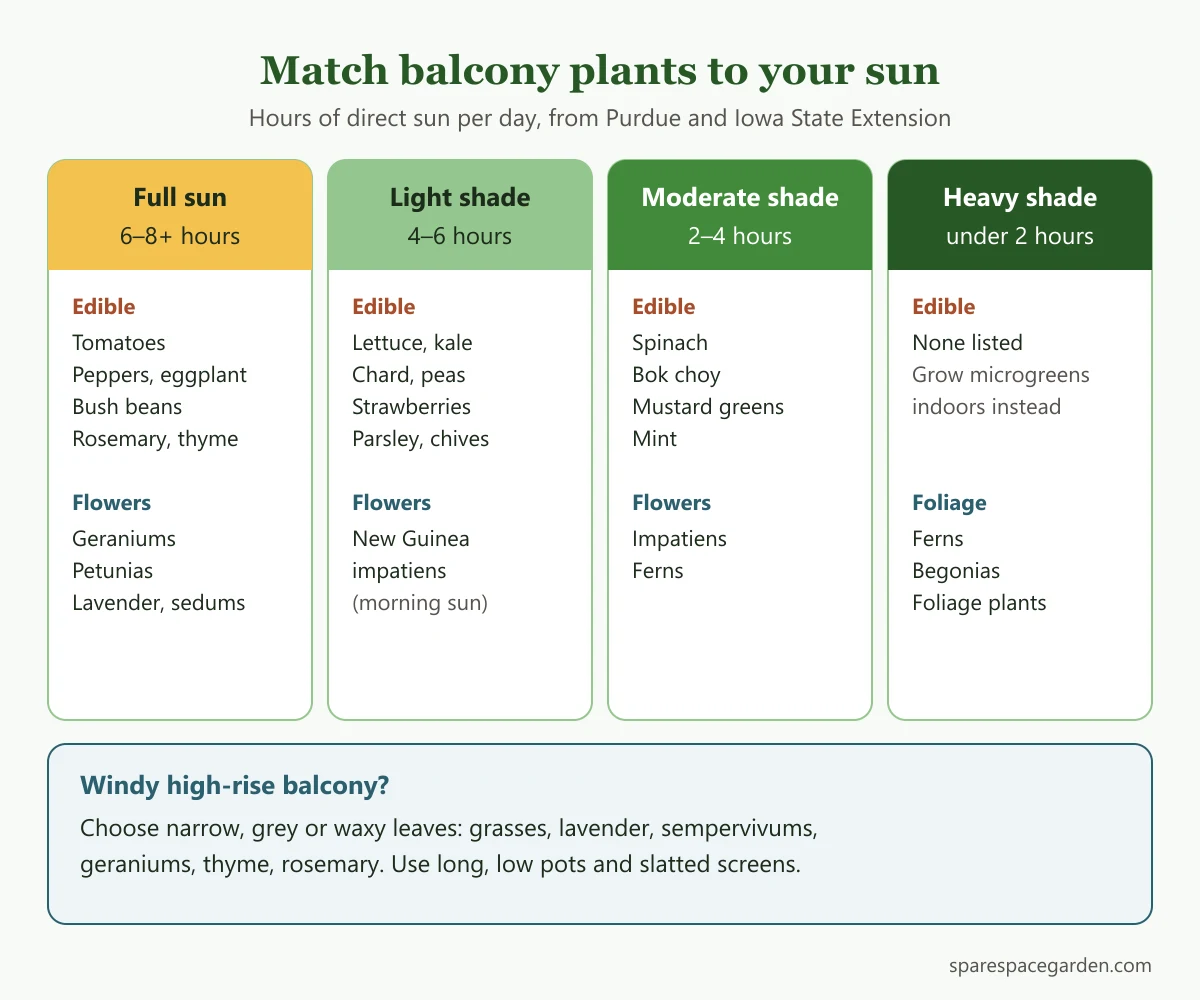 Edible and ornamental picks for each light level, plus the rule for windy balconies.
Apartment balcony plants for full sun (6+ hours)
A balcony with six or more hours of direct sun can grow almost anything, including fruiting crops that need the most light. The catch is heat and drying. The RHS advice on roof gardens and balconies says plants in exposed spots often need watering twice a day in summer, and that leaf scorch can happen even when plants are well watered.
Edible options:
- Tomatoes: Purdue's minimum is an 8-inch (20 cm) pot for dwarf types and 12 inches (30 cm) for large ones.
- Peppers and eggplant: a 10-inch (25 cm) pot per plant at minimum. See how to grow peppers in pots for variety choices.
- Bush beans: a 6-inch (15 cm) minimum per plant, and they stay low enough for a railing planter.
- Woody herbs: rosemary, thyme and sage suit the hot, dry end of the balcony.
Ornamental options: The RHS calls pelargoniums (geraniums) hard to beat for toughness and flowering in exposed spots, and names lavender and sedums as drought-tolerant choices that also feed pollinators. Petunias are a good pick if you have pets, as noted below.
Use the biggest pots your balcony can safely hold, and check the weight limit with your building manager before you add large, heavy containers. The RHS points out that small pots dry out much faster. For layout and weight planning, see how to start a balcony vegetable garden.
Plants for a part-shade balcony (2–6 hours)
Part shade is where leafy crops do well. Iowa State notes that edible plants grown for their leaves are more productive in part shade than fruiting crops. A little afternoon shade can also help cool-season greens get through summer heat.
Light shade: 4 to 6 hours
Iowa State lists arugula, beans, beets, bok choy, kale, lettuce, mustard greens, peas, radishes, sorrel, spinach and Swiss chard here. Fruit options include strawberries. Most culinary herbs also fit: basil, chives, cilantro, mint, parsley, sage and tarragon all appear on its light-shade list.
For flowers, Clemson Cooperative Extension says New Guinea impatiens grow best with morning sun and afternoon shade, which describes many east-facing balconies.
Moderate shade: 2 to 4 hours
The list gets shorter. Iowa State names only bok choy, mustard greens and spinach among vegetables, and mint among herbs. Harvest them young, since leaves stay small in low light. Older impatiens types fit here too: Clemson says they do well in filtered or partial shade and need protection from hot afternoon sun.
Tip: On a part-shade balcony, put the tallest pots at the back wall and the leafy crops toward the railing, where the light is strongest. Lifting a trough onto a stand can catch light that a solid railing was blocking.
Plants for a full-shade balcony (under 2 hours)
Be honest with yourself here. Iowa State's heavy-shade category (under 2 hours of direct sun) lists no vegetables, fruits or herbs at all, so a deeply shaded balcony is foliage territory.
Good choices are plants grown for their leaves: ferns, begonias and other shade foliage plants. Impatiens can add color where the light is bright but indirect. Clemson notes that impatiens in containers need more frequent watering and possibly more feeding than those in the ground, and recommends watering at the base to limit downy mildew.
If you still want something to eat, grow it indoors. Microgreens are a good fit for a bright windowsill; see how to grow microgreens indoors.
Plants for a windy high-rise balcony
Wind dries leaves, snaps stems and tips over pots, and it gets stronger with height. The RHS gives a simple rule for choosing wind-tolerant apartment balcony plants: look for narrow, grey or waxy leaves, because these lose less water. Anything sold as good for coastal gardens is likely to suit as well.
Plants the RHS names for exposed balconies and roofs include:
- Grasses, whose narrow leaves let the wind pass through rather than tearing.
- Sempervivums (houseleeks), which cope well with exposed spots.
- Lavender and santolina, with hairy, grey foliage.
- Pelargoniums, for tough summer color.
- Dwarf spring bulbs, which stay low.
- Dwarf pine (Pinus mugo), junipers and Viburnum tinus as sheltering evergreens.
For food, apply the same logic: low, compact crops such as thyme, rosemary, bush beans, lettuce and strawberries cope better than tall tomatoes or vining cucumbers. Put the leafy crops in the most sheltered corner.
The RHS also says slatted or mesh screens filter wind and create calmer air behind them, while solid screens create turbulence on the far side. Long, low planters stay put better than tall, narrow pots. For more space-saving layouts, see these small balcony garden ideas.
Watch out: The RHS advises fixing taller plants and climbers securely to the building or railings on exposed sites. Check your lease or building rules before attaching anything, and never stand pots on top of a railing ledge.
Winter hardiness: roots in pots are colder
A plant's hardiness zone describes how cold its whole body can get in the ground, where soil insulates the roots. In a pot, the roots sit at close to air temperature. Illinois Extension says containerized plants lack that insulation and are much more sensitive to cold injury, and the RHS notes that plants in pots may need extra winter protection for the same reason.
The difference can be large. The University of Kentucky nursery extension lists temperatures that injure the roots of container-grown plants:
- Boxwood (Buxus sempervirens): 27°F (-3°C)
- Red Japanese maple (Acer palmatum 'Atropurpureum'): 15°F (-9°C)
- Arborvitae (Thuja occidentalis): 10°F (-12°C)
- 'P.J.M.' rhododendrons: -9°F (-23°C)
Kentucky adds that roots rarely, if ever, survive below -10°F (-23°C), and that young roots are less able to adapt to cold than mature ones.
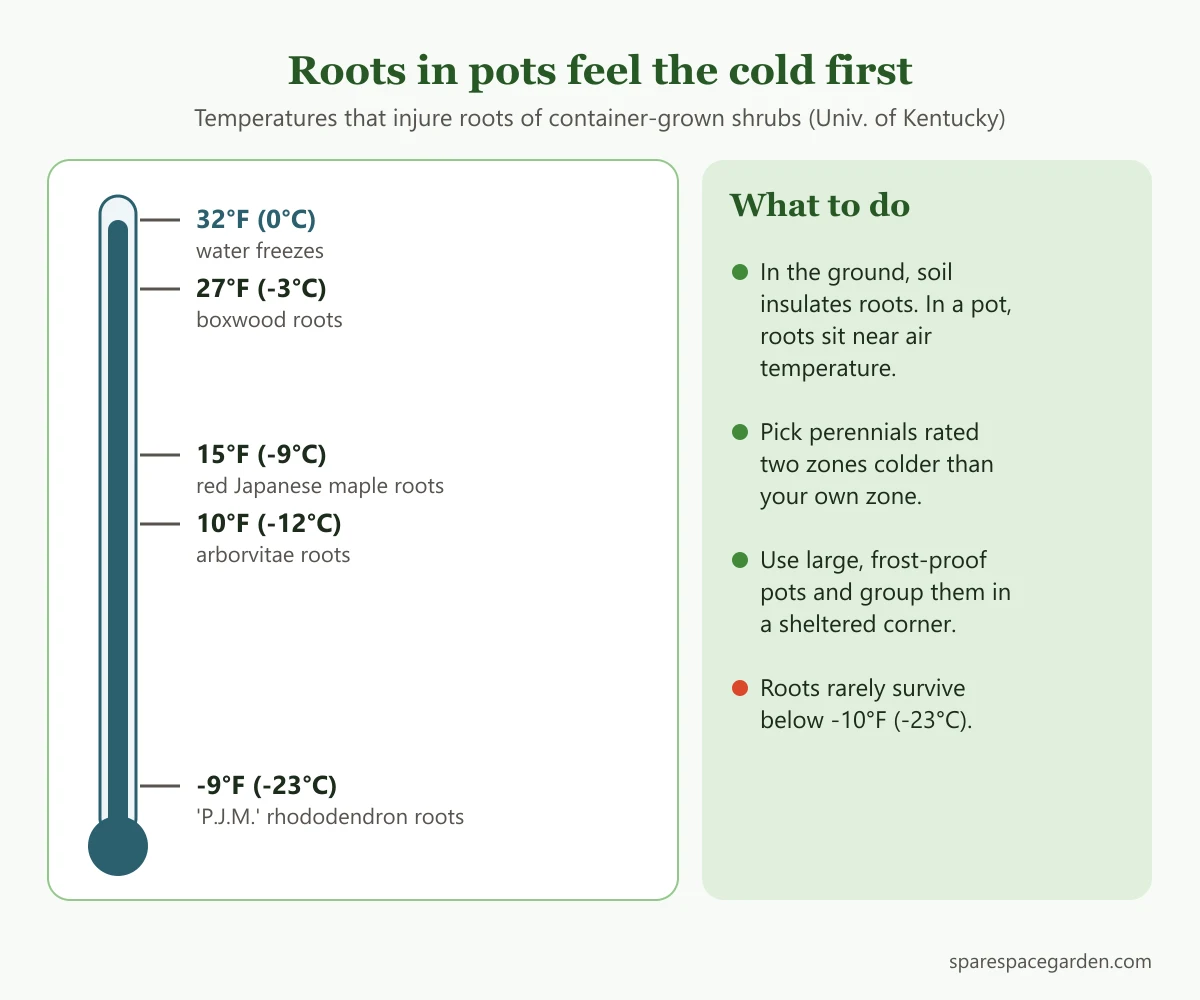 Root injury temperatures for common container shrubs, from University of Kentucky data.
How to use this when choosing perennials, shrubs and herbs that stay out all winter:
- Find your zone on the USDA Plant Hardiness Zone Map. Zones are 10°F (about 5.6°C) apart and based on the average coldest winter temperature.
- Pick plants rated two zones colder. Illinois Extension says this greatly reduces the effort needed to protect them. If you're in zone 7, look for zone 5 plants.
- Use large containers. Illinois notes they protect roots better than small pots.
- Huddle pots together in a sheltered corner out of the prevailing wind.
- Choose frost-proof pots. The RHS warns that terracotta can crack in winter.
Annual vegetables and summer flowers aren't affected, since they finish before hard frost.
Pet safety: check the ASPCA list
If a cat or dog shares your balcony, check every plant against the ASPCA's toxic and non-toxic plants list before you buy. Several of the most popular balcony plants are on the toxic side.
| Plant | ASPCA listing (dogs and cats) | Notes |
|---|---|---|
| Geranium (Pelargonium) | Toxic | Vomiting, loss of appetite, skin irritation |
| Tomato plant | Toxic | Green parts contain solanine; ripe fruit is non-toxic |
| Mint | Toxic | Large amounts can cause vomiting and loose stools |
| Lavender | Toxic | Nausea, vomiting, loss of appetite |
| Chives | Toxic | Can cause anemia |
| Begonia | Toxic | Most toxic part is underground |
| Coleus | Toxic | Vomiting, diarrhea |
| Lilies (Lilium) | Toxic to cats | Kidney failure in cats |
| Basil, rosemary | Non-toxic | Safe herb choices |
| Petunia, nasturtium | Non-toxic | Safe flowering choices |
| Boston fern | Non-toxic | Good for shade |
The ASPCA also notes that any plant can cause vomiting or stomach upset in pets, so non-toxic doesn't mean edible for them. If you think your pet has eaten a toxic plant, call your vet or the ASPCA Animal Poison Control Center at (888) 426-4435.
Frequently asked questions
What are the easiest apartment balcony plants for beginners?
On a sunny balcony, geraniums, petunias, rosemary and bush beans forgive most mistakes. In part shade, lettuce, chard, parsley and mint are easy and quick to harvest. Whatever you choose, a large pot and steady watering matter more than the plant itself.
What can I grow on a balcony with almost no direct sun?
Edibles need at least 2 hours of direct sun. Iowa State lists spinach, bok choy and mustard greens for 2 to 4 hours, and lettuce, kale and chard for 4 to 6. Below 2 hours, grow ferns or other foliage plants outside and keep edibles on an indoor windowsill.
Which balcony plants are safe for cats and dogs?
On the ASPCA list, basil, rosemary, petunias, nasturtiums and Boston ferns are non-toxic to both. Geraniums, mint, lavender, chives, begonias and tomato plants are listed as toxic, and lilies are dangerous to cats. Check the full list for anything else.
Will my potted plants survive winter on the balcony?
Annuals won't, but hardy perennials and shrubs can if you plan for colder roots. Choose plants rated two zones colder than your area, use large frost-proof pots, and group them in a sheltered spot. Roots of container plants can be injured at temperatures well above what the same plant survives in the ground.
Do plants on a high balcony need more water?
Usually yes, because sun and wind dry pots out quickly. The RHS says exposed container plants often need watering twice a day in summer. Larger pots and plants with narrow, grey or waxy leaves reduce how often you need to water.