To harvest basil so it keeps growing, cut whole stem tips just above a pair of leaves instead of plucking big leaves off the bottom. Each cut wakes up two tiny buds at that point, and those buds become two new stems. Do this regularly and a single upright seedling turns into a bushy plant that keeps producing until cold weather.
The rest comes down to how much you take, when you start, what you do about flower buds and how you look after the pot between harvests. Each step is covered below, with the numbers university extension services use.
Quick answer: Start when the plant has 6 to 8 leaves. Cut each stem just above a leaf pair, leaving at least 2 to 4 leaves below the cut. For a big pesto harvest, take up to a third of the plant, then give it a few weeks to regrow. Pinch off flower buds as soon as they appear.
Where to cut basil: just above a leaf pair
Basil leaves grow in opposite pairs along a square stem. The spot where a pair joins the stem is called a node, and tucked into the angle between each leaf and the stem is a tiny bud. While the stem's growing tip is intact, those side buds mostly stay small.
When you remove the tip, the buds at the node below your cut start to grow. Utah State University Extension puts it simply: cut stems just above a leaf node, leaving a few leaves behind to promote new growth and branching. The University of Kentucky gives the same instruction in its basil guide, and Illinois Extension notes that pinching stem tips encourages a bushy plant and more leaf growth.
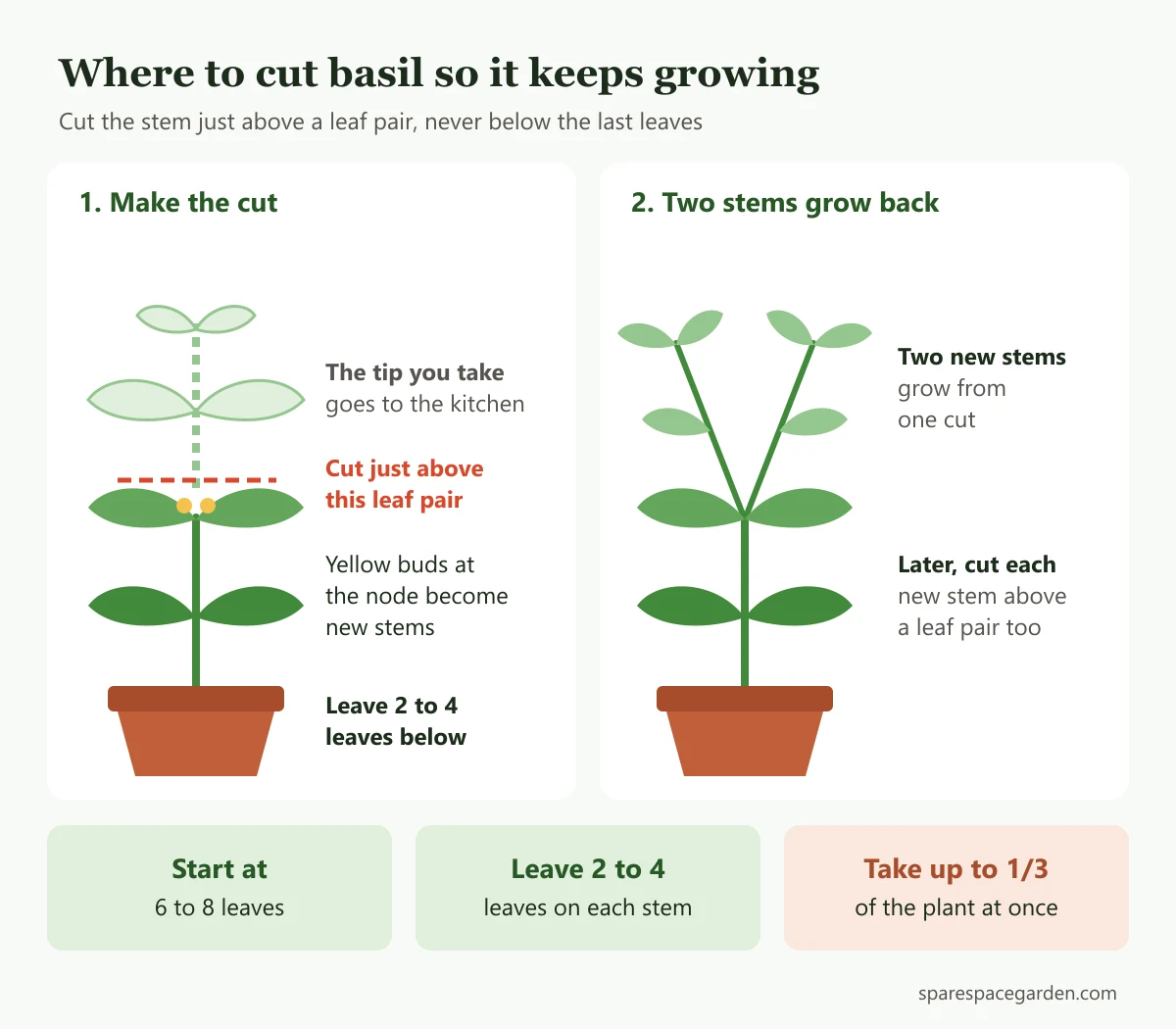 Cut just above a leaf pair. The two buds at that node grow into two new stems.
Cut close above the node, but don't nick the leaves or buds you're leaving behind. A long bare stub above the node serves no purpose, since new growth comes from the buds, not from the stub.
How to harvest basil so it keeps growing, step by step
When to start
Utah State recommends starting once a plant has 6 to 8 leaves. That first cut is really a pinch: you take the top of the stem and leave the lower leaves to power regrowth. After that, Kentucky's guide says you can harvest basil often through the growing season.
The routine
- Pick a stem and look down from the tip until you find a pair of healthy leaves you want to keep.
- Count what stays. Utah State advises removing enough stem so that only 2 to 4 leaves remain on it.
- Cut just above that leaf pair with clean scissors or a sharp knife, as both Utah State and Kentucky recommend. Soft young tips can be pinched off between finger and thumb.
- Move around the plant. Take tips from several stems rather than cutting one stem down to nothing.
- Rotate plants if you have more than one pot. Utah State suggests alternating which plants you harvest for a steady supply.
For smaller everyday picks, Clemson's Home & Garden Information Center describes pinching off branch ends with one or two sets of leaves. That small, frequent harvest is what keeps the plant branching.
Tip: Harvest when leaves are dry. Clemson advises against harvesting in wet weather, and Rutgers recommends picking basil when the leaves are cool and dry. Mid-morning after the dew has gone, or a cool late afternoon, both work.
How much to take, and how often
Two numbers set the limits. For large recipes like pesto, the University of Kentucky's basil guide says you can harvest up to a third of the plant at one time, then allow it to regrow for a few weeks before the next large harvest. For single-leaf picking, a Rutgers fact sheet says the plant should not be reduced to fewer than four sets of leaves.
Between those big cuts, light picking can be continuous. Clemson notes that continually harvesting basil leaves through the season helps keep plants producing until frost, and UC IPM says frequent harvesting of mature leaves extends the life of the plant.
| Harvest type | How much to take | What to leave | Source |
|---|---|---|---|
| First pinch | The top of the stem | 2 to 4 leaves on the stem | Utah State |
| Everyday picking | Branch tips with 1 or 2 leaf pairs | Plenty of foliage on the plant | Clemson, Wisconsin Master Gardeners |
| Big harvest for pesto | Up to one-third of the plant | Two-thirds, then a few weeks to regrow | University of Kentucky |
| Tired, woody plant | Cut back by about a third, then feed | Lower leafy stems | Wisconsin Master Gardeners |
| Final harvest before frost | Whole plant, cut 6 to 8 in (15 to 20 cm) above the soil | Nothing if frost is coming | Wisconsin Master Gardeners |
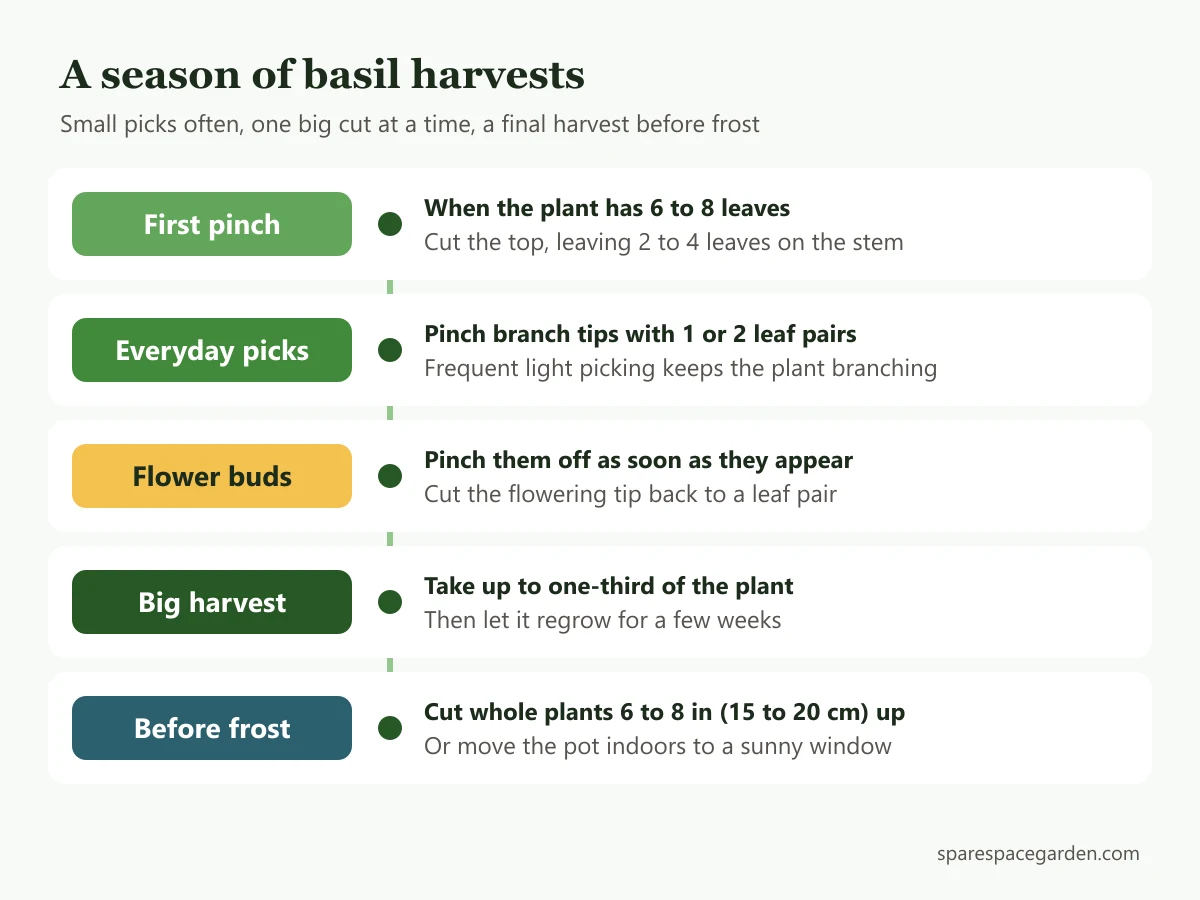 A season of basil harvests: small picks often, one big cut at a time, and a final harvest before frost.
If you need a lot of basil at once, more plants beat harder cutting. Kentucky suggests one or two plants for cooking and three to five plants if you want to store basil or make pesto.
Pinch off flower buds as soon as they show
By midsummer, many basil plants start pushing up flower spikes at the stem tips. Illinois Extension advises pinching off flower buds as soon as you see them form, because leaving them affects the flavor of the leaves. Clemson and the RHS give the same advice, and the Wisconsin Master Gardener program says removing flower spikes keeps the plant producing leaves up to frost.
The best way to remove buds is the same cut you use for harvesting: take the stem tip that carries the buds back to a leaf pair. That way you get a harvest and a branch point in one move.
Not every source agrees on what pinching flowers achieves. Utah State's fact sheet says removing flowers as they form does not by itself stimulate new foliage and can push flowers to form in the leaf axils instead. Its suggestion is to avoid stressing the plants, since high summer heat and water stress cause basil to flower and set seed. In practice, regular tip harvests, steady watering and a pinch at the first sign of buds all point the same way.
Tip: The RHS suggests letting at least one plant flower if you have several, since the flowers are rich in nectar for bees. The flowers are edible too, with a milder flavor than the leaves.
Harvesting mistakes that stop basil regrowing
The most common mistake is stripping the big bottom leaves. It feels gentle because the top looks untouched, but it does the opposite of what you want: the growing tip keeps heading upward, the side buds stay dormant, and you end up with a tall, bare stem with a tuft of leaves on top. Take the tips instead and let the lower leaves stay.
| What you see | Likely cause | Fix |
|---|---|---|
| Tall, bare stems with leaves only at the top | Picking lower leaves and leaving the tips | Cut tips back to a leaf pair; leave lower leaves on |
| No regrowth from a stem | Cut below the last leaf pair, so no buds remain | Always leave at least one leaf pair, ideally 2 to 4 leaves |
| Plant stalls after a big cut | More than a third removed at once | Take up to a third, then wait a few weeks |
| Flower spikes and tougher leaves | Heat, dry spells, or tips left uncut | Pinch buds early, water steadily, harvest tips often |
| Blackened leaves | Cold nights near 50°F (10°C) or frost | Bring pots in or do a final harvest |
Two more habits help you harvest basil so it keeps growing. Spread each harvest across the plant, so no single stem is cut to the bone. And don't wait for the plant to get huge before your first cut: an early pinch at 6 to 8 leaves sets up the branching for the whole season.
Keeping potted basil productive between harvests
Cutting in the right place is only half the job. Basil keeps growing after each harvest only as fast as its pot, light and temperature allow, and container basil needs a little more attention than basil in the ground.
Pot size. The RHS recommends a container at least 8 inches (20 cm) wide and deep, and Kentucky gives the same minimum. Bigger pots dry out more slowly, which matters because water stress pushes basil to flower.
Light. Utah State notes that basil grown in full sun has more essential oils and better flavor than shade-grown basil. UC IPM gives at least 4 to 6 hours of sun a day as the minimum, with light afternoon shade in hot areas, while Clemson says basil grows reasonably well in part sun of about six hours. Indoors, give it your brightest window; Iowa State adds that indoor plants have a less intense flavor.
Warmth. Basil is a warm-season plant. The Wisconsin Master Gardener program says it needs temperatures above 50°F (10°C) to grow and does best in the 80s and 90s °F (roughly 27 to 37°C). Illinois warns that cold air can stunt growth and blacken leaves at 50°F (10°C), and UC IPM says basil is damaged below 40°F (4°C).
Water. The RHS advises keeping the compost evenly moist and watering in the morning, since basil dislikes wet roots overnight. Avoid splashing the leaves. Utah State warns that overwatering contributes to root rot, so let excess water drain away.
Feeding. Regular cutting removes leaves the plant has to replace, and pots run short of nutrients. The RHS suggests an organic-based, balanced liquid fertilizer for container basil and says to avoid potassium-rich tomato feeds, which encourage flowering. Don't overdo it: Clemson and Iowa State both note that too much fertilizer, especially nitrogen, reduces flavor. Follow the label, and see our guide to fertilizer for potted plants for how often to feed.
If you're growing basil on a windowsill alongside other herbs, our guide to growing herbs indoors year-round covers light and watering for the whole group.
The last big harvest before cold weather
Basil doesn't tolerate frost. Kentucky's guide notes that the leaves turn black at the first frost, so harvest them before it arrives. When the forecast turns, the Wisconsin Master Gardener program suggests either covering plants completely or making a final harvest, and says whole plants can be cut 6 to 8 inches (15 to 20 cm) from the ground just before they begin to flower.
A pot gives you an extra option. Kentucky suggests moving potted basil indoors before the first fall frost to stretch the season a few extra weeks, and Clemson recommends a sunny window and careful watering, with no water left standing in the saucer. Expect slower growth indoors, and keep harvesting the same way: tips back to a leaf pair.
A final harvest produces more basil than you can use fresh. Our guide on how to keep basil fresh after picking covers short-term storage, freezing, drying and pesto.
Frequently asked questions
Should I pick individual basil leaves or cut whole stems?
Cut stems for most harvests. Taking the tip back to a leaf pair makes the plant branch, while picking single leaves gives you basil without the extra growth. Clemson notes that leaves can also be harvested one at a time, but if you pick leaves only, Rutgers advises never reducing the plant below four sets of leaves.
How often can you harvest basil?
Small tip harvests can go on all season as you need them; Clemson and UC IPM both say frequent harvesting keeps plants producing. For a big cut of up to a third of the plant, Kentucky advises waiting a few weeks before the next large harvest.
Will basil grow back if I cut it all the way down?
Only if leaves and buds remain below the cut. A stem cut below its last leaf pair has no buds left to regrow from. Iowa State Extension, writing about leafy annual herbs like basil, advises cutting just above a leaf or leaf pair and leaving about 4 to 6 inches (10 to 15 cm) of stem for later growth.
Can you still eat basil after it flowers?
Yes. The leaves are still edible, but Illinois Extension notes that flowering affects their flavor, and Iowa State says much of the flavor has dissipated once seed forms. The flowers are edible too, according to the RHS. Cut the flowering tips back to a leaf pair and the plant can put out new leafy shoots.
What time of day is best to harvest basil?
Pick when the leaves are cool and dry. South Dakota State University Extension suggests mid-morning once the dew has dried, and Rutgers notes a late-afternoon harvest can also give cool, dry leaves. Avoid harvesting in wet weather.