Growing thyme in pots suits this herb well, because a container lets you give it the conditions it comes from: sun, a lean and gritty mix, and roots that never sit wet. Thyme is a small, woody Mediterranean perennial, and the RHS warns that overwatering, especially in winter, is a bigger risk than drought.
The other common problem is a plant that turns woody and sparse after a few years. Both are easy to prevent. Below you'll find the right mix and pot, how to water, whether to start from seed, cuttings or a nursery plant, how to prune, and how to get a pot through winter.
Quick answer: Give each plant a pot at least 6 inches (15 cm) wide and 4 inches (10 cm) deep with drainage holes, filled with potting mix plus up to 25% grit by volume. Put it where it gets 6 or more hours of direct sun, water only when the mix has dried, and trim lightly in spring and after flowering.
Upright or creeping thyme: choosing a type
Thymes fall into two broad groups, and the difference matters in a pot.
Upright (shrubby) thymes such as common thyme (Thymus vulgaris) form a small bush. NC State Extension describes common thyme as a mound about 6 to 12 inches (15 to 30 cm) high and 6 to 16 inches (15 to 40 cm) wide. The RHS notes upright types are easier to harvest. Illinois Extension names French and English thyme as the most popular culinary types, and citrus thymes add lemon, lime or orange scents.
Creeping thymes such as Thymus serpyllum hug the ground. NC State lists it at only 2 to 3 inches (5 to 8 cm) tall and says it's mainly ornamental and rarely used in cooking. Creeping types look good spilling over the edge of a pot or filling a shallow bowl.
| Upright thyme | Creeping thyme | |
|---|---|---|
| Example | Common thyme (T. vulgaris), French, English | T. serpyllum and its cultivars |
| Height | About 6 to 12 in (15 to 30 cm) | About 2 to 3 in (5 to 8 cm) |
| USDA zones (in the ground) | 5 to 9 (NC State) | 4 to 9 (NC State) |
| Best use | Kitchen harvesting | Edges, shallow bowls, ornament |
| Trimming | Light trim in spring and after flowering | Very light trim after flowering |
If you're buying for the kitchen, choose an upright culinary thyme. The RHS points out that most thyme varieties are sold only as plants, and its recommended list carries the Award of Garden Merit (AGM) label.
Growing thyme in pots: size and a gritty mix
Thyme needs far less root room than most herbs. The RHS recommends a pot at least 6 inches (15 cm) wide and 4 inches (10 cm) deep per plant, with plenty of drainage holes. The University of Maryland Extension container guide puts thyme with small herbs at a minimum of 1 to 3 gallons (4 to 11 L) of mix and 4 to 6 inches (10 to 15 cm) deep. A bigger pot isn't better: Iowa State warns that oversized containers stay wet too long.
The mix. The RHS guide to growing thyme suggests a soil-based compost mixed with horticultural grit at up to 25% by volume. In practice, that's roughly three parts potting mix to one part grit. NC State says thyme does well in sandy or shallow rocky soils, needs good drainage, and prefers a neutral to alkaline pH. If you blend your own base, our guide on how to make potting soil explains the main ingredients.
Terracotta helps. Clay, ceramic and wood pots dry out faster than plastic or metal, according to Maryland. That's a drawback for thirsty plants, but an advantage for thyme. Iowa State University Extension recommends clay or terracotta pots for indoor herbs for exactly that reason.
Skip the gravel layer. Maryland notes that rocks or pot pieces in the base don't improve drainage and can raise the water level inside the pot. Mix the grit through the soil instead.
 A thyme pot: small, gritty and fast-draining, in full sun.
Sun and sparse watering
Sun. Thyme wants full sun, which NC State defines as 6 or more hours of direct sunlight a day. The RHS recommends a warm, sunny spot. On a balcony, a south- or west-facing ledge is ideal. Indoors, Iowa State says most herbs need around eight hours of direct light, so a south-facing window or a grow light 6 to 12 inches (15 to 30 cm) above the plant for 12 to 16 hours a day works best. For more on keeping pots going inside, see our guide to growing herbs indoors year round.
Water. The RHS describes established thyme as drought tolerant and says it rarely needs watering in the ground. Pots dry faster, so water containers in hot, dry spells and water new plants until they establish. Iowa State advises letting the soil dry between waterings, and Illinois Extension recommends keeping indoor thyme on the dry side.
A simple test works: push a finger into the mix. If it feels dry below the surface, water thoroughly until it drains from the base, then empty the saucer. If it's still damp, wait.
Watch out: Overwatering, especially in winter, is the most common way to lose potted thyme. The RHS warns that wet roots can rot. A pot standing in a saucer of water all winter is the classic case.
Feeding. Thyme is not a heavy feeder. Indoors, Iowa State suggests an all-purpose fertilizer at half or quarter strength from early spring through summer, with none in winter. Outdoors, fresh mix with a little organic matter, as Illinois recommends, is usually enough. If you do feed, follow the label.
Plants, cuttings or seed: how to start
Thyme can be grown from seed, but Illinois Extension says divisions or cuttings are much easier, and NC State calls germination uneven. For most people growing thyme in pots, buying a plant or rooting a cutting is the faster route.
Buying a plant
A nursery plant gives you something to pick within weeks. Plant it at the same depth it was growing, in your gritty mix, and water it in. The RHS suggests planting from mid-spring to early summer.
Rooting cuttings
The RHS recommends softwood cuttings in spring or early summer and semi-ripe cuttings in summer. Iowa State's stem cutting method, which lists thyme among plants that root well, goes like this:
- Cut a 2 to 4 inch (5 to 10 cm) stem tip with a clean, sharp knife.
- Strip the leaves from the lower half of the cutting.
- Insert the cut end into moist perlite. Several cuttings fit in one 6 inch (15 cm) container. Rooting hormone is optional.
- Cover the pot with a clear plastic bag and keep it in indirect light. A little condensation inside is a good sign.
- Pot up once roots are at least 1 inch (2.5 cm) long. Iowa State says most cuttings root in 4 to 6 weeks.
The RHS also suggests layering and division in spring or fall. Division suits creeping, mat-forming types.
Sowing seed
If you want to try seed, the RHS gives a germination temperature of 59 to 68°F (15 to 20°C), with seeds usually sprouting within a couple of weeks. Move seedlings into 3 inch (7.5 cm) pots once they have several leaves. Expect to wait: the RHS says seed-grown plants can take about a year to be ready for harvesting.
Pruning thyme so it doesn't go woody
Thyme is a woody plant, and left alone it builds up bare, twiggy stems with leaves only at the tips. Regular light trimming is what keeps a potted plant compact.
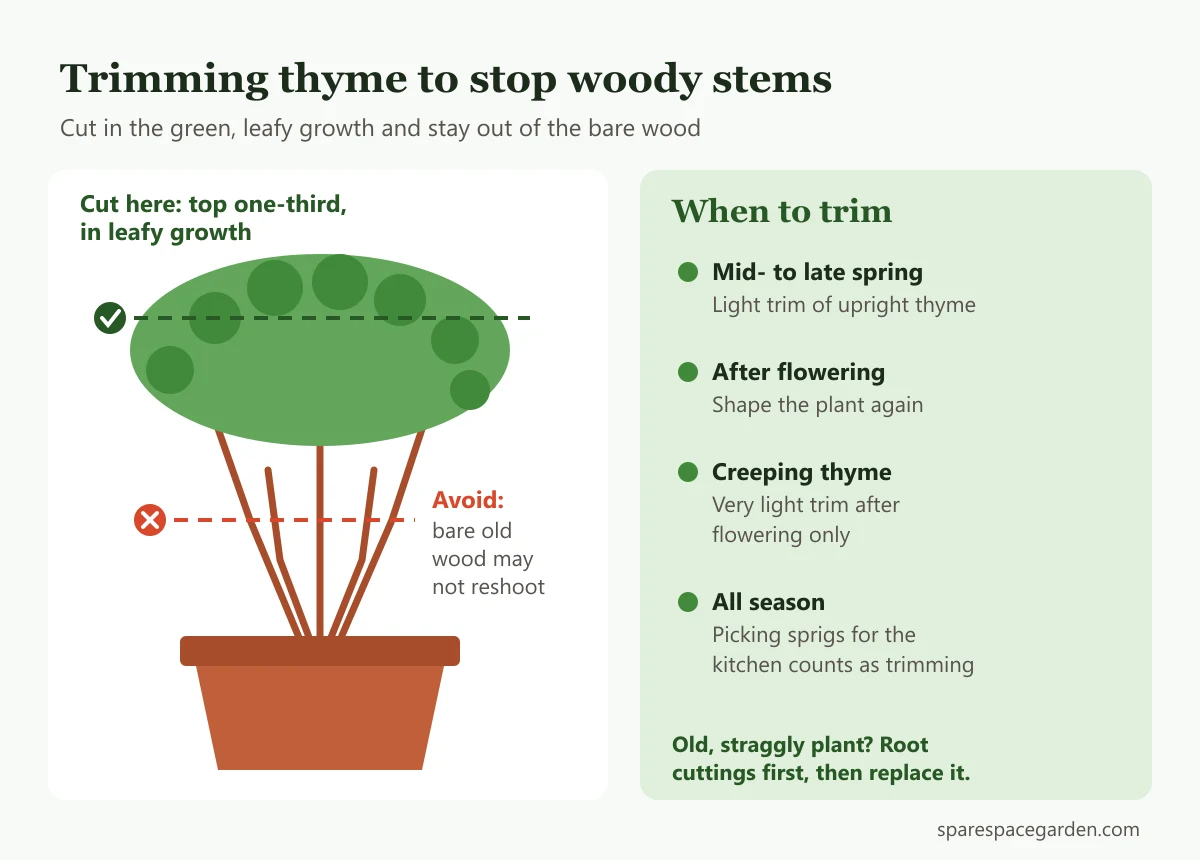 Trim in the green, leafy growth and stay out of the bare wood.
- When: The RHS suggests a light trim of shrubby thymes in mid- to late spring, after flowering, or both. NC State recommends cutting back in early spring and summer to reduce woody growth, and trimming whenever the plant gets leggy.
- How much: For harvests, Iowa State recommends removing the top one-third of growth on perennial herbs such as thyme.
- Where to cut: Stay in the leafy growth. The RHS warns that hard pruning into old wood is risky because those stems may not reshoot.
- Creeping types: These need only a very light trim after flowering to remove the spent flowers, according to the RHS.
Sources differ on rescuing an old plant. Illinois Extension suggests cutting older, woody plants back severely in spring to push out young stems, while the RHS cautions that old wood may not regrow and suggests replacing straggly plants after several years. A sensible middle path is to take cuttings first, then try the hard cut on the old plant. If it doesn't recover, you already have its replacement.
Tip: Harvesting is pruning. Snipping sprigs for the kitchen through the season keeps the plant bushy. The RHS notes that soft new growth in late spring and summer has the best flavor, and Illinois suggests cutting just before flowering for drying.
Getting potted thyme through winter
Common thyme is rated for USDA zones 5 to 9 in the ground, according to NC State, and the RHS says most widely sold varieties handle frost. Growing thyme in pots changes the picture, though. Iowa State's overwintering guide explains that roots are far less cold hardy than the top of the plant, and the small volume of mix in a container can drop into the single digits °F (about -18 to -13°C), cold enough to kill roots.
How much protection you need depends on your winters:
- Mild winters: Leave the pot outside, but keep it out of the rain. For wet winters, the RHS suggests moving containers to a sheltered spot, such as against a building. Raise the pot on feet so it never sits in water.
- Cold winters: Iowa State suggests either burying pots in a garden bed after the plants go dormant but before the soil freezes, or keeping them in an unheated garage or shed where temperatures stay between 20 and 45°F (-7 and 7°C).
- Watering in storage: In an unheated building, Iowa State says pots may need water every two to three weeks when temperatures are above freezing. Never water frozen soil.
- Tender types: The RHS advises moving less hardy thymes, such as T. cilicicus, into a greenhouse or porch for winter.
You can also bring a pot indoors. Illinois Extension suggests potting thyme in fall and growing it all winter in a bright, sunny spot, keeping the mix on the dry side.
Common problems and fixes
| What you see | Likely cause | Fix |
|---|---|---|
| Bare, woody center, leaves only at tips | No regular trimming, or an old plant | Trim lightly each spring and after flowering; root cuttings to replace it |
| Plant wilts or collapses even though the mix is damp | Wet roots, often in winter | Add grit, use a terracotta pot with holes, empty saucers, shelter from rain |
| Long, pale, floppy stems indoors | Not enough light | Move to a south window or add a grow light |
| Fine speckling on leaves in hot, dry weather | Spider mites (NC State notes them on creeping thyme) | Rinse foliage and check the undersides of leaves |
| Chewed leaves or young shoots | Rosemary beetle, leafhoppers, slugs or snails (RHS) | Check plants and remove pests by hand; the RHS says damage is rarely severe |
If a plant does die, our guide on whether you can reuse potting soil explains when the old mix is safe to use again.
Frequently asked questions
Does thyme do better in terracotta or plastic pots?
Terracotta usually suits it better. Maryland Extension notes that clay pots dry out faster than plastic, and thyme prefers a mix that dries between waterings. Plastic works too if you add plenty of grit and water less often.
How often should I water thyme in a pot?
There's no fixed schedule. Water when the mix feels dry below the surface, soak it until water drains out, then let it dry again. In cool weather or indoors in winter, that may be only occasionally.
Can thyme grow indoors on a windowsill?
Yes. Iowa State lists thyme among the better herbs for indoor growing. It needs a sunny south-facing window or a grow light, a terracotta pot and a light hand with the watering can.
Can I grow thyme with other herbs in one pot?
It's possible, but pick partners with similar needs. Iowa State recommends growing each herb in its own container indoors, and thyme's sparse watering clashes with moisture lovers such as parsley. Our guide on how to grow parsley in pots shows how different that care is.
How long does a potted thyme plant last?
It's a perennial, so a well-kept plant lasts for several years. The RHS notes that shrubby thymes can become straggly after several years, so root a few cuttings every so often and replace the oldest plants.


