Growing broccoli in containers is possible, but it's worth knowing the deal up front: each plant needs about 5 gallons (19 L) of potting mix, takes up a couple of feet of space for two to three months, and gives you one main head plus a few weeks of smaller side shoots. In return, you get broccoli picked at its best, which is hard to buy.
Success depends mostly on timing. Broccoli forms good heads in cool weather and falls apart in heat, so the goal is to have heads forming in spring before summer arrives, or in fall as temperatures drop.
Quick answer: Plant one broccoli per 5-gallon (19 L) pot that's 12–18 in (30–45 cm) deep, or three in a 15-gallon (57 L) tub. Set out young transplants with 4–6 leaves about 2–4 weeks before your last spring frost, or in mid to late summer for fall. Expect the main head 55–65 days after transplanting, then side shoots for several more weeks.
How much space broccoli really needs
Broccoli is one of the more space-hungry vegetables for a pot. The RHS describes calabrese (the familiar large-headed broccoli) as growing up to 60 cm (2 ft) tall and wide, and in-ground spacing guides from US extension services run 12 to 24 inches (30 to 60 cm) between plants.
For containers, the numbers from extension services line up well:
- The University of Maine container guide lists a 5-gallon pot for one broccoli plant, or a 15-gallon tub for three.
- University of Wisconsin Extension puts broccoli among the larger crops that need at least 5 gallons and a depth of 12 to 18 inches (30 to 45 cm).
Crowding costs you head size. Utah State University Extension notes that planting broccoli as close as 1 foot by 1 foot (30 by 30 cm) reduces both the head and the side shoots, and the RHS says closer spacing gives smaller heads. If you have room for only one pot, a single plant in 5 gallons beats two plants squeezed together.
| Container | Plants | Depth | What to expect |
|---|---|---|---|
| 5 gal (19 L) pot | 1 | 12–18 in (30–45 cm) | One main head, then side shoots |
| 15 gal (57 L) tub | 3 | 12–18 in (30–45 cm) | Three heads, ready at about the same time |
| Smaller than 5 gal | Not recommended | Under 12 in (30 cm) | Small heads, fast drying, higher stress |
Use a fresh potting mix in a pot with drainage holes. The RHS suggests a soil pH of at least 6.8 for calabrese, so if you blend your own mix, avoid making it very acidic. Our guide to the best potting soil for vegetables covers what to look for on the bag.
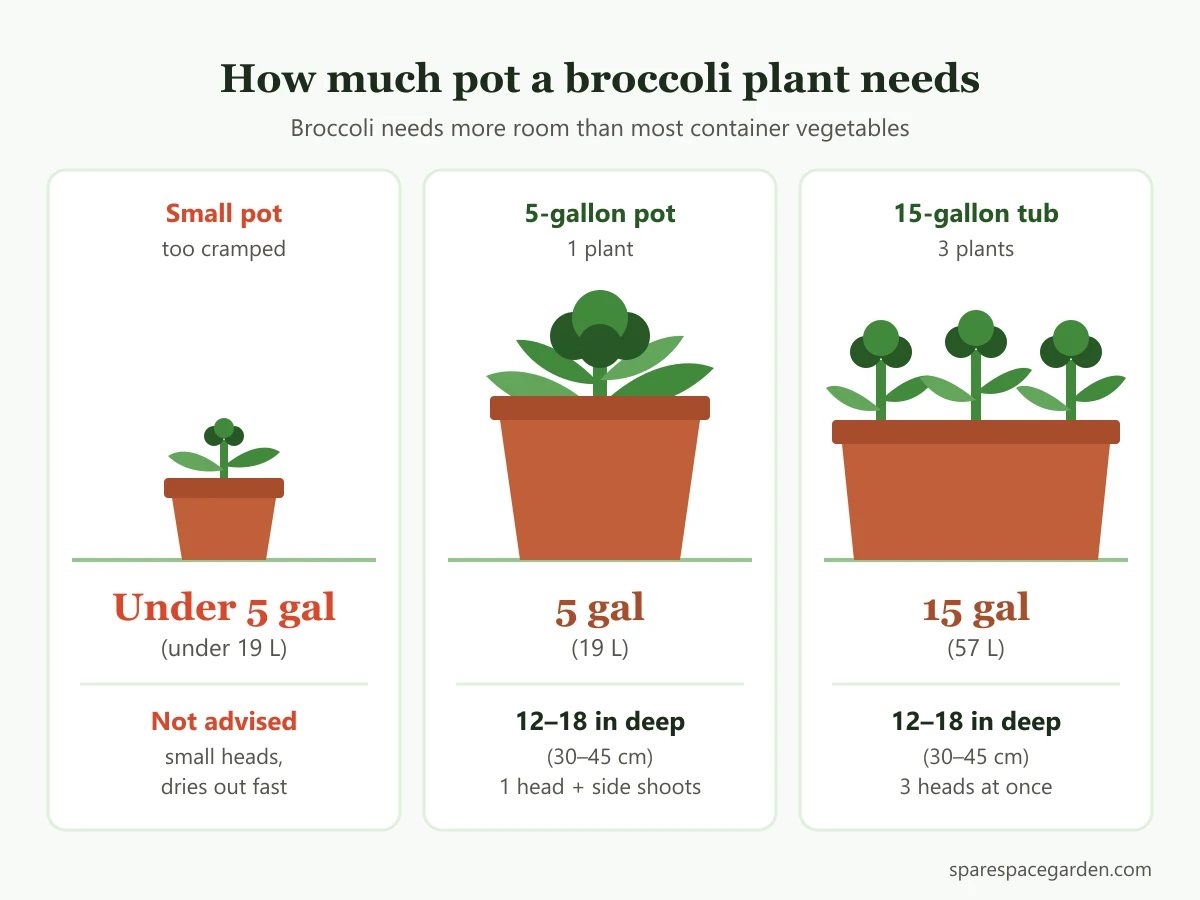 Container sizes for broccoli, from the University of Maine and Wisconsin extension guides.
Timing: plant so heads form in cool weather
Most problems with growing broccoli in containers come from heads forming at the wrong temperature. Mississippi State University Extension says broccoli forms firm, compact heads best at about 55 to 70°F (13 to 21°C). Utah State notes that growth is best at or below 75°F (24°C), and that summer heat causes loose, bitter heads.
Cold can be a problem too. University of Maryland Extension's broccoli page warns that temperatures below 45°F (7°C) may stop heading or cause the plant to bolt, even though established plants handle frost well. Utah State says broccoli isn't seriously damaged down to 28°F (-2°C).
Spring planting
- Maryland Extension sets out 5- to 7-week-old transplants about four weeks before the last spring frost.
- Utah State's broccoli guide suggests planting 2 to 3 weeks before the last frost-free date.
Plant within that window, not later. A spring crop planted late runs into summer heat right as the head forms.
Fall planting
Fall is often the better season for broccoli in a pot. Maryland Extension notes that fall plantings often yield more than spring ones in the mid-Atlantic, and plants mature into cooling weather instead of rising heat. Utah State suggests counting back 50 to 75 days from when you want to harvest. In Maryland, that means transplants in the ground by the first week of August; adjust for your own first frost date.
A container helps here. During a late-summer hot spell, you can move the pot into afternoon shade, which isn't an option for broccoli in a garden bed.
Choosing the right transplants
Transplant age matters more for broccoli than for most vegetables. Utah State recommends transplants with 4 to 6 mature leaves and a well-developed root system, sown 6 to 7 weeks before planting out.
Older plants are a risk. Utah State says larger, more mature transplants are more likely to "button," meaning they form a tiny, premature head instead of a full one. Cold weather, or stress from too little water or nutrients before or after transplanting, can trigger buttoning as well.
When buying nursery plants, look for compact, young plants rather than the biggest ones in the tray. A plant that has filled its cell pack with roots and started to look stretched is more likely to button. If you grow your own and seedlings get tall and thin, see our guide to leggy seedlings.
The RHS adds a planting tip: set broccoli a little deeper than it grew in its nursery pot, with the lowest leaves at soil level, so the stem is better supported.
Varieties that suit pots
For containers, faster and more compact varieties make the most sense. A short growing time means less risk of the head meeting a heat wave, and a smaller plant fits a 5-gallon pot better.
| Variety | Type | Days to harvest | Notes from sources |
|---|---|---|---|
| Packman | Heading | 50 days | Fast; listed for containers by UMaine |
| Green Comet | Heading | 55 days | Listed by Utah State |
| Premium Crop | Heading | 65 days | Listed by Utah State; slower |
| Arcadia | Heading | Varies by catalog | Listed for containers by UMaine |
| Kabuki | Heading (calabrese) | Varies by catalog | Compact, suited to small spaces and autumn cropping (RHS) |
| Purple sprouting types | Sprouting | 4 to 10 months | Big plants, 2–3 ft (60–90 cm); many small purple spears (RHS) |
Days to harvest for heading types are usually counted from transplanting. Maryland Extension gives 55 to 65 days from transplanting for broccoli in general, longer for fall crops.
Sprouting broccoli is a different plant. Instead of one big head, it makes many small spears over a long period. The RHS says it takes four to ten months to start cropping and then gives pickings for up to two months, and plants usually reach 60 to 90 cm (2 to 3 ft). That's a long time to give up a pot, so sprouting broccoli suits a large container in a mild-winter area more than a small balcony.
Growing broccoli in containers: feeding and watering
Broccoli is a hungry crop. Maryland Extension describes it as having a high nutrient requirement, and recommends a starter fertilizer at transplanting, a side-dressing three weeks later, and another feed after the central head is cut.
In a container, a liquid feed is the easiest way to follow that pattern. The University of Maine suggests a balanced water-soluble fertilizer such as 20-20-20, mixed as directed, every other week in summer. Utah State adds extra nitrogen when the head is about the size of a quarter and again after harvest to push side shoots.
Don't overdo it. Utah State links hollow, discolored stems to boron deficiency and advises avoiding excess fertilizer; split, moderate feedings at the label rate are the safer choice. Our article on fertilizer for potted plants explains liquid and slow-release options.
Watering needs to be steady. Mississippi State points out that broccoli's shallow roots dry out quickly, and Maryland Extension recommends watering more often once heads form. Utah State warns that water stress in hot weather can make heads open and flower early. The University of Maine notes that containers may need water every day; check the mix daily and water when the top feels dry, until water runs from the drainage holes.
Watch out: A pot that dries out completely during a warm spell is the fastest route to a loose, flowering head. If you can't check daily, a self-watering container holds a reserve below the soil.
Harvesting the main head and side shoots
Harvest the main head while the buds are still tight. Maryland Extension says mature heads measure 3 to 8 inches (8 to 20 cm) across and should be cut before the flowers open or show any yellow. The RHS suggests cutting calabrese when the head is 10 to 15 cm (4 to 6 in) across and still firm. A head grown in a pot is often at the smaller end of that range, so watch the buds rather than waiting for a supermarket-size crown.
How to harvest:
- Check the head daily once it reaches about 3 in (8 cm). In warm weather it can open quickly.
- Cut the stem with a sharp knife, taking 6 to 8 inches (15 to 20 cm) of stalk, as Maryland Extension suggests.
- Leave the plant in its pot. Side shoots form in the leaf joints below the cut.
- Feed once after cutting to support new growth.
- Pick side shoots when they're 3 to 6 inches (8 to 15 cm) long, the size Utah State gives, and keep picking.
The RHS says side shoots can extend the harvest for up to eight weeks. Mississippi State describes many varieties producing smaller side shoots for several weeks after the main head is cut. Once the plant only makes thin, quickly flowering shoots, it's time to compost it and replant the pot.
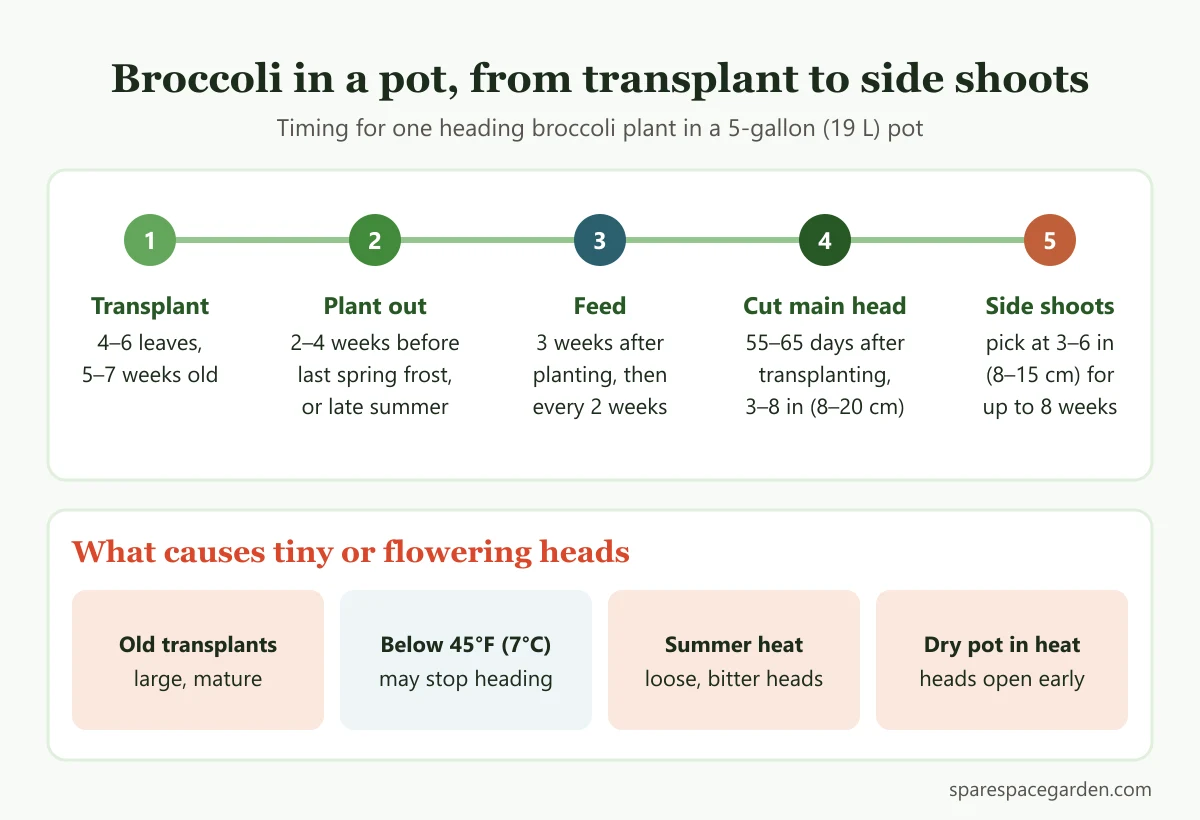 From young transplant to side shoots: the timing for one broccoli plant in a pot.
Common problems with potted broccoli
Most issues trace back to temperature, transplant age or water. Pests are the other big factor: Utah State lists aphids, cabbage worms and loopers, and flea beetles, and Maryland Extension adds the harlequin bug. Covering plants with fine insect mesh, as the RHS recommends, keeps cabbage butterflies and moths from laying eggs. For aphids, see how to get rid of aphids naturally.
| Symptom | Likely cause | Fix |
|---|---|---|
| Tiny head on a small plant ("buttoning") | Old transplants, cold, dry soil or low nutrients after planting | Use young transplants with 4–6 leaves; keep water and feeding steady |
| Loose head, yellow flowers opening | Heat or water stress | Harvest at once; plant earlier in spring or switch to fall |
| Bitter, loose heads in summer | Heads forming in hot weather | Time planting so heads form in cool weather |
| Hollow, discolored stem | Boron deficiency, linked to high pH or water stress | Avoid excess fertilizer; keep watering steady |
| Holes in leaves, green caterpillars | Cabbage worms or loopers | Pick off by hand; cover with fine mesh |
| Curled leaves with insect clusters | Aphids | Spray off with water or use insecticidal soap per the label |
If you'd rather have a brassica that crops for months from one pot, kale is the easier choice; see our guide to growing kale in containers.
Frequently asked questions
What size pot do you need for broccoli?
At least 5 gallons (19 L) and 12 to 18 inches (30 to 45 cm) deep for one plant, according to University of Maine and Wisconsin extension guides. A 15-gallon (57 L) tub can hold three plants. Smaller pots dry out quickly and tend to give smaller heads.
How many broccoli plants can go in one container?
One per 5-gallon pot. For more plants, use a large tub; the University of Maine lists three plants in a 15-gallon tub. Utah State notes that tight spacing reduces head size and side shoots.
How long does broccoli take to grow in a pot?
Most heading varieties are ready 55 to 65 days after transplanting, according to Maryland Extension, and fall crops take a little longer. Fast varieties such as 'Packman' are listed at about 50 days. Sprouting broccoli is much slower, taking four to ten months to start cropping.
Why did my broccoli make a tiny head?
That's called buttoning. Utah State links it to larger, more mature transplants, and to cold weather or a shortage of water or nutrients around transplanting. Young transplants and steady care make it less likely.
Does broccoli keep producing after you cut the head?
Yes. Leave the plant in the pot after cutting the main head, and side shoots form in the leaf joints below. The RHS says they can extend the harvest for up to eight weeks, and a feed after cutting helps.