Leggy seedlings are young plants with long, thin, pale stems and leaves spaced far apart. They're stretching to find light, almost always because the light is too weak or too far away, and warmth and crowding make it worse.
The good news is that the cause is easy to fix, and some crops can be rescued by burying the stretched stem. Tomatoes and cabbage-family plants recover well. Cucumbers and their relatives usually don't, and re-sowing is faster.
Quick answer: Keep grow lights about 2–4 in (5–10 cm) above the seedlings, as Clemson Extension advises (Maryland Extension allows up to 6 in, or 15 cm), on a timer for 14–18 hours a day. After germination, keep the room at about 65–70°F (18–21°C) by day and 55–60°F (13–16°C) at night, thin to one seedling per cell, and add a gentle fan. Rescue stretched tomatoes and brassicas by planting them deeper.
What leggy seedlings look like
In horticulture, "leggy" has a specific meaning. University of Illinois Extension describes it as elongated internodes, the stretches of stem between leaves. The plant spends its energy growing upward instead of building leaves and a thick stem.
Common signs:
- Tall, thin stems that bend easily
- A long gap between the seed leaves and the soil
- Small, pale leaves spaced well apart
- Seedlings leaning hard toward a window
- Stems that flop over once the plant is a few inches tall
That last sign is the real problem. Clemson Extension notes that seedlings grown in low light become leggy and weak and tend to topple over when only a few inches tall. Weak stems also struggle with wind and sun after transplanting.
Why seedlings stretch
Seedlings stretch when they're trying to grow out of shade. Indoors, four things trigger it, often together.
Light that's too weak
This is the main cause. A window, even a bright one, gives far less light than the open sky, and it comes from one side. Illinois Extension points out that indoor growers can't match the sun's intensity, and the RHS advises giving seedlings as much light as possible as soon as they emerge to stop them growing thin and leggy. Late winter, when most seeds are started, is also when days are shortest and the sun is lowest.
Lights hung too high
Grow lights lose intensity quickly as you raise them. A fixture that looks bright from across the room can be far too weak at the seedlings if it hangs well above the few inches extension guides recommend. Lights left in place while the seedlings grow upward also fall out of range.
Too much warmth
Warmth speeds up stem growth. Seeds often sprout best on a heat mat, but seedlings left there, or under a closed humidity dome, grow fast and soft. University of Maryland Extension suggests cooler conditions once seedlings are up.
Crowding and starting too early
Seedlings packed tightly shade each other and compete for light. Maryland Extension says leaving seedlings in the seed flat too long is one of the most common mistakes, and that sowing too early leads to tall, root-bound plants that don't do well in the garden. Maryland also notes that tomatoes and cabbage-family plants are especially prone to stretching toward the light.
| Sign | Most likely cause | What to change |
|---|---|---|
| Whole tray tall, pale and floppy | Light too weak or too far away | Lower lights to 2–4 in (5–10 cm), or move off the windowsill under lights |
| Seedlings all leaning one way | One-sided window light | Add a grow light; turn trays daily in the meantime |
| Fast, soft growth under good light | Room or heat mat too warm | Remove the mat and dome; aim for 65–70°F (18–21°C) by day |
| Stretching mainly in the middle of a crowded tray | Overcrowding | Thin to one per cell, or prick out into separate pots |
| Tall plants circling the pot | Started too early | Pot up, sow later next year |
How far grow lights should be from seedlings
Closer than most people expect. Extension guidance for seed starting works in single-digit inches:
- Clemson Extension: fluorescent tubes 2–4 in (5–10 cm) above the seedlings, keeping that gap as they grow.
- University of Maryland Extension: fluorescent and LED fixtures 2–6 in (5–15 cm) above seedlings, and the tops of transplants 1–2 in (2.5–5 cm) from the lights after potting up.
- Illinois Extension: tubes only a few inches from the tops of the plants.
Hang the fixture on chains or adjustable cords, or stack the trays on books and remove them as plants grow. Strong LED panels give off more light than tubes or simple shop lights, so check the maker's recommended distance before hanging one that close. Leaves that turn pale, bleached or crisp near the light mean it's too close. Follow the fixture maker's instructions for hanging and wiring, and keep plugs, timers and cords away from water trays and spills.
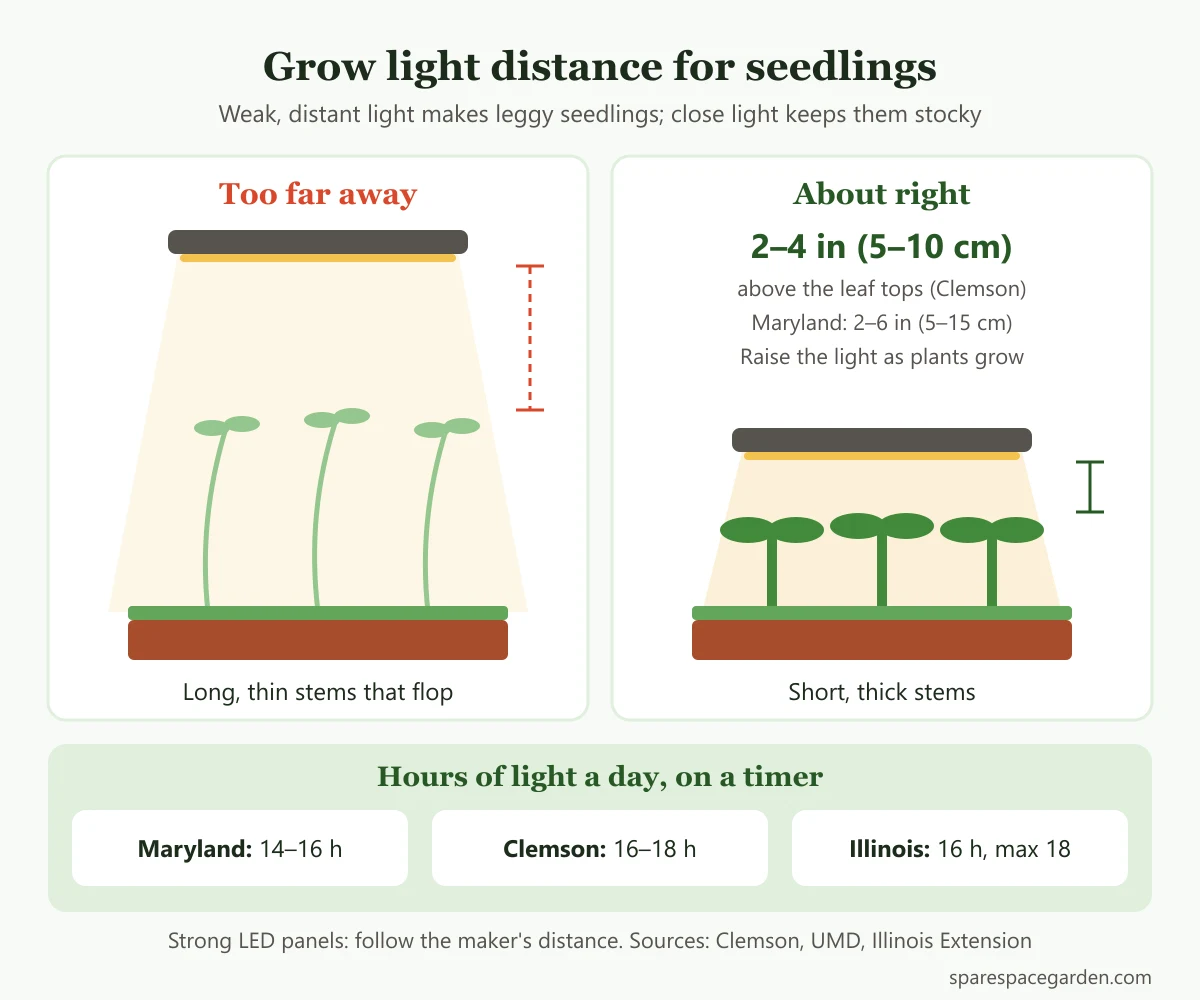 Light distance and hours from Clemson, Maryland and Illinois Extension.
How many hours of light
Use an outlet timer so the lights run the same hours every day. Maryland Extension recommends 14–16 hours, Clemson 16–18 hours of bright light (natural and artificial together), and Illinois Extension suggests 16 hours, with 18 as the maximum for seedlings. Seedlings still need a dark period, so don't leave lights on around the clock.
Tip: If you only have a windowsill, use it for crops that cope. Illinois Extension notes that lettuce can get by on a bright sill, though even lettuce benefits from added light. Microgreens are another good windowsill option; see how to grow microgreens indoors.
Other ways to prevent leggy seedlings
Light does most of the work, but these steps help keep stems short and thick.
Cool them down after germination
Take trays off the heat mat and remove domes as soon as most seedlings are up. Maryland Extension suggests about 65–70°F (18–21°C) during the day and 55–60°F (13–16°C) at night. A cool room under strong light grows stocky plants. A warm room under weak light grows tall ones.
Thin and space them
Keep one seedling per cell. Maryland Extension advises keeping the strongest one and removing the others, and snipping at soil level with small scissors avoids disturbing the roots of the one you keep. Seedlings sown in a shared tray should be moved to their own pots once they're large enough to handle, before their leaves start to overlap.
Add a breeze or brush them
Movement makes stems thicker. Clemson suggests placing a fan near the seedlings once they have two true leaves, set to give a gentle sway, and warns that it dries the mix faster, so check moisture more often. An extension expert answering an Ask Extension question on leggy seedlings noted that even 1–2 hours a day on low helps.
With no fan, brush your hand or a wooden stick lightly across the tops of the seedlings. Maryland Extension says gently brushing tomato transplants this way helps control height and increases stockiness.
Time your sowing
Count back from your planting-out date and follow the seed packet. Starting earlier doesn't give you bigger plants, just plants that stretch indoors for longer. Our guide to growing tomatoes in pots from seed shows how to work out the date for tomatoes.
How to fix leggy seedlings you already have
You can't shrink a stretched stem. What you can do is stop the stretching now and, for some crops, bury the extra stem so it becomes roots.
- Fix the light today. Lower the lights to 2–4 in (5–10 cm), set the timer, and move window-grown plants under lights.
- Cool the room. Remove heat mats and domes.
- Thin crowded cells to the strongest seedling.
- Start a fan or daily brushing.
- Bury the stem deeper when potting up or planting out, if the crop tolerates it (see below).
- Support any that flop with a small stick and a soft tie until new growth firms up.
New growth made under good light will be compact, even if the bottom of the stem stays long.
Which seedlings you can bury deeper
Tomatoes: yes. Tomato stems grow roots wherever they're buried. The RHS tomato guide says to replant a leggy seedling more deeply, so the first pair of leaves sits just above the compost surface. Hold it by a leaf, not the stem. At planting-out time, very tall tomatoes can go into a trench with the stem laid sideways, as Maryland Extension describes.
Cabbage family: yes. The RHS advises planting brassica transplants up to the depth of their true leaves, and the extension expert in the Ask Extension answer above said broccoli-type crops and tomatoes can both be planted deep, up to the first leaves. This covers broccoli, cabbage, cauliflower, kale and Brussels sprouts. See growing kale in containers for spacing in pots.
Peppers: a little. Sources disagree on burying peppers deeply. If you try, set them only slightly deeper and keep the mix from staying soggy around the stem.
Cucumbers, squash and melons: no. In a separate Ask Extension answer on leggy cucumbers, the expert said cucumbers don't handle deep planting well and recommended sowing again. Squash and melons are in the same family, and the same cautious approach applies.
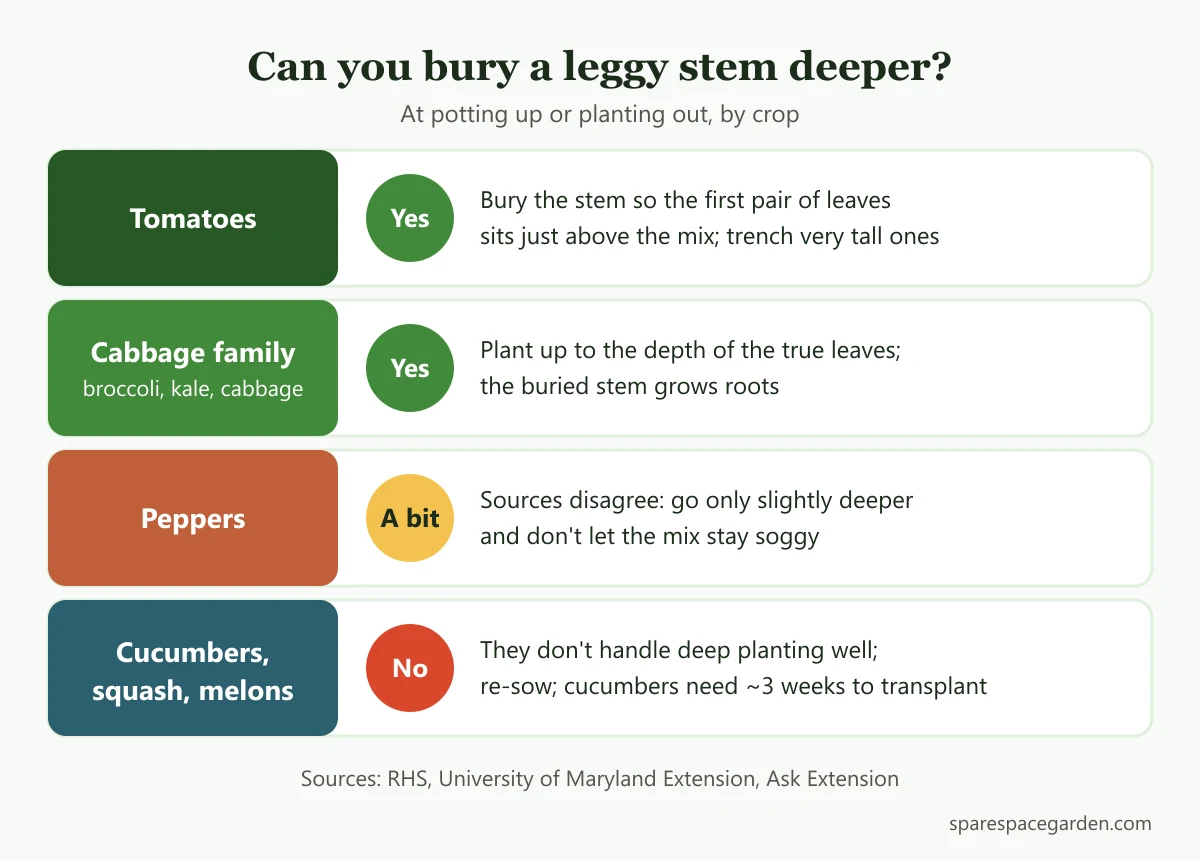 Burying a stretched stem helps some crops far more than others.
Watch out: For pot-grown transplants other than tomatoes and brassicas, the RHS general rule is to plant no deeper than they grew in their original container. Don't bury a stem you aren't sure about just to hide it.
When to start over
Sometimes re-sowing is quicker and gives better plants. Start again when:
- Seedlings have toppled over and can't hold themselves up, even after the light is fixed.
- The crop doesn't tolerate deep planting, such as cucumbers or squash.
- There's still plenty of time before your planting-out date. The Ask Extension expert pointed out that cucumbers need only about three weeks from sowing to transplanting.
- Stems are pinched or collapsing at the soil line. That usually points to a seedling disease such as damping off rather than legginess, so start again with washed pots and fresh mix.
For fast crops, sowing straight into the final container after your last frost avoids the indoor stretch completely. If you replace a tray, fix the light first, or the new batch will stretch the same way.
Frequently asked questions
Will leggy seedlings recover on their own?
Not fully. The stretched part of the stem stays long, but new growth under better light will be compact. One extension expert put it simply: there is little that can be done to correct legginess itself, so the practical options are better light, deeper planting for crops that tolerate it, or re-sowing.
Can a windowsill grow seedlings that aren't leggy?
Sometimes, for tough crops in a bright south-facing window later in spring. Clemson notes that windowsill transplants tend to reach for light and become very tall, so for tomatoes, peppers and brassicas started in late winter, a grow light is the reliable answer. Turning the tray daily helps a little with leaning.
Are leggy seedlings caused by too much fertilizer?
Light and temperature are the main causes. Feeding a stretched seedling won't fix the stretching. Many seed-starting mixes already contain some fertilizer, so check the label. If yours has none, Clemson suggests a water-soluble starter feed, at the rate on its label, at every other watering once seedlings are growing, with plain water in between.
Why are seedlings leggy even under a grow light?
The light is probably too high, too weak, or on for too few hours, or the room is warm. Lower the fixture to 2–4 in (5–10 cm), run it 14–16 hours on a timer, and remove any heat mat. Strong LED panels are the exception: follow the maker's distance.