Growing radishes in containers is about as quick as vegetable gardening gets. Small round radishes need a pot only 4 to 6 inches (10–15 cm) deep, and most are ready 25 to 35 days after sowing. The catch is that they want cool weather and steady moisture; heat and dry spells turn them hot, pithy or straight to flower.
This guide covers pot depth for round and daikon types, when to sow in spring and fall, spacing, watering, and how to time the harvest so roots are crisp rather than woody.
Quick answer: Use a pot 4–6 in (10–15 cm) deep for small round radishes; long daikon types need far more depth. Sow ¼–½ in (6–13 mm) deep and 1–2 in (2.5–5 cm) apart, from 2–3 weeks before your last spring frost or in late summer for fall. Keep the mix evenly moist and pull roots at about 1 in (2.5 cm) across, usually 25–35 days after sowing.
Pot size for growing radishes in containers
Radish type decides the pot. Small spring radishes have short roots, so a shallow pot works. Oregon State University Extension recommends containers 4 to 6 inches deep for radishes, and University of Maryland Extension's container guide gives the same 4–6 inches (10–15 cm), with 1 to 3 gallons (4–11 L) of mix.
Those are minimums. The RHS radish guide suggests a container at least 30 cm (1 ft) wide and deep for salad radishes. A bigger pot isn't needed for root length, but it holds more water, which matters for a crop that cracks and turns hot when it dries out.
Winter and oriental radishes, including daikon (mooli), are a different crop. The RHS notes that oriental types can reach 30 cm (1 ft) or more, and University of Illinois Extension says daikon can grow to about 18 inches (45 cm) long. NC State Extension's rule for root crops is a container 1.5 times deeper than the mature root, so even a 12-inch daikon calls for about 18 inches (45 cm) of mix. A tall grow bag or deep tub is the practical choice, or a shorter variety; Virginia Cooperative Extension suggests checking seed catalogs for types suited to containers.
| Radish type | Examples | Pot depth | Spacing | Days to harvest |
|---|---|---|---|---|
| Small spring (salad) radishes | 'Cherry Belle', 'Champion', 'Easter Egg' | 4–6 in (10–15 cm) minimum | 1–2 in (2.5–5 cm) | 25–35 days from sowing |
| Winter and oriental (daikon) radishes | 'Daikon Long White' and other mooli types | About 1.5x root length; 18 in (45 cm) for a 12 in (30 cm) root | 6–8 in (15–20 cm) | At least 8 weeks |
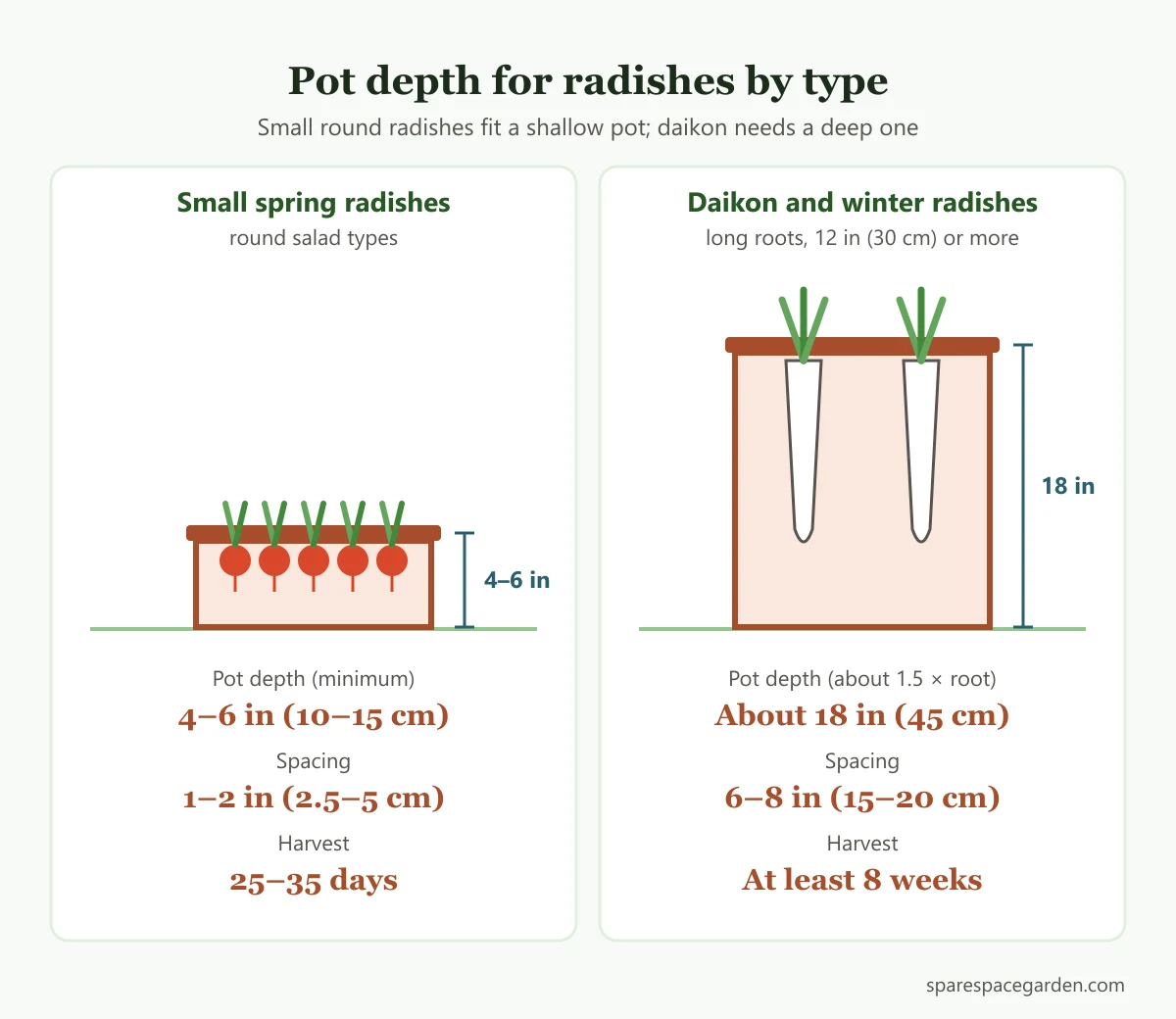 Pot depth and spacing for round and daikon radishes.
Any pot material works as long as it has drainage holes. If you're comparing pots for root crops in general, our guide to the best container for growing carrots covers plastic, clay, fabric and wood in detail.
When to sow radishes in pots: spring and fall
Radishes are a cool-season crop. Utah State University Extension's radish fact sheet says they grow best when temperatures stay at or below 80°F (27°C), and that cooler conditions improve flavor and quality.
Spring. Utah State suggests planting 2 to 3 weeks before the last spring frost, once the soil reaches 40°F (4°C). Seed germinates best at 55–75°F (13–24°C) and emerges in 5 to 10 days; the RHS gives 7 to 10 days outdoors. University of Maryland Extension notes that radish plants tolerate heavy spring and fall frosts, so an early start is low-risk. Illinois Extension adds that you can start spring radishes in late winter in a cold frame, window box or patio container.
Fall. Utah State recommends starting fall plantings in mid- to late August to avoid summer heat, with another round in early September. Illinois Extension says to sow spring types again in late summer for a fall harvest, and to sow winter types such as daikon in mid- to late summer. The RHS sows winter radishes in July or August and warns that winter types sown too early will bolt.
Containers give you one advantage here: you can start pots in a warm, sunny spot in early spring and move them to light shade as the weather heats up.
How to sow radish seeds in a container
Utah State notes that radishes are always grown from seed, so sow them straight into the pot they'll grow in.
- Fill the pot with fresh potting mix to within 1–2 inches (2.5–5 cm) of the rim. Oregon State recommends commercial potting soil rather than soil dug from the ground. If you're reusing last season's mix, see can you reuse potting soil first.
- Sow ¼–½ in (6–13 mm) deep. That's the depth Maryland and Illinois Extension give; Utah State and the RHS say about ½ in (1 cm). Daikon and other winter radishes go a little deeper, about 2 cm (1 in) according to the RHS.
- Space seeds 1–2 in (2.5–5 cm) apart for small round types. Virginia Cooperative Extension lists 1 inch between plants in containers, and the RHS says salad radishes sown at least 2.5 cm (1 in) apart shouldn't need thinning. Space daikon 15–20 cm (6–8 in) apart.
- Water gently so the seed doesn't wash to one side, and keep the surface moist until seedlings appear.
- Thin early. If seedlings come up crowded, Maryland Extension suggests thinning to 2–4 inches (5–10 cm) depending on type. Remove the smaller, weaker ones, as the RHS advises.
Thinning matters more than it seems. Illinois and Utah State both list overcrowding as a reason radishes grow leaves but no roots.
Tip: Radishes need little feeding. Maryland Extension notes that too much nitrogen pushes leafy tops at the expense of roots, so fresh potting mix is usually enough for a crop this short.
Watering: even moisture for crisp roots
Steady moisture is the single biggest factor in radish quality. Utah State says moisture swings cause root cracking, slow leaf growth and hot, bitter roots, and that stress during the first 6 weeks often leads to early flowering and low yields. The RHS adds that roots in dry soil may fail to swell at all.
Cracking has a specific trigger. Illinois Extension and Utah State both point to a heavy watering after a dry spell, which makes mature roots split. Split radishes are usually still edible, according to the RHS, but they don't keep well.
Containers dry out faster than beds, and Oregon State advises checking them every day. Water when the top of the mix feels dry, until it drains from the bottom. Utah State recommends mulch to hold moisture, and a thin layer over the pot surface helps on a windy balcony. Maryland Extension's target is soil that's evenly moist, but not wet.
Heat, bolting and hot-tasting radishes
Warm weather is the main reason radishes fail. Utah State says high summer temperatures trigger flower stalks in many varieties, and hot weather also causes bitterness, stronger heat and hollow roots. The RHS says heat and drought cause bolting, which stops the root from developing.
Taste is linked to growing speed. Utah State and Illinois Extension both say radishes that grow too slowly, are heat stressed or are left too long turn hot. Size alone doesn't make them hot; age and stress do.
You have a few ways around this in containers:
- Move the pot. The RHS suggests a cooler spot in light shade, out of the midday sun, in warm weather.
- Pick heat-tolerant types for late spring. Illinois Extension names 'Icicle' and 'French Breakfast' as later varieties that handle summer heat better, as long as they're watered regularly.
- Skip midsummer sowings. Sow in spring and again from late summer, when nights cool down.
- Don't overdo shade. Maryland Extension recommends at least 6 hours of direct sun, ideally 8–10, and Utah State notes that roots don't fill out in heavy shade.
If a plant sends up a flower stalk, the RHS suggests pulling it unless you want the edible seed pods.
Succession sowing for a steady supply
Because radishes stay at their best for only a short time, small sowings every week or two beat one big sowing. The recommended gap varies by source:
- University of Maryland Extension: a small number of seeds every 5 days
- Virginia Cooperative Extension: weekly
- Utah State University Extension: every 10 days
- University of Illinois Extension: every 10–14 days
A practical approach when growing radishes in containers is to keep two or three small pots or a long trough and sow one section each week. When you pull one pot, resow it straight away. In spring, stop when daytime temperatures start climbing past 80°F (27°C), then start again in late summer.
 From seed to harvest in about a month, with a new sowing every 5–14 days.
When to harvest radishes
Harvest by size and age, not just the calendar. Maryland Extension and Virginia Cooperative Extension both give 25–35 days from sowing for spring radishes, while Utah State gives a wider 25–45 days depending on variety. The RHS says salad radishes can be ready in as little as 4 weeks from germination, but early sowings in cold weather take 6–8 weeks.
Pull spring radishes when they're about 1 inch (2.5 cm) across. Maryland Extension advises harvesting before roots crack, turn pithy or get too hot, and the RHS says roots left too long become pithy, hot or woody. Once the shoulders start to show above the mix, check pots often; the window between crisp and pithy is short.
Winter and oriental radishes are slower. The RHS gives at least 8 weeks for oriental types, harvested in late summer and autumn, and says winter radishes can be lifted in November.
Watch for these common problems:
| Symptom | Likely cause | Fix |
|---|---|---|
| Leaves but no swollen root | Overcrowding, heat, late sowing or heavy shade | Thin early, sow in cool weather, give 6+ hours of sun |
| Split or cracked roots | Heavy watering after a dry spell, or roots left too long | Water evenly; harvest at about 1 in (2.5 cm) |
| Hot, bitter taste | Slow growth, heat stress or old roots | Keep moist, sow in cool months, pick on time |
| Spongy, pithy or hollow roots | Left in the pot too long, or hot weather | Harvest sooner; sow smaller batches more often |
| Flower stalk forms | Heat or drought stress | Move to light shade; avoid midsummer sowing |
| Tiny holes in leaves | Flea beetles | Usually cosmetic; a floating row cover keeps them off |
Frequently asked questions
How deep does a container need to be for radishes?
For small round radishes, 4–6 inches (10–15 cm) is enough, according to Oregon State and Maryland Extension. The RHS suggests 30 cm (1 ft) wide and deep, which holds more water. Daikon needs much more depth, roughly 1.5 times the length of the root.
How many radishes can you grow in one pot?
It depends on the pot's surface area. Spaced 2 inches (5 cm) apart, each radish uses about 4 square inches (26 cm²), so a round pot 12 inches (30 cm) across fits roughly two dozen. At 1 inch apart, as Virginia Cooperative Extension allows, you can fit more, but thin promptly if leaves crowd.
Why are my radishes all leaves and no root?
Utah State and Illinois Extension list overcrowding, heat from sowing too late, and heavy shade as the usual causes. Too much nitrogen also favors leaves, according to Maryland Extension. Thin seedlings early and sow in cool weather with at least 6 hours of sun.
Can you grow radishes in containers indoors?
You can start them indoors or on a patio in late winter, as Illinois Extension suggests, but they need at least 6 hours of direct sun to form good roots. On a dim windowsill, radish leaves are a better bet as microgreens grown indoors, which are cut as young seedlings.
What else grows well with radishes in spring pots?
Other cool-season crops share the same window. Growing spinach in containers uses a similar spring and fall schedule, and Illinois Extension suggests sowing a few radish seeds with slow carrots to mark the rows.