Growing spinach in containers works best when you treat it as the cool-season crop it is. Spinach grows quickly in the mild weather of spring and fall, then switches to flowering (bolting) as days get longer and warmer. Once that happens, the leaves turn bitter and the plant stops producing.
A pot gives you an advantage here. It doesn't need to be deep, you can sow it early, and you can move it into shade when a warm spell arrives. Below you'll find timing, pot size, sowing, slow-bolting varieties, harvesting and what to grow in summer instead.
Quick answer: Use a pot at least 12 inches (30 cm) wide and 4 to 12 inches (10 to 30 cm) deep. Sow seeds 1/2 to 1 inch (13 mm to 2.5 cm) deep in early spring or late summer, thin to about 3 inches (7.5 cm) apart, and keep the mix evenly moist. Pick outer leaves from about a month after sowing, and switch to Malabar or New Zealand spinach for midsummer.
Why spinach bolts, and how to delay it
Spinach flowers in response to long days and rising temperatures. Illinois Extension explains that spinach bolts during the long days of late spring or summer, and that warm temperatures speed this up. Utah State University Extension says spinach grows best at or below 75°F (24°C) and that temperatures above that also make the flavor bitter.
Heat and day length are not the only triggers. The RHS lists hot, dry conditions and a lack of water, and University of Wisconsin–Madison Extension adds that poor, dry soil encourages bolting. Oregon State University's vegetable research pages note that bolting risk also rises with crowding, with falling soil moisture or nutrients, and when young plants are exposed to 40–60°F (4–16°C) temperatures.
You can't change day length outdoors, but a container lets you manage most of the rest:
- Timing: grow spinach in spring and fall, not through the longest days.
- Water: a pot that dries out stresses the plant, so check it daily.
- Spacing: thin seedlings so plants don't crowd each other.
- Temperature: move the pot into shade during warm spells.
- Variety: choose a slow-bolting type for late spring sowings.
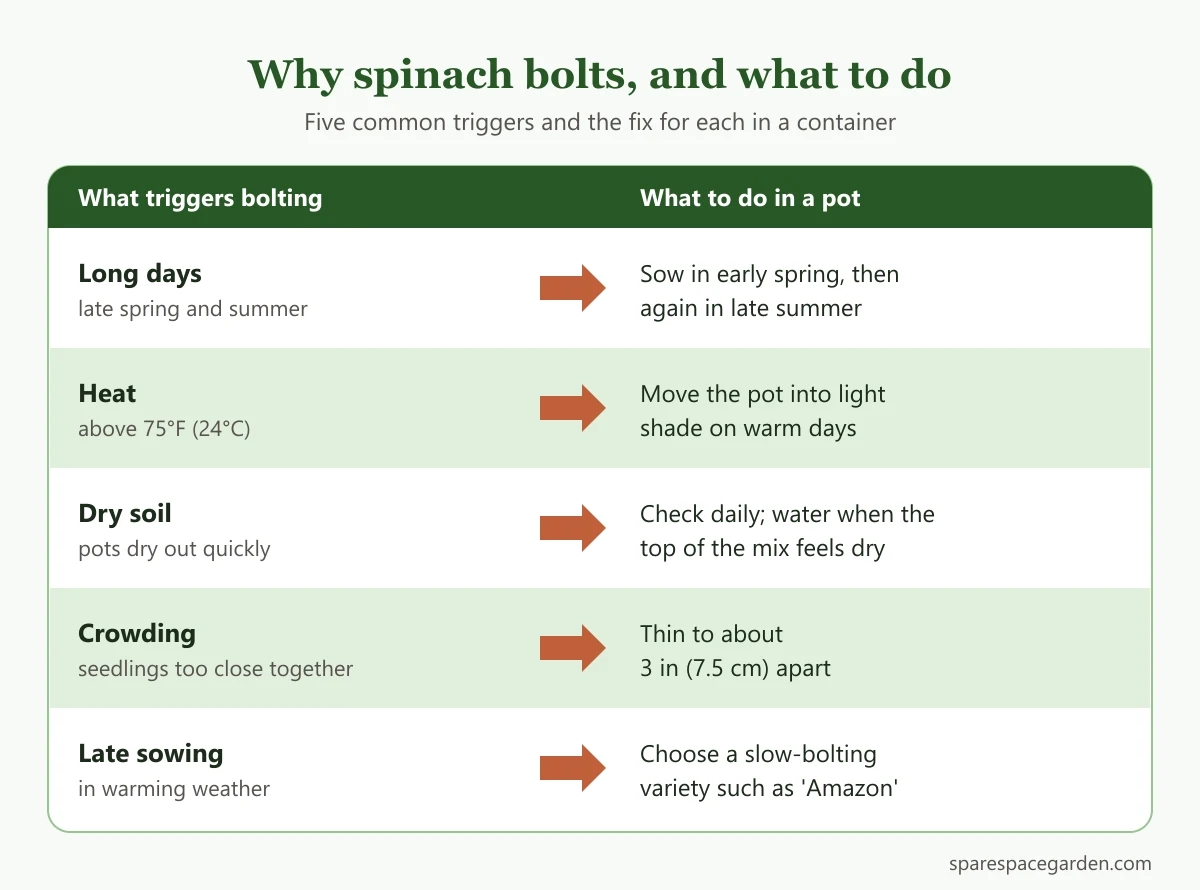 Common bolting triggers and what you can do about each one in a pot.
Slow-bolting spinach varieties
Variety choice can't stop bolting, but it buys time. Seed catalogs often describe these as "long standing" or "slow bolting", and Utah State and Illinois both recommend that type for late spring planting.
| Variety | What sources say | Source |
|---|---|---|
| 'Amazon' | Resistant to bolting and downy mildew; RHS Award of Garden Merit | RHS |
| 'Missouri' | Slow to bolt; RHS Award of Garden Merit | RHS |
| 'Indian Summer' | Slow bolting | UW–Madison Extension |
| 'Olympia' | Slow bolting; about 46 days to maturity | UW–Madison Extension |
| 'Space' | Described as bolt resistant; about 39 days | UW–Madison Extension |
| 'Tyee' | Described as very slow to bolt; about 39 days | UW–Madison Extension |
| 'Bloomsdale Longstanding' | Older variety; about 48 days | UW–Madison Extension |
Oregon State suggests a simple rule: slow-bolting varieties for late spring and summer harvests, and fast-growing varieties for fall, winter and early spring.
When to sow spinach in containers
Spinach handles cold far better than heat, so the main sowings come early in spring and again as summer ends. Utah State gives the soil temperatures: seed can be sown once the soil reaches 40°F (4°C), germinates best at 55–65°F (13–18°C) and takes about 7 to 10 days to come up. Germination slows when temperatures rise above 80°F (27°C). University of Maryland Extension suggests sowing after the soil reaches 45°F (7°C).
| Season | When to sow | Notes |
|---|---|---|
| Early spring | 2–4 weeks before your last frost date | Utah State gives 2–3 weeks; UW–Madison gives about 4 weeks |
| Mid to late spring | Every 1–2 weeks while it's still cool | Switch to slow-bolting varieties for later sowings |
| Summer | Usually skip | Long days and heat cause fast bolting; grow a heat-tolerant substitute |
| Late summer to early fall | Once the worst heat has passed | UW–Madison sows in mid-August in Wisconsin |
| Late fall | For overwintering in mild areas | Plants can survive down to 20°F (-7°C) |
The frost figure comes from North Carolina State Extension's plant database, which also suggests sowing every one to two weeks for an extended harvest. UW–Madison suggests about every two weeks. Small, frequent sowings suit containers well: several pots sown a week or two apart give you a steady supply instead of one big glut.
For fall sowings in warm weather, Illinois Extension suggests refrigerating the seed for 1 to 2 weeks before planting.
Pot size and depth for growing spinach in containers
Spinach doesn't need a deep pot, so it fits in containers that would be too small for most vegetables. Recommendations vary:
- NC State Extension: containers as small as 1 gallon (3.8 L) and as shallow as 4 to 6 inches (10 to 15 cm).
- University of Maryland Extension: a minimum of 1 to 3 gallons (4 to 11 L) of growing media, 4 to 6 inches (10 to 15 cm) deep.
- RHS spinach guide: a container at least 12 inches (30 cm) wide and deep, or a growing bag.
Treat the small sizes as a minimum. Since dry soil is one of the bolting triggers, a deeper pot that holds more mix gives you more room for error on a warm day. A wide, shallow trough or window box also works well because spinach spreads sideways rather than down.
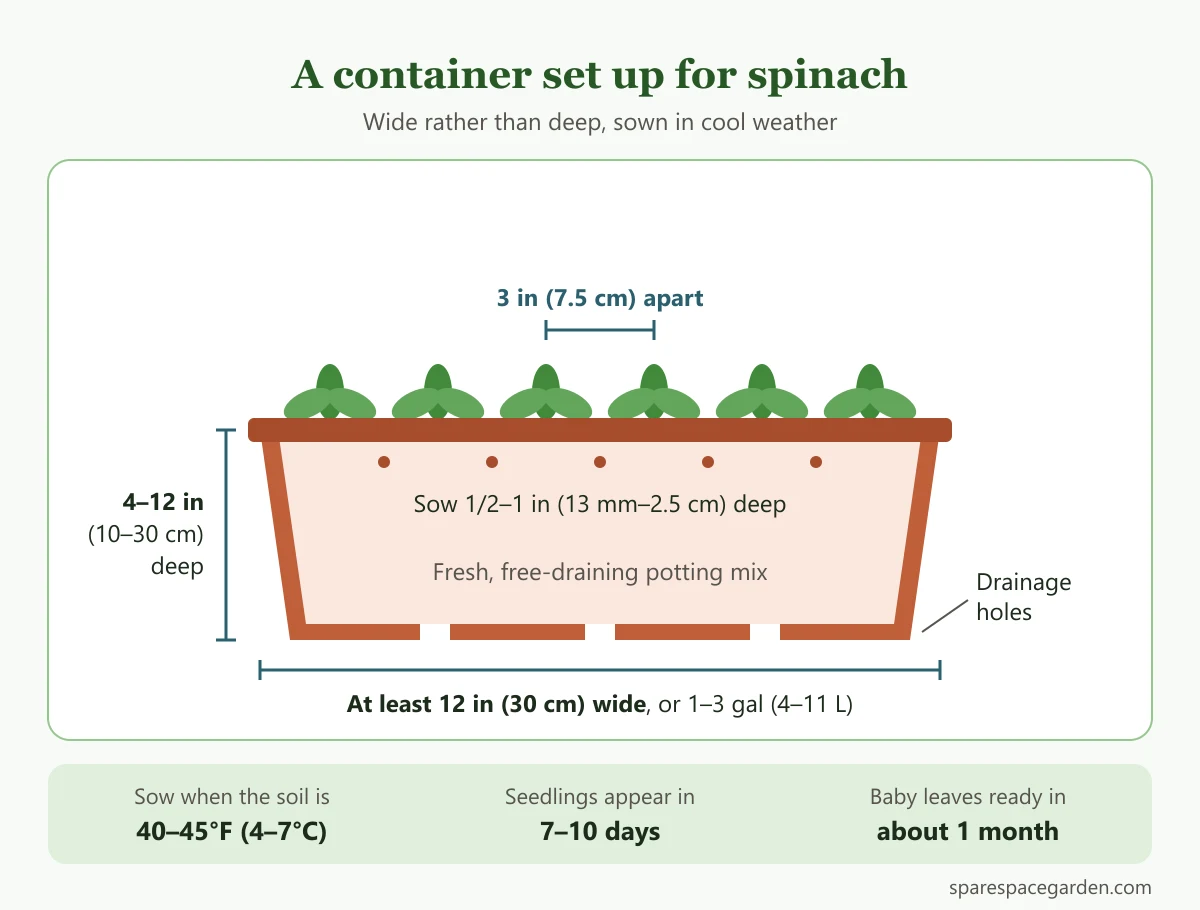 A simple spinach pot: wide rather than deep, with plants about 3 inches apart.
Use a pot with drainage holes and a fresh, free-draining potting mix rather than garden soil. NC State lists moist, rich, well-drained soil high in organic matter, with a pH of 6.0 to 8.0. If you mix your own, see our guide on how to make potting soil.
How to sow spinach in a pot
The RHS notes that direct sowing is usually preferred, because transplanting can trigger bolting. The steps:
- Fill the pot with moist potting mix, leaving a little space below the rim for watering.
- Sow thinly, 1/2 to 1 inch (13 mm to 2.5 cm) deep. Utah State and Illinois use 1/2 inch, NC State gives 1/4 to 1/2 inch, and the RHS uses 1 inch (2.5 cm).
- Space seeds about 1 to 4 inches (2.5 to 10 cm) apart, as UW–Madison suggests, or scatter them thinly across a wide pot.
- Keep the surface moist until seedlings appear, usually within 7 to 10 days at the right temperature.
- Thin to about 3 inches (7.5 cm). That is the spacing used by the RHS, Utah State and University of Maryland. Illinois gives 2 to 4 inches for whole-plant harvests and 4 to 6 inches (10 to 15 cm) for plants you'll pick from over time. Eat the thinnings.
If you're growing spinach in containers to pick leaves for weeks from fewer plants, err toward the wider spacing. Crowding is one of the bolting triggers Oregon State lists, so a pot crammed with seedlings tends to flower sooner.
Tip: Sow two or three smaller pots a week or two apart instead of one large one. When the first pot starts to bolt, the next one is ready to pick, the same approach that works for growing cilantro in pots.
Light, shade and watering
Light. Spinach grows best in full sun in spring and fall, according to University of Maryland Extension, but it tolerates partial shade of 4 to 6 hours of direct light. NC State goes further and says it can manage with 3 to 4 hours, and that some shade helps in hot weather. That makes spinach one of the few vegetables suited to an east-facing balcony.
Shade in warm weather. The RHS recommends growing spinach in light shade in warm weather to keep plants cooler, and gives 60–70°F (15–20°C) as the range spinach likes best. In a container, that can be as simple as moving the pot from a south-facing wall to the shady side of the balcony once temperatures rise, or tucking it behind taller plants.
Water. Watering is the hardest part of growing spinach in containers on a sunny balcony. Utah State suggests 1 to 2 inches (2.5 to 5 cm) of water a week and warns that uneven moisture makes leaves tough and can cause off-flavors. In a pot, use your finger instead of a ruler: water when the top of the mix feels dry, until water runs from the drainage holes. The RHS advises watering early in the morning and avoiding evening watering, which can encourage slugs, snails and downy mildew.
Feeding. Utah State says to avoid both water and fertilizer stress. Fresh potting mix carries a short crop like baby spinach, while a pot you'll pick for weeks may benefit from a diluted liquid feed. Follow the label for the rate.
Watch out: A pot of spinach on a sunny balcony floor can dry out and heat up in one warm afternoon, which is exactly the stress that pushes it to flower. On the first warm day of late spring, move it into shade.
Cut-and-come-again harvesting
Spinach can be picked as baby leaves or as full-size plants, and either way, picking the right part keeps it going. The RHS says baby leaves are ready about one month after sowing and mature leaves after about two months. University of Maryland gives 28 to 55 days from seed to maturity.
There are two ways to pick:
- Leaf by leaf. Start once plants have at least five or six leaves, the threshold used by Illinois and UW–Madison. Take the outer leaves first so the inner ones keep growing, as Utah State recommends. The RHS suggests taking a few leaves from each plant every few weeks.
- Whole-pot cut. Utah State says you can cut all leaves to within 2 inches (5 cm) of the soil if the growing point isn't damaged. The RHS notes that established plants cut just above the base should regrow for at least one more harvest.
When a central stalk starts to shoot up, the plant is bolting. Illinois Extension advises harvesting the whole remaining crop when seed stalks begin to form, since leaf quality declines quickly once flowering starts. That's your cue to clear the pot and sow again, or to plant a summer substitute.
Heat-tolerant alternatives for summer
In midsummer, you can swap true spinach for a plant that handles heat. None is a true spinach, but all are cooked and eaten the same way.
- Malabar spinach is a twining vine that grows in hot weather when true spinach struggles. University of Wisconsin–Madison Extension says it can reach 10 feet (3 m) and does best on a sturdy trellis. Plant it a few weeks after the last frost; it does little while nights stay below 60°F (16°C). See our guide to climbing vegetable plants for pot and support sizes.
- New Zealand spinach is a tender annual that, according to UW–Madison, grows best in long, warm days and keeps producing all summer. University of Maryland notes it should be planted after frost danger passes. Its leaves are smaller and fuzzier than spinach.
- Perpetual spinach is actually a type of chard. The RHS says it can be harvested for up to a year and suits small spaces.
If you want another cool-season leafy crop for the same pots, kale is hardier still; see growing kale in containers.
Frequently asked questions
How deep does a pot need to be for spinach?
Shallower than for most vegetables. NC State and University of Maryland give 4 to 6 inches (10 to 15 cm) as the minimum, while the RHS suggests at least 12 inches (30 cm) wide and deep. A deeper pot holds more water, which helps delay bolting.
Can you grow spinach in a pot indoors?
Yes, as long as it gets enough light and stays cool. NC State says spinach tolerates as little as 3 to 4 hours of sun a day, and Utah State notes it grows best at or below 75°F (24°C). A bright, cool windowsill suits baby-leaf sowings better than full-size plants.
Why does my potted spinach keep bolting?
Most often the sowing is too late in spring, so the plants meet long, warm days. Dry soil, crowding and a hot spot make it worse. Sow earlier, thin to about 3 inches (7.5 cm), keep the mix evenly moist and choose a slow-bolting variety such as 'Amazon' or 'Tyee' for later sowings.
How long does spinach take to grow in a container?
The RHS says baby leaves are ready about a month after sowing and mature leaves after about two months. University of Maryland gives 28 to 55 days from seed to maturity, and fast varieties such as 'Space' and 'Tyee' are listed at about 39 days by UW–Madison.
Does spinach grow back after cutting?
Yes, if you leave the growing point. Utah State says you can cut leaves to within 2 inches (5 cm) of the soil, and the RHS expects at least one more harvest from established plants cut above the base. Picking outer leaves only gives a longer, steadier supply.