Growing kale in containers works well because kale is a leaf crop: you don't wait for a single harvest, you pick a few leaves at a time for months. Give each plant its own pot about 12 inches (30 cm) wide and deep, a spot with at least 6 hours of sun, and plant it in early spring or late summer so it grows through cool weather.
Kale is one of the hardiest vegetables you can grow. Light frost makes the leaves taste sweeter, and a healthy plant can keep producing from autumn into the following spring.
This guide covers pot size, timing, varieties that suit pots, feeding, picking, pests and getting a potted plant through winter.
Quick answer: Grow one kale plant per pot at least 12 in (30 cm) wide and deep, which holds roughly 5 gallons (19 L). Plant about 4 weeks before your last spring frost or 6 weeks before your first fall frost. Start picking the large outer leaves 50 to 75 days after sowing, taking two or three at a time.
Choosing a pot for kale
One plant per pot is the standard advice. The RHS kale guide recommends a container at least 30 cm (12 in) wide and deep for each mature plant, and suggests a compact variety such as 'Dwarf Green Curled' for pots. A straight-sided pot of that size holds roughly 5 gallons (19 L) of mix.
Bigger is fine, and often better. Full-size kale can reach 90 cm (3 ft) according to the RHS, and Illinois Extension describes some types growing 3 to 4 feet tall. A tall plant in a small pot dries out fast and tips over in wind. If you want two plants together, use a wide tub or trough and give each one at least 12 in (30 cm) of space, which matches the RHS spacing for compact varieties.
Every container needs drainage holes. Fill it with a fresh potting mix rather than garden soil; our guide to the best potting soil for vegetables explains what to look for. NC State Extension gives a preferred soil pH of 6.0 to 7.5 for kale, a range most commercial mixes fall within.
| What you're growing | Container | Plants per container | Notes |
|---|---|---|---|
| Baby leaves for salads | Any pot or trough 6–8 in (15–20 cm) deep | Many, about 3 in (7.5 cm) apart | Pick at 4–6 in (10–15 cm) tall |
| Compact kale ('Dwarf Green Curled', 'Starbor') | 12 in (30 cm) wide and deep, about 5 gal (19 L) | 1 | Best choice for balconies |
| Full-size or Tuscan kale | 5 gal (19 L) or larger | 1 | Can reach 3 ft (90 cm); stake in exposed spots |
| Two compact plants | Wide tub or trough | 2 | At least 12 in (30 cm) between plants |
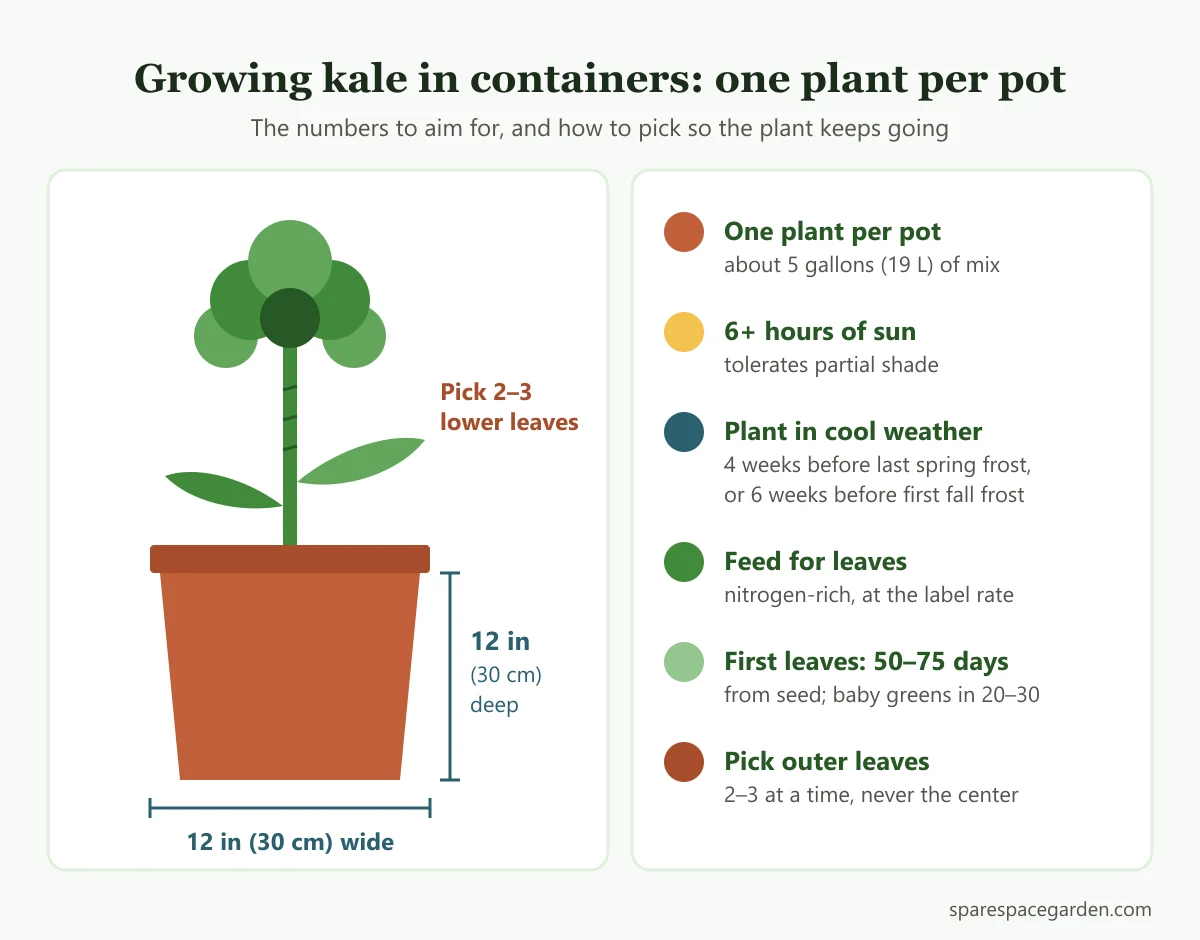 Pot size, light and picking method for one kale plant in a container.
When to plant kale in pots
Kale is a cool-season crop, and when growing kale in containers, timing matters more than almost anything else. Utah State University Extension says kale grows best when temperatures stay at or below 75°F (24°C), and that summer heat slows growth and can make leaves bitter or off-flavored.
That gives you two windows:
- Spring: NC State Extension's kale guide suggests planting about four weeks before your last spring frost date for a summer harvest. Utah State gives 4 to 5 weeks before the last frost for transplants.
- Late summer to fall: NC State suggests planting six weeks before your first fall frost date for an autumn and early winter harvest. Utah State counts backward: plant 50 to 75 days before you want to harvest, aiming for maturity about 2 to 3 weeks after the first fall frost.
The fall crop is usually the better one for flavor. Utah State, NC State and Illinois Extension all note that frost improves the taste of kale, because the plant builds up sugars in its leaves as the weather cools.
If you start your own seedlings, Utah State says transplants take 5 to 6 weeks to grow and should have 4 to 6 mature leaves when you plant them out. Seedlings that stretch toward a dim window are a common problem; see our guide to leggy seedlings if yours look thin and tall.
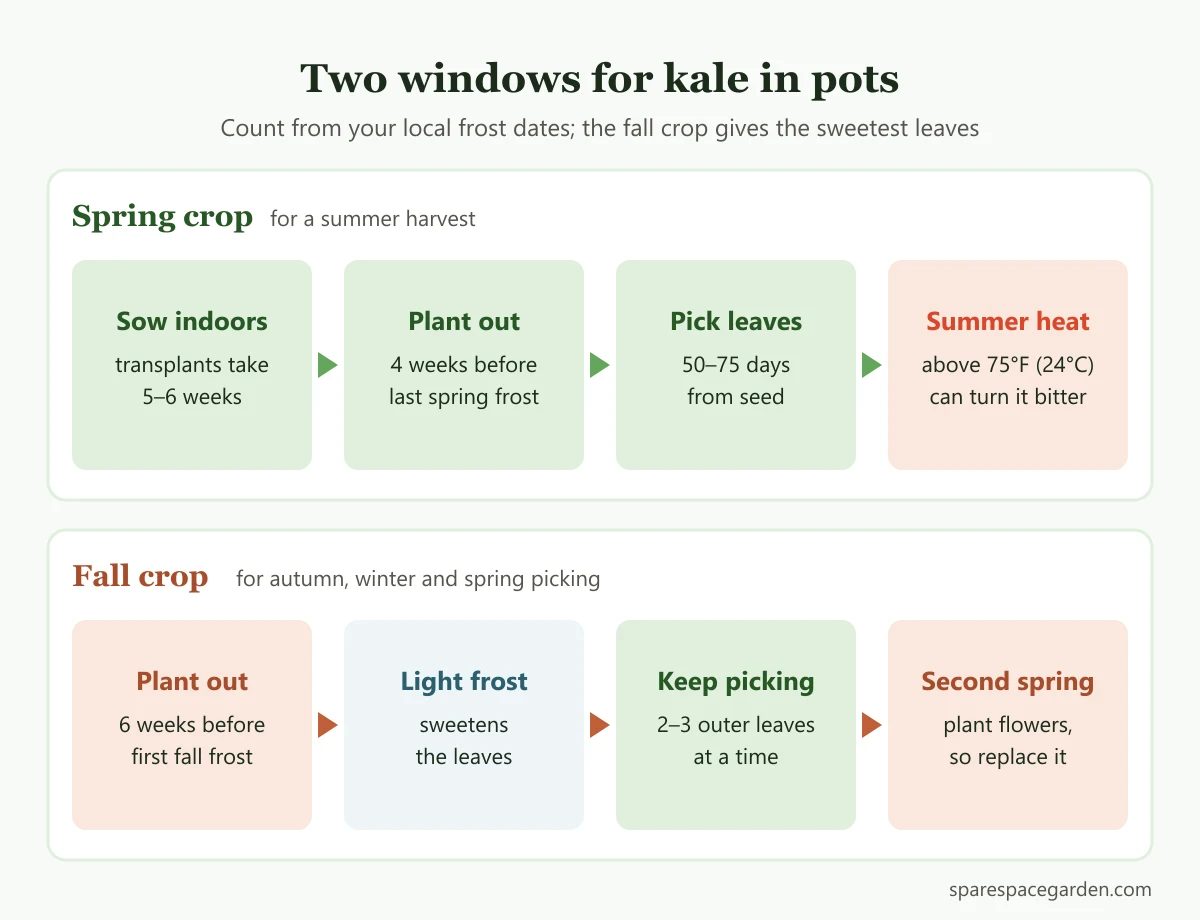 Spring and fall planting windows for kale in pots, counted from your frost dates.
Varieties that suit containers
Compact varieties are the easiest fit for a pot. The RHS names 'Dwarf Green Curled' as a compact kale for containers and small plots, and lists 'Starbor' and the Tuscan-style 'Yurok' as compact plants too.
Some common varieties and the days to harvest given by extension services:
| Variety | Type | Days to harvest | Notes from sources |
|---|---|---|---|
| Improved Dwarf Siberian | Blue-green, frilly | 50 | Very cold tolerant (NC State) |
| Red Russian | Flat, lobed, purple stems | 50 | Tender leaves, good for salads (NC State, RHS) |
| Starbor | Curly green | 55 | Compact (RHS, Utah State) |
| Redbor | Curly burgundy | 55 | Tall and fully hardy, so better in a large pot (RHS, NC State) |
| Toscano (Lacinato, Cavolo Nero) | Long, puckered dark leaves | 65 | Tolerates heat and cold (NC State) |
For a windy balcony, start with a dwarf curly type. Tall varieties such as 'Redbor' and the Tuscan types make a striking pot but need a heavier container and, in exposed spots, a stake.
Growing kale in containers: sun, water and feeding
Mississippi State University Extension recommends at least six hours of full sun a day for kale, though it also performs in partial shade. That makes it a good choice for an east-facing balcony that gets only morning sun. In hot climates, moving a spring-planted pot into afternoon shade can ease heat stress as summer arrives.
Watering
Steady moisture keeps the leaves tender. Utah State notes that uneven watering makes kale leaves tough and can cause off flavors. Pots dry far faster than garden beds, and Clemson's Home & Garden Information Center advises checking containers at least once a day, and twice on hot, dry or windy days. Water until it runs from the drainage holes, then let the excess drain away. If you can't check daily, self-watering containers for vegetables can help.
Feeding
Kale is grown for its leaves, so nitrogen is the nutrient it uses most. NC State says kale especially needs nitrogen for good color and tenderness. The RHS notes that feeding is usually unnecessary in the ground, but recommends a nitrogen-rich fertilizer for kale grown in containers.
For pots, Clemson notes that a potting mix with added fertilizer generally feeds plants for 8 to 10 weeks. After that, it suggests a water-soluble fertilizer at the label rate every two to three weeks. Don't go over the label rate: Clemson also warns that container plants lack the buffer of a large soil volume, so overfeeding shows up quickly. Our article on fertilizer for potted plants compares liquid and slow-release options.
Tip: Pale, yellowish older leaves on a kale plant that's been in the same pot for a couple of months often point to low nitrogen. Before you feed, check that the pot isn't waterlogged, since soggy roots can cause the same symptom.
How to harvest kale for months
The way you pick decides how long a plant keeps producing. NC State recommends picking the large outer leaves and letting the center keep growing. The RHS suggests taking two or three of the lower leaves per plant at a time. Illinois Extension describes the result well: after a few weeks of picking, the plant looks like a small palm tree, with a bare stem and a tuft of leaves at the top.
Timing from seed, according to NC State:
- Baby greens: 20 to 30 days after seeding.
- Mature leaves: 50 to 75 days after seeding.
A few picking habits help:
- Pick from the bottom up, removing the oldest full-size leaves first, as Utah State advises.
- Never strip the growing tip. That's where all new leaves come from.
- Remove any yellow or damaged lower leaves even if you don't eat them. The RHS notes that clearing faded leaves improves airflow and helps deter fungal disease.
- Pick regularly. Leaves left too long get tough.
The RHS says mature kale can be picked from autumn through spring. Most varieties are biennial: they keep producing leaves until they flower in their second spring, at which point the leaves turn bitter and it's time to replace the plant.
Pests: cabbage worms and aphids
Two pests cause most of the trouble on kale in pots. Utah State lists cabbage worms and loopers, which chew holes in leaves and hide in the center of the plant, and aphids, which feed on the undersides of leaves and make them curl. The RHS singles out the mealy cabbage aphid, which can make kale inedible if numbers build up.
The simplest prevention is a physical barrier. Illinois Extension recommends floating row covers to keep cabbage worm moths and flea beetles off the plants, and the RHS suggests fine-mesh insect netting on hoops or canes. A single pot is easy to cover with a small hoop of netting.
For aphids already on the plant, Utah State suggests a strong spray of water or insecticidal soap; follow the label for any product you use. Our guide on how to get rid of aphids naturally covers gentle options in more detail. For caterpillars on a few plants, checking the undersides of leaves and removing them by hand is often enough.
| Problem | Likely cause | Fix |
|---|---|---|
| Ragged holes in leaves, green droppings | Cabbage worms or loopers | Pick off caterpillars; cover the plant with fine netting |
| Curled leaves, gray or green clusters underneath | Aphids | Spray off with water or use insecticidal soap per the label |
| Tiny round holes in young leaves | Flea beetles | Cover young plants with row cover |
| Tough, bitter leaves in summer | Heat or uneven watering | Plant for fall; water steadily; give afternoon shade |
| Plant sends up a flower stalk in spring | Second-year flowering | Pick what's left and replace the plant |
Keeping potted kale through winter
Kale tops are very hardy. Utah State says young plants aren't seriously damaged down to 25°F (-4°C) and that mature plants are extremely hardy. Mississippi State says most varieties tolerate the low 20s °F (about -6°C), with Siberian and Russian types among the hardiest.
The weak point of growing kale in containers over winter is the roots. Illinois Extension's advice on overwintering potted plants explains that most plants' roots are far less cold-hardy than their above-ground parts, and that the small amount of mix in a pot gets much colder than garden soil. A kale plant that would sail through winter in the ground can lose its roots in a pot left on an exposed balcony.
To give potted kale the best chance:
- Move pots to shelter. Group them against a house wall, out of strong wind.
- Insulate the pot. Illinois Extension suggests mulching grouped pots with straw or leaves, or sinking pots into the ground where you have space.
- Keep the mix moist. Illinois Extension notes that roots keep taking up water in winter, and moist mix freezes more slowly than dry mix. Water on mild days when the mix is dry.
- Stake tall plants. The RHS recommends sturdy canes in autumn so winter gales don't loosen the roots.
- Cover in hard freezes. A layer of horticultural fleece or a frost cloth over the plant on the coldest nights adds a little protection; remove it when the weather eases.
In regions with long stretches well below the low 20s °F, treat potted kale as a fall crop and harvest heavily before the deepest cold arrives.
Frequently asked questions
How big of a pot does kale need?
The RHS recommends a pot at least 12 in (30 cm) wide and deep for one mature plant, which holds roughly 5 gallons (19 L). Compact varieties fit that size well. Tall or Tuscan types do better in a larger pot that won't tip over.
Can you grow kale in a pot indoors?
You can grow baby kale leaves on a bright windowsill, and the RHS notes kale microgreens are ready in two or three weeks. Full-size plants need at least 6 hours of sun and cool temperatures, so they usually do better outside on a balcony or patio.
How many times can you harvest kale?
Many times. If you take only the large outer leaves, two or three at a time, the center keeps producing new ones. The RHS says mature plants can be picked from autumn through spring, until the plant flowers in its second year.
Why is my potted kale bitter?
Heat is the usual cause. Utah State says kale grows best at or below 75°F (24°C) and that summer heat can make leaves bitter, and uneven watering adds to the problem. Fall-grown kale picked after a light frost tastes sweeter.
Can kale survive winter in a container?
Often, yes, in mild-winter areas. The leaves handle hard frost, but roots in a pot are much more exposed to cold than roots in the ground. Move the pot to a sheltered spot, insulate it, and keep the mix lightly moist.