Growing beans in containers is one of the easier ways to get a real harvest from a balcony or patio. Beans grow fast, need little fertilizer and are sown straight into the pot, so there are no seedlings to fuss over. The main decision is the type: compact bush beans or tall, climbing pole beans.
Bush beans suit smaller pots and give a quick crop over a few weeks. Pole beans need a bigger, heavier container and a tall support, but they keep producing for much longer. This guide covers pot sizes, sowing, support, watering, feeding, picking and succession sowing for both.
Quick answer: Sow beans 1 to 2 inches (2.5 to 5 cm) deep once the soil is at least 60°F (16°C). Bush beans fit 3 to 4 plants in a 2.5-gallon (9.5 L) pot; pole beans want a container about 30 inches (75 cm) wide and 18 inches (45 cm) deep with 6 to 8 ft (1.8 to 2.4 m) canes. Keep the mix moist from flowering on and pick pods every day or two.
Bush or pole beans: which suits your space
Both are the same kind of bean, Phaseolus vulgaris, in most seed catalogs. The difference is how they grow. South Dakota State University Extension explains that bush beans produce all their pods within one to three weeks, while pole beans flower continuously and make new pods all season. Pole beans can grow up to six feet (1.8 m) and sometimes taller.
That shapes how much you pick. University of Maryland Extension notes that pole beans generally produce higher yields over a longer period in less space than bush types. Bush beans are faster to start, though: Alabama Extension gives 55 to 65 days to harvest for bush beans and 70 to 80 days for pole beans.
| Bush beans | Pole beans | |
|---|---|---|
| Height | Up to 18 in (45 cm) | 6 ft (1.8 m) or more |
| Minimum pot | 12–18 in (30–45 cm) wide | 30 in (75 cm) wide, 18 in (45 cm) deep |
| Plants per pot | 3–4 per 2.5 gal (9.5 L) | One per cane, 4–5 canes per pot |
| Support | None needed | Canes or trellis, 6–8 ft (1.8–2.4 m) |
| Days to first picking | 55–65 | 70–80 |
| Picking period | 1–3 weeks per sowing | Midsummer to early fall |
| Best for | Small pots, quick crops, windy spots | Larger tubs, long harvests, vertical space |
On an exposed balcony, bush beans are the safer choice. A wigwam of 8-foot canes covered in leaves catches a lot of wind, and the pot has to be heavy enough to stay upright. A large pot of wet mix is also a real load, so check your balcony's weight limit with the building manager first.
Pot size for growing beans in containers
Container advice for beans varies more than for most crops, partly because bush and pole types are often lumped together. Here is what the main sources say:
- Bush beans: The RHS French bean guide recommends containers at least 12–18 inches (30–45 cm) wide for dwarf (bush) beans, with plants at least 6 inches (15 cm) apart. Alabama Extension suggests 3 to 4 plants per 2.5-gallon (9.5 L) container.
- Pole beans: The RHS asks for at least 30 inches (75 cm) wide and 18 inches (45 cm) deep, and heavy enough to stay upright once the plants are growing.
- Either type: Oregon State University Extension suggests one sprouted seed or seedling per 5-gallon (19 L) container for best results. That is a generous allowance, but it keeps watering simple.
University of Maryland Extension's container guide lists beans under both its small group (1 to 3 gallons, 4 to 6 inches deep) and its medium group (4 to 6 gallons, 8 to 12 inches deep). In practice, the bigger end is easier to manage. A pot that holds more mix stays moist longer, and beans dislike drying out once they flower.
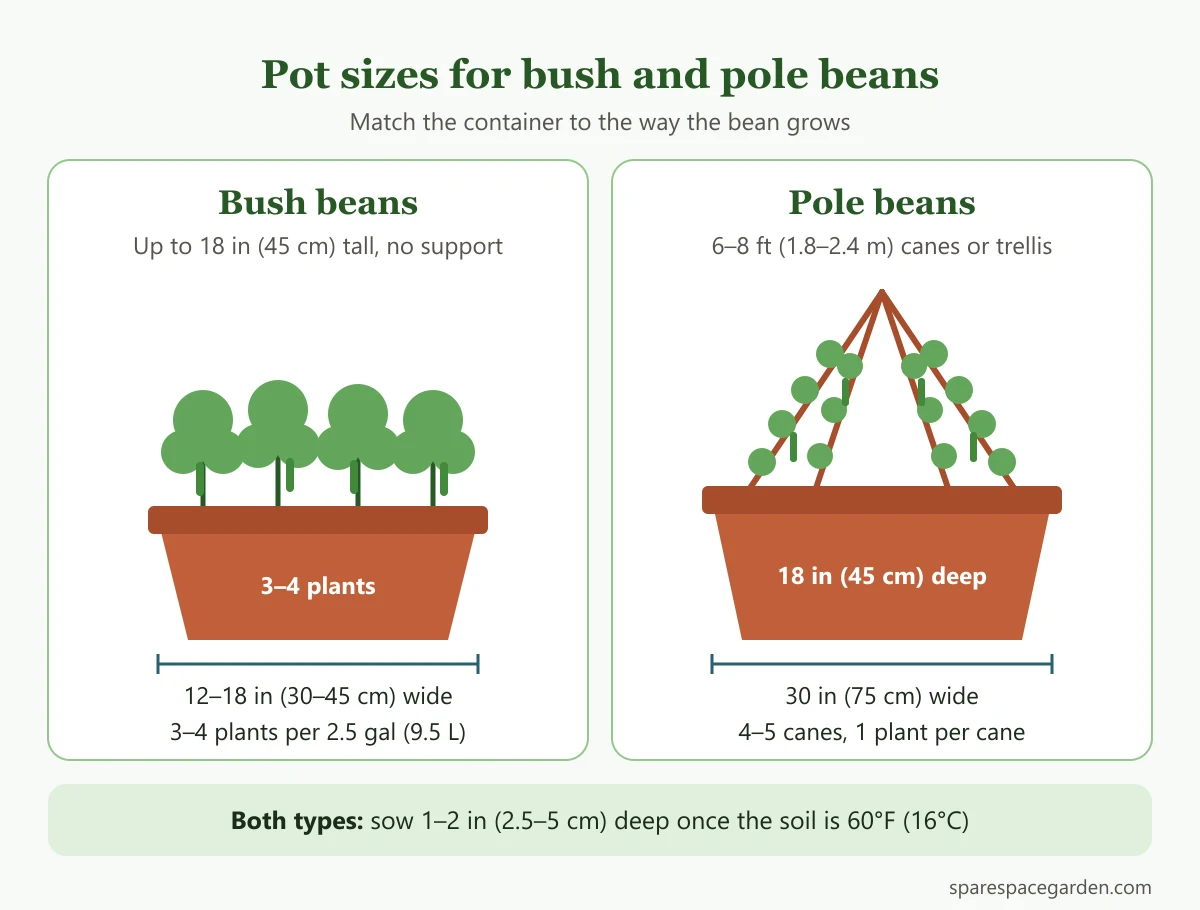 Pot sizes and spacing for bush and pole beans.
Whatever you choose, use pots with drainage holes and fill them with commercial potting mix, not garden soil, as Oregon State advises. Our guide to the best potting soil for vegetables explains what to look for on the bag.
Sowing beans and setting up support
Sowing directly in the pot
Beans are almost always sown where they will grow. Alabama Extension advises direct sowing and does not recommend transplants. The RHS does allow sowing one bean per small pot indoors for an early start, then planting out at 3 inches (8 cm) tall once frost has passed.
Soil temperature matters more than the calendar. Clemson's Home & Garden Information Center says not to plant beans until the soil is at least 60°F (16°C) at a 4-inch (10 cm) depth, because bean seeds do not germinate well in cold soil and plants are killed by light frost. A soil thermometer pushed into the pot answers the question quickly. Pots on a sunny balcony can warm up sooner than garden beds, so check the pot itself rather than a local planting date.
- Fill the pot with moist potting mix to about an inch (2.5 cm) below the rim.
- Push the seeds in 1 to 2 inches (2.5 to 5 cm) deep. Clemson, SDSU and Alabama use 1 inch; the RHS uses 2 inches (5 cm).
- Space bush beans about 2 to 4 inches (5 to 10 cm) apart and thin to the 3 or 4 strongest plants in a 2.5-gallon pot, or to 6 inches (15 cm) apart in a wider container.
- For pole beans, set the canes first. The RHS sows two seeds at the base of each cane and thins to the stronger one.
- Water once after sowing and then keep the mix just moist, not soggy, until shoots appear.
Tip: If you haven't grown beans for a few years, SDSU Extension notes that a Rhizobium inoculant can increase yield. University of Maryland Extension adds that inoculating seed speeds up nitrogen fixation.
Giving pole beans something to climb
Pole beans twine around a support on their own once the shoots find it, so the support must be in place at sowing time. The RHS uses a wigwam of four or five canes, 6 inches (15 cm) apart at the base, with canes 8 ft (2.5 m) tall. Clemson suggests trellises at least 6 to 8 feet (1.8 to 2.4 m) tall and sturdy enough to withstand wind and rain.
When the vines reach the top, the RHS recommends cutting off the extra growth to encourage side shoots lower down, where you can reach the pods. For other ways to build a support and train vines, see our guide to climbing vegetable plants.
Clemson names 'Blue Lake' and 'Kentucky Wonder' among its pole varieties, and 'Bush Blue Lake 274', 'Contender' and 'Provider' among its bush types.
Watering beans, especially at flowering
Water is where growing beans in containers differs most from a garden bed. Beans need steady moisture, and the most sensitive time comes later than many people expect. Clemson calls pod set and pod development the critical period for moisture. The RHS gives similar advice: water in dry weather, especially once plants flower and form pods, and remember that containers dry out quickly.
SDSU Extension suggests keeping the soil moist but not soggy, letting the surface dry up to half an inch (1.3 cm) deep between waterings. Alabama Extension advises about 1 to 2 inches (2.5 to 5 cm) of water a week, more in hot weather, and avoiding wetting the leaves. In a pot, ignore rain gauges and use your finger: Oregon State recommends checking containers daily and watering until it runs out of the drainage holes when the mix is dry.
Heat is the other flowering problem. Clemson notes that blossoms may drop above 90°F (32°C), especially on varieties such as 'Blue Lake 274', and that pods usually start setting again when the weather cools. Moving pots out of hot afternoon sun during a heat wave can help. If daily watering is hard to keep up, self-watering containers for vegetables hold a reserve below the mix.
Watch out: Pod set is the stage Clemson flags as most sensitive to dry soil, and a small pot can dry out in a single hot afternoon. Check the mix every morning from first bloom until the last pods are picked.
Feeding: why beans need little nitrogen
Beans are legumes. University of Maryland Extension explains that they fix their own nitrogen once a good root system is established, and warns that excess nitrogen will delay flowering. SDSU Extension says plainly that beans do not need extra nitrogen fertilizer.
That doesn't mean a pot needs nothing. Potting mix holds only a small store of nutrients, and frequent watering washes them out. The RHS says beans in the ground need no feeding, but beans in containers benefit from a high-potassium liquid fertilizer, such as tomato feed, every two weeks once the first flowers appear.
A simple routine for containers:
- Start with fresh potting mix that contains a starter fertilizer.
- Skip high-nitrogen lawn or leafy-green feeds.
- Once flowers appear, use a high-potassium liquid feed every two weeks, following the label rate.
In-ground advice varies a little. Clemson's program includes a light side-dressing before first bloom, while Maryland says side-dressing is usually not necessary. For more on choosing products, see our article on fertilizer for potted plants.
Picking often and sowing again
Regular picking is what keeps beans flowering. University of Maryland Extension says to pick snap beans regularly to keep plants producing heavily, and Clemson notes that harvesting continues on a daily basis once pods reach picking size.
Pick pods when they are 6–8 inches (15–20 cm) long, snap cleanly and still look smooth. The RHS says to pick before the beans show through the pod, and Clemson agrees: harvest before you can see the enlarging seed. Hold the stem with one hand and pull the pod with the other so you don't tear the plant.
Succession sowing for a longer harvest
Because bush beans finish their crop in one to three weeks, a single pot gives a short burst. Sow another pot every few weeks instead. The interval varies by source:
- Clemson: every 10 to 14 days.
- Alabama and University of Maryland: every 2 to 3 weeks.
- University of Maryland: keep sowing from the frost-free date through mid-to-late July.
Two or three pots of bush beans sown a couple of weeks apart give a steady supply. Pole beans need less of this, since the RHS says climbers crop from midsummer to early fall if picked regularly.
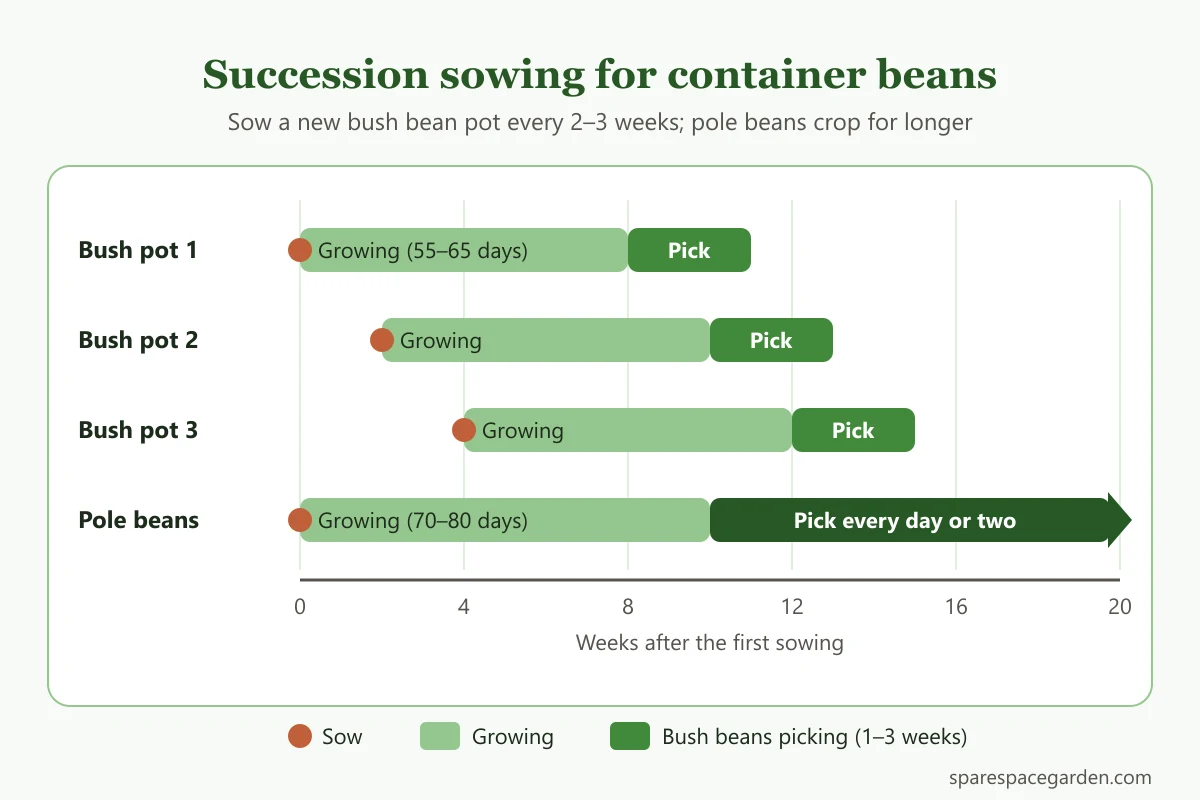 Sow bush beans every 2 to 3 weeks; one pole bean pot crops for much longer.
Common problems with container beans
Most problems when growing beans in containers trace back to temperature, water or too much fertilizer.
| Problem | Likely cause | Fix |
|---|---|---|
| Seeds rot or don't come up | Cold soil | Wait until the mix is at least 60°F (16°C) |
| Flowers fall off without pods | Heat above 90°F (32°C) or dry mix | Water steadily; shade pots on very hot afternoons |
| Lots of leaves, few flowers | Excess nitrogen | Stop high-nitrogen feeds; use a high-potassium feed |
| Tough, bulging pods | Picked too late | Pick every day or two at 6–8 in (15–20 cm) |
| Short harvest from bush beans | Normal for the type | Sow a new pot every 2 to 3 weeks |
| Pole bean wigwam tips over | Pot too light, exposed site | Use a heavy, wide pot; tie canes to a railing |
Frequently asked questions
Can you grow beans in a 5-gallon bucket?
Yes. Oregon State Extension suggests one bean plant per 5-gallon (19 L) container, which suits a single pole bean on a cane or trellis. Bush beans can share a bucket of that size, since Alabama Extension fits 3 to 4 plants into a 2.5-gallon pot. Drill drainage holes in the base first.
Are bush or pole beans better for containers?
Bush beans are easier in small pots and windy spots because they need no support and stay under about 18 inches (45 cm). Pole beans yield more over a longer season, according to University of Maryland Extension, but they need a pot around 30 inches (75 cm) wide and 6 to 8 ft (1.8 to 2.4 m) of support.
How long do beans take to grow in a pot?
Alabama Extension gives 55 to 65 days from sowing for bush beans and 70 to 80 days for pole beans, and SDSU gives a range of 50 to 70 days. The RHS says dwarf beans start cropping in eight to ten weeks. Variety and temperature both shift the timing.
Do beans in pots need fertilizer?
They need very little nitrogen because beans fix their own. For containers, the RHS suggests a high-potassium liquid feed every two weeks once flowers appear. Avoid heavy nitrogen, which University of Maryland Extension says delays flowering.
Why are my bean flowers dropping off?
Heat and dry soil are the usual reasons. Clemson notes that blossoms may drop above 90°F (32°C) and that pods set again once temperatures cool. Keep the mix evenly moist through flowering and give pots some afternoon shade during heat waves.