Cucumber spider mites are tiny, eight-legged pests that pierce leaf cells and suck out the contents. The first thing you notice is a fine, pale speckling on top of the leaves. In a bad outbreak, silky webbing follows, and the vine yellows and dries out from the bottom up.
The species behind most outbreaks is the two-spotted spider mite (Tetranychus urticae), which UK gardeners know as glasshouse red spider mite. The RHS lists cucumbers among its edible hosts and says few plants are completely immune. On a hot balcony, mites can build up fast, so early detection matters more than any spray.
Quick answer: Look for pale stippling on cucumber leaves, then tap a leaf over white paper: specks that crawl are mites. Hose the leaf undersides forcefully at least once a day while mites are active, keep pots well watered and remove the worst leaves. Use insecticidal soap or horticultural oil only below 90°F (32°C), after testing a few leaves and following the label, and avoid broad-spectrum insecticides.
How to spot cucumber spider mites early
Spider mites are easy to miss because they're so small. UC IPM's spider mite pest note says adult females, the largest stage, are less than 1/20 inch (about 1 mm) long. The RHS guide to glasshouse red spider mite puts adults at up to 1 mm and describes them as yellowish-green with a pair of darker markings. They turn orange-red in autumn and winter, or when a plant is badly damaged.
Watch for these signs, in roughly the order they appear:
- Stippling. UC IPM describes early damage as a stippling of light dots on the leaves, sometimes with a bronze tint. The RHS calls it a fine pale mottling on the upper surface.
- Life on the underside. Turn the leaf over. The RHS says you'll find tiny mites, white cast skins and eggshells, and a x10 hand lens makes them much easier to see.
- Paler, drying leaves. On cucurbits, UC IPM says leaves become pale and stippled, then dry up and die in later stages.
- Webbing. Fine silk between leaves and stems shows up in heavy infestations. UC IPM notes that webbing is the easiest way to tell spider mites from other tiny pests such as aphids and thrips.
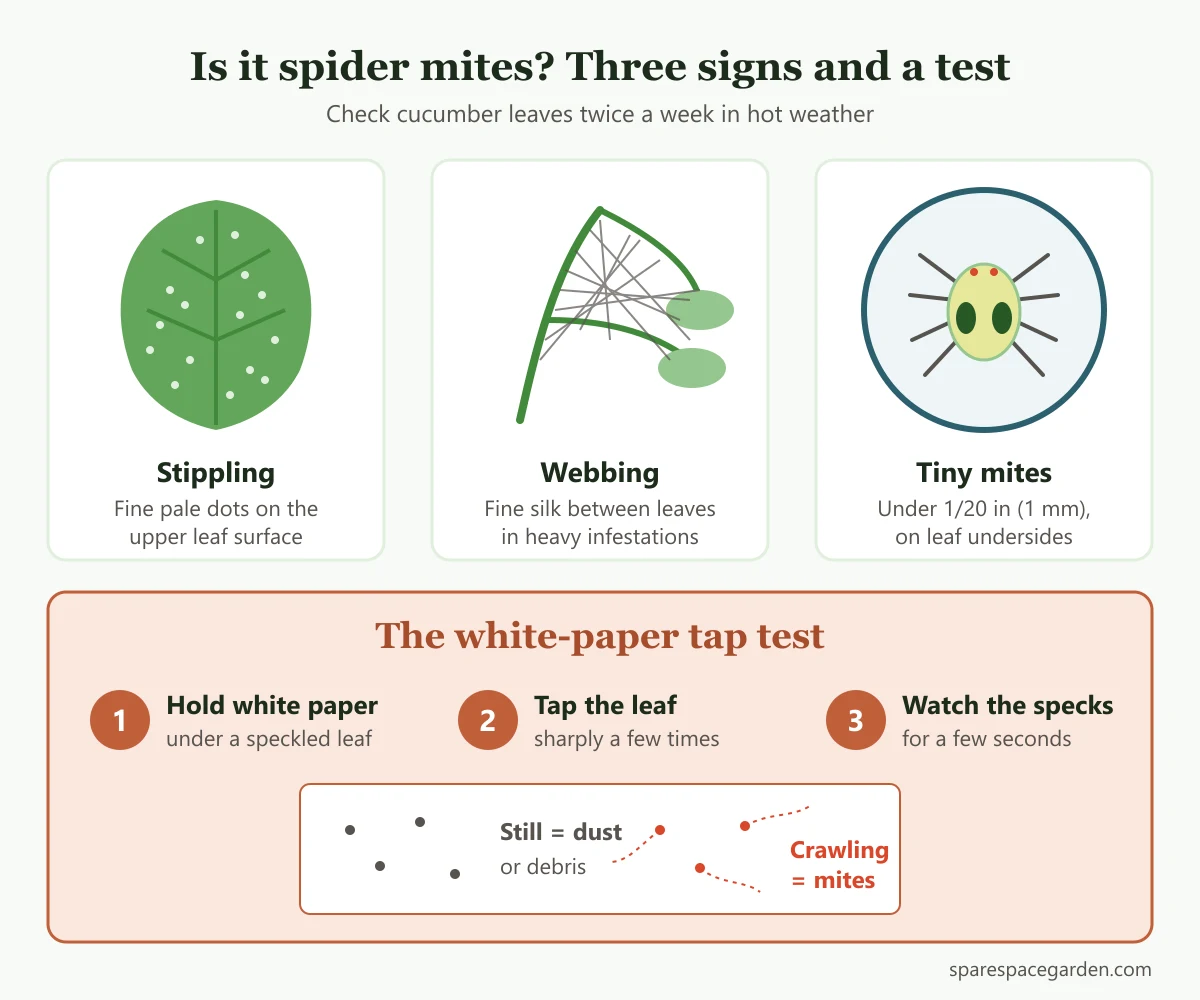 Three signs to look for, and a ten-second test to confirm them.
The white-paper tap test
Hold a sheet of white paper under a speckled leaf and tap the leaf sharply a few times. UC IPM says disturbed mites move around rapidly, so watch the paper for a few seconds. Specks that crawl are mites. Specks that stay put are probably dust or debris.
UC IPM recommends confirming that mites are present before you treat, because they may already be gone by the time you notice the damage. If the moving specks are teardrop-shaped, long-legged and unusually fast, they may be predatory mites, which are about the same size as the pests. Those are worth keeping.
What else causes speckled cucumber leaves?
| What you see | Likely cause | What to check |
|---|---|---|
| Fine pale dots, mites on the underside, maybe webbing | Spider mites | Tap test over white paper |
| White powdery patches that rub off | Powdery mildew | No mites on the paper; see our powdery mildew treatment guide |
| Curled leaves, sticky honeydew, insects with two rear "tubes" | Aphids | See how to get rid of aphids naturally |
| Tiny white insects that fly up when you brush the leaves | Whiteflies | See our home remedies for whiteflies |
| Even yellowing of the oldest leaves, no speckles | Nutrient shortage or age | Feeding and watering routine |
Why hot balconies and walls favor spider mites
Spider mites love the conditions that many balconies create in midsummer. UC IPM lists hot, dusty conditions, water-stressed plants and insecticide sprays in hot weather as the main triggers for outbreaks. Colorado State University Extension adds that dry conditions strongly favor them: mites feed more when humidity is low, and drought-stressed plants may become more nutritious to them.
A cucumber in a pot against a sunny wall checks every box. The wall reflects heat, an overhang keeps off rain that would otherwise rinse the leaves, and a container dries out much faster than garden soil. The RHS notes the same pattern in greenhouses, where plants grown hot, dry and crowded suffer the worst damage.
Our guide to growing cucumber plants in pots covers pot size and watering, which go a long way toward keeping a vine out of drought stress.
How fast spider mites multiply
Speed is what turns a few speckled leaves into a webbed plant. According to the RHS, development from egg to adult takes about 55 days at 50°F (10°C) but only 12 days at 70°F (21°C). UC IPM's cucurbit guidelines say a generation can pass in as few as 5 to 7 days in midsummer, or take a month during cool periods.
Each female adds a lot to that. Colorado State says mature females may lay a dozen eggs a day for a couple of weeks.
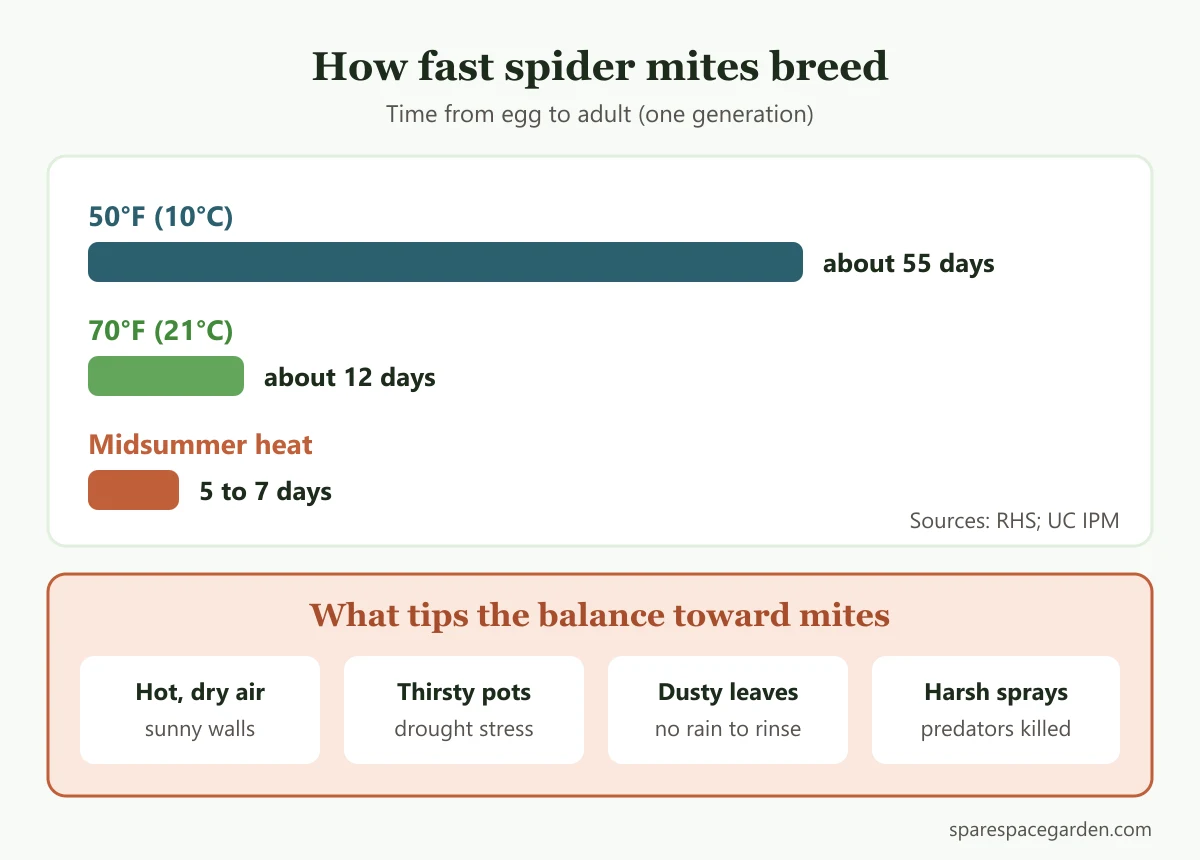 Warm weather shortens each generation from weeks to days.
Two practical points come out of this. First, check plants at least twice a week in hot weather, turning over a few leaves near the bottom and middle of the vine. Second, plan on repeat treatments. Colorado State notes that most miticides don't affect eggs, so a single spray leaves the next generation untouched.
Mites also carry over from year to year. The RHS says mature females overwinter in cracks and crevices, including stakes, canes, soil and plant debris, and UC IPM mentions leaf litter. That's why end-of-season cleanup matters on a balcony with reused trellises and pots.
How to control cucumber spider mites without harsh sprays
Work from the gentlest step up. Each of these also spares the predators that help keep mites down.
- Confirm with the tap test. Don't treat speckled leaves until you've seen mites moving.
- Hose the undersides. UC IPM recommends forcefully spraying plants with water, especially the undersides of leaves, at least once a day for infested plants. Colorado State says a forceful spray removes and kills many mites, washes off dust that interferes with predators, and breaking up webbing may delay egg-laying. Spray early in the day so leaves dry before evening.
- Water the pot properly. Keep the potting mix evenly moist. Both UC IPM and Colorado State link drought stress to worse mite problems.
- Remove the worst leaves. Snip off heavily speckled, webbed leaves and put them straight into a sealed bag for the trash, not a balcony compost bin. Don't strip so many that fruit is left exposed: UC IPM notes that leaf loss on melons and squash can lead to sunburned fruit.
- Raise the humidity. The RHS says regular spraying with water and keeping humidity high reduces the risk, though it won't control the mite on its own. In greenhouses it suggests damping down the floor in hot weather. On a balcony, grouping pots and wetting a paved floor on hot afternoons is a smaller version of the same idea.
Tip: Space vines so leaves don't touch the wall or a neighboring plant. Mites walk from leaf to leaf, and a vine grown up a trellis with some airflow is easier to inspect and spray. Our guide to growing cucumbers vertically covers trellis setups for small spaces.
Insecticidal soap and horticultural oil on cucumbers
If water sprays don't keep up, soap and oil are the lowest-impact products. Both kill only by direct contact, so UC IPM stresses thorough coverage, especially of leaf undersides, and says repeat applications may be needed.
Cucumbers need extra care with soap. UConn Extension's insecticidal soap fact sheet lists cucumber among plants that may be sensitive. It advises spot-treating part of a plant and waiting at least 24 hours before treating the rest.
Follow these rules from UC IPM and UConn:
- Follow the label. Check that the product lists vegetables or cucumbers, and use the rate and interval printed on it.
- Avoid heat. Don't spray when it's above 90°F (32°C), or on a wilted or drought-stressed plant. Water the day before.
- Mind slow drying. UConn says to avoid oil when humidity stays above 90% for 48 hours or rain is likely.
- Keep sulfur away. UC IPM warns that sulfur can burn cucurbits and shouldn't be used within 30 days of an oil spray.
- Don't swap in dish soap. UConn says dish soaps and detergents can strip the waxy protective layer from leaves.
Which one works better? Colorado State calls insecticidal soap only marginally effective against two-spotted spider mite, and less useful where webbing blocks the spray. It describes horticultural oil at the 2% summer rate as perhaps the most effective miticide available for home use. UConn adds that oil smothers mite eggs as well. Hose off the webbing first so the spray can reach the mites.
Watch out: Oil isn't selective. UConn notes it kills predatory mite eggs as easily as spider mite eggs. Once dry it has little effect, so spot-treat the infested leaves rather than the whole vine, and spray in the early morning or evening.
Predatory mites and other natural enemies
Predatory mites eat spider mites and can be bought by mail. UC IPM names two main types:
- Western predatory mite (Galendromus occidentalis), which UC IPM says works better under hot, dry conditions.
- Phytoseiulus species, the most common choice under glass. The RHS calls Phytoseiulus persimilis the most commonly used biological control for this pest and says it can succeed on outdoor plants in summer.
Phytoseiulus needs humidity. Cornell University's biological control guide says relative humidity above 60% is required for survival, especially of eggs. At 81°F (27°C), only 7.5% of eggs hatched at 40% humidity, compared with 99.7% at 80%. A dry, sunny balcony is a tough place for it, so ask the supplier which species suits your conditions.
UC IPM's release guideline is one predator for every 10 spider mites, concentrated on the worst-hit leaves. Predators need prey: without spider mites they starve or leave, so release them early in an outbreak rather than as prevention on clean plants.
Be realistic about results outdoors. Colorado State says bought predatory mites have worked indoors, but effective outdoor use hasn't been demonstrated in Colorado. UC IPM's cucurbit guidelines note that research on the western predatory mite in cucurbits hasn't been done. Wild predators help too: UC IPM lists sixspotted thrips, the spider mite destroyer lady beetle, minute pirate bugs, bigeyed bugs and lacewing larvae.
Why broad-spectrum insecticides make mites worse
Spraying a strong general insecticide on a mite problem often backfires. UC IPM gives three reasons:
- These products kill the natural enemies that were holding mites in check.
- Some insecticides stimulate mite reproduction. In lab tests, mites exposed to carbaryl reproduced faster than untreated mites.
- Carbaryl, some organophosphates and some pyrethroids may raise leaf nitrogen levels, which favors mites.
UC IPM adds that applications in hot weather often lead to mite outbreaks within a few days. Colorado State says carbaryl kills most spider mite natural enemies and can contribute greatly to outbreaks, and that imidacloprid soil treatments and malathion have also worsened some mite problems. If you've sprayed a cucumber for beetles or aphids with a broad-spectrum product, inspect it for mites over the following week.
Frequently asked questions
Can cucumber plants recover from spider mites?
Yes, if you act early. UC IPM says light infestations on cucurbits can be tolerated, while heavy infestations lower yield and fruit quality. Badly bleached leaves won't turn green again, but new growth stays healthy once mite numbers are under control.
Are cucumbers from a plant with spider mites safe to eat?
The mites feed on leaves, not inside the fruit, though UC IPM notes that heavy webbing can cover fruit. Rinse the cucumbers before eating. If you've used any spray, check the label for how long to wait between spraying and harvest.
Does neem oil kill spider mites on cucumbers?
UC IPM lists neem among the oils that can control spider mites, provided the spray contacts them directly. Test it on a few leaves first, never spray above 90°F (32°C) and follow the label. Repeat applications are usually needed because new mites hatch after each spray.
Why do cucumber spider mites come back every summer?
They overwinter close by. The RHS says mature females shelter in cracks, stakes, canes, soil and plant debris. At the end of the season, remove old vines, clear debris from pots and trays, and clean trellises and stakes before you reuse them.
Do spider mites spread to other plants on a balcony?
Yes. The RHS describes the mite as feeding on a very wide range of plants, and the pepper leaf yellowing guide covers the same mites on peppers. Check neighboring pots, especially beans, eggplants and peppers, whenever you find mites on a cucumber.