The best apartment patio garden ideas for renters share one rule: everything can be picked up and carried away. A ground-level patio has no balcony weight limit, so you can use bigger pots, a planter on legs and a trellis box tall enough to block a neighbor's view. What you usually can't do is dig, drill into walls or leave marks on the concrete.
Below: lease checks, container groupings, climbing screens, stain-free pots and a garden that leaves with you on moving day.
Quick answer: Ask your landlord or HOA what's allowed, then grow in movable containers at least 10–12 inches (25–30 cm) deep in a spot with 6–8 hours of direct sun. Use a freestanding trellis planter for privacy, raise every pot on feet or bricks to prevent water stains, and time annual crops to finish before your lease ends.
Check your lease and HOA rules first
Your rental agreement shapes a patio garden more than the sun does. Colorado State University Extension's Pueblo County office points out that leases often prohibit unauthorized yard changes, which usually rules out in-ground and even raised garden beds, so ask your landlord or leasing agency first. CSU's PlantTalk service adds that apartment and condo residents may be limited by covenants, so check with the homeowners association or management company as well.
Questions worth asking, ideally by email so you have the answer in writing:
- Can I keep containers, a planter on legs and a freestanding trellis on the patio?
- Is there a height limit for screens or plants along the patio edge?
- May I attach anything to walls, fences or railings, even with clamps?
- Is the outdoor faucet for tenant use, and may water drain onto shared paving?
- Are string lights or outdoor extension cords allowed?
CSU PlantTalk's renter advice suggests offering a written agreement that lists what you'll plant, how you'll maintain it, and a promise to restore the space to its original condition when you move. Keep things tidy, too. The Pueblo County article warns that dead plants and weeds can prompt a landlord to step in.
Tip: Photograph the patio before you set anything down, especially the paving where the pots will sit. A dated photo makes any move-out conversation about marks much easier.
Plan your apartment patio garden around sun and use
Ground-level patios are often shaded by fences, hedges, the building itself or the balcony above. Watch where the light falls over a whole day before you buy plants. Purdue University Extension says most vegetables need at least 6 to 8 hours of direct sunlight for good production. If your patio gets less than that, our guide to apartment balcony plants sorts options by sun, shade and wind, and the same lists work at ground level.
Good apartment patio garden ideas start with zones, so divide the space by use:
- Growing strip: the sunniest edge, for vegetables and fruiting crops.
- Screen line: the side facing a neighbor, parking lot or walkway.
- Seating corner: the shadiest spot, since people need shade more than tomatoes do.
- Clear path: a route from the door to the faucet and the trash.
Put the heaviest planters where they'll stay all season. A pot full of wet soil is movable in theory and stubborn in practice.
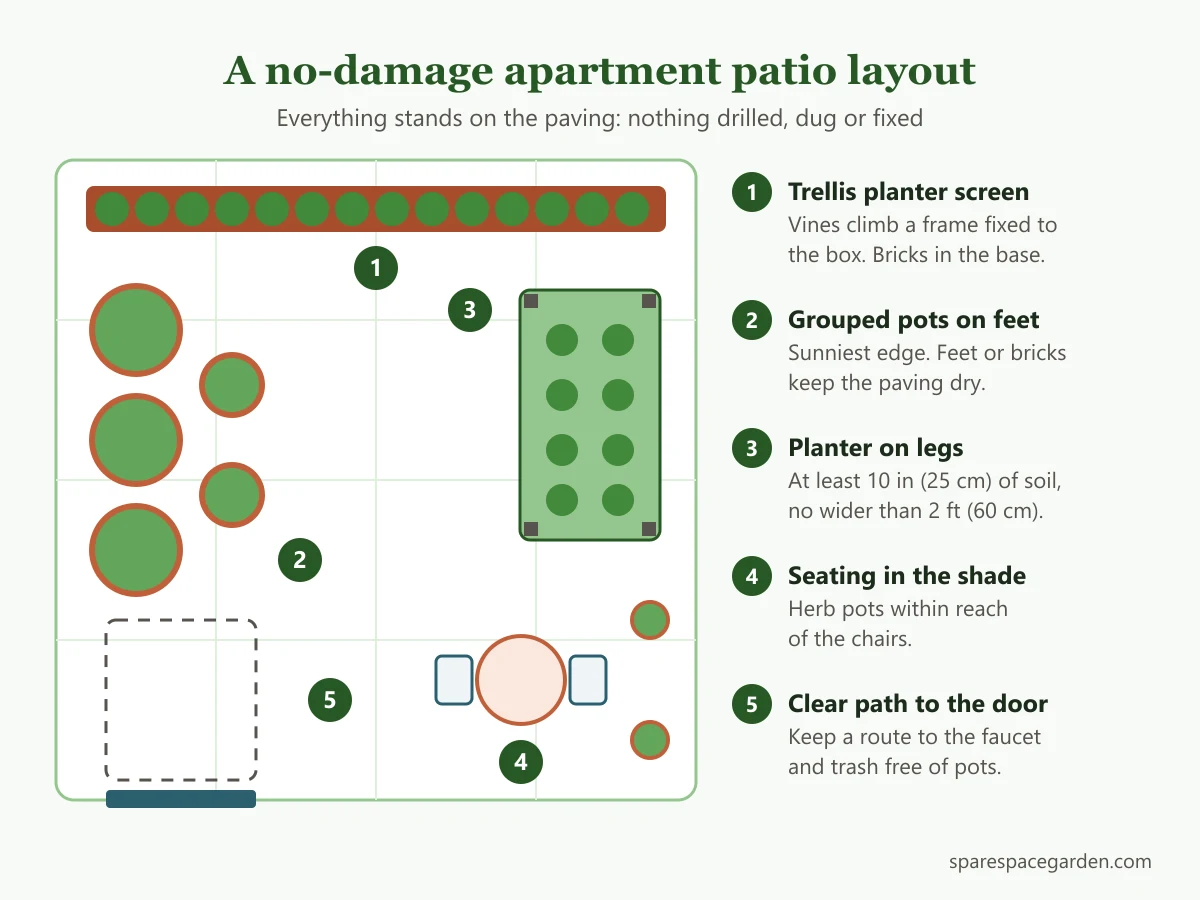 A renter-friendly patio layout: nothing is drilled, dug or fixed in place.
Group containers for a fuller look and easier care
A few large containers usually beat a crowd of small ones. The RHS guide to growing plants in containers says fewer, larger pots are easier to look after and often look better, because big pots dry out more slowly. Its guide to planting up a container adds that grouping containers together gives them some protection from extreme temperatures.
Three groupings that suit a patio:
- The trio: a tall plant at the back (a staked tomato or trellised bean), a bushy pepper or herb in the middle, and trailing nasturtiums or strawberries at the front.
- The kitchen cluster: matching herb pots next to the door you use most, so you pass them every day.
- The salad trough: a long, shallow trough of lettuce and greens on a low stand.
Use the sizes below as minimums. Purdue's table gives the top diameter per plant, and it warns that small containers dry out quickly and need frequent watering.
| Plant | Minimum pot per plant (top diameter) | Patio idea |
|---|---|---|
| Lettuce, spinach, radishes, greens | 4 in (10 cm) | Salad trough or planter on legs |
| Parsley, peas | 5 in (13 cm) | Kitchen cluster |
| Bush beans, annual flowers | 6 in (15 cm) | Front of a trio |
| Dwarf tomato, broccoli | 8 in (20 cm) | Middle of a trio |
| Peppers, eggplant, cucumbers | 10 in (25 cm) | Growing strip |
| Large tomato | 12 in (30 cm) | Back of a trio, staked |
| Squash | 14 in (36 cm) | Corner of the growing strip |
Treat these as bare minimums. Bigger pots hold more water, which is why our crop guides suggest a 5-gallon (19 L) pot per plant for growing broccoli in containers and for eggplant.
Every container needs drainage. Purdue suggests three or four holes about 1/4 inch (6 mm) wide in the base, since larger holes let soil wash out. If daily watering is hard to keep up with, self-watering containers for vegetables can stretch the time between waterings.
Raised planters on legs: the renter's raised bed
When a lease rules out raised beds, a planter on legs is often the workaround, because it sits on the paving like furniture and comes apart for moving. Ask first anyway.
Look for these features:
- Soil at least 10 inches (25 cm) deep. University of Georgia Extension says most garden crops need at least 10 inches of soil, and that planters can be built that deep and raised off the ground on legs or blocks.
- A strong base that drains. UGA warns that the bottom must hold the weight of wet soil and still let water out.
- Rot-resistant material. Purdue recommends naturally water-resistant cedar or redwood, or recycled-plastic lumber, and advises against wood treated with creosote or pentachlorophenol.
- A comfortable height. UGA suggests 24 inches (61 cm) tall for wheelchair access and notes that a bed 36 inches (91 cm) off the ground avoids excessive bending.
- A reachable width. Purdue says a bed you can reach from only one side should be no more than 2 feet (60 cm) wide.
Shallow-rooted crops suit these planters best: lettuce, spinach, radishes and herbs. UGA notes that 10 inches may not be deep enough for crops like potatoes on a hard surface, so grow those in deep bags instead. For more on raised and floor-standing boxes, see vegetable planters for a deck.
Privacy screens with climbing plants, no drilling needed
A long planter box with a trellis panel fixed to the box itself, not the fence, makes a green wall you can roll away in fall. Annual vines cover it in one season. A tall, leafy panel catches wind, so the RHS advice for tall pots applies: put a layer of bricks or stones in the base and choose a sheltered spot.
CSU PlantTalk tells renters to avoid vines. That makes sense for perennial vines rooted in the ground, which can cling to walls and are hard to remove. Annual vines in a freestanding planter are a different case, since they die at the first frost and leave with the pot.
Good annual vines for a patio screen, all planted after the last frost:
- Scarlet runner bean: Illinois Extension lists vines 8 to 12 feet (2.4–3.7 m) long with scarlet flowers and edible pods. Iowa State University gives 10 to 20 feet (3–6 m) and suggests a protected, sunny spot.
- Hyacinth bean: 10 to 15 feet (3–4.6 m) long by Illinois' figures, with purple flowers. Iowa State says it can completely cover a fence or trellis. Grow it for looks rather than food.
- Morning glory: Iowa State says it reaches 10 feet (3 m) about two months after planting, in full sun or partial shade.
- Black-eyed Susan vine: smaller, at 4 to 8 feet (1.2–2.4 m). Iowa State says it prefers partial or light shade and doesn't tolerate intense heat, which makes it a good pick for a shadier patio.
- Cup-and-saucer vine: Iowa State reports 15 to 25 feet (4.6–7.6 m) in one summer in full sun, so it needs the tallest, sturdiest frame.
Illinois Extension says you can sow seed directly or start it indoors 4 to 6 weeks before planting out, and that vines may reseed the following year. Pull up stray seedlings so they don't sprout in shared areas. For an edible screen of pole beans, peas or cucumbers, see our list of climbing vegetable plants.
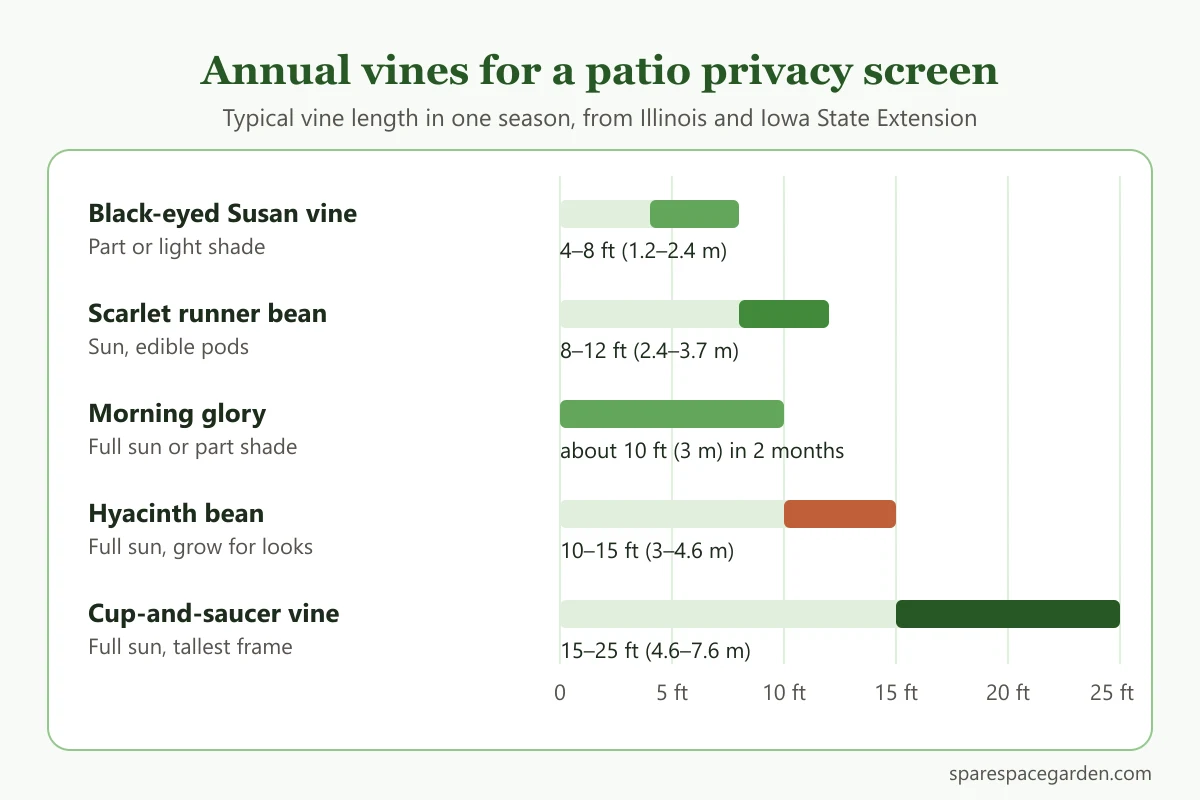 Annual vines for a portable privacy screen, with typical length and light.
Apartment patio garden ideas for seating and lighting
The patio is also where you'll sit, so mix food plants into the seating area instead of fencing them off. Purdue notes that vegetables and flowers can be combined in attractive planters as long as each plant's light needs match.
A few ideas that blend the two:
- Herbs within arm's reach of a chair. Basil, thyme and mint in pots beside the seating mean you'll pick them often. Keep mint in its own pot, as the RHS notes containers help keep spreading plants under control.
- Colorful edibles as decoration. Rainbow chard, purple basil, nasturtiums and strawberries look as good as bedding plants.
- Lighting with no fixings. Solar stake lights pushed into large pots, or string lights hung between two poles set in weighted planters, avoid hooks in the building. Check your lease on outdoor cords first.
For more indoor-and-out herb setups, read how to start an apartment herb garden.
Protect pavers and concrete from water stains
Patio stains usually come from water trapped under pots, full saucers and fertilizer granules. All three are easier to prevent than to clean.
- Raise every pot. The RHS recommends lifting pots onto bricks or pot feet so drainage holes stay clear. The gap also lets air dry the paving underneath.
- Use saucers in summer only. The RHS suggests saucers to catch excess water in summer and removing them before winter so pots don't stand in water. Empty them after rain.
- Water until a little drains out, then stop. Purdue says to water when the top inch (2.5 cm) of soil feels dry and to use enough that some excess runs out of the drainage holes.
- Keep fertilizer off the paving. An Ask Extension expert answer calls iron staining from fertilizer a common issue and advises sweeping pellets off concrete. Feed over the soil only, and follow the label for dilution.
- Move pots now and then. Shifting them every few weeks lets you spot marks early. Rolling plant caddies make this easy for heavy containers.
Watch out: If a rust-colored mark does appear, the Ask Extension expert notes that hardware-store iron removers exist and that you should read the instructions so the chemicals don't harm nearby plants. Test any cleaner on a hidden spot first.
Plan for moving day: a take-it-with-you garden
The most practical apartment patio garden ideas are the ones that move with you, and the Pueblo County article notes that container gardens are built to be portable.
- Time your crops to your lease. In the last season before a move, choose fast annual crops such as lettuce, radishes and bush beans over long-season plants.
- Keep perennials in their own pots. Rosemary, thyme, chives and strawberries move easily as single containers.
- Empty spent pots early. Old mix can be refreshed and reused instead of thrown out. Our guide on whether you can reuse potting soil explains how.
- Restore the patio. Lift every pot, sweep, scrub any marks and compare with your move-in photos.
- Check rules for long moves. For interstate moves, the University of Washington's Miller Library advises contacting the USDA Animal and Plant Health Inspection Service (APHIS) about quarantines. The state you're moving to may have its own plant rules, so check with its agriculture department too.
Frequently asked questions
Do I need my landlord's permission for potted plants on a patio?
It depends on your lease, so read it and ask if it's unclear. CSU Extension notes that leases often restrict yard changes such as in-ground or raised beds, while movable containers are a lower-risk option. HOA covenants can add their own limits.
How can I add privacy to a rented patio without drilling?
Use a freestanding trellis fixed to a heavy planter box and grow annual vines such as scarlet runner bean, hyacinth bean or black-eyed Susan vine. Weight the base with bricks or stones, as the RHS suggests for tall pots.
Can I put a raised garden bed on an apartment patio?
A raised planter on legs is usually the best fit, because it doesn't touch the soil and comes apart for moving. Aim for at least 10 inches (25 cm) of soil, as UGA Extension recommends, and a base strong enough to hold wet soil while still draining. Ask your landlord before buying a large one.
What should I do with my patio garden when I move out?
Pack perennials and herbs in their pots, give away or compost annuals, and refresh spent potting mix for your next home. Leave the paving clean and unmarked. If you're moving between states, check with USDA APHIS and your new state's agriculture department before you load plants.