If you want to know how to grow parsley in pots, the short version is this: give it a deeper pot than most herbs, be patient with the seed, and keep the mix evenly moist. Parsley is a hardy biennial with a taproot, so it needs more root room than small herbs like basil or thyme.
It's also one of the few herbs that does reasonably well on a bright windowsill. Below you'll find which type to choose, how big the pot should be, how to get the slow seed to sprout, light needs indoors and out, how to pick it, and what to expect from a plant in its second year.
Quick answer: Use a pot with drainage holes that holds 4 to 6 gallons (15 to 23 L) of mix and is 8 to 12 inches (20 to 30 cm) deep. Soak seed overnight, sow about 1/2 inch (1 cm) deep and expect 2 to 6 weeks for sprouts. Start cutting outer stems at the base once plants are about 8 inches (20 cm) tall, and sow a fresh pot each year.
Flat-leaf or curly parsley: which to grow
Both are the same species, Petroselinum crispum, and both grow well in containers. The difference is mostly flavor and looks.
University of Wisconsin Extension describes flat-leaf types as having a stronger, sweeter flavor, while curly types contain much less essential oil. Illinois Extension calls flat-leaf the preferred cooking type and notes that moss-curled parsley, with its tightly curled leaves, is the classic garnish. The RHS adds that curly varieties are usually shorter and more decorative.
| Type | Leaves | Flavor | Varieties to look for |
|---|---|---|---|
| Flat-leaf (Italian) | Flat, deeply cut, like cilantro | Stronger, sweeter | 'Titan' (RHS AGM), 'Italian', 'French' |
| Curly (moss-curled) | Tightly curled, compact | Milder | 'Moss Curled', 'Bravour' (both RHS AGM), 'Envy' |
| Hamburg (root parsley) | Flat leaves | Grown mainly for its root | Sold as Hamburg or turnip-rooted |
Wisconsin also notes that flat-leaf types may overwinter better than curly ones, which matters if your pots stay outside. Curly parsley's compact shape suits a small windowsill pot. Hamburg parsley is grown mainly for its root, so this guide sticks to the two leaf types.
Choosing a pot deep enough for the taproot
Parsley sends down a taproot, and extension sources from Wisconsin, Illinois and North Carolina all warn against disturbing it. That's the main reason it needs more depth than small herbs.
The University of Maryland Extension container guide puts parsley in its medium group, alongside rosemary and lavender, with a minimum of 4 to 6 gallons (15 to 23 L) of growing media and a depth of 8 to 12 inches (20 to 30 cm). The RHS gives a similar figure from the other side of the Atlantic: a container at least 10 inches (25 cm) wide and deep. For comparison, UMD puts cilantro and thyme in its small group at 1 to 3 gallons, so parsley needs roughly twice the room.
A few details make the pot work better:
- Drainage holes are a must. Parsley wants consistently moist soil, but not waterlogged soil.
- Skip the gravel layer. UMD says rocks or broken pot pieces in the base don't improve drainage and can raise the water level inside the pot.
- Material matters. UMD notes that clay, ceramic and wood dry out faster than plastic or metal. Since parsley prefers steady moisture, a plastic or glazed pot is easier to manage if you grow parsley in pots outdoors in summer.
- Use potting mix, not garden soil. NC State describes parsley's ideal soil as rich, moist and well drained. Our guide on how to make potting soil covers a basic container recipe.
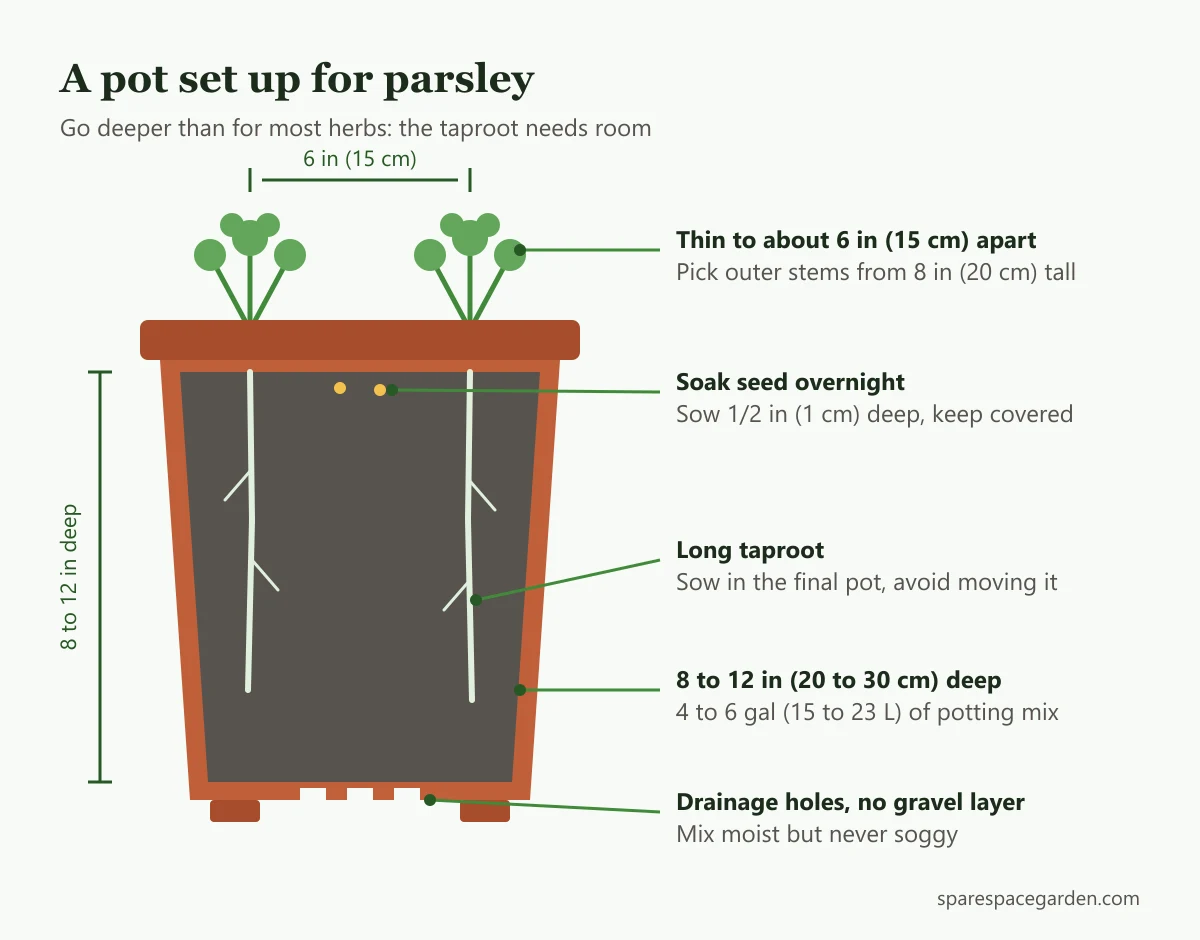 Parsley needs a deeper pot than most herbs because of its taproot.
How to grow parsley in pots from seed
Parsley seed is famously slow. Wisconsin describes germination as erratic and often low, and the RHS says it often takes a month or more, with seedlings expected within six weeks. Soaking helps. UF/IFAS, Wisconsin and Illinois all recommend soaking the seed in water overnight before sowing.
- Soak the seed in water overnight, then drain it.
- Fill the pot with moist potting mix, leaving a little space below the rim.
- Scatter the seed thinly and cover it with about 1/2 inch (1 cm) of mix, the depth the RHS uses. Iowa State University Extension lists parsley as a seed that germinates in darkness, so make sure it's covered.
- Keep it warm and moist. Iowa State gives 20 to 25 days to germinate at 70 to 75°F (21 to 24°C). UF/IFAS gives 7 to 12 days for soaked seed. In cool, wet soil it can take several weeks, according to Wisconsin.
- Thin the seedlings to about 6 inches (15 cm) apart, the spacing used by UF/IFAS and Maryland. The RHS gives 6 to 12 inches (15 to 30 cm) for plants in open ground. Thinnings are edible.
Sowing directly into the final pot avoids moving the taproot at all. If you'd rather start seeds indoors for an outdoor pot, Wisconsin suggests sowing 8 to 10 weeks before your last spring frost. The RHS recommends moving seedlings outside once they're 4 to 6 inches (10 to 15 cm) tall and hardened off, setting them at the same depth they were growing. Our notes on leggy seedlings help if young plants stretch toward a dim window.
Tip: The RHS advises against planting supermarket pots of parsley outdoors. They're overcrowded and meant for short-term indoor use. A plug plant or small nursery pot from a garden center is a better start.
Light and water outdoors and on a windowsill
Outdoors
NC State lists parsley for full sun (6 or more hours of direct sun a day) and says it also grows in light shade. In hot climates, shade helps: UF/IFAS Gardening Solutions says parsley does best with a little afternoon shade, which may also prolong its life. The RHS suggests moving pots into shade during hot, sunny weather.
Water so the mix stays moist but not soggy, and check pots regularly in warm weather. For feeding, the RHS says containers may benefit from a balanced liquid feed every few weeks during the growing season. Follow the label rates.
Indoors
Light is the limiting factor on a windowsill. Iowa State's guide to growing herbs indoors says most herbs need around eight hours of direct light a day indoors, though some manage with six. A south-facing window is the best choice, and a bright east or west window can work. Illinois Extension adds that parsley grows best indoors with high light and a cool spot.
If your windows are dim, Iowa State recommends grow lights 6 to 12 inches (15 to 30 cm) from the leaves for 12 to 16 hours a day. Indoors, feed with an all-purpose fertilizer at half or quarter strength from early spring through summer, and skip winter feeding. For window choices, see our guide to setting up a herb window garden.
Bringing outdoor pots inside
NC State says parsley can be brought indoors before temperatures drop into the 20s °F (about -7 to -1°C). That's simple with a pot. Move it to your brightest window and water well.
Harvesting parsley from the outside in
Start picking once plants are about 8 inches (20 cm) tall, the height NC State suggests. Cut the outer stalks at the base of the plant and leave the center alone. The RHS explains that taking a few outer stems this way encourages new growth from the middle.
Taking a few stems at a time keeps a pot productive for months. Iowa State notes that a leafy herb like parsley can also be cut back hard when you need a lot at once, but regular light picking keeps the supply steadier.
For storage, the RHS suggests freezing chopped leaves in ice-cube trays topped with water. You can also dry bunches in a warm, dark, airy place, though dried parsley has less flavor than fresh.
The two-year life cycle: why parsley bolts
Parsley is a biennial. In year one it grows a leafy rosette, which Wisconsin puts at 12 to 18 inches (30 to 45 cm) tall. If it survives winter, it flowers and sets seed in year two. NC State says second-year plants reach 2 to 3 feet (60 to 90 cm) and that leaves are less flavorful once flowering starts. Illinois describes the leaves as tough and bitter at that stage.
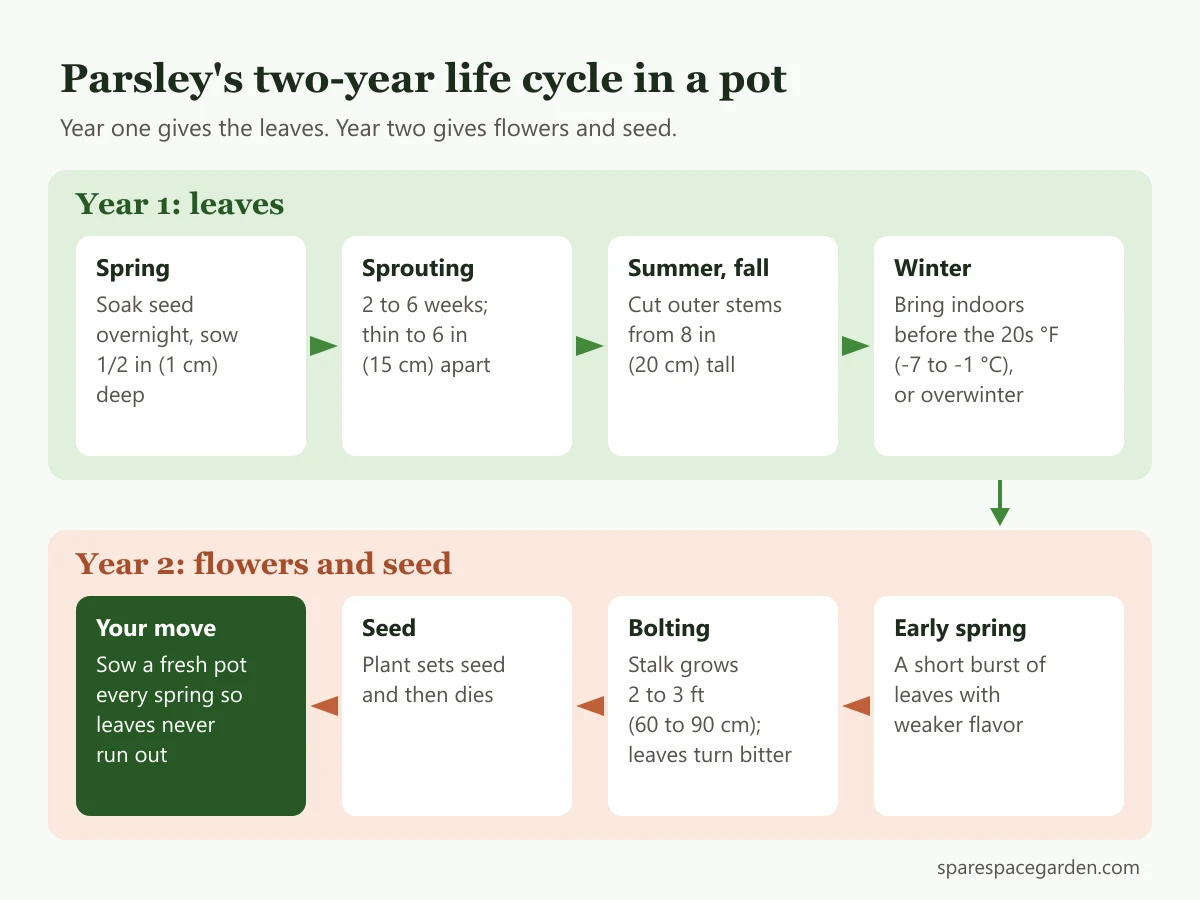 Parsley gives leaves in its first year and flowers in its second, so plan on a new pot each year.
A pot that overwinters will give you a short burst of early spring leaves before the flower stalk appears. Wisconsin notes this early growth has weaker flavor. The RHS advises not keeping plants into a second year for cropping, unless you want seed.
In practice, the easiest way to grow parsley in pots is to start a new one each spring. Wisconsin also suggests a few sowings through midsummer for a continuous harvest. In frost-free climates the timing flips: UF/IFAS recommends planting in fall in Florida, where plants grow through winter and then flower, set seed and die in late spring.
Watch out: Once you see a thick central stalk rising above the leaves, the plant has started to flower. Pick what you can, and make sure a younger pot is already growing.
Swallowtail caterpillars and other pests
The most surprising visitor on potted parsley is the black swallowtail caterpillar, sometimes called the parsleyworm. Young caterpillars are mostly black with a white saddle and look like bird droppings. Older ones are green with black bands and yellow spots, and grow to about 1 1/2 to 2 inches (4 to 5 cm) long. When disturbed, they push out a forked orange organ behind the head that releases an unpleasant smell. Wisconsin notes it is harmless to people.
Mississippi State University Extension points out that caterpillars feed most heavily in their last days before pupating, so a plant can be stripped quickly. On the other hand, Wisconsin says they're usually not numerous enough to cause real problems, and insecticides are rarely justified. If you'd like to support the butterflies, an extra pot of parsley gives them something to eat besides your kitchen supply.
| Pest or problem | What you'll see | What to do |
|---|---|---|
| Black swallowtail caterpillar | Striped green, black and yellow caterpillars; stems stripped | Handpick, or move them to fennel or Queen Anne's lace elsewhere |
| Aphids | Clusters of small insects on stems and new growth | Hose them off; see our guide to getting rid of aphids naturally |
| Slugs and snails | Ragged holes, slime trails | Pots help; the RHS notes they're harder for slugs to reach |
| Septoria leaf spot | Spots on leaves | Wisconsin notes it can be seed-borne; buy quality seed |
| Carrot fly, celery leaf miner | Damaged roots or blotched leaves | The RHS lists both, since parsley shares pests with carrots and celery |
If you do choose a spray, Wisconsin mentions Bt (Bacillus thuringiensis) as an option for the caterpillars. Always follow the label, and remember that it kills the same caterpillars that would become swallowtail butterflies.
Frequently asked questions
Can you grow parsley indoors all year?
Yes. Wisconsin says parsley can be grown indoors year-round in bright light, watered well and fed regularly. A south-facing window or a grow light gives the best results. Our list of the best herbs to grow indoors compares it with other windowsill herbs.
Why is my parsley seed not sprouting?
It's probably just slow. The RHS says seedlings can take up to six weeks, and cool, wet soil slows them further. Soak the seed overnight, keep the pot warm at around 70 to 75°F (21 to 24°C), make sure the seed is covered, and don't let the surface dry out.
Does parsley come back every year?
Not for long. As a biennial it flowers in its second year and then dies, and the leaves turn bitter once it flowers. Treat it like an annual and sow a fresh pot every spring.
How many parsley plants fit in one pot?
At the 6 inch (15 cm) spacing used by UF/IFAS, a 10 to 12 inch (25 to 30 cm) pot holds two or three plants. UF/IFAS also notes that most cooks need only a few plants, so one well-sized pot is often enough.
Is parsley grown the same way as cilantro?
The two look alike and both have taproots, but cilantro is a fast annual that bolts in summer heat, while parsley lasts through a full season and flowers in its second year. Our guide to growing cilantro in pots covers its quicker, succession-sown routine.