The fastest way to get rid of aphids naturally on a potted plant is to knock them off with a firm spray of water, squash or prune out the colonies you can reach, and follow up with insecticidal soap or horticultural oil only if they keep coming back. Outdoors, lady beetles, lacewings and tiny parasitic wasps usually finish the job once you stop using broad-spectrum sprays.
Containers make this easier than a big garden bed. You can reach every shoot tip, turn the pot to check leaf undersides, and carry an indoor plant to the sink or shower.
Quick answer: Spray aphids off sturdy plants with a strong stream of water, early in the day, and repeat whenever they return. Squash or snip off tight clusters. If numbers stay high, use an insecticidal soap or a 1 to 2% horticultural oil spray, following the label, that covers leaf undersides, never above 90°F (32°C) or on a thirsty plant. Cut back on high-nitrogen fertilizer and keep ants off the pot.
How to spot aphids (and what they're doing to your plant)
Aphids are soft, pear-shaped insects with long legs and antennae. The RHS aphid guide puts them at 1 to 7 mm long (up to about 1/4 inch), in green, black, yellow, pink, white or mottled colors. Most colonies are wingless females giving birth to live young. Winged forms show up when a colony gets crowded or the plant declines, and they fly off to start new colonies elsewhere.
One feature sets them apart from every other insect. According to UC IPM's aphid pest notes, most species have a pair of tube-like "cornicles" sticking out backward from the rear end. A hand lens makes them easy to see.
Look for them on:
- Shoot tips and flower buds
- The undersides of young leaves
- Leaves that are curled, puckered or distorted
The other clue is honeydew, a sticky, shiny liquid that aphids excrete, which often turns black with sooty mold. The RHS notes that sooty mold is harmless and wipes off with a damp cloth. A trail of ants going up and down the stem is another giveaway.
How much damage do aphids do?
Less than their numbers suggest. UC IPM says low to moderate numbers usually don't seriously harm plants, and most established plants outgrow the damage. Heavy colonies can yellow leaves and stunt shoots, and some species cause curling. The RHS adds that aphids very rarely kill plants, though some species spread plant viruses, which is a bigger concern than the feeding itself.
The real issue is speed. UC IPM says a female can give birth to as many as 12 young a day, and in warm weather many species go from newborn to reproducing adult in 7 to 8 days.
How to get rid of aphids naturally, step by step
To get rid of aphids naturally, work from the gentlest method to the strongest. Each gentle step spares the predators that keep aphids down later in the season.
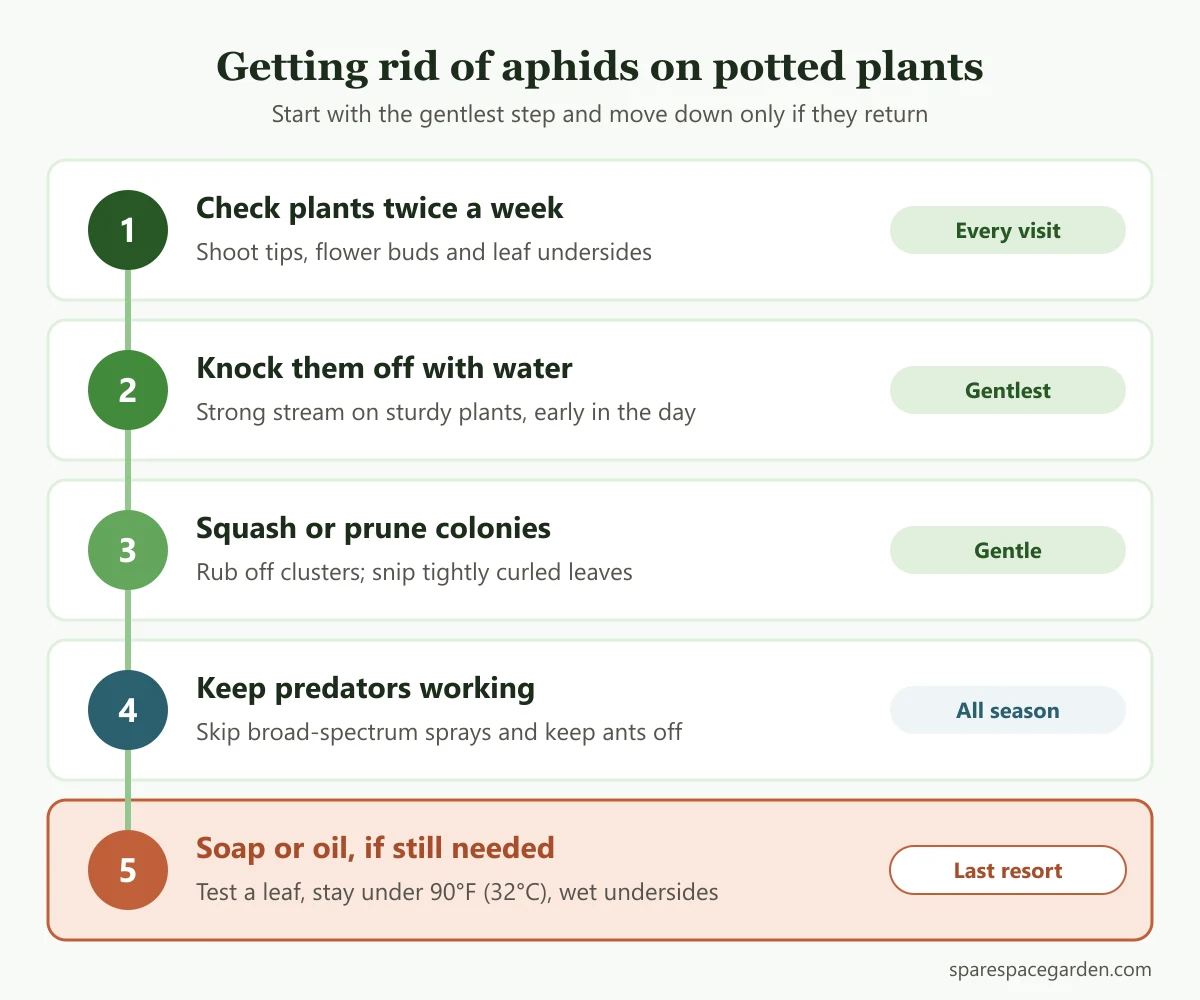 Start at the top and move down only if the aphids keep coming back.
1. Check plants twice a week
UC IPM recommends checking plants at least twice a week while they're growing fast, paying close attention to leaf undersides. A small colony on one shoot is far easier to deal with than a plant covered from top to bottom.
2. Blast them off with water
A strong stream of water knocks aphids off sturdy plants, and UC IPM notes that most dislodged aphids can't find their way back. It also rinses off honeydew. Spray early in the day so the leaves dry quickly, which lowers the risk of fungal disease.
For a balcony pot, a hose nozzle works well. For houseplants, a kitchen sink sprayer or a lukewarm shower does the same job; tip the pot on its side and cover the mix with a bag so it doesn't wash out. Go gently on seedlings and soft new growth, which can tear. Repeat whenever new aphids appear.
3. Squash or prune the colonies
The RHS suggests simply crushing colonies by hand. Run a thumb and finger along infested stems, or wipe them with a damp cloth. Where aphids are hiding inside tightly curled leaves, UC IPM says pruning is often the best option, because sprays and predators can't reach them there. Snip those leaves off and bin them.
4. Use insecticidal soap or horticultural oil
If aphids keep returning, these are the lowest-impact sprays. They're covered in detail in the next section, because "natural" doesn't mean harmless.
Insecticidal soap and horticultural oil: how to use them safely
Both work only on contact. Colorado State University Extension's insecticidal soap fact sheet explains that soaps are potassium salts of fatty acids that kill soft-bodied insects by disrupting their cell membranes. Oils coat the insect and block its breathing openings. Neither leaves a toxic residue, so an aphid that lands on the plant tomorrow won't be affected.
That means coverage is everything. Spray until the tops and undersides of the leaves are wet, including shoot tips and buds. UC IPM suggests a 1 to 2% oil solution and warns that both products may need repeat applications.
Follow these rules from UC IPM, Colorado State and UConn Extension's horticultural oil fact sheet:
- Follow the label. Use the rate and interval printed on the product. Colorado State notes that leaf damage can build up with repeated soap sprays, so don't spray more often than you need to.
- Test first. Spray a few leaves and wait a day or two before treating the whole plant. UC IPM says some plants are sensitive and suggests testing several days ahead.
- Avoid heat. Don't spray soap or oil above 90°F (32°C). UConn also says not to use oil below 40°F (4°C), or when humidity stays above 90% for 48 hours, because slow drying causes injury.
- Water first. Never spray a wilted or drought-stressed plant. Water it the day before.
- Skip sensitive plants. UConn lists ferns as plants to avoid, notes that coleus and wax begonia may show pitting, and advises against oil on open blooms, transplants and tender young shoots.
- Keep sulfur apart. UConn warns against applying oil with sulfur or within 2 weeks of a sulfur spray.
Watch out: Dish soap is not the same as insecticidal soap. Colorado State says the detergents in dish soap can injure plants and that homemade soap solutions are not recommended for insect control.
What "natural" sprays can still harm
Soaps and oils kill whatever they coat. UConn says oils are not selective and kill beneficial insects and predatory mite eggs that are directly sprayed. Colorado State says adult lady beetles and bees are generally not affected by soap, but their larvae may be, and that soap also kills beneficial mites.
Once a spray dries, the residue has little effect, according to UConn. So time it well. Spray in the early morning or evening, when bees aren't foraging, and don't spray plants in full flower. Spot-treat only the infested shoots rather than the whole plant, and leave alone any colony that has lady beetle larvae or parasitized "mummies" in it.
Neem oil works the same way as other oils, by smothering. UConn notes that plant-based oils such as neem are less refined and may cause more plant damage than refined horticultural oils, so the test-a-leaf rule matters even more. The RHS goes further and doesn't support pesticide use at all, pointing out that most pesticides, organic ones included, can reduce the natural enemies in a garden.
Let beneficial insects do the work
On a balcony or patio, natural enemies often find aphid colonies on their own. UC IPM lists lady beetles, lacewing larvae, syrphid (hover) fly larvae and soldier beetles as the main predators, and it's the larvae of most of them that eat the most aphids.
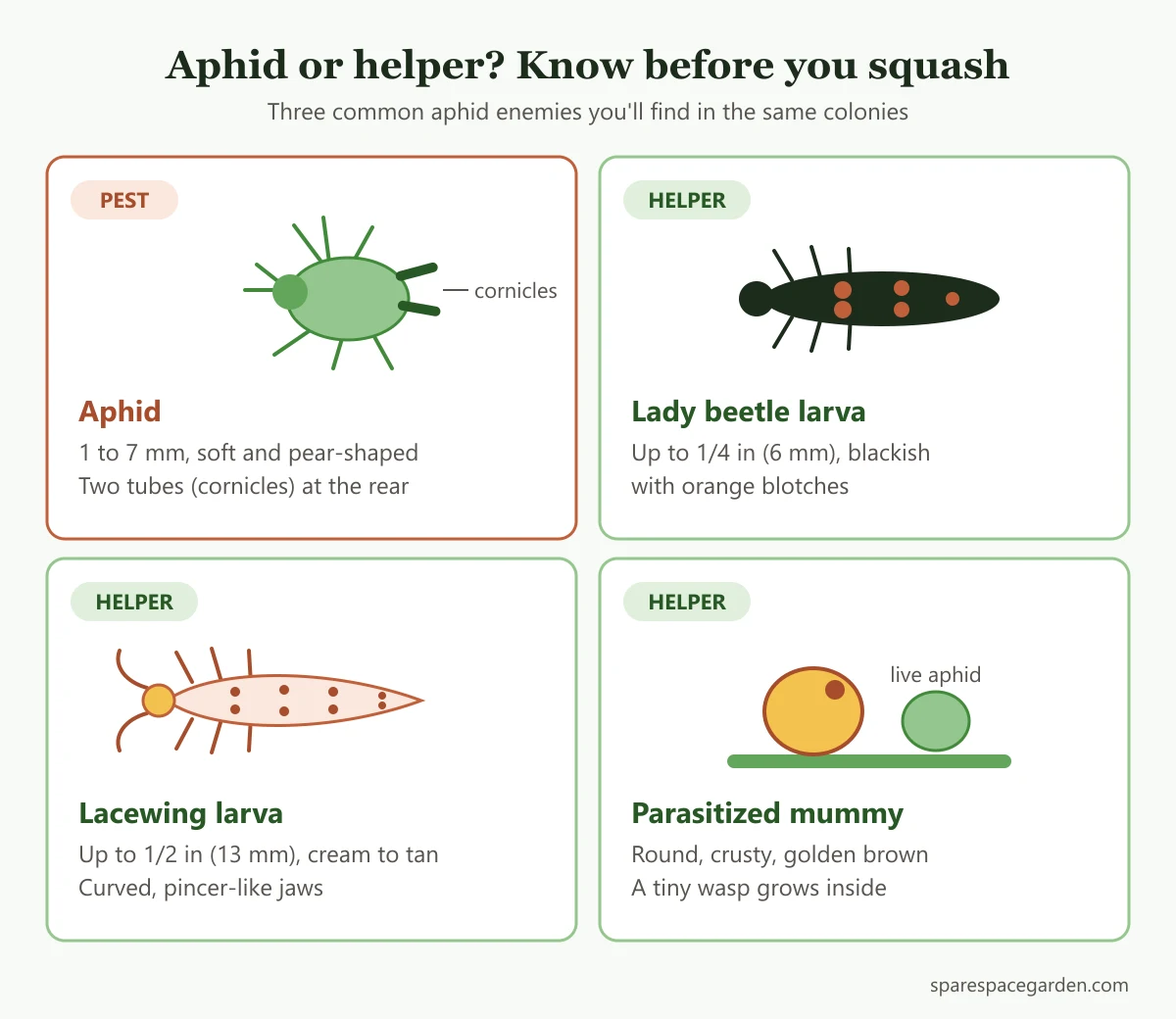 Learn to recognize the helpers so you don't squash or spray them.
- Lady beetle larvae. Long-legged, blackish with orange blotches, and up to 1/4 inch (6 mm) long. UC IPM's convergent lady beetle page describes them as resembling tiny alligators. Many people mistake them for pests.
- Lacewing larvae. Also alligator-shaped, cream to tan, up to about 1/2 inch (13 mm) long, with curved, pincer-like mouthparts.
- Parasitic wasps. Too small to notice, but they leave clear evidence. They lay eggs inside aphids, which turn into round, crusty, golden-brown "mummies." UC IPM says that when you see mummies, a big drop in aphid numbers usually follows within a week or two.
Give them time. The RHS points out that aphid numbers often rise in spring before predators catch up. Avoid broad-spectrum insecticides, and grow a few flowering plants nearby: UC IPM notes that adult lady beetles and lacewings feed on nectar and pollen.
Why buying ladybugs often fails
Bags of live ladybugs sound like the perfect natural fix, but they rarely work on a small scale. UC IPM explains that commercially sold convergent lady beetles are collected from their overwintering sites with portable vacuums. At that stage of their life they're programmed to migrate, and most fly away within 1 or 2 days of release, even when aphids are plentiful.
The numbers needed are also large. UC IPM cites one heavily infested rose bush that needed about 1,500 beetles each time, in two releases a week apart. If you still want to try, UC IPM suggests keeping them refrigerated (not frozen), misting the plant first and releasing them at dusk at the base of the plant.
Stop feeding aphids: nitrogen and ants
Two habits make aphid problems in containers worse.
Too much nitrogen. UC IPM says high nitrogen levels favor aphid reproduction. Fast, soft growth from heavy feeding is exactly what they like. Use no more nitrogen than the plant needs, and choose slow-release fertilizers applied in small amounts over the season. Our guide to fertilizer for potted plants covers types and timing.
Ants. Ants "farm" aphids for their honeydew. The RHS and UC IPM both say ants protect aphid colonies by driving off predators. If ants are climbing your pots, the beneficial insects can't do their job.
To keep ants out of a container:
- Move the pot so leaves and stems don't touch walls, railings or other plants. UC IPM recommends removing these "bridges."
- Wrap the stem or the pot with a band of tape and apply a sticky barrier to the tape, not directly to bark. UC IPM gives this method for tree trunks; for pots, make sure no leaves bypass the band.
- Use enclosed ant baits near the pot. UC IPM says baits can control ants without harming aphid predators.
Tip: Indoors there are no predators to help, so prevention matters more. Check new plants, rinse shoot tips in the sink at the first sign of aphids, and move houseplants that summered outdoors back in only after a careful look.
Methods compared at a glance
| Method | Best for | How often | Watch out for |
|---|---|---|---|
| Strong water spray | Sturdy plants, any size colony | Whenever aphids reappear | Tender seedlings; spray early so leaves dry |
| Squashing or wiping | Small colonies you can reach | At every check | Don't crush lady beetle larvae |
| Pruning infested tips | Aphids inside curled leaves | As needed | Bin the clippings |
| Insecticidal soap | Heavy or returning colonies | Per label, only as needed | Above 90°F (32°C), stressed plants, bees, larvae |
| Horticultural or neem oil | Heavy or returning colonies | Per label | Same as soap; also below 40°F (4°C), open blooms, sulfur |
| Beneficial insects | Outdoor and balcony pots | Ongoing | Broad-spectrum sprays and ants drive them off |
| Bought ladybugs | Rarely worth it in small spaces | One release | Most leave within 1 to 2 days |
Frequently asked questions
Does dish soap and water kill aphids?
It can, but extension services advise against it. Colorado State University Extension says household dish soaps contain detergents that can injure plants and recommends a registered insecticidal soap instead. If you use any soap spray, test it on a few leaves first and follow the label.
Can you get rid of aphids naturally for good?
Not for good, because winged aphids keep arriving and soap, oil and water only affect the aphids present that day. Repeat the water spray every few days, keep checking twice a week, and let natural enemies build up. Cutting back on high-nitrogen fertilizer also slows their return.
Are aphids on indoor plants different?
The insects are the same, but indoors they can breed all year and there are no predators to help. Rely on rinsing, wiping and pruning, and use insecticidal soap labeled for houseplants if needed. Other sap-feeders like whiteflies need a slightly different approach, covered in our home remedies for whiteflies on plants.
Is neem oil safe for bees?
Like other oils, it kills insects it coats directly, so don't spray bees or plants in full bloom. UConn Extension notes that dried oil residue has little effect on beneficial insects, so spray in the early morning or evening when bees aren't active. Always follow the product label.
What other pests look like aphids?
Tiny spider mites, whiteflies and mealybugs also cluster on leaf undersides and cause similar stunting. Aphids are the ones with cornicles and no fine webbing. If you see stippled leaves and webbing on cucumbers or beans, read our guide to spider mites on cucumbers.