Fungus in indoor plant soil looks alarming, but most of it is harmless. White fuzzy threads, a yellow slimy patch, or a cluster of small yellow mushrooms are usually organisms breaking down dead organic matter in the potting mix. They don't attack the plant. What they do tell you is that the mix is staying too wet, for too long, often in low light or still air.
That's the part worth acting on. The same conditions that feed surface fungi also cause root rot, and root rot does kill houseplants.
Quick answer: White fuzz on the surface is usually a harmless saprophytic fungus; scrape it off and water only when the mix is dry 1 to 2 inches (2.5 to 5 cm) down. Small yellow mushrooms don't hurt the plant but are considered poisonous, so pick them if pets or children are around. A hard white crust is fertilizer salt, not fungus. If the plant wilts while the soil is wet, check the roots for rot.
What's growing on your plant's soil?
Start by matching what you see to one of five common culprits. Four are cosmetic or mild. One needs fast action.
| What you see | What it is | Harms the plant? | What to do |
|---|---|---|---|
| White fuzzy or cobweb-like threads on the surface | Saprophytic fungus (mold) | No | Scrape off, let the mix dry more between waterings |
| Yellow, orange or white slimy blob that later turns powdery | Slime mold | No | Break up or scoop out, let it dry |
| Small lemon-yellow mushrooms, 1 to 3 inches (2.5 to 7.5 cm) tall | Yellow houseplant mushroom | No, but poisonous if eaten | Pick them, especially around pets and kids |
| Hard white or tan crust on the soil or pot rim | Fertilizer and water salts | Yes, over time | Scrape off and flush the mix with water |
| Wilting in wet soil, mushy brown roots | Root rot | Yes, often fatal | Cut out rotten roots, repot in fresh mix |
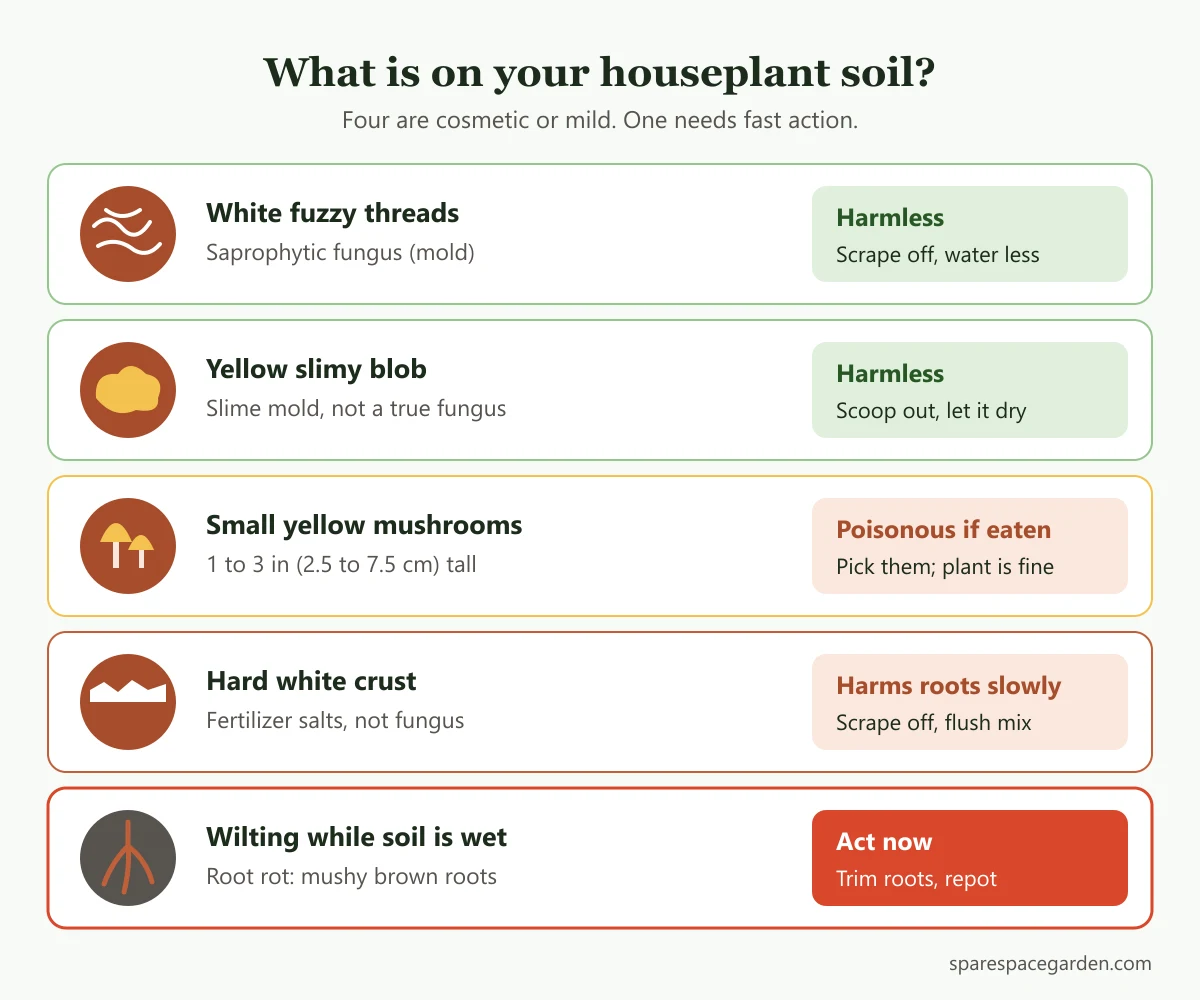 Five things that show up on houseplant soil, and which ones matter.
White fuzzy mold on the soil surface
The most common fungus in indoor plant soil is a thin, white, cottony or thread-like growth across the surface. Oregon State University Extension's Douglas County Master Gardeners describe it as a saprophytic fungus, meaning it feeds on decaying material, and explain that the visible threads are mycelium, the root-like body of the fungus. They note that this kind of soil mold is usually not particularly harmful to people, unless someone has a severe mold allergy.
All potting mix contains fungi. They only become visible when conditions favor them, and the Master Gardeners list the usual reasons: problems with the potting soil, watering, drainage, light or air circulation.
How to get rid of it
- Feel the mix. Push a finger in. If it's soggy, watering is the cause.
- Scrape off the top layer. Remove the moldy mix and replace it with fresh potting mix. Repotting isn't necessary unless the plant is due for it anyway.
- Change the watering. Iowa State University Extension advises checking moisture before every watering and waiting until the mix is dry down an inch or two (2.5 to 5 cm). If you're unsure, wait another day.
- Improve air and light. Space pots so air moves between them, and move a leggy, pale plant somewhere brighter. The Master Gardeners note that poor light can aggravate fungal growth.
- Remove dead leaves from the soil surface, since they feed the fungus.
Some people sprinkle a little ground cinnamon on the surface. The OSU Master Gardeners say some growers report success with it, since cinnamon contains a substance with some fungicidal properties. They advise against baking soda, because too much leaves sodium in the mix that can harm the plant.
Tip: Bottom watering keeps the surface drier. Set the pot in a bowl of water so the mix soaks it up through the drainage holes, and don't leave it standing there for more than a few hours.
Yellow slime mold
Slime molds look like fungi but aren't. Wisconsin Horticulture's slime mold guide explains that they are more closely related to amoebas and spend most of their life as a lumpy, slowly moving mass that can be white, yellow, orange or red. The common species Fuligo septica looks like scrambled eggs. Within a few hours it can switch to a dry, spore-producing stage that turns crusty and powdery.
Slime molds feed on bacteria, other microbes and organic matter, not on plants. Clemson's Home and Garden Information Center says they are not known to be dangerous to people or animals and typically disappear in dry conditions. Wisconsin notes one minor issue: if a slime mold grows over leaves, it can block light and cause yellowing.
To deal with it, break it up, let it dry, or lift it out with a spoon and throw it away. Then cut back on watering so it doesn't return.
Mushrooms in houseplant pots
Small, lemon-yellow mushrooms that seem to appear overnight are almost always Leucocoprinus birnbaumii, known as the yellow houseplant mushroom or flower pot parasol. Iowa State University Extension's yellow mushroom FAQ describes them as about 1 to 3 inches (2.5 to 7.5 cm) tall with oval or bell-shaped caps 1 to 2 inches (2.5 to 5 cm) wide, growing alone or in clusters.
The mushroom is only the fruiting body. Most of the fungus lives in the mix as mycelium, which may have arrived in the bag of potting mix or as airborne spores. Iowa State says it breaks down dead organic matter and does not harm living plants. Other mushroom species can pop up in pots for the same reason: damp mix with plenty of organic material.
Getting rid of the fungus completely is hard. The University of Washington Botanic Gardens' Miller Library notes there is no getting rid of it short of replacing all the soil, and it may return even then. Iowa State adds that fungicides generally aren't effective. In practice:
- Pick mushrooms as soon as they appear.
- Let the mix dry more between waterings.
- Repot into fresh mix if you want to try a clean start, accepting that the mushrooms may return.
Are mushrooms in plant pots safe for pets and children?
Treat them as poisonous. Iowa State says the yellow houseplant mushroom is regarded as poisonous to people and animals, and recommends removing mushrooms as they appear if pets or small children live in the home. The Miller Library adds that handling them won't hurt you; the risk is eating them.
If a child eats any part of a mushroom, the University of Utah Poison Control Center advises removing what's left from the mouth, rinsing the mouth with water, and calling Poison Control at 1-800-222-1222 (US) or your doctor right away. If a pet eats one, call your veterinarian.
Watch out: Never eat a mushroom from a plant pot. Utah Poison Control's rule is simple: don't eat any part of an unknown plant or mushroom.
White crust is salt, not fungus
A hard, white or tan crust on the soil surface or around the rim of the pot isn't a fungus at all. Colorado State University's PlantTalk explains that it's a buildup of salts from fertilizer and tap water, especially softened water, left behind as water evaporates. Mold is soft and fuzzy; salt crust is dry and crunchy.
Salts matter more than surface mold. CSU lists brown leaf tips, yellowing and wilting even in moist soil as signs that salts are damaging roots. To fix it, scrape off the crust and about ½ to 1 inch (1.3 to 2.5 cm) of the top mix, fill the pot to the top with tepid water, let it drain, and repeat a couple more times. University of Maryland Extension suggests leaching with at least three times the pot's volume of water.
Our article on whether you can reuse potting soil covers salt crust in old mix in more detail.
Root rot: the real danger
Surface fungi are a warning sign. Root rot is the actual problem. Iowa State Extension explains that root rot in houseplants is caused by fungal and fungus-like organisms such as Pythium, Phytophthora, Rhizoctonia and Fusarium, which flourish in wet, poorly drained mix and attack stressed plants. Overwatering is the main trigger.
The symptoms are easy to misread. Lower leaves wilt first, then the wilting spreads upward, which looks like thirst. Watering more makes it worse. Iowa State also lists yellowing or browning leaves, leaf drop and fungus gnats as signs of overwatering.
How to check and treat root rot
- Slide the plant out of its pot and look at the roots.
- Compare. Iowa State describes healthy roots as firm and white with many fine feeder roots; rotted roots are mushy and brown or reddish.
- Cut away rotten roots. University of Maryland Extension suggests removing the rotten portions and repotting the healthy sections, or taking cuttings and rooting them in sterile potting mix.
- Repot in fresh, well-drained mix in a pot with drainage holes. UMD recommends a soilless potting mix labeled for houseplants.
- Discard severely damaged plants, as UMD advises, and don't reuse their mix.
Fungus gnats often turn up alongside soggy mix and rotting roots. If you're seeing small flies too, see our guide to getting rid of gnats in potted plants.
Why fungus in indoor plant soil keeps coming back
Scraping off mold or picking mushrooms only removes what you can see. As the OSU Master Gardeners put it, if the conditions that caused the growth aren't addressed, more will appear. These are the usual causes and fixes:
- Watering on a schedule. Check the mix first and water only when it's dry an inch or two down.
- Water left in saucers or cachepots. Iowa State warns against letting pots sit in saucers or decorative outer pots holding water. Empty them after watering.
- No drainage holes. Use a plain nursery pot with holes inside a decorative pot if you like the look.
- Pot too large. Iowa State advises against oversized containers, which hold extra wet mix around a small root ball.
- Organic-rich or old, compacted mix. Heavy, broken-down mix holds more water. Our guide to making your own potting soil explains how to keep a mix airy.
- Low light and still air. Plants in dim corners use water slowly, so the mix stays wet longer.
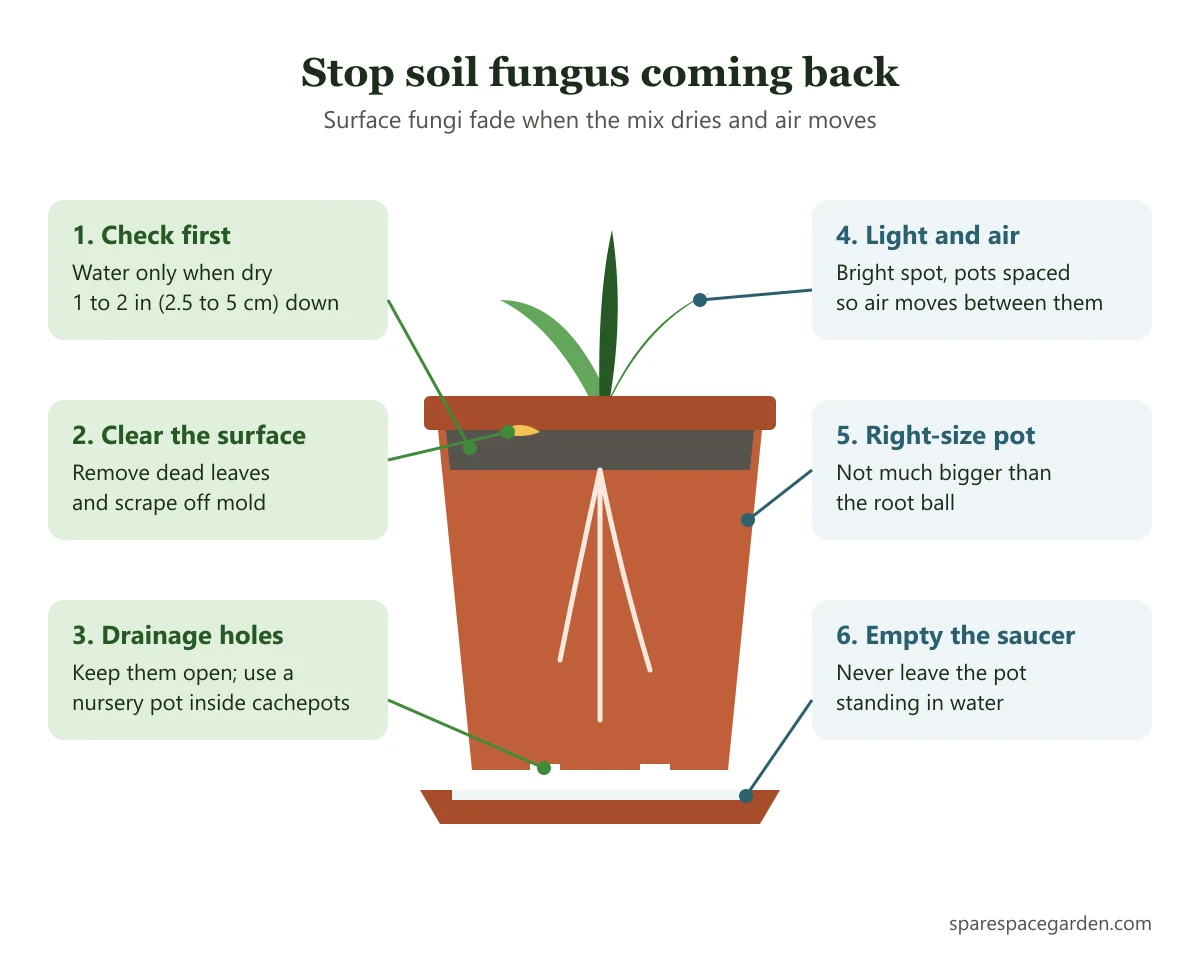 Fix the conditions and most surface fungi fade on their own.
Damp, organic mix also attracts springtails and other small creatures. If you've spotted those as well, our guide to bugs in potted plant soil explains which ones are harmless.
Frequently asked questions
Is white fungus on plant soil harmful to the plant?
Usually not. Extension sources describe it as a saprophytic fungus that feeds on decaying material, not on living roots. It does signal overly wet conditions, which can lead to root rot, so adjust your watering.
Is mold in houseplant soil dangerous to people?
For most people, no. OSU Extension's Master Gardeners say this kind of soil mold usually isn't particularly harmful unless someone has a severe mold allergy. If you're sensitive, scrape it off outdoors or wear gloves and a mask, and keep the mix drier.
Should I repot a plant with fungus in the soil?
Not necessarily. For surface mold, scraping off the top layer and replacing it with fresh mix is usually enough, along with less frequent watering. Repot if the mix stays soggy, smells sour, or the roots show signs of rot.
Why does my plant have mushrooms but looks healthy?
Because the mushrooms aren't feeding on the plant. The yellow houseplant mushroom breaks down dead organic matter in the potting mix. A healthy-looking plant just means the roots haven't been affected by the damp conditions yet.
Does cinnamon get rid of fungus in plant soil?
Some growers report that a light dusting helps, and OSU's Master Gardeners note cinnamon has some fungicidal properties. It won't fix the cause, though. Drier mix, better drainage, light and airflow do far more.