Fertilizer for potted plants has to make up for two things a garden bed never faces: a small volume of mix, and water that drains straight out of the bottom, taking nutrients with it. Most container plants need their first feed within weeks of potting, then regular top-ups while they're actively growing.
The routine is simple once you know what the label numbers mean, which type suits your plants, and how to spot too much.
Quick answer: Start feeding about 6 weeks after potting into fresh mix. Use a balanced water-soluble fertilizer about every 2 weeks at the label rate, or at half strength with every watering, or mix controlled-release granules in at planting. Always feed moist mix, ease off in winter, and flush with plain water if a white crust appears.
Why potted plants need regular feeding
A pot holds a few quarts or gallons of mix, and that's all the root system can draw from. Colorado State University Extension explains that fast-growing container plants quickly use up the limited nutrient supply in the soil, and that well-drained mixes also lose fertilizer through drainage water.
Watering speeds this up. University of Illinois Extension's container fertilizing guide says frequent watering leaches nutrients out of containers, so they must be replaced regularly. The RHS suggests feeding container plants about six weeks after planting, as the nutrients in the compost start to run out.
Pot size plays a part too. The RHS notes that smaller containers can leave vegetables short of moisture and nutrients, and that containers at least 18 inches (45 cm) deep and wide need less frequent feeding than small ones. A small pot on a sunny balcony is the one that runs out first.
Tip: Check the potting mix bag before you start. The RHS advises reading it to see how long any added fertilizer will last. For help choosing a mix, see the best potting soil for vegetables.
N-P-K and micronutrients: reading the label
Every fertilizer label shows three numbers. According to University of Florida IFAS, they are the percentages of nitrogen (N), phosphorus (P) and potassium (K) by weight, so a 16-4-8 product is 16 percent nitrogen, 4 percent phosphorus and 8 percent potassium. The label also tells you whether the product is water soluble or controlled release.
The RHS guide to fertilizer types sums up what each nutrient does:
- Nitrogen supports leaves and stems.
- Phosphorus supports healthy root and shoot growth.
- Potassium supports flowering, fruiting and cold hardiness.
That's why Illinois Extension suggests high-nitrogen fertilizers for plants grown for their foliage, and lower-nitrogen, higher-phosphorus products for flowering and vegetable plants. For an all-purpose choice, the UConn home garden fact sheet on houseplant fertilization gives 20-20-20 or 10-8-7 as examples.
Micronutrients matter more in pots
Plants also need small amounts of trace elements. The RHS lists boron, copper, iron, manganese, molybdenum and zinc, plus calcium, magnesium and sulfur as other major nutrients. UConn notes that soilless mixes often lack micronutrients, so if you use a synthetic fertilizer, choose one that includes them. The RHS gives the same advice for soil-less compost. Organic fertilizers usually supply most or all micronutrients, according to UConn, because of what they're made from.
Types of fertilizer for potted plants compared
Four types cover almost every container. They differ mainly in how fast nutrients arrive and how much control you have over the dose.
| Type | How it works | How often | Best for | Watch for |
|---|---|---|---|---|
| Water-soluble or liquid (synthetic) | Dissolves in watering can; fast acting | Every 1 to 2 weeks, or half strength at every watering | Vegetables, annuals, houseplants | Easy to overdo; measure every time |
| Controlled-release granules | Coated pellets release a little with each watering | Once at planting; many last 3 to 4 months | Long-term plantings, busy growers | May run out before a long season ends |
| Organic liquid (such as fish emulsion) | Faster than dry organics | Per label | Patios and balconies | Smell; may attract animals |
| Organic granular or pellets | Broken down slowly by soil organisms | Per label; release over many months | Shrubs, perennials, large pots | Slow to fix a shortage |
Water-soluble and liquid fertilizers
The RHS describes inorganic liquid and soluble feeds as fast acting and best suited to containers and correcting deficiencies. Illinois Extension says reapplying a liquid fertilizer about every two weeks gives most containers enough, or you can feed at every watering with a half-strength solution. Colorado State gives the same two options: dilute with every watering, or full strength weekly or every two weeks.
Controlled-release granules
These are water-soluble fertilizer inside a resin coating. Illinois explains that nutrients are released each time the pot is watered, and that many products for annual plants last 3 to 4 months, depending on moisture and temperature. The RHS lists sulfur, wax and plastic resin as coating materials. They're the most hands-off option, but Colorado State says they are insufficient to carry container plants through a full season under its conditions and recommends supplementing with soluble fertilizer.
Organic liquids and granules
Organic feeds are usually less concentrated and slower acting than synthetic ones, according to the RHS, though liquid organics are faster than dry ones. Powdered or pelleted organics such as bone meal, hoof and horn or comfrey pellets need soil organisms to break them down and release nutrients over many months.
Fish emulsion is a popular organic liquid. Illinois Extension gives a typical analysis of 2-4-1, though products vary, and notes the smell makes it a poor choice indoors. Colorado State adds that fish emulsion and blood meal may act too slowly for actively growing plants and can attract pets and pests.
How often to fertilize potted plants
How often depends on how fast the plant grows and what you grow it for. Here is extension and RHS guidance for active growth.
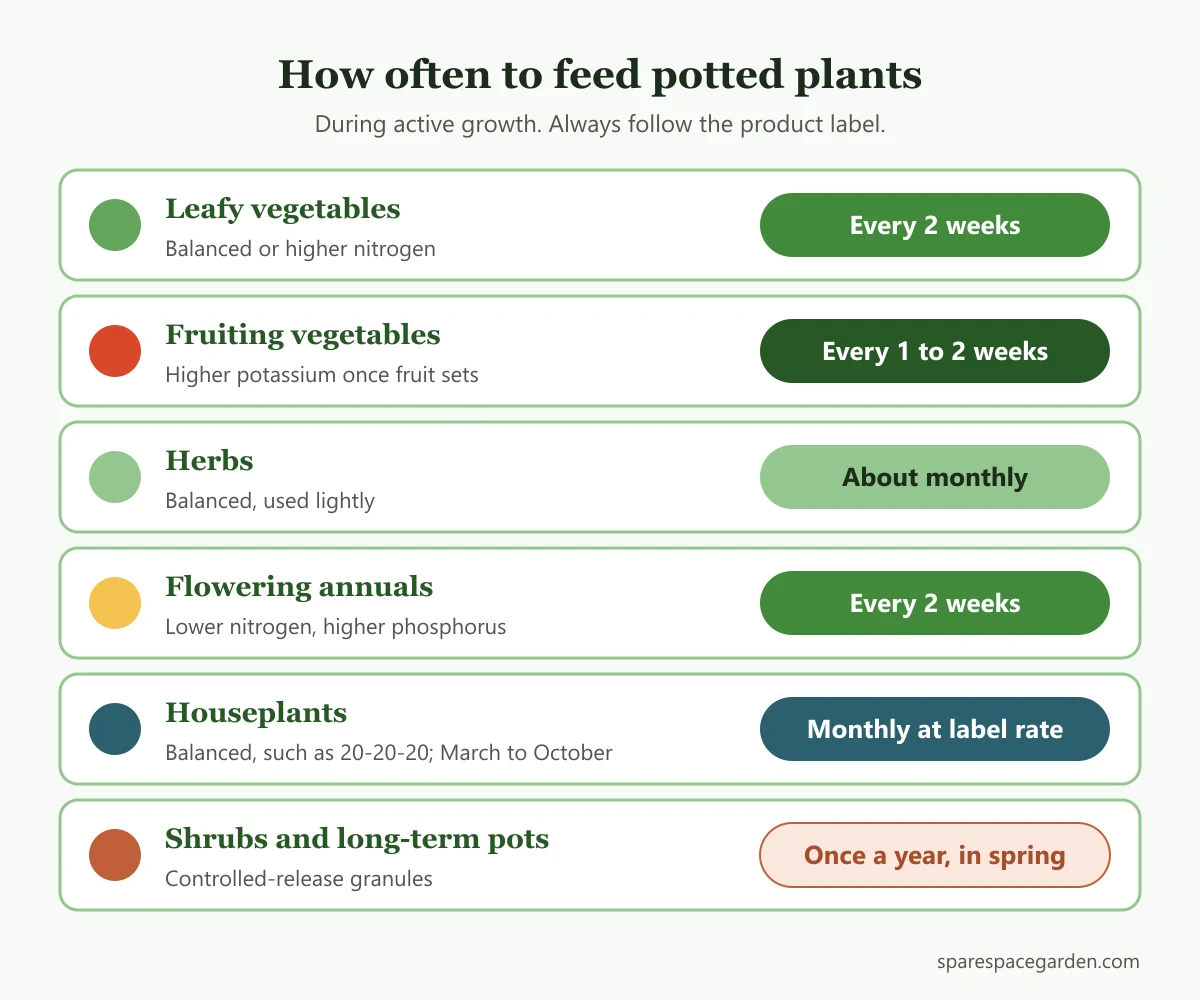 Typical feeding intervals during active growth. Always check the product label.
| Plant group | Suggested fertilizer | How often in active growth |
|---|---|---|
| Leafy vegetables and foliage plants | Balanced or higher nitrogen | About every 2 weeks (RHS, Illinois) |
| Fruiting vegetables | Balanced early, higher potassium once fruit sets | Weekly to every 2 weeks (Colorado State) |
| Herbs | Balanced, used lightly | About monthly (University of Maryland) |
| Flowering annuals and baskets | Lower nitrogen, higher phosphorus | Every 2 weeks, or half strength each watering (Illinois) |
| Houseplants | Balanced, such as 20-20-20 | Monthly at label rate, or half strength twice a month (UConn) |
| Shrubs and long-term plantings | Controlled-release | Once a year in spring (RHS) |
Vegetables
The RHS suggests a general-purpose liquid fertilizer every two weeks for vegetables in containers. Fruiting crops take more: Colorado State suggests full-strength feeds weekly or every two weeks. For crop-specific schedules, see the best fertilizer for tomatoes in pots and the best soil for strawberries in pots, which covers berry feeding.
Herbs
Herbs need less than vegetables. In an Ask Extension answer, University of Maryland's Home & Garden Information Center quoted guidance that light monthly applications of liquid fertilizer should be enough, warning that herbs overfed with nitrogen grow lush but with a weaker concentration of the oils that give them flavor. The RHS herbs in containers guide recommends a balanced fertilizer for leafy growth rather than a potassium-rich one.
Houseplants
UConn says houseplants respond to fertilizer from March until October. Water-soluble products are usually labeled for monthly use, but UConn suggests half strength twice a month or quarter strength weekly for a steadier supply. In its example, that means half a teaspoon per quart (about 2.5 mL per 0.95 L) twice a month, or a quarter teaspoon per quart weekly. University of Nebraska–Lincoln Extension is more conservative, at every two months for actively growing plants, so slow growers can go longer.
How to apply fertilizer safely
Fertilizers are salts, and most damage comes from how they're applied rather than which product you chose.
- Water first, then feed. Illinois and UConn both say to apply fertilizer only to moist mix, never bone-dry mix, to avoid root damage.
- Measure to the label. The RHS says to always follow product instructions for method, timing and dosage. Stronger doesn't mean faster.
- Dilute rather than double up. If you want to feed more often, lower the strength, as UConn suggests, instead of adding extra doses.
- Don't stack products. If the mix already contains fertilizer or controlled-release granules, check how long they last before adding a liquid feed on top.
- Skip stressed plants. Washington State University's HortSense says never to fertilize plants stressed by heat or drought. Water and let them recover first.
- Mind the leaves. If you use a foliar feed, the RHS suggests spraying on dull days to avoid leaf scorch.
Watch out: WSU says container plants are particularly susceptible to fertilizer damage, and that quick-release products not watered in properly, or applied in hot weather, are a common cause.
Signs of too much fertilizer and how to flush it out
Excess fertilizer leaves salts behind in the mix, and those salts can damage roots. WSU says overfertilized plants may first wilt and grow slowly, with brown tips on young and old leaves.
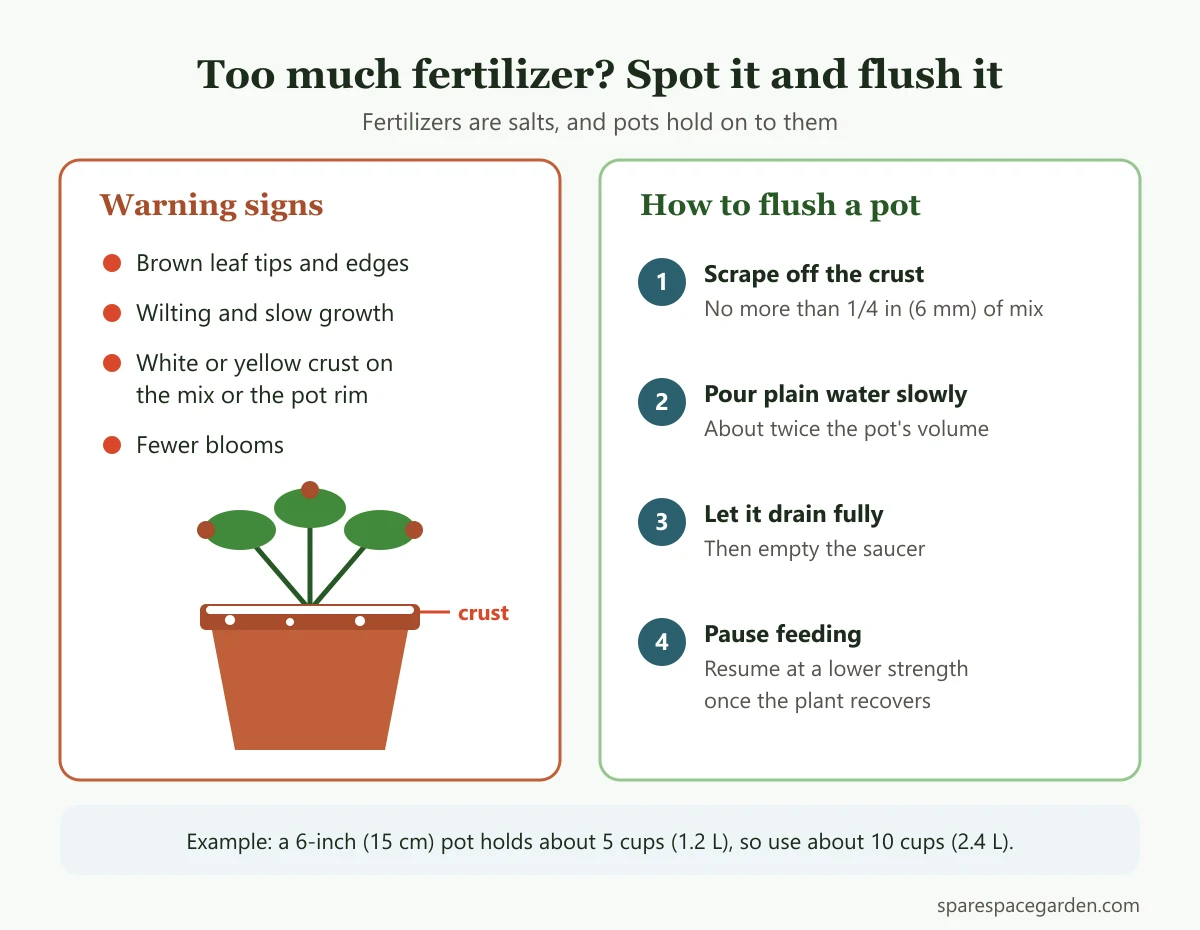 Common signs of salt buildup, and how to leach it out with plain water.
| What you see | Likely cause | What to do |
|---|---|---|
| Brown leaf tips and edges | Fertilizer salt buildup | Stop feeding; flush the pot |
| Wilting, dead root tips | Root damage from salts | Flush; resume feeding at a lower strength |
| White or yellow crust on the mix or pot rim | Salts left as water evaporates | Scrape off the crust, then flush |
| Slow growth, fewer blooms | Salt buildup, or too little feed | Check for crust first; if none, feed more regularly |
The symptoms come from WSU, Nebraska and Colorado State. WSU describes a brownish or whitish crust on the mix or along the inside rim of the pot, and Nebraska mentions a ring of white crusty deposits on clay pots. If yellowing leaves are the main symptom, our guide to pepper plant leaves turning yellow covers other causes.
How to leach a pot
Nebraska Extension recommends leaching every 4 to 6 months as standard practice for houseplants:
- Remove any crust from the surface, taking off no more than about 1/4 inch (6 mm) of mix.
- Pour plain water slowly through the pot, using about twice the pot's volume. A 6-inch (15 cm) pot holds about 5 cups (1.2 L), so use about 10 cups (2.4 L).
- Let it drain away completely and empty the saucer.
- Wait until the plant looks healthy again before you feed, then use a lower strength.
WSU notes that flushing works for quick-release and liquid fertilizers, not slow-release granules still in the mix. For those, or for badly crusted mix, UConn suggests repotting into fresh medium. For outdoor pots, Colorado State suggests watering until about 10 percent of the water drains out the bottom each time, which keeps salts from building up in the first place.
Seasonal adjustments
Feed when plants are growing and stop when they're not. The RHS container maintenance guide says feeding usually stops after late summer and resumes in mid-spring, though bedding plants and short-lived annuals can be fed until early autumn. It doesn't consider winter feeding necessary.
- Spring: Start feeding as new growth appears. For long-term pots, the RHS suggests adding controlled-release fertilizer in spring or when repotting.
- Summer: Peak feeding. Pots dry out faster and need more watering, which leaches more nutrients, so stay on schedule. Avoid feeding during heat stress.
- Fall: Taper off as growth slows. Illinois notes that how long controlled-release granules last depends on moisture and temperature, so check the label timing.
- Winter: Nebraska advises against feeding dormant plants, since it can cause a harmful buildup of salts. Houseplants under strong grow lights may keep growing, so feed those only if they're putting out new leaves.
Some containers have their own schedules. See fertilizer for hanging baskets and fertilizer for citrus trees in pots for those.
Frequently asked questions
Is liquid or slow-release fertilizer better for potted plants?
Both work. Liquid fertilizer gives you more control and acts quickly, while controlled-release granules save effort and feed steadily for a few months. Colorado State recommends adding soluble fertilizer to supplement controlled-release products, so a common routine is granules at planting plus liquid feeds later in the season.
Should you fertilize a plant right after repotting?
Usually not. The RHS suggests starting to feed container plants about six weeks after planting, when the nutrients in fresh compost start to run out, and many bagged mixes include a starter fertilizer. Check the bag, and start feeding once that period is up.
Is one fertilizer enough for all your potted plants?
A balanced all-purpose fertilizer, such as 20-20-20, works for most containers. Fruiting plants benefit from a higher-potassium feed once they start setting fruit, and herbs need lighter doses. Just adjust how often you feed.
Is fish emulsion good for indoor plants?
It works as a fertilizer, but Illinois Extension notes the smell makes it a poor choice indoors. Outdoors it's less of an issue, though Colorado State warns that the odor can attract pets and pests to pots.
Can you over-fertilize potted plants?
Yes, and it's more common in containers than in the ground. Brown leaf tips, wilting in moist mix and a white crust on the surface are the usual signs. Stop feeding, flush the pot with about twice its volume of plain water, and resume at a lower strength once the plant recovers.