Red composting worms are almost always red wigglers, Eisenia fetida, the species behind nearly every home worm bin. They live in the surface layer of decaying organic matter rather than deep in the soil, so a crowded box of bedding and food scraps suits them in a way it never would suit an ordinary garden earthworm.
This guide is about the worm itself: how it differs from earthworms and nightcrawlers, what temperatures and moisture it tolerates, how much it eats, how it breeds, and how to buy it safely. If you still need a bin, see how to make a DIY worm composter.
Quick answer: Red composting worms (red wigglers, Eisenia fetida) do best at about 55–77°F (13–25°C) in bedding as damp as a wrung-out sponge. NC State Extension says a pound (0.45 kg) of them, roughly 1,000 worms, eats up to 2 pounds (0.9 kg) of food scraps a week. Young worms can breed about 1 to 2½ months after hatching. Buy them from a worm grower, never from a bait shop or your garden.
What red composting worms are
Of more than 9,000 earthworm species, only seven are suitable for worm composting, according to NC State Extension's vermicomposting guide, and Eisenia fetida is the one most people use. Some guides also list its close relative Eisenia andrei. Guides spell it red wiggler or red wriggler, and sellers sometimes just say red worms, so check for the Latin name on any listing.
Oregon State University Extension describes the red wiggler as a surface dweller that does not burrow. A few facts from that guide explain how to look after one:
- It breathes through its skin. The skin has to stay moist, which is why dry bedding kills worms.
- It is mostly water. Worms are about 75–90% water.
- It avoids light. Worms move down and away from bright light.
- It has no teeth. Food is ground in a gizzard with small mineral particles, so a little grit or soil in the bedding helps.
Red wigglers vs earthworms and nightcrawlers
Digging up worms from the garden is the most common beginner shortcut, and it doesn't work. Oregon State explains that common garden earthworms and nightcrawlers (Lumbricus terrestris) are burrowing worms that will not survive in a worm bin. They need deep soil to tunnel through, not a shallow layer of wet paper and vegetable peelings.
NC State adds a practical problem: you can't reliably tell whether a worm from your yard is Eisenia fetida at all. Bait-shop "red worms" carry the same uncertainty, and some invasive species are sold as bait under misleading names (more on that below).
| Trait | Red wiggler | Nightcrawler / garden earthworm | Jumping worm |
|---|---|---|---|
| Latin name | Eisenia fetida | Lumbricus terrestris and others | Amynthas species |
| Where it lives | Surface layer, doesn't burrow | Burrows into soil | Often in groups; leaves grainy soil |
| In a worm bin | The standard composting worm | Won't survive | Never use |
| When handled | Wriggles | Wriggles | Thrashes like a snake, may shed its tail |
Sources: Oregon State Extension, NC State Extension, Maine Department of Agriculture, Conservation and Forestry.
Temperature and moisture: what red wigglers tolerate
Red wigglers handle a wider range than most people expect, but they only eat and breed well in the middle of it. Oregon State says worms survive from about 40°F to 90°F (4–32°C), do best at 55–77°F (13–25°C), and feed less below 50°F (10°C). NC State gives an ideal range of 59–77°F (15–25°C), with outer limits of 32–95°F (0–35°C).
Most heated homes stay inside those ranges, which is why so many people keep their bins indoors. Outdoors, the danger is freezing in winter and overheating in summer sun. Oregon State notes you can keep composting through winter if the bin sits somewhere that doesn't freeze. Our guide to indoor worm composting covers the best spots in an apartment.
Moisture matters as much as temperature, because worms breathe through damp skin. NC State puts the target at about 80% moisture, with limits of 60–90%, and Oregon State gives 75–85%. In practice, both describe the feel of a wrung-out sponge: a squeezed handful should release only a couple of drops.
Acidity is the third factor. Oregon State says worms prefer a pH around 5.5 and tolerate 4 to 9, while NC State lists a range of above 5 and below 9. You rarely need to measure it; avoiding piles of citrus and other acidic scraps keeps most bins in range.
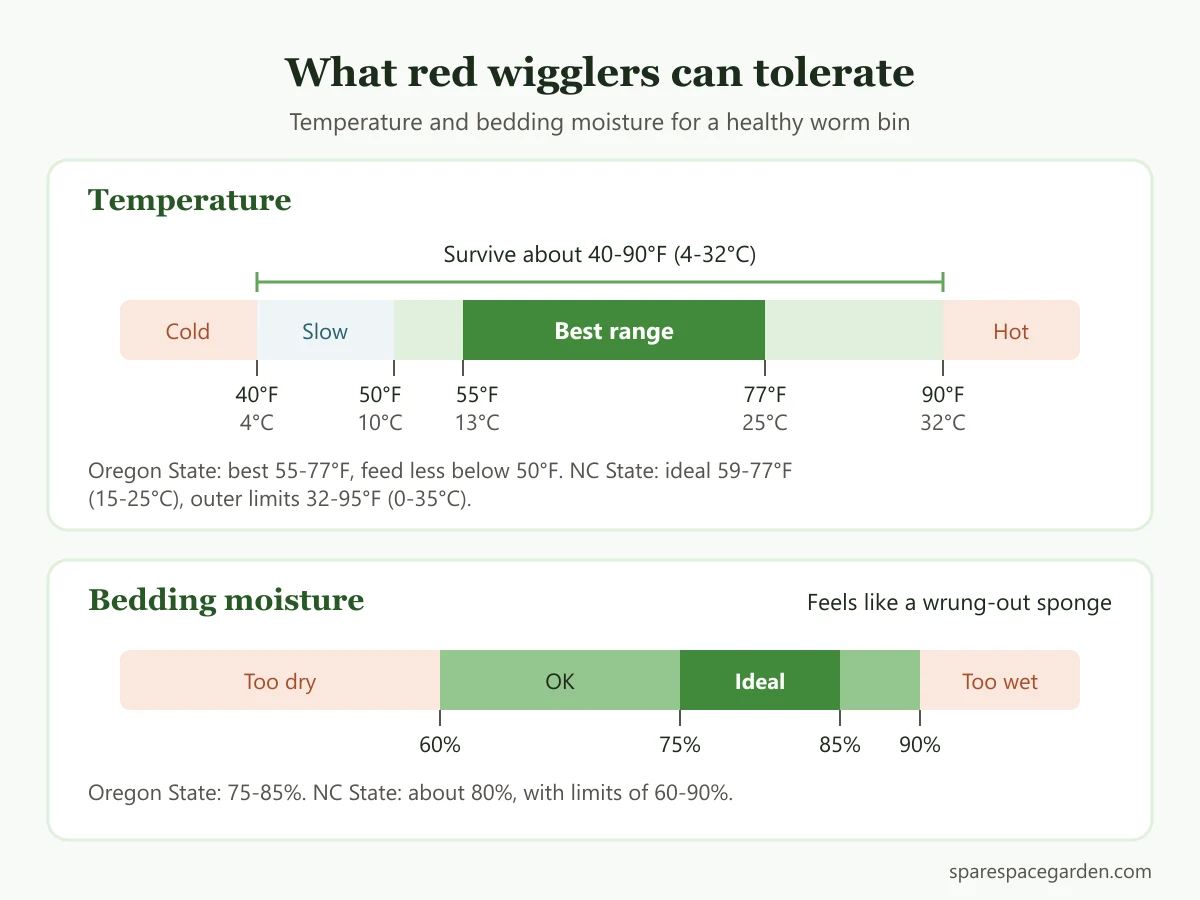 Temperature and moisture ranges for red wigglers, from Oregon State and NC State Extension.
How much red composting worms eat
Published feeding rates vary a lot, so treat them as ceilings rather than targets:
- NC State: a pound (0.45 kg) of worms eats up to 2 pounds (0.9 kg) of food scraps a week.
- Oregon State: a worm can eat up to its own body weight daily, but the guide suggests starting with ¼ to ½ pound (113–227 g) of scraps per pound of worms per week and increasing as the population grows.
- Tillamook County Master Gardeners (associated with OSU Extension): about half its body weight per day.
The gap makes sense once you know what worms actually eat. Oregon State notes that they feed mainly on the microbes breaking the food down, not on fresh scraps. A new bin has few microbes and worms that are still settling in, so it handles far less than an established one. Feed only when the last meal is mostly gone, chop scraps small, and leave out meat, dairy, oily food, citrus and onions.
Tip: If food is still sitting untouched after two to three weeks, Oregon State suggests stopping feeding for up to two weeks. Its guide lists too much food first among the reasons worms die.
How red wigglers reproduce
Each red wiggler is both male and female, but Oregon State notes that it still needs to mate with another worm to reproduce. After mating, worms lay cocoons: lemon-shaped capsules about the size of a match head (NC State) or smaller than a grain of rice (Oregon State).
The numbers vary by source and by conditions:
- Cocoons per worm: up to four a week, or about 100 a year (Oregon State).
- Hatching time: about three weeks (Oregon State). Tillamook County Master Gardeners give 32 to 73 days, depending on temperature and humidity.
- Young per cocoon: 2 to 5 (Oregon State) or 2 to 7 (NC State).
- Time to breeding age: 30 to 45 days after hatching (Oregon State), or 8 to 10 weeks (Tillamook County Master Gardeners).
Put together, Oregon State says a population can double in about 60 days. That's why a bin started with fewer worms catches up within a few months.
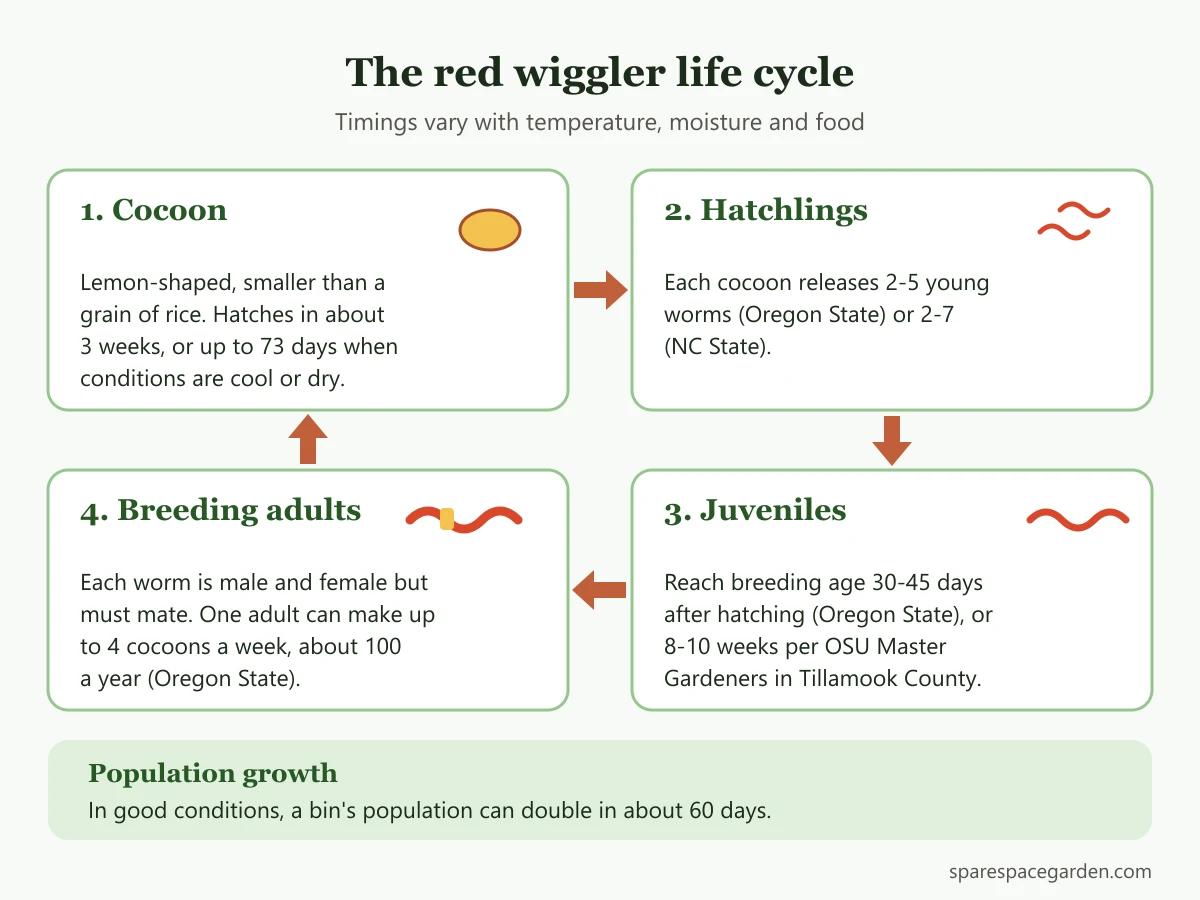 How a red wiggler goes from cocoon to breeding adult.
Does the population keep growing?
No. A worm bin doesn't fill up with worms forever. Oregon State notes that too little food slows growth and reproduction, and that a bin packed with castings becomes an unhealthy place for worms, which is one reason it recommends harvesting at least twice a year. The population tends to level off at what your feeding and bin space can support. If you're producing more scraps than the worms can handle, NC State's advice is to buy more worms or start a second bin.
When you harvest castings, look for cocoons and return them to the bin along with any worms.
Where to buy red wigglers, and how many
Buy from a worm grower or composting supplier, not a bait shop. Oregon State's advice is to buy from a reputable source, confirm the species, and check seasonal availability before you plan the bin's start date.
Worms are sold by weight. NC State estimates about 1,000 worms per pound (0.45 kg), and Oregon State gives the same figure but notes that bedding packed with a purchased pound lowers the actual count. Tillamook County Master Gardeners use a lower estimate of about 500 worms per pound, so the number you receive varies.
How many to order depends on your bin's size and how much food you produce. NC State's starting point is about 1 pound per square foot (0.09 m²) of bin surface. Our guide to starting a worm farm has a table matching worm amounts to weekly scraps, and explains why starting smaller is fine.
Watch out: The EPA warns that invasive jumping worms may be sold as "Alabama jumpers" or "Georgia jumpers." Maine's agriculture department adds "snake worms" to the list. If a listing uses names like these, skip it.
Don't release composting worms outdoors
Earthworms feel like a natural part of the garden, but in some places they aren't native at all. Maine's agriculture department notes that glaciers left the state with no native earthworms, and that European species such as nightcrawlers arrived through colonial trade. Its advice is simple: don't release live worms into the wild, and dispose of unwanted worms in the trash.
The bigger concern is jumping worms (Amynthas species), which Maine's jumping worm fact sheet says should never be bought or used for composting, worm composting, gardening or bait. The North Central IPM Center notes that the red wigglers and other worms used for worm composting are different species and don't cause the same disruption, but jumping worms can turn up in mixed or mislabeled shipments. Signs to check for:
- A band near the head that is milky white, smooth and flat to the body, wrapping all the way around
- Violent thrashing when handled, with some worms shedding their tails
- Dry, grainy castings that look like coffee grounds
- Worms about 3–8 inches (7–20 cm) long, darker and more rigid than common earthworms
If a shipment looks wrong, don't add it to your bin or your garden. Contact your state's agriculture or natural resources department for help with identification.
Signs of unhealthy worms
Healthy red wigglers stay in the bedding, look moist, and clear food steadily. When something is off, the worms show it before the bin collapses. These causes come from Oregon State and NC State's troubleshooting guides:
| What you see | Likely cause | What to do |
|---|---|---|
| Many worms crawling up walls or out of the bin | Poor conditions, or vibration from washers, dryers or foot traffic | Check moisture and food; move the bin somewhere quieter |
| Dead or dying worms | Too much food, too wet, too dry, or extreme temperatures | Correct moisture, stop feeding, move to 55–77°F (13–25°C) |
| Worms sluggish, food untouched | Bin too cold, or worms overfed | Move somewhere warmer; pause feeding |
| Rotten smell | Too wet, blocked drainage, too much food, poor airflow | Add 4 in (10 cm) of dry bedding, stop feeding 2–3 weeks |
| Ants in the bin | Bedding too dry | Mist the bedding until damp |
| Mites, centipedes or soldier fly larvae | Pests that compete with or prey on worms | Feed less and keep food buried |
For smells, fruit flies and wet bedding in an indoor bin, see our indoor worm composting guide.
Frequently asked questions
Can you use worms from the garden for composting?
No. Most worms in garden soil are burrowing species, and Oregon State says garden earthworms and nightcrawlers won't survive in a worm bin. NC State also notes that you can't identify yard worms as Eisenia fetida. Buy red wigglers from a grower instead.
Are red wigglers the same as earthworms?
Red wigglers are a type of earthworm, but they behave very differently from the worms you find when you dig. They live in surface litter and decaying organic matter rather than tunneling through soil, which is what makes them suited to a shallow bin.
How fast do red wigglers multiply?
Quickly, when conditions are right. Oregon State says a mature worm can produce up to four cocoons a week, each hatching 2 to 5 young in about three weeks, and the population can double in roughly 60 days. Cold, dry or underfed bins grow much more slowly.
Can red composting worms survive winter outside?
Only where the bin won't freeze. Oregon State gives a survival range of about 40–90°F (4–32°C), and NC State lists 32°F (0°C) as the lower limit. In cold climates, move the bin into a garage, basement or the house before hard frosts.
Are red wigglers invasive?
Red wigglers are not the main concern; jumping worms are. Still, earthworms aren't native everywhere, including Maine, and Maine's agriculture department advises never releasing live worms into the wild. Keep red wigglers in the bin and put unwanted worms in the trash.