A vertical herb garden indoors stacks your herbs up a wall or a set of shelves instead of lining them along one windowsill. It's the obvious move when the sill is full, but it brings three problems a single row of pots doesn't have: water running down onto the wall and floor, lower tiers sitting in shade, and herbs with very different watering needs sharing one structure.
Below: the main systems, how to protect the wall, light each level, water from the top down and place each herb, plus a simple rail build.
Quick answer: Choose a system with separate pots you can lift out, such as a wall rail or a shelf unit, and put a waterproof backing behind and a drip tray under anything planted directly on the wall. Give each tier its own grow light 6 to 12 inches (15 to 30 cm) above the leaves on a 12 to 16 hour timer. Put moisture-loving mint and parsley at the bottom and dry-loving rosemary, thyme and oregano at the top.
Four ways to build a vertical herb garden indoors
Indoor setups fall into four types, which differ mainly in how they handle water and whether you can remove one plant on its own.
Wall pockets
Fabric or felt pocket panels hang flat on the wall, and each pocket holds potting mix directly. The RHS guide to green walls describes living wall systems built from felt, planter boxes and grow-bag-style products, and notes that green walls can be grown indoors as long as they get additional artificial light. Pockets are cheap and light, but water poured into the top row seeps into the rows below, and the damp fabric sits right against your wall.
Plank and pallet planters
A board or pallet is fixed to the wall, with small boxes or pots attached to its face. Planted boxes are fixed in place. If you reuse a shipping pallet, check the stamp first. The University of Washington's Elisabeth C. Miller Library explains that heat-treated pallets carry the initials HT (or sometimes KD) near the IPPC logo, while pallets treated with the fumigant methyl bromide are marked MB. Its answer to a reader goes further and advises against growing food in wooden pallets at all. New, untreated boards avoid the question.
Rails with hanging pots
A metal rail or rod is screwed to the wall, and pots hang from S-hooks or clip-on holders. Every pot is separate, so you can unhook one, water it at the sink, let it drain and hang it back. Of the wall-mounted options, this one keeps the wall driest.
Tiered shelves with a light on each shelf
A freestanding shelf unit holds pots on trays, with a grow light fixed under each shelf to light the one below. There's no drilling, and because every level has its own light, this system copes best with a dim room or a wall far from the window.
| System | Water risk to the wall | Remove one plant? | How to light it | Best for |
|---|---|---|---|---|
| Wall pockets | High: wet fabric touches the wall | No | Light bar aimed at the panel | Small, compact herbs |
| Plank or pallet planter | Medium: boxes drain down the board | Only with loose pots | Light bar above each row | A decorative feature wall |
| Rail with hanging pots | Low: pots come down to drain | Yes | Light bar above each rail | Kitchens and narrow walls |
| Tiered shelf with lights | Low: freestanding, tray per shelf | Yes | One light under each shelf | Dim rooms, the most plants |
If you'd rather use ceiling hooks than a wall, our guide to a hanging herb garden indoor setup covers that option.
Protecting the wall and floor from moisture
Indoors, runoff can stain paint, soften drywall and grow mold behind the planter where you can't see it. Plan the water path before you hang anything.
- Put a waterproof layer behind anything planted on the wall. Many felt pocket panels have a plastic back; fix them only through the mounting holes or loops so you don't puncture it. For plank planters and homemade pockets, add a sheet of rigid plastic, acrylic or another waterproof board between the planter and the wall.
- Hold the planter off the wall. Mounting it on wooden battens or spacers leaves a gap for air to move, so any damp that gets through can dry out.
- Catch every drip. Use pots with drainage holes set in saucers or closed-bottom holders, a tray on each shelf, and a long trough or tray under the lowest row of a wall system.
- Fix into something solid. A planter full of wet mix is far heavier than it looks empty. Screw into wall studs or use anchors rated for the load, and check your lease before drilling if you rent. If you're unsure what's behind the wall or what it can hold, ask a qualified handyperson. Tall freestanding shelves loaded with wet pots can tip, so secure them as the maker recommends.
- Look behind it. Once a month, check the wall behind and below the planter for damp patches, staining or mold, and dry it out before it spreads.
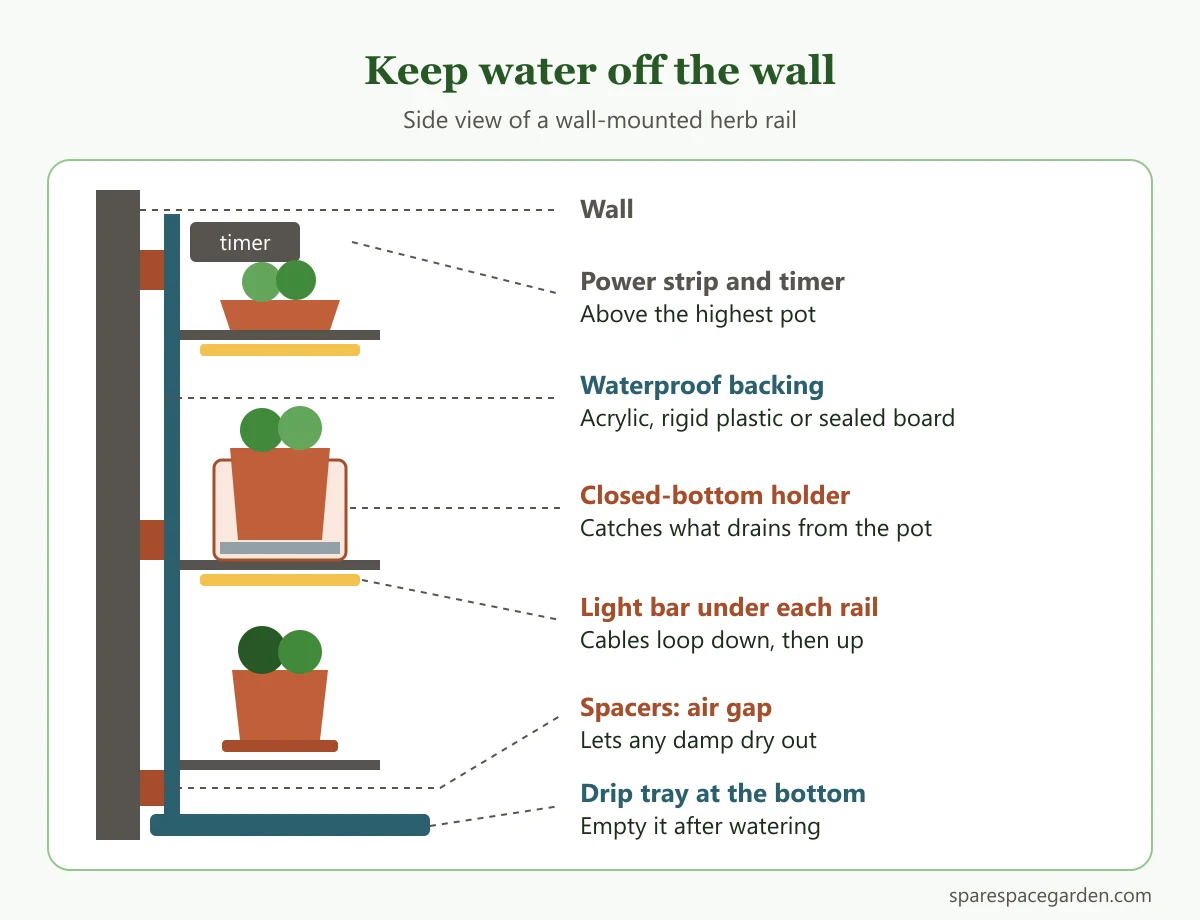 Keep water in front of the waterproof layer, give the wall an air gap, and catch runoff at the bottom.
Watch out: Water and electricity share this structure. Mount power strips and timers above the highest pot, route light cables so they dip below the plug before rising to it (a drip loop), and never water so hard that it splashes onto light fittings. Follow each fixture maker's safety instructions, and ask an electrician if you want anything hard-wired.
Lighting every tier evenly
A wall a few feet from the window rarely gets enough sun for herbs. Iowa State University Extension says most herbs need about eight hours of direct light a day indoors, with some tolerating six. On a stacked system, each tier also shades the one below, so the bottom shelves come up short even beside a bright window.
The fix is one light per tier. Iowa State's advice on adding light for indoor herbs is to use full-spectrum grow lights in high-output fixtures, placed 6 to 12 inches (15 to 30 cm) from the leaves and plugged into a timer set for 12 to 16 hours a day. It suggests a compact fluorescent bulb in a task light for a few plants, or a plug-in 4-foot (1.2 m) LED shop light for a larger collection.
Spacing the shelves
Work out the gap between shelves from the bottom up: pot height, plus the height you'll keep the herbs trimmed to, plus 6 to 12 inches (15 to 30 cm) of space under the light. For example, 5-inch (13 cm) pots with herbs kept to 8 inches (20 cm) and a 6-inch (15 cm) gap need about 19 inches (48 cm) between shelves. Adjustable shelves or lights hung from chains let you change this as plants grow.
Getting even light across each shelf
- Match the light to the shelf. Pick a fixture that runs nearly the full width of the shelf. Pots beyond the ends of a short light bar get noticeably less light.
- Put every tier on one timer so all shelves get the same day length.
- Rotate pots every few days and swap end pots with middle ones, so no plant leans or stretches.
- Leave room for air. Iowa State's guide to setting up supplemental lights says to provide air circulation to carry off the heat a fixture gives off. Open wire shelves help more than solid boards.
For pockets and rails, mount a light bar above each row, angled down at the plants. Window light and seasonal changes are covered in our guides to a herb window garden and growing herbs indoors year-round.
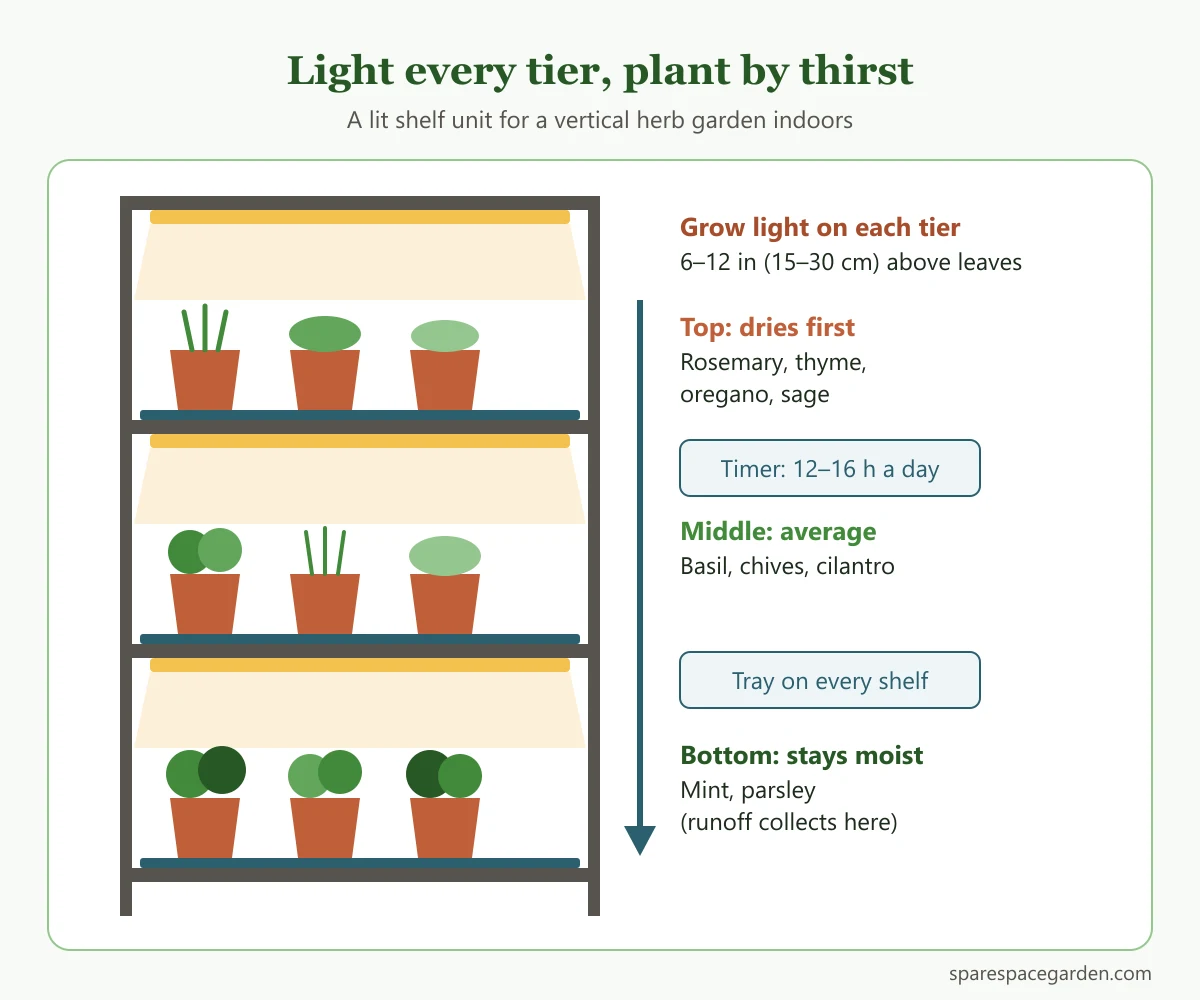 One light per tier, 6 to 12 inches above the leaves, with herbs placed by how much water they like.
Watering a vertical herb garden from top to bottom
Water moves down. In a pocket wall or any system where planters drain into the row below, the top tier dries first and the bottom stays wettest, because it gets its own water plus everything that runs through from above. Air near the ceiling is often warmer too, which dries upper pots a little faster.
That means checking each tier on its own rather than watering everything on one schedule. Iowa State advises letting the soil dry between waterings for indoor herbs, and Clemson's Home & Garden Information Center puts it as watering thoroughly, then letting the soil dry out somewhat before watering again. Push a finger into each pot before you water it.
A routine for pocket walls
- Water the top row slowly, a little at a time.
- Wait a few minutes for it to seep down.
- Check the lowest pockets before adding water there. They often need little or none.
- Stop when the first drips reach the tray, and empty it.
A routine for rails and shelves
Take each pot to the sink, water until it drains, let it drip and put it back. If you water in place, empty each tray afterward. A mix that stays wet invites fungus gnats; see how to get rid of gnats in potted plants if they show up.
Where each herb goes: thirsty low, dry-loving high
The RHS advises choosing plants with similar light and moisture needs for a green wall, which keeps care simple. On a vertical garden, use gravity to your advantage: herbs that like it damp go where water collects, and herbs that hate wet roots go where the mix dries first.
- Bottom tier: mint and parsley. The RHS says to keep mint's compost evenly moist, and Clemson notes that mints thrive in moist soil. The RHS green walls guide lists parsley and chives among herbs that tolerate shade, which suits a lower shelf if light is uneven. Give mint its own pot; both the RHS and Clemson recommend containers to stop it spreading.
- Middle tiers: basil, chives and cilantro. These like steady moisture but not soggy roots. Cilantro dislikes heat, so keep it away from warm air near the ceiling; our guide to growing cilantro in pots explains why.
- Top tier: rosemary, thyme, oregano and sage. Illinois Extension says to keep rosemary's soil on the dry side and warns that extra water can lead to root rot. The RHS lists thyme and oregano as herbs that need sun. Our guide to growing thyme in pots covers the gritty mix it prefers.
| Tier | Conditions | Herbs to put there |
|---|---|---|
| Top | Dries first, often warmest | Rosemary, thyme, oregano, sage |
| Middle | Average moisture | Basil, chives, cilantro |
| Bottom | Stays moist longest, catches runoff | Mint, parsley |
Iowa State recommends one herb species per container and warns that oversized pots stay wet too long. Separate pots also let you move a struggling plant up or down a tier. For which herbs cope best indoors, see our list of the best herbs to grow indoors.
A simple DIY rail herb wall
This build uses separate pots, so it's the easiest to keep dry and to change later.
- Pick the wall. Ideally near a window, with an outlet nearby for lights. Avoid the space above a radiator or heat vent; University of Missouri Extension advice reprinted by the Miller Library warns against putting indoor herbs near a heat source.
- Find the studs or use anchors rated for the weight, and get permission if you rent.
- Fix a waterproof backer, such as a sheet of acrylic or a sealed board, on small spacers.
- Mount the rails about 19 inches (48 cm) apart for small pots and trimmed herbs, using the shelf formula above.
- Add a light bar under each rail and one above the top rail. Run the cables up to a timer and power strip above the top row, with drip loops.
- Hang the pots, with drainage holes, inside closed-bottom holders or with clip-on saucers.
- Plant by tier, dry-loving herbs on top, thirsty herbs at the bottom, and set a tray under the bottom rail.
- Feed lightly. Iowa State suggests an all-purpose fertilizer at half or quarter strength from early spring through summer and none in winter. Follow the label.
Tip: Leave one hook empty on each rail. It gives you somewhere to park a pot while you water or rearrange, and room to add a new herb later.
Frequently asked questions
Can you grow a vertical herb garden indoors without grow lights?
Only on a very bright wall beside a sunny window. Most herbs need about eight hours of direct light a day, and lower tiers get less than the top. The RHS notes that indoor green walls need artificial light, so plan on lights for at least the lower levels.
What herbs grow best in a vertical garden indoors?
Compact herbs that stay small with regular trimming work best: thyme, oregano, chives, basil, parsley and mint. Put dry-loving thyme, oregano and rosemary high, and moisture-loving mint and parsley low. Large or spreading plants are easier in a floor pot.
How do I stop a vertical garden from damaging my wall?
Keep a waterproof layer between planter and wall, mount it on spacers, and catch runoff in saucers and a bottom tray. Rails and shelves with separate pots are safest, since you can water each pot at the sink.
How far apart should the shelves be on a lit herb shelf?
Add the pot height, the height you'll trim the herbs to, and 6 to 12 inches (15 to 30 cm) for the light. Small pots and herbs kept to about 8 inches (20 cm) need roughly 19 inches (48 cm) per shelf.