To grow peppers in pots, give each plant its own container of at least 5 gallons (19 L), a spot with 6 to 8 hours of direct sun, and a loose potting mix that drains fast. Wait until the soil and nights are warm before moving plants outside, water whenever the top of the mix dries, and feed regularly once flowers appear.
Peppers are one of the easier fruiting crops for containers. They stay fairly compact, and you can move a pot into the sun or out of a cold snap. Most failures come from stress: dry spells, heat at flowering, or a pot that's too small.
This guide covers pot sizes for sweet and hot types, planting, daily care, and fixes for common problems.
Quick answer: Plant one pepper per pot of at least 5 gallons (19 L), or a 9 in (22 cm) pot for a compact chili. Give it 6–8 hours of direct sun, plant out once the soil reaches 65°F (18°C) and nights stay above 54°F (12°C), and expect the first green peppers 70–85 days after transplanting.
Choosing the right pot for peppers
Pot size has a direct effect on how big the plant gets and how often you have to water. University of Maryland Extension's pepper guide gives a 5-gallon minimum for peppers grown in containers, and Oregon State University Extension also lists peppers among the larger plants that need five-gallon containers.
Small chilies are the exception. The RHS chilli growing guide suggests one plant per 22 cm (9 in) pot, or three plants in a standard growing bag. According to the RHS, compact varieties reach only 20–30 cm (8–12 in) tall, while others grow to 60 cm (2 ft) or more, so check the seed packet before you choose a pot.
Whatever the size, the pot needs drainage holes. Oregon State suggests drilling holes along the side about ½ inch (1.3 cm) above the bottom and raising the pot on bricks or wooden slats so water can escape. A bigger pot also holds more water, which matters on a hot balcony where a small pot can dry out between morning and evening.
| Pepper type | Minimum container | Days from transplanting to harvest | Notes |
|---|---|---|---|
| Compact chilies (windowsill types) | 9 in (22 cm) pot | 70–85 days for most types | 8–12 in (20–30 cm) tall |
| Standard hot peppers (jalapeño, cayenne) | 5 gallons (19 L) | 70–85 days | Handle summer heat better than bells |
| Bell and other large sweet peppers | 5 gallons (19 L), larger is better | 70–80 days to mature green, plus 2–3 weeks for full color | Stake or cage heavy plants |
| Habanero types | 5 gallons (19 L) or larger | 90–120 days | Slowest to ripen |
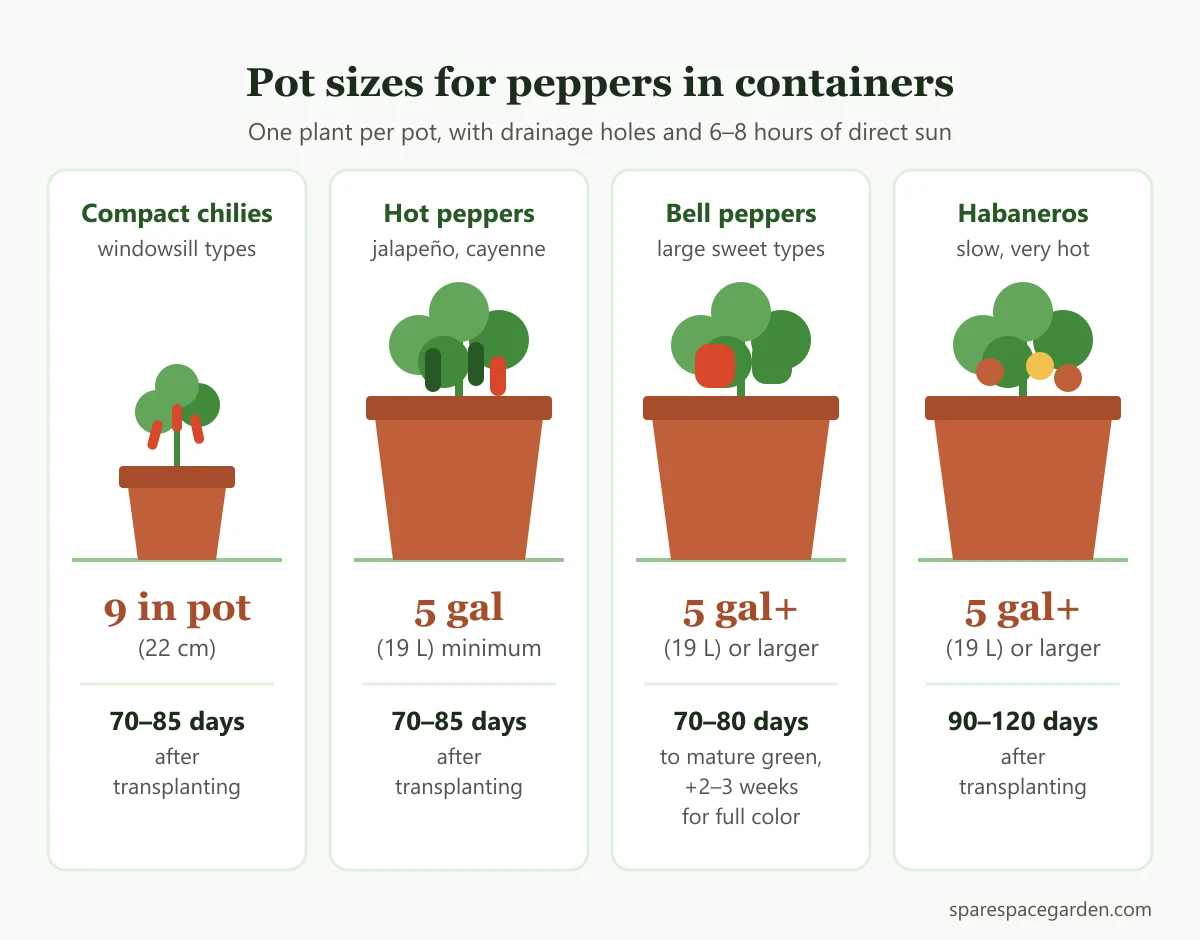 Minimum pot sizes and harvest times for common pepper types.
How to grow peppers in pots, step by step
Once you have the container, planting takes about ten minutes. The timing matters more than the technique.
- Fill the pot with fresh potting mix. Use a commercial potting mix rather than garden soil, which packs down and drains poorly in a container. North Carolina A&T's extension guide notes that most mixes combine composted pine bark, peat moss and perlite, and it advises against mixes very high in peat. Clemson's Home & Garden Information Center gives a soil pH of 6.0–6.5 for peppers. Our guide to the best potting soil for vegetables explains what to look for on the bag.
- Start seeds early or buy transplants. Maryland Extension recommends starting seed indoors 8 to 10 weeks before your average last frost date, and some types need 12 weeks. The RHS suggests a germination temperature of about 70°F (21°C), so a heated propagator helps. If your seedlings stretch toward the window, see our guide to leggy seedlings.
- Harden off for 2–3 weeks. Set young plants outside for a few hours a day and increase the time gradually, as the RHS advises.
- Wait for warm soil and nights. Maryland Extension says that plants set out before the soil reaches 65°F (18°C) tend to sit and do nothing. The RHS says to plant outside once nights are reliably at least 54°F (12°C). In much of the US, NC A&T suggests planting about two to three weeks after the last spring frost.
- Plant one pepper per pot. Set it at the same depth it grew in its nursery pot, firm the mix, and water until it runs out of the drainage holes.
- Add support at planting time. Oregon State recommends a stake or tomato cage, especially for large-fruited types. Putting it in now avoids damaging roots later.
Tip: For a bushier chili with more (but smaller) fruits, the RHS suggests pinching out the growing tip once the plant reaches about 12 in (30 cm). This can delay the first fruits slightly, so skip it in a short summer.
Sun and temperature for peppers in containers
Peppers need full sun to flower and fruit well. Oregon State Extension says fruiting crops like peppers need 6 to 8 hours of direct sun daily, and Maryland Extension notes that peppers prefer 8 to 10 hours. On a balcony, that usually means a south- or west-facing spot in the Northern Hemisphere (north-facing in the Southern Hemisphere).
Temperature controls whether flowers turn into fruit. Clemson gives an ideal growing range of 70–85°F (21–29°C) by day and 60–70°F (16–21°C) at night. Iowa State University Extension puts the best range for bell pepper flowering and fruit set at 70–80°F (21–27°C), and notes that hot peppers tolerate high temperatures much better than bells.
| Condition | What tends to happen | Source |
|---|---|---|
| Nights in the low to mid 50s°F (about 10–13°C) | Slow growth, yellowing leaves, flower drop | University of Illinois Extension |
| Nights below 60°F (16°C) or above 75°F (24°C) | Flowers and small fruit drop | University of Maryland Extension |
| Days above 86°F (30°C) | Fewer fruits set | RHS |
| Days above 95°F (35°C) | Flowers and small fruit drop | University of Maryland Extension |
This is where containers help. During a heat wave, you can slide the pot into a spot with late afternoon shade, which Maryland Extension's page on poor fruit set recommends for season-long yields. In a cool spring, you can keep pots against a warm, sunny wall.
Watering peppers in pots
Uneven watering causes more pepper problems than almost anything else. Maryland Extension states the goal plainly: uniform soil moisture. Pots dry out much faster than garden beds, so a schedule written for in-ground peppers doesn't translate well.
Oregon State advises checking containers every day and watering when the top of the mix feels dry. Water slowly until it drains out the bottom, then stop; the mix should be moist, not waterlogged. In full sun, daily watering is often needed, and the RHS notes that containers may need water every day in hot, dry weather.
A few habits make this easier:
- Water in the morning so the plant starts the hottest part of the day with moist roots.
- Empty saucers after watering so the roots don't sit in standing water.
- Group pots together in summer; they shade each other's sides and dry a little more slowly.
Watch out: Letting a pot dry out completely and then soaking it is the classic setup for blossom end rot. If you can't check pots daily, look at self-watering containers for vegetables, which hold a reserve of water below the soil.
Feeding peppers in containers
Potting mix holds only a small amount of nutrients, and frequent watering washes them out. NC A&T notes that the starter fertilizer in most mixes lasts about two weeks. After that, it suggests a weekly water-soluble fertilizer with an equal ratio, such as 20-20-20, until the plants flower, then switching to a high-potassium fertilizer. The RHS gives similar advice for chilies: a weekly high-potassium liquid feed once flowering begins.
Oregon State offers another routine: an all-purpose water-soluble fertilizer at half strength every three to four days, or a dry fertilizer every three weeks. Pick one approach and stick with it, and always follow the product label for rates.
More is not better. Clemson warns that over-fertilized peppers grow lots of leaves with few blooms or fruit, and Maryland Extension lists too much nitrogen as a cause of poor fruit set. For more on product types, see our article on fertilizer for potted plants.
Common problems and how to fix them
Most problems with potted peppers trace back to temperature, water or feeding. Use this table to match what you see with the likely cause.
| Symptom | Likely cause | Fix |
|---|---|---|
| Flowers fall off, no fruit forms | Nights too cold or too warm, extreme heat, dry soil, hot dry wind | Move the pot to afternoon shade in heat waves, water steadily, shelter from wind |
| Dark, sunken patch at the bottom of the fruit | Blossom end rot from uneven watering and calcium shortage in the fruit | Keep the mix evenly moist; remove damaged fruit |
| Lush leaves but few flowers | Too much nitrogen | Cut back feeding and switch to a high-potassium fertilizer |
| Slow growth and yellow leaves early in the season | Cold nights or cold soil | Wait for warmer weather or move pots to a warmer spot |
| Sticky leaves, clusters of small insects | Aphids | Rinse them off or use insecticidal soap according to the label |
Two notes on the table. Maryland Extension observes that pepper plants often stop setting fruit in midsummer heat and start again in late summer and early fall, so a pause in July isn't always a problem. Yellow leaves can also come from watering or feeding issues; our guide to pepper plant leaves turning yellow covers the full list.
For pests, NC A&T names aphids and leaf miners as the main insects on container peppers, while the RHS adds whitefly and red spider mite for plants grown under cover. See how to get rid of aphids naturally for gentle options.
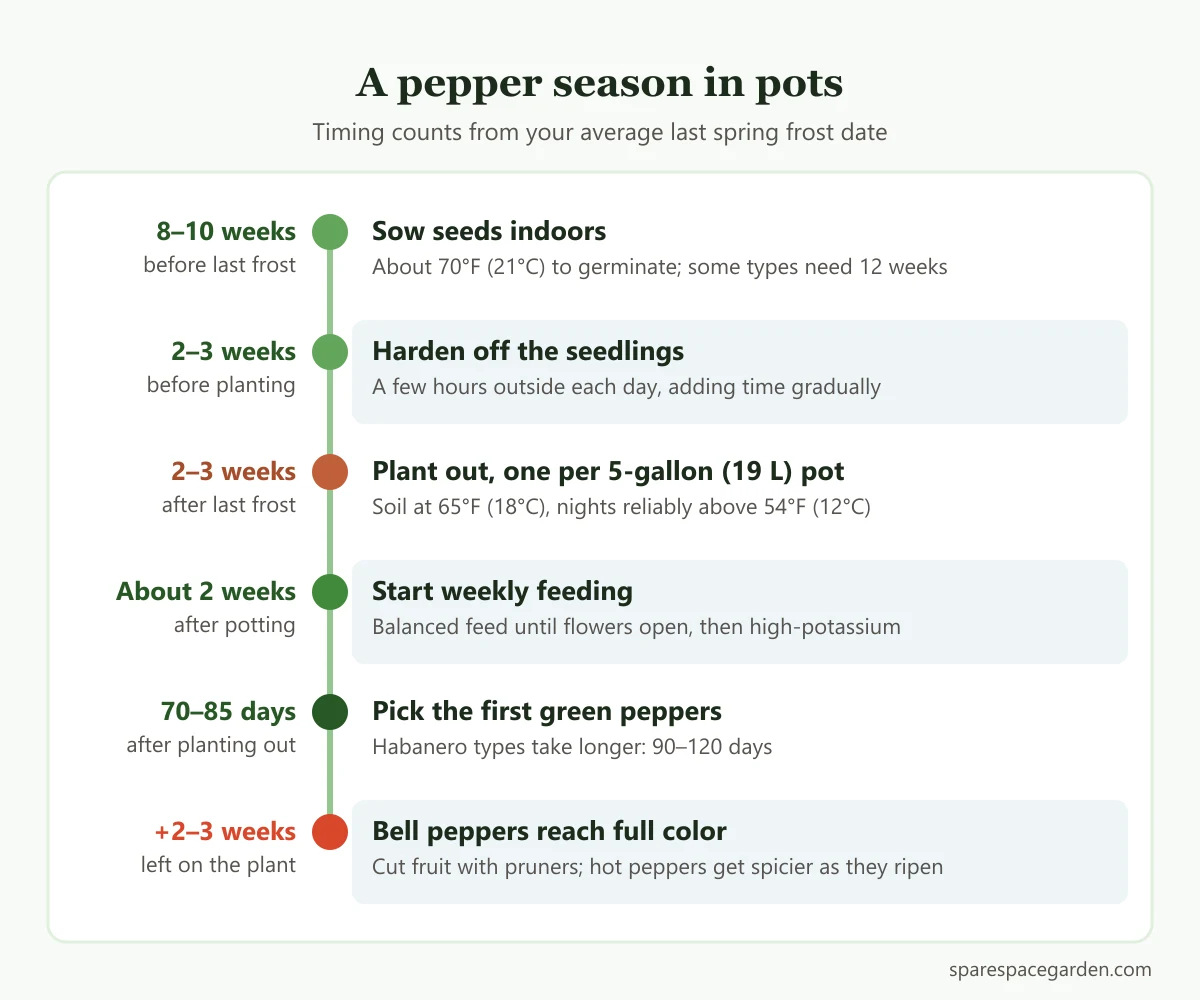 A pepper season in pots, from sowing to full-color fruit.
Harvesting peppers from containers
Patience pays with peppers. Maryland Extension puts most sweet and hot types at 70–85 days from transplanting, and bell peppers reach the mature green stage 70–80 days after transplanting. Leaving a bell on the plant to turn red, yellow or orange takes another 2–3 weeks. Habanero types are slower, at 90–120 days. Counted from seed, Clemson gives 100–120 days.
You can pick sweet peppers at full size while still green, or wait for full color. Hot peppers generally get spicier as they mature, according to NC A&T.
Cut peppers off with pruners or scissors instead of pulling them, as NC A&T recommends; pepper branches snap easily. Pick regularly, too. Maryland Extension lists infrequent harvesting as one reason plants slow down flower and fruit production.
Frequently asked questions
Can you grow peppers in a pot smaller than 5 gallons?
Compact chilies can. The RHS recommends a 22 cm (9 in) pot for one chili plant, and dwarf windowsill types stay 8–12 in (20–30 cm) tall. For bell peppers and full-size hot peppers, US extension services set 5 gallons (19 L) as the minimum, and a smaller pot will dry out quickly and limit the harvest.
How many pepper plants can go in a 5-gallon pot?
One is the safest choice. Oregon State and Maryland Extension both treat 5 gallons as the space for a single pepper plant, although NC A&T allows one or two. Two plants share water and nutrients, so the pot needs watering even more often.
Can peppers grow in pots indoors?
Yes, but light is the limit. The RHS notes that compact chili varieties can grow on a sunny indoor windowsill, and that chilies do best in a greenhouse or conservatory. Larger sweet peppers need more light than most windows provide, so they usually do better outside in summer.
Why are the flowers falling off my potted pepper plant?
Temperature is the most common reason. Maryland Extension says nights below 60°F (16°C) or above 75°F (24°C), or days above 95°F (35°C), can make flowers drop. Dry soil, hot winds and too much nitrogen also cause it, so check those after you rule out the weather.
How often should you water peppers in pots?
Check them every day and water when the top of the mix is dry. In hot, sunny weather, that often means daily watering, according to Oregon State and the RHS. Water until it drains from the bottom so the whole root zone gets wet.