The best small balcony garden ideas use the parts of a balcony that usually sit empty: the railing, the walls, the corners and the space overhead. Put a salad box on a table, herbs on a tiered shelf, beans up a trellis and a tumbling tomato in a basket, and a balcony only a few feet deep can keep you in salad and herbs most of the season.
Each idea below comes with its limits, because a layout that suits one balcony can be unsafe or unproductive on another. Weight, sun, wind and building rules decide which ones fit yours.
Quick answer: For the most food in the least floor space, combine low, light ideas (railing boxes 6–8 in / 15–20 cm deep for greens and herbs, a shallow salad box) with one or two vertical ones (a trellis behind a 5-gallon / 19 L pot, a tiered shelf, a hanging basket). Keep heavy pots near walls, put sun-loving crops highest, and check your building's rules before fixing anything to a railing.
Three limits to check before you choose
Every idea here depends on the same three things, so check them first. Our guide on how to start a balcony vegetable garden covers each one step by step; this is the short version.
- Sun. University of Maryland Extension gives 6–8 hours of direct sun for tomatoes, peppers and squash, and 3–5 hours for lettuce, spinach and Asian greens. Fewer hours means more greens and herbs, fewer fruiting crops.
- Weight. Maryland Extension notes that a 20-inch (51 cm) container of moist mix and plants can weigh 100 pounds (45 kg). The New York Botanical Garden's balcony guide says the middle of a balcony is its weakest point, so heavy pots belong around the edges.
- Wind. The RHS guide to roof gardens and balconies warns that containers dry out rapidly in windy, hot weather and recommends slatted or mesh screens over solid ones.
Ideas for the railing and floor edge
The railing gets the most light on many balconies, and the strip of floor along it is often wasted. Both suit low, shallow crops.
1. Railing planters and window boxes
A long, narrow box along the railing holds a row of lettuce, herbs or radishes without taking floor space. Depth sets the limit: Clemson's Home & Garden Information Center says most plants need containers at least 6 to 8 inches (15–20 cm) deep, Texas A&M AgriLife Extension lists 6- to 10-inch (15–25 cm) pots for green onions, parsley and herbs, and Oregon State Extension says radishes need only 4 to 6 inches (10–15 cm).
The constraints are safety and drying. A railing box puts weight on the outer edge, sits in full wind and can fall if it isn't fixed well, so mount it on the inside of the railing and get permission first; many buildings restrict railing planters. Shallow boxes also dry fast, so plan to check them every day in summer.
2. A salad box on a small table
A shallow wooden salad box is one of the lightest small balcony garden ideas that still gives a steady supply of greens. University of Maryland Extension's Salad Box design measures 21 by 15 inches (53 × 38 cm) and 3½ inches (9 cm) high, gives 2.0 square feet (0.19 m²) of growing area, and weighs about 12–15 pounds (5.4–6.8 kg) when filled with moist mix and plants.
Maryland Extension suggests sowing salad greens, thinning them to 1–2 inches (2.5–5 cm) apart, and cutting lettuce and arugula twice in a cycle of about 8 weeks. Because the box is light, you can move it into sun in spring and fall and out of the hottest sun in summer. It also sits low, so wind is rarely a problem.
Ideas that use the wall
A bare wall is the biggest unused growing area on most small balconies. The RHS notes that walls can hold climbers, shelving and planting pockets, and its own wall trial found that south-, southwest- and west-facing walls suit edible crops.
3. Tiered shelves, étagères or a ladder
Open shelving holds many small pots in one footprint. The RHS suggests étagères (open shelving) to use height on a wall or fence, and a planted wooden ladder with herbs such as rosemary, basil and thyme.
The catch is light and drying. Lower shelves sit in the shade of the ones above, so put sun-loving herbs on top and greens, which manage on 3–5 hours of sun, below. Small pots dry quickly; the RHS says smaller pots need more frequent watering and feeding. A loaded shelf can also tip in a gust, so choose a wide, sturdy unit and secure it if the building allows.
4. A trellis or mesh panel above a large pot
A climber turns a 5-gallon (19 L) pot into a wall of leaves. Oregon State Extension suggests one bean plant per 5-gallon container with a pole or trellis. Virginia Tech's vertical gardening guide recommends mesh with openings no wider than 4 inches (10 cm).
In the RHS wall trial, 2 × 2 inch (5 × 5 cm) timber battens held metal mesh away from the wall so air could circulate. Cucumber 'Marketmore', 'Tumbling Tom' tomatoes, basil and 'Salad Bowl' lettuce all did well, while runner beans gave a small, tough crop in extreme heat. A leafy trellis catches wind like a sail, so use a heavy pot and put it in the most sheltered spot. Our list of climbing vegetable plants gives pot and trellis sizes for each crop.
5. Wall pockets and fixed containers
Pocket planters and wired-on containers grow food on a wall with almost no floor space. The RHS suggests planting pockets on walls, fences or window ledges for fruit, salad leaves or herbs.
In its wall trial, the RHS drilled drainage holes in every container, used lightweight multipurpose compost, and left 2 inches (5 cm) of space at the top of straight-sided pots and 3 inches (7.5 cm) in tapered ones. It also found that compost in the highest pots dried out fastest in wind, so put drought-tolerant herbs up high and thirsty greens lower down.
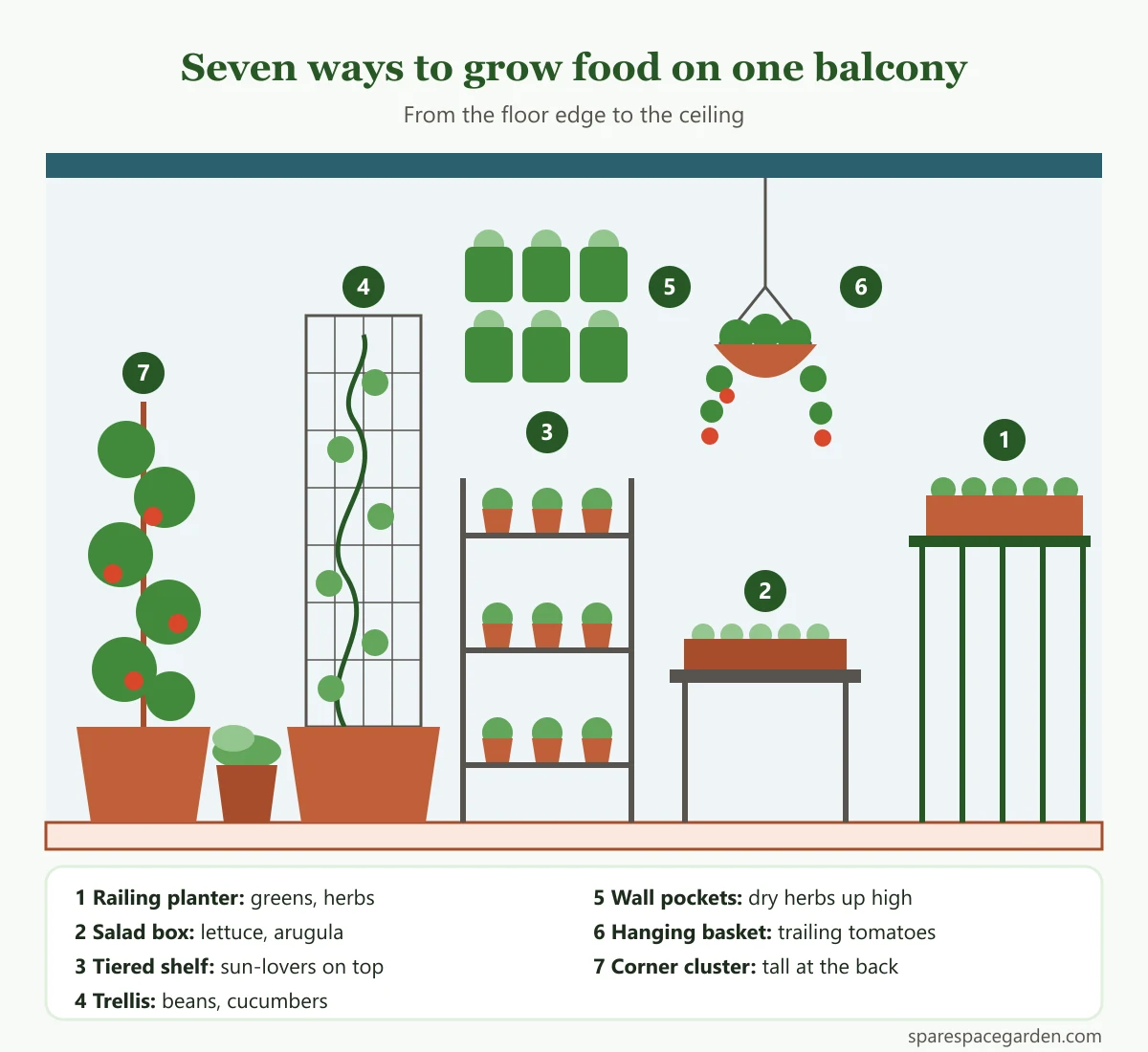 Seven ways to grow food on one small balcony, from the floor edge to the ceiling.
Ideas that use overhead space
If your balcony has a ceiling or a sturdy overhang, the air above head height can hold food too.
6. Hanging baskets for trailing crops
Hanging baskets suit crops that spill over the edge. The RHS describes bush tomatoes as ideal for hanging baskets and window boxes, and trailing types cascade over the sides. Texas A&M notes that small-fruited tomato varieties make excellent hanging baskets and lists 'Tumbling Tom' for containers. Strawberries are the other classic; see growing strawberries in hanging baskets.
Baskets are the most demanding idea on this list. The RHS small-space design guide advises using the biggest basket you can, because baskets dry out quickly in exposed spots, and notes they'll need feeding once the compost's nutrients run out. A wet basket is heavy, so hang it only from a hook fixed into the structure and approved by your building, and keep it out of walkways.
Watch out: Never hang a basket from the outside of a railing over the street or a neighbor's balcony. Wind can swing it, and a falling basket can hurt someone.
Corner layouts that mix herbs, greens and fruiting crops
A corner is the best spot for your largest pot, because it's against two walls, often sheltered, and away from the weak middle of the floor.
7. A stepped corner cluster
Build the corner like a staircase: tall crops at the back, shorter ones in front, trailing ones at the edge. Virginia Tech suggests planting short, sun-loving crops on the sunny (south) side of taller ones, and growing lettuce and radishes in the shade of taller crops, where they can be picked before the big plants fill out.
The RHS wall trial points the same way. The warm base of a sunny wall suited cucumbers and eggplant, shade from larger plants helped heat-sensitive parsley, and cut-and-come-again crops worked best at a height you can reach for frequent picking. For herbs that share a pot, Iowa State University Extension advises grouping plants with comparable water needs and gives 4–6 hours of sun a day as the minimum.
One stepped corner might hold a 5-gallon (19 L) tomato or pepper at the back, a 1-gallon (3.8 L) pot of lettuce in its shade, and a pot of parsley and green onions at the front. Texas A&M lists 1 gallon for two lettuce plants, three parsley plants or three to five green onions.
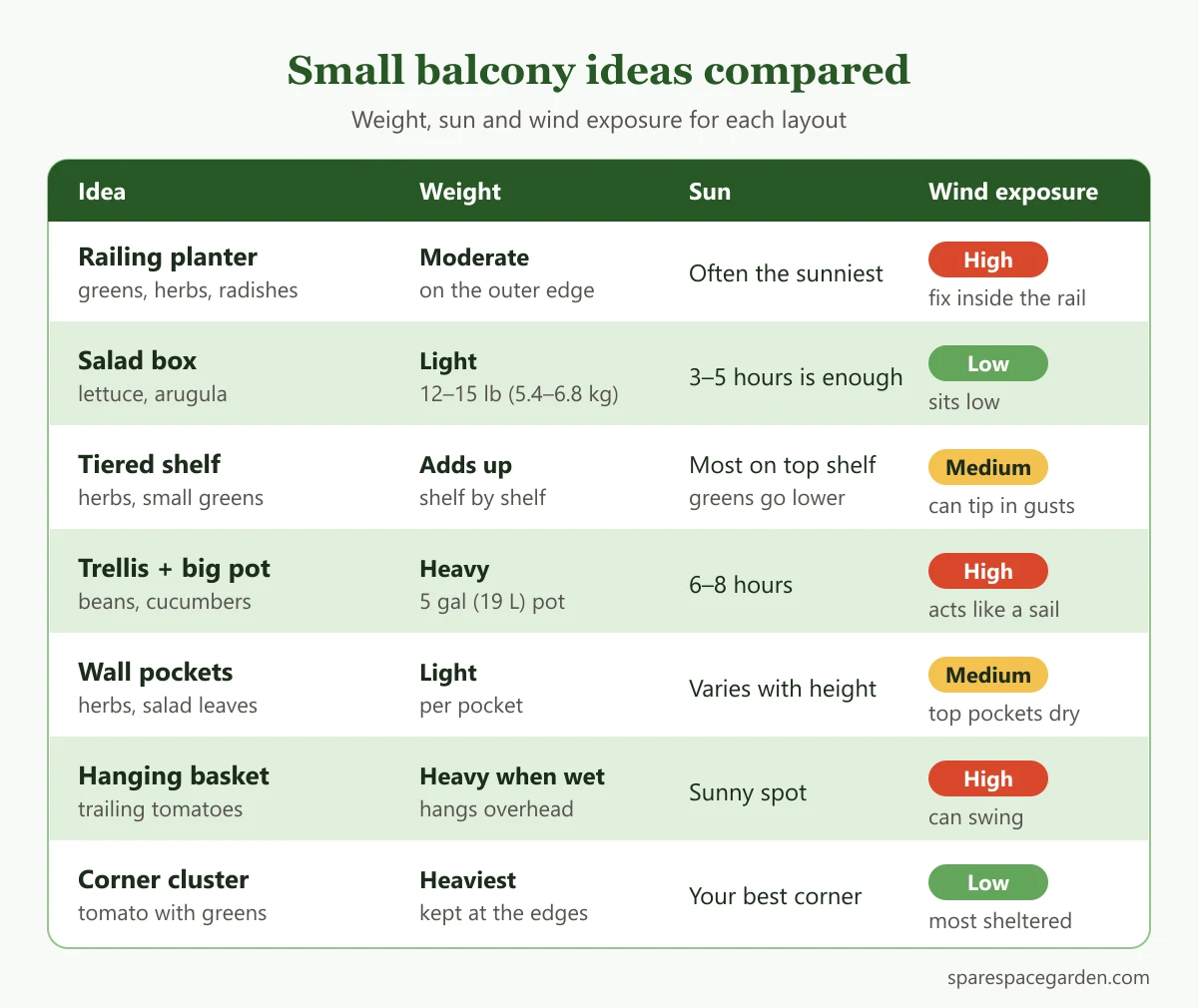 How each idea compares on weight, sun and wind.
Foldable, stackable and movable options
On a balcony that doubles as living space, gear that moves or packs away keeps the garden from taking over.
- Plant caddies: Maryland Extension notes that rolling caddies make heavy containers portable, which helps when you need to chase the sun or sweep up.
- Shelving on castors: the RHS suggests wooden shelving fitted with castors as a movable living wall or screen.
- Grow bags: Maryland Extension shows potatoes in five-gallon (19 L) fabric bags. Fabric bags are light to move and fold flat for storage when the season ends.
- Stacked or tiered planters: these put several small pockets of soil in one footprint. Each tier holds less mix, so expect to water more often, as the RHS says of smaller pots in general.
- Folding tables and stands: a fold-down table under a salad box gives you a work surface in summer and clears the floor in winter.
Tip: Whatever you choose, keep a clear route to the door and any fire exit. NYBG notes that if your balcony is part of a fire escape, the exit has to stay clear.
Which small balcony garden ideas fit your space
Use this table to match small balcony garden ideas to your conditions. Where sources give figures, they're shown; the rest are the practical trade-offs described above.
| Idea | Best crops | Weight | Sun | Wind and safety |
|---|---|---|---|---|
| Railing planter | Lettuce, herbs, radishes | Light to moderate, on the edge | Often the sunniest spot | Fully exposed; mount inside the rail, with permission |
| Salad box | Lettuce, arugula, salad greens | About 12–15 lb (5.4–6.8 kg) | 3–5 hours suits greens | Low and stable |
| Tiered shelf or étagère | Herbs, greens in small pots | Adds up shelf by shelf | Top shelves get the most | Can tip; choose a wide base |
| Trellis above a big pot | Pole beans, cucumbers, tomatoes | Heavy pot at the base | 6–8 hours for fruiting crops | Acts like a sail; mesh no wider than 4 in (10 cm) |
| Wall pockets | Salad leaves, herbs, strawberries | Light per pocket | Varies with height | High pockets dry fastest |
| Hanging basket | Trailing tomatoes, strawberries, herbs | Heavy when wet, overhead | Sunny spot | Use a structural hook; dries quickly |
| Corner cluster | Tomato or pepper with greens and herbs | Heaviest, kept at the edges | Your best corner | Most sheltered spot |
For a larger, built-in option, see balcony raised garden beds, and for a full vertical setup, read how to build a vertical vegetable garden.
Frequently asked questions
What can I grow on a very small balcony?
Leafy greens, herbs and radishes give the most food for the space, because they fit shallow containers, and leafy greens tolerate partial shade. Texas A&M lists 1-gallon (3.8 L) containers for lettuce, radishes and parsley. With 6–8 hours of sun, add one compact tomato or pepper in a 5-gallon (19 L) pot.
How do I grow vegetables vertically on a balcony?
Put a trellis or mesh panel behind a large pot and grow climbers such as pole beans or cucumbers up it. Virginia Tech recommends mesh openings no wider than 4 inches (10 cm), and the RHS mounts mesh slightly away from the wall for airflow. Shelves, wall pockets and hanging baskets add more vertical space for herbs and greens.
Are railing planters safe?
They can be, if they're designed for your railing shape, fixed securely and hung on the inside. They sit in full wind and put weight on the balcony edge, so many buildings limit them. Check your lease or building rules before installing one.
How do I keep a small balcony garden watered?
Check every container daily in summer. Shallow boxes, small shelf pots, high wall pockets and hanging baskets dry fastest, and the RHS notes that wind speeds up drying. Grouping pots helps, and self-watering containers for vegetables can carry you through busy days.