A balcony vegetable garden starts with three checks, not with seeds: how many hours of direct sun the space gets, how much weight it can safely hold, and how exposed it is to wind. Once you know those, choosing containers and crops is the easy part.
This guide walks through the setup in the order you'd do it, from reading your balcony's direction to a simple plan for the first season. It's written for renters and condo owners as much as for anyone with a private terrace.
Quick answer: Fruiting crops such as tomatoes and peppers need 6–8 hours of direct sun, while lettuce, spinach and other greens manage with 3–5. Ask your building about weight limits, keep heavy pots near walls rather than mid-balcony, use saucers so water doesn't drip on neighbors, and start with a few 1- to 5-gallon (3.8–19 L) containers.
Step 1: Count your sun hours by balcony direction
Sun decides what you can grow, so measure it before you buy anything. University of Maryland Extension says warm-season crops (tomato, pepper, eggplant, squash) need 6–8 hours of direct sun, while cool-season crops such as lettuce, spinach and Asian greens need 3–5 hours.
Direction gives you a first estimate. In the Northern Hemisphere, Maryland Extension notes that south- and west-facing spots are the sunniest and warmest, and north- and east-facing spots are shadier and cooler. South of the equator, swap north and south.
| Balcony faces (Northern Hemisphere) | What to expect | Best first crops |
|---|---|---|
| South | Sunniest and warmest; can run hot | Tomatoes, peppers, bush beans, cucumbers |
| West | Sunny, with hot afternoons | Fruiting crops, with afternoon heat to watch |
| East | Morning sun, shadier and cooler | Lettuce, spinach, parsley, green onions, radishes |
| North | Little direct light; NYBG says about two hours | Leafy greens in the brightest corner, modest yields |
Direction is only a guide, though. A balcony stacked under another one gets less direct sun and rain, as the New York Botanical Garden's balcony guide points out, and nearby buildings can block hours of light. Check the spot on a clear day: note when direct sun first reaches the floor and the railing, and when it leaves.
 How balcony direction affects sun hours and crop choice (Northern Hemisphere).
Two more light details matter. Maryland Extension warns that brick, concrete and reflective surfaces act as heat sinks, which can bake plants on a south or west balcony in midsummer. On the dim side, Clemson's Home & Garden Information Center says reflective materials such as white-painted surfaces can increase the light plants receive, and NYBG suggests mirrors and light-colored walls for north-facing spaces.
Step 2: Check weight limits and building rules
Weight is the limit most people overlook. Maryland Extension notes that a 20-inch (51 cm) container filled with moist growing medium and plants can weigh 100 pounds (45 kg), and a few of those plus people and furniture add up fast.
There's no single safe number to plan around, because balconies differ. The RHS guide to roof gardens and balconies says balconies that project from a building have strict weight limits and recommends checking with a chartered structural engineer or surveyor. In practice, start by asking your landlord, building manager or condo association what the balcony is rated for and what's allowed.
Where you put the weight matters as much as how much there is:
- Keep heavy pots near walls. The RHS suggests placing heavy containers near load-bearing walls or over beams. NYBG puts it simply: the weakest point of a balcony is its middle, so keep heavy pots around the perimeter.
- Go light where you can. The RHS recommends lightweight containers, and NYBG notes that potting soil is lighter than garden soil.
- Read the rules. NYBG asks whether your balcony is part of a fire escape (if so, keep the exit clear) and whether the floor has a waterproofing membrane you shouldn't puncture when fixing anything down.
Watch out: Railing boxes and hanging planters put weight on the edge of the balcony, and some buildings ban them outright. Get permission before you fix anything to a railing or wall.
Step 3: Plan for wind and the neighbors below
Wind and drainage are the two problems that make a balcony different from a patio. Both are easier to handle at the planning stage than after a pot blows over or a neighbor complains.
Wind
NYBG notes that higher floors get stronger wind, and wilting can be a sign of wind stress rather than thirst. The RHS says containers dry out rapidly in windy, hot weather, and it prefers slatted or mesh screens over solid ones, because solid barriers create turbulence. If your building restricts screens, NYBG suggests chicken wire covered with climbing vines.
Light containers are the other risk. Clemson warns that lightweight containers and mixes can let strong wind blow plants over, and the RHS advises securing pots filled with light peat-free mix. Tall crops on tall stakes catch the most wind, so put them in the most sheltered corner and move pots in before a storm.
Drainage and the balcony below
Every container needs drainage holes, but on a balcony that water has to go somewhere. Maryland Extension says draining water can mark and stain concrete and wood decking, and that plastic saucers or self-watering containers prevent the problem, which matters when you garden above a neighbor's balcony.
A few habits keep the peace:
- Water slowly so the saucer catches the runoff, and empty it after watering.
- Keep pots back from the railing edge so overspray doesn't go over the side.
- Raise pots slightly on feet if your saucers allow it. The RHS notes that raising containers stops roots becoming waterlogged.
Texas A&M AgriLife Extension adds that drain holes work best along the side of a container, about ¼ to ½ inch (0.6–1.3 cm) from the bottom.
Step 4: Choose containers and potting mix
Bigger containers are easier to care for, but on a balcony you're balancing size against weight. Oregon State University Extension says most vegetables need containers holding 2 to 5 gallons (7.6–19 L) of soil and at least 12 inches (30 cm) deep. Texas A&M lists 5 gallons (19 L) as the most suitable size for tomatoes, peppers and eggplant, with 1 to 2 gallons (3.8–7.6 L) for chard and dwarf tomatoes.
Material changes how often you water:
- Plastic, metal and fiberglass lose less moisture than terracotta, according to the RHS, and they're lighter. The trade-off, as NYBG notes, is that plastic pots tip more easily in wind.
- Terracotta is heavier and more stable but dries faster. NYBG suggests setting a plastic pot inside a terracotta one for stability and temperature control.
- Wide, deep containers dry out more slowly than small ones, the RHS says.
Fill them with potting mix, never soil dug from the ground. Oregon State recommends commercial potting soil, and Texas A&M notes that soilless mixes are lightweight, drain well and are free of weed seeds. Our guide to the best potting soil for vegetables covers what to look for on the bag.
Best vegetables for a balcony vegetable garden
Pick crops that match your sun hours first and your space second. Maryland Extension recommends "bush" or "dwarf" varieties and starting small in your first year, and Texas A&M notes that leafy crops tolerate more shade than root crops, while fruit-bearing plants need the most sun of all.
Container sizes below come from Texas A&M AgriLife Extension, and days are counted from seeding to harvest.
| Crop | Container per planting | Light | Days to harvest |
|---|---|---|---|
| Leaf lettuce | 1 gal (3.8 L), 2 plants | Tolerates partial shade | 45–60 |
| Radishes | 1 gal (3.8 L), 3 plants | Tolerates partial shade | 20–60 |
| Parsley | 1 gal (3.8 L), 3 plants | Tolerates partial shade | 70–90 |
| Bush beans | 2 gal (7.6 L) minimum, 3 in (7.5 cm) apart | Full sun | 45–65 |
| Cucumbers | 1 gal (3.8 L), 1 plant | Full sun | 50–70 |
| Peppers | 5 gal (19 L), 1–2 plants | Full sun | 90–120 |
| Tomatoes | 5 gal (19 L), 1 plant | Full sun | 90–130 |
Texas A&M also fits spinach (2 plants) and green onions (3–5 plants) into 1-gallon (3.8 L) pots. On a windy or shady balcony, these low leafy crops and the first three rows of the table are the safest bets, though radishes form better roots with 6 or more hours of sun; see our guide to growing radishes in containers. With 6–8 hours of sun, add one or two fruiting crops. Texas A&M lists compact tomato varieties such as 'Patio', 'Tiny Tim' and 'Tumbling Tom' for containers, and our guide on how to grow peppers in pots covers peppers in detail. If you'd rather grow up than out, see these climbing vegetable plants for small spaces.
Make watering easy before you plant
Watering is the daily job, so set it up to be quick. Maryland Extension calls easy access to water important and notes that some containers need watering every day in hot, dry weather. Texas A&M says once a day is usually enough, but plants with lots of foliage may need water twice a day. The RHS roof garden guide goes further: in summer, pots may need water twice a day, if not more.
A practical routine based on that advice:
- Check every pot daily. Clemson suggests checking containers at least once a day and twice on hot, dry or windy days.
- Water in the morning, deeply. NYBG recommends deep morning watering and clustering containers together to reduce evaporation.
- Carry less. NYBG suggests a two-gallon (7.6 L) watering can or a coiled hose that attaches to a kitchen faucet.
- Mulch the surface. Texas A&M lists compost, straw and shredded bark among mulches that reduce water loss.
Tip: If you work long days or travel, look at self-watering containers for vegetables. They hold a reservoir under the soil and also stop drips reaching the balcony below.
A simple first-season plan
A small, well-placed start beats a crowded balcony. Here's one way to run the first season of a balcony vegetable garden once you know your sun hours and weight rules.
- Early spring: set up two or three 1-gallon (3.8 L) pots of lettuce, spinach or radishes in the brightest spot. Radishes can be ready in as little as 20 days by Texas A&M's range.
- After your last frost: if you get 6–8 hours of sun, add one or two 5-gallon (19 L) pots, such as a compact tomato and a pepper, placed against the wall in the most sheltered corners.
- Early summer: add a 2-gallon (7.6 L) pot of bush beans or a pot of parsley and green onions. Move salad greens out of the hottest midday sun, since Oregon State notes they may need shade in summer.
- Late summer into fall: sow lettuce and radishes again as summer crops finish.
- Throughout: feed regularly, following the fertilizer label. Oregon State notes that container plants dry out and lose nutrients faster than plants in the ground.
That's five or six containers, well within what most balconies hold, and enough to show you what your space does well. Next year, scale up the crops that worked. For layout ideas once you're ready to add more, read our small balcony garden ideas.
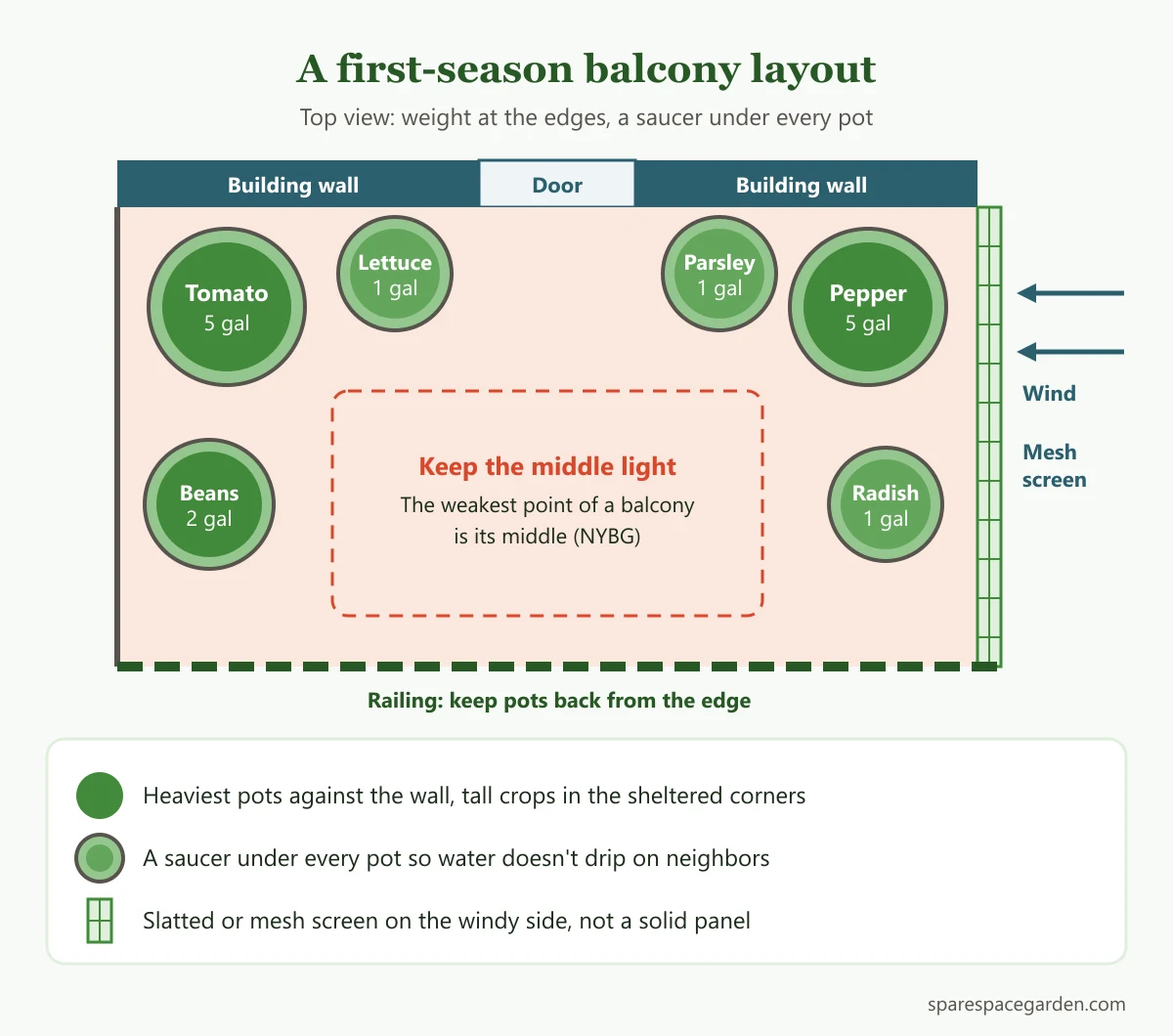 A first-season balcony layout: weight at the edges, saucers under every pot and a mesh screen on the windy side.
Frequently asked questions
Can you grow vegetables on a north-facing balcony?
Yes, but choose carefully. NYBG says north-facing balconies get only about two hours of light a day, while Maryland Extension gives 3–5 hours of direct sun for cool-season crops. Try lettuce, spinach and parsley in the brightest corner, use light-colored surfaces to bounce light, and skip tomatoes and peppers.
How much weight can a balcony hold?
It depends on the building, so there's no safe universal figure. The RHS says projecting balconies have strict weight limits and recommends checking with a structural engineer or surveyor. Ask your landlord or building manager first, and remember that a 20-inch (51 cm) pot of moist mix can weigh about 100 pounds (45 kg).
What is the easiest vegetable to grow on a balcony?
Leaf lettuce and radishes are the easiest starting points. Texas A&M lists both for 1-gallon (3.8 L) containers, says they tolerate partial shade, and gives radishes 20–60 days from seed to harvest. Both are low-growing, so wind is less of a problem.
How often should you water a balcony vegetable garden?
Check every container daily. Texas A&M says once a day is usually enough, but leafy plants may need water twice a day, and the RHS notes exposed containers may need watering twice a day or more in summer. Wind and reflected heat both speed up drying.
Do I need permission to start a balcony garden?
Often, yes, at least for anything heavy or fixed in place. NYBG suggests talking with your building's manager or owner before a large project, and many leases and condo rules cover railing planters, hanging pots and drainage. A few small pots on the floor are rarely an issue, but asking first avoids problems later.