Rooftop planters work harder than pots in a backyard. They sit in full sun above a surface that can get far hotter than the air, catch wind from every side, and rest on a waterproof roof that you can't afford to damage. The safest all-round choice is a pale, non-porous planter that is long, low and as large as the roof can carry.
Below: materials compared, size by crop, weight, roof protection, anchoring and watering. Planning a structure instead? Read about rooftop greenhouse basics.
Quick answer: Choose pale fiberglass, resin, plastic or cedar over dark metal, unglazed terracotta and fabric. Give lettuce at least 6–8 inches (15–20 cm) of mix and tomatoes 5 gallons (19 L) or more, fill with lightweight potting mix, set every planter on feet over a protective mat, and get your building's approval on weight before you fill anything.
What a roof does to a planter
Three things set a roof apart from the ground: heat, wind and the surface underneath. The RHS guide to roof gardens and balconies names strong winds and sunshine as the main limits on a roof garden, and warns that leaves can scorch even when plants are well watered.
Heat comes from above and below. Brooklyn Botanic Garden notes that black roofs get much hotter than white or silver ones and can reach 170°F (77°C) in New York City on very hot days. Inside the pot, NC State Extension says the mix in outdoor containers can swing by as much as 30°F (about 17°C) between day and night.
Wind dries planters out and pushes them over; the RHS says small containers dry out quickly in wind and heat. And everything rests on a waterproof layer that has to keep working for years.
Rooftop planter materials compared
No material is perfect on a roof. NC State Extension's container chapter sorts pots into nonporous (plastic, metal, fiberglass, glazed), semi-porous (wood) and porous (clay, unglazed terracotta), and says porous and semi-porous pots need watering more often.
| Material | Weight | Drying speed | Winter | Main rooftop concern |
|---|---|---|---|---|
| Fiberglass or resin | Light | Slow | Check the maker's frost rating | Tall pots can tip |
| Plastic | Light | Slow | Can stay out all year | Sun degrades it over time |
| Metal | Light if thin-walled | Slow | Gets very cold | Heats up fast in sun |
| Cedar or redwood | Medium | Faster | Can stay out all year | Lasts around 10 years unpainted |
| Unglazed terracotta | Heavy | Fast | Can crack in frost | Weight and frost damage |
| Fabric grow bag | Very light | Fast | Not covered by sources | Dries out and blows around |
Fiberglass, resin and plastic
These are the usual first choice. The RHS recommends fiberglass, plastic or lightweight metal containers on roofs because they're non-porous, so the mix inside doesn't dry out as fast as it would in terracotta. Brooklyn Botanic Garden also favors plastic or lightweight wooden planters over heavier terracotta or concrete.
Two limits apply. University of Illinois Extension notes that plastic, resin and fiberglass pots are light, so tall or top-heavy plants in them tip more easily. Sunlight also wears plastic down: the RHS says it degrades over time, and University of Maryland Extension warns that plastics not made for outdoor use turn brittle. Buy outdoor-grade pots, and check the frost rating on fiberglass and resin, since NC State only confirms that plastic and wood can stay out year-round.
Metal
Metal planters run hot. The RHS says metal containers heat up quickly in summer and get very cold in winter, and Illinois Extension says metal and dark-colored pots absorb more heat, which can damage roots and dry the mix faster. If you use metal, pick a pale finish, go large, and consider lining the inside walls. NC State notes that containers in full sun may need extra insulation to keep roots from overheating.
Wood
Wood is semi-porous, so it dries faster than plastic, but it's a sensible middle-weight option. NC State says cedar and redwood resist decay naturally and can last around 10 years without staining or painting, while the RHS points out that wood rots over time. Long wooden troughs also make low, stable shapes, which helps in wind.
Terracotta and fabric
Unglazed terracotta is the hardest material to justify on a roof. It's heavy, it dries out fast, and NC State says unglazed ceramic pots shouldn't stay outside over winter because absorbed water freezes and cracks them. If you love the look, the RHS advises buying frost-proof pots rather than ones labeled only frost-resistant.
Fabric grow bags are light, which is good for the roof and bad in a gust. Illinois Extension groups fabric with terracotta as a porous material that dries out much faster than plastic. On an exposed roof that can mean watering more than once a day, so keep fabric bags for sheltered corners.
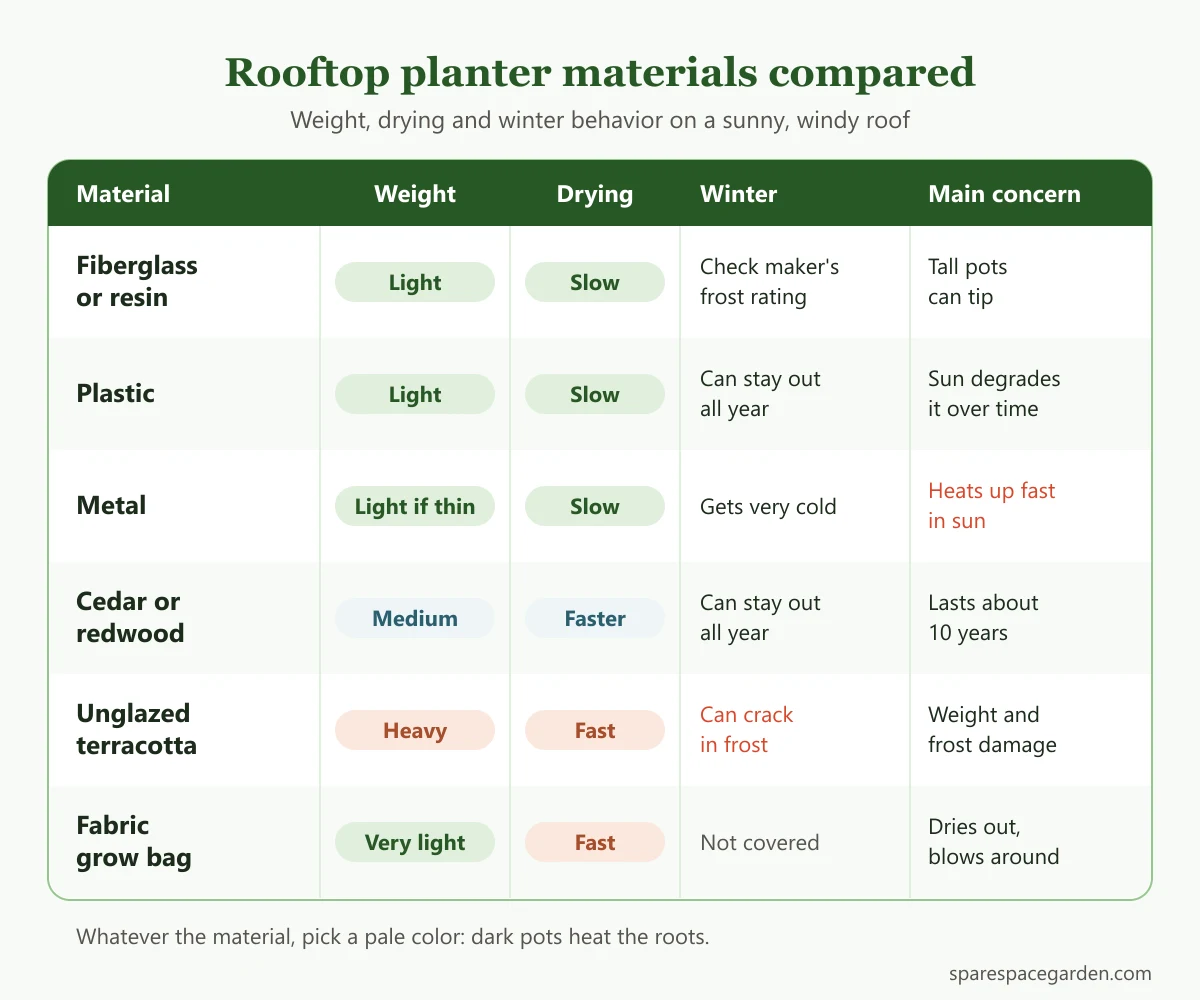 How six common planter materials compare on a sunny, windy roof.
Color and heat: keep the roots cool
Color matters as much as material in full sun. University of Maryland Extension says dark container colors can raise potting mix temperatures and injure tender roots, and NC State advises keeping dark containers out of full summer sun. A roof often has no shade to move them into, so start with white, cream, pale gray or light wood.
A few more ways to cut root heat:
- Go bigger. The RHS notes that larger containers dry out more slowly, which matters most on hot, exposed days.
- Shade the sides. Illinois Extension suggests shading containers with trailing plants. Grouping planters so they shade one another works the same way.
- Insulate thin walls. For metal or thin plastic in full sun, NC State says extra insulation inside the pot can protect the roots.
- Keep away from vents. Brooklyn Botanic Garden warns against growing beside air-conditioning units or intake fans, whose heat can scorch plants and may pose a fire hazard.
How big rooftop planters should be
Bigger planters dry out more slowly, but every gallon adds weight. UMD's guide to container types gives three minimums for vegetables:
- Small crops (herbs, radishes, scallions, spinach, salad greens, peas): 1–3 gallons (3.8–11 L) of mix, 4–6 inches (10–15 cm) deep.
- Medium crops (dwarf tomatoes, peppers and eggplant, summer squash, cabbage-family crops, beans, beets, chard, carrots): 4–6 gallons (15–23 L), 8–12 inches (20–30 cm) deep.
- Large crops, one plant per container (tomatoes, peppers, eggplant, cucumbers, winter squash): 8–10 gallons (30–38 L), 12–16 inches (30–41 cm) deep.
NC State's figures differ a little: 6–8 inches (15–20 cm) of mix for lettuce, 10–12 inches (25–30 cm) for carrots, and 5 gallons (19 L) as the minimum for tomatoes and eggplant. On a hot, windy roof, the larger number is the safer target if your weight allowance covers it.
Shape counts too. The RHS says long, low planters work especially well on roofs, and Illinois Extension says square pots are the most stable and tapered pots the least.
Weight and the roof membrane
Get approval before you fill
Weight is the one question no article can answer for your building. The RHS advises checking how much the roof can carry with a chartered structural engineer or surveyor, confirming the roof is waterproof, and placing heavy containers near load-bearing walls or over a beam or joist. Brooklyn Botanic Garden adds that you need permission from your landlord, co-op board or superintendent, and that it's worth asking whether roof work such as repainting is planned.
A few numbers help that conversation. UMD puts soilless potting mix at about 10 pounds per cubic foot (about 160 kg per cubic meter) dry, and both UMD and NC State say a 20-inch (51 cm) container of moist mix and plants can weigh about 100 pounds (45 kg). Our balcony raised garden bed guide shows how to estimate the soaked weight of any planter from its size.
To keep weight down:
- Use lightweight mix. Brooklyn Botanic Garden calls lightweight growing medium a must on roofs and suggests bagged container mixes with sphagnum, perlite and vermiculite. Our guide to the best potting soil for vegetables explains what to look for.
- Skip the gravel. NC State says never to put gravel or rocks in the bottom of a container for drainage. The RHS suggests polystyrene pieces in the base of large pots instead, to save weight.
- Know the trade-off. The RHS notes that soil-based compost holds water better but is heavier, and that light compost in a light container may need fixing so it doesn't blow over.
Protect the waterproofing
Planters shouldn't sit flat on the roof surface. Brooklyn Botanic Garden suggests rubber mats, wooden decking or another buffer under containers to improve drainage and protect the roofing, and the RHS says raising containers keeps roots from becoming waterlogged. For larger gardens, the RHS mentions a suspended "false" floor that carries weight onto the walls, a job for a professional.
- Feet over a mat. Set every planter on pot feet or a slatted stand above the protective layer, so water drains away and the surface underneath can dry.
- A clear drain path. The RHS says excess irrigation water should flow to a drainpipe outlet, and Brooklyn Botanic Garden says to clear dead leaves before they clog the roof drain.
- Side drain holes. For containers on solid surfaces, NC State suggests holes along the side ¼–½ inch (6–13 mm) above the bottom.
- No fixings into the roof. Never screw, nail or drill into the roof surface to anchor a planter.
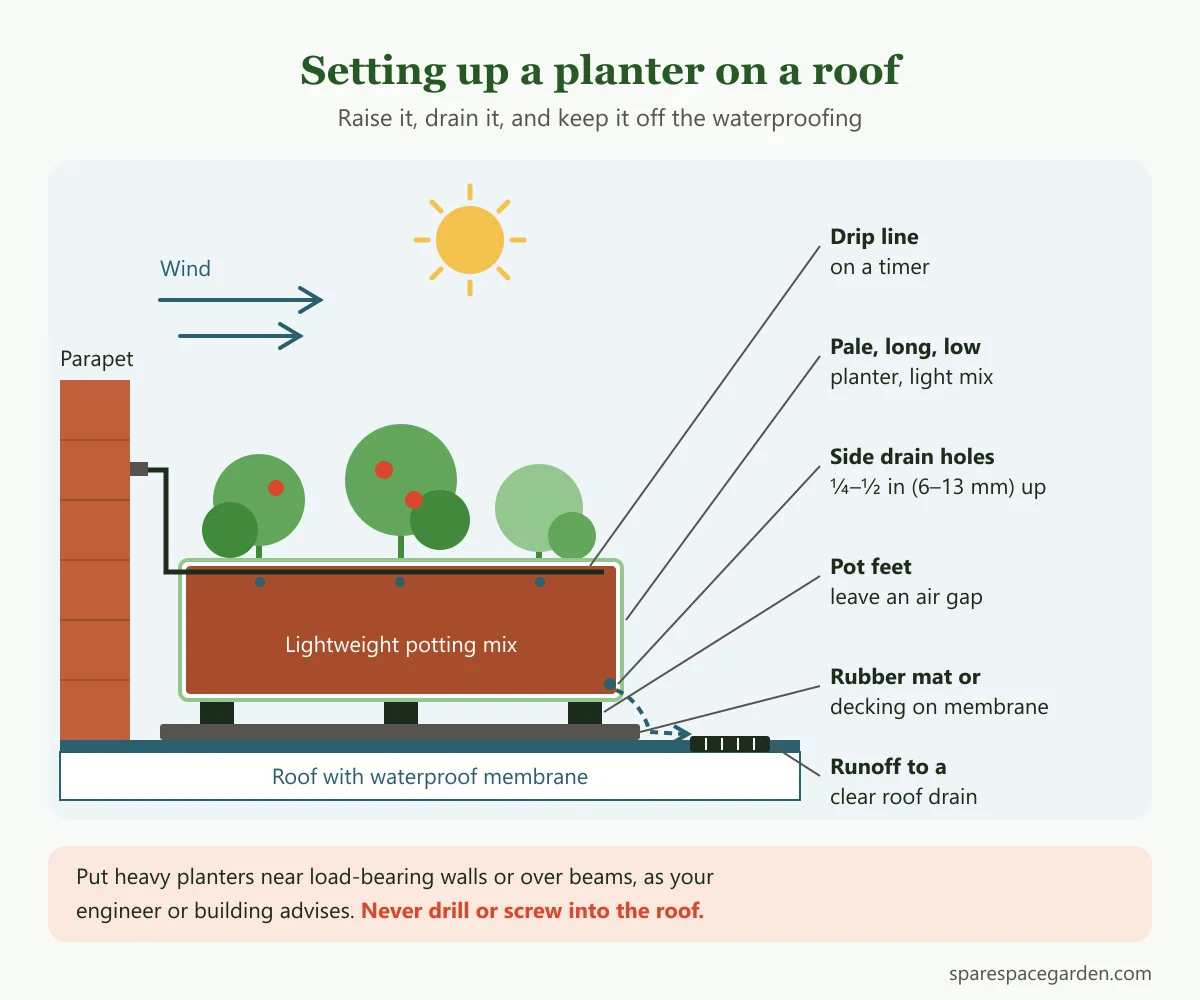 A planter set-up that keeps water moving and the roof surface protected.
Watch out: Don't drag a full planter across the roof. Empty it or use a wheeled caddy on a protected path, so a rough base can't scrape the surface.
Anchoring rooftop planters against wind
Because you can't bolt anything into the roof, stability has to come from shape, weight and position.
- Choose low and wide. The RHS warns that tall, narrow containers are prone to blowing over, especially with tall plants, and suggests bricks or stones in the base. Long, low troughs are steadier.
- Pick straight sides. Illinois Extension rates square pots the most stable shape.
- Use the walls. Brooklyn Botanic Garden suggests low containers against perimeter walls, or a well-secured trellis as a windbreak. The RHS adds that solid walls create turbulence on their sheltered side, while slatted or mesh screens filter the wind.
- Weight tall pots. NC State says denser mixes help prevent blow-down and that sand can act as a counterweight for top-heavy plants. Save this for the few tall pots that need it, since it adds load.
- Tie up tall crops. The RHS says taller plants should be fixed securely, and Brooklyn Botanic Garden says to secure furniture, tools and watering cans so they don't take off.
Watering planters on a roof
Water supply often decides how many rooftop planters you can manage. Brooklyn Botanic Garden says most rooftop container plants need daily watering in the growing season, and the RHS says summer watering may be needed twice a day or more.
- Find a tap first. Brooklyn Botanic Garden says many rooftop gardeners run drip irrigation from roof-level spigots. A rain barrel is the fallback, but it's heavy when full, so weigh it, secure it and get approval.
- Consider drip lines. NC State calls drip systems convenient and timesaving, and notes they use less water per cycle, which means less nutrient runoff. A rain-delay timer stops it running after a storm, and UMD mentions battery-powered timers for containers.
- Mind hot hoses. NC State warns that a hose lying in the sun can deliver hot water that stunts root development. Let it run until the water is cool.
Tip: If there's no tap on the roof, self-watering containers for vegetables hold a reservoir under the mix and stretch the time between waterings. Brooklyn Botanic Garden mentions subirrigated planters for exactly this reason.
Frequently asked questions
What are the best planters for a rooftop garden?
Light-colored fiberglass, resin, outdoor-grade plastic or cedar suit most roofs. They're lighter than terracotta or concrete, and the non-porous ones hold moisture longer. Long, low shapes are the most wind-stable.
Are metal planters a good idea on a roof?
They can work with care. Metal heats up quickly in summer and gets very cold in winter, and the extra heat can damage roots. Choose a pale finish, a large size and an insulated lining.
How do you stop rooftop planters from blowing over?
Use low, wide or square planters, group them against parapet walls, and put the heaviest pots where the building says they can go. Weight the base of tall pots with bricks or stones as the RHS suggests, tie tall plants securely, and never anchor anything by drilling into the roof.
Do rooftop planters damage the roof?
They can if they trap water or scrape the surface. Put rubber mats or decking under containers, set planters on feet, keep the roof drain clear of leaves, and check with your building before installing anything large.
How deep should rooftop planters be for vegetables?
UMD gives 4–6 inches (10–15 cm) for herbs and salad greens, 8–12 inches (20–30 cm) for medium crops such as beans and dwarf tomatoes, and 12–16 inches (30–41 cm) for full-size tomatoes, peppers and cucumbers. Deeper planters dry out more slowly but weigh more.