A balcony raised garden bed gives you a deep, roomy growing space without a yard, but it also puts a lot of weight in one spot once the mix is soaked. Before you buy or build one, work out roughly what it will weigh when wet, check that against what your building allows, and plan where the drainage water will go.
This guide covers the weight math in plain numbers, then the practical parts: legged versus floor-standing beds, how deep each crop needs, liners and trays, and how to fill and look after the bed.
Quick answer: Bagged soilless mix weighs about 10 lb per cubic foot dry, but soaked it can approach 60 lb per cubic foot (roughly 1 kg per liter). Each inch of wet mix adds up to about 5 lb per square foot, or about 10 kg per square meter for each centimeter. Ask your building about load limits, use 8 inches (20 cm) of mix for greens and 12 inches (30 cm) or more for tomatoes, and put a tray under every drain hole.
How much does a balcony raised garden bed weigh?
Most of the weight is water. University of Maryland Extension puts soilless potting media at about 10 pounds per cubic foot and garden soil at about 75 pounds per cubic foot. Water is far heavier than dry mix: the USGS lists water at 62.4 pounds per cubic foot, which works out to 1 kilogram per liter.
UMD also notes that a good potting mix is 50 to 80 percent pore space. Right after a thorough watering, much of that space holds water. Add that water to the dry weight and a soaked mix lands somewhere around 40 to 60 pounds per cubic foot. That's an estimate built from those two figures, not a lab measurement, so plan with the top of the range.
For a real-world check, UMD says a 20-inch (51 cm) container filled with moist potting mix and plants can weigh 100 pounds (45 kg).
| Material | Weight per cubic foot | Weight per liter | Where the figure comes from |
|---|---|---|---|
| Soilless potting mix, dry | About 10 lb | About 0.16 kg | UMD Extension |
| Soilless mix, soaked | About 40–60 lb | About 0.6–1.0 kg | Estimate from UMD pore space and USGS water weight |
| Water | 62.4 lb | 1.0 kg | USGS |
| Garden soil | About 75 lb | About 1.2 kg | UMD Extension |
That last row is the reason garden soil has no place in a balcony bed. UMD adds that soil is too dense to let air and water move well around roots in a container, so it fails on drainage as well as weight.
How to estimate the load before you buy
You don't need an engineering degree to get a ballpark figure. You need a tape measure and five minutes.
- Measure the inside of the bed. Use the depth you will actually fill, not the outside height of the frame.
- Work out the volume. In US units, multiply length × width × depth in feet to get cubic feet. In metric, multiply the three measurements in centimeters and divide by 1,000 to get liters.
- Multiply by the wet weight. Use 60 lb per cubic foot, or 1 kg per liter.
- Add everything else. Include the bed itself (check the product listing), the plants, any water sitting in the tray, and the watering can you'll set down next to it.
- Divide by the footprint. This gives the load per square foot or square meter, which is the number a building manager or engineer will ask about.
Here's a worked example. A 2 × 4 ft bed filled 12 inches deep holds 8 cubic feet (about 226 L). At 60 lb per cubic foot, the mix alone can reach about 480 lb (218 kg). Spread over 8 square feet, that's 60 lb per square foot, or about 290 kg per square meter. Fill it only 6 inches (15 cm) deep and both numbers drop by half.
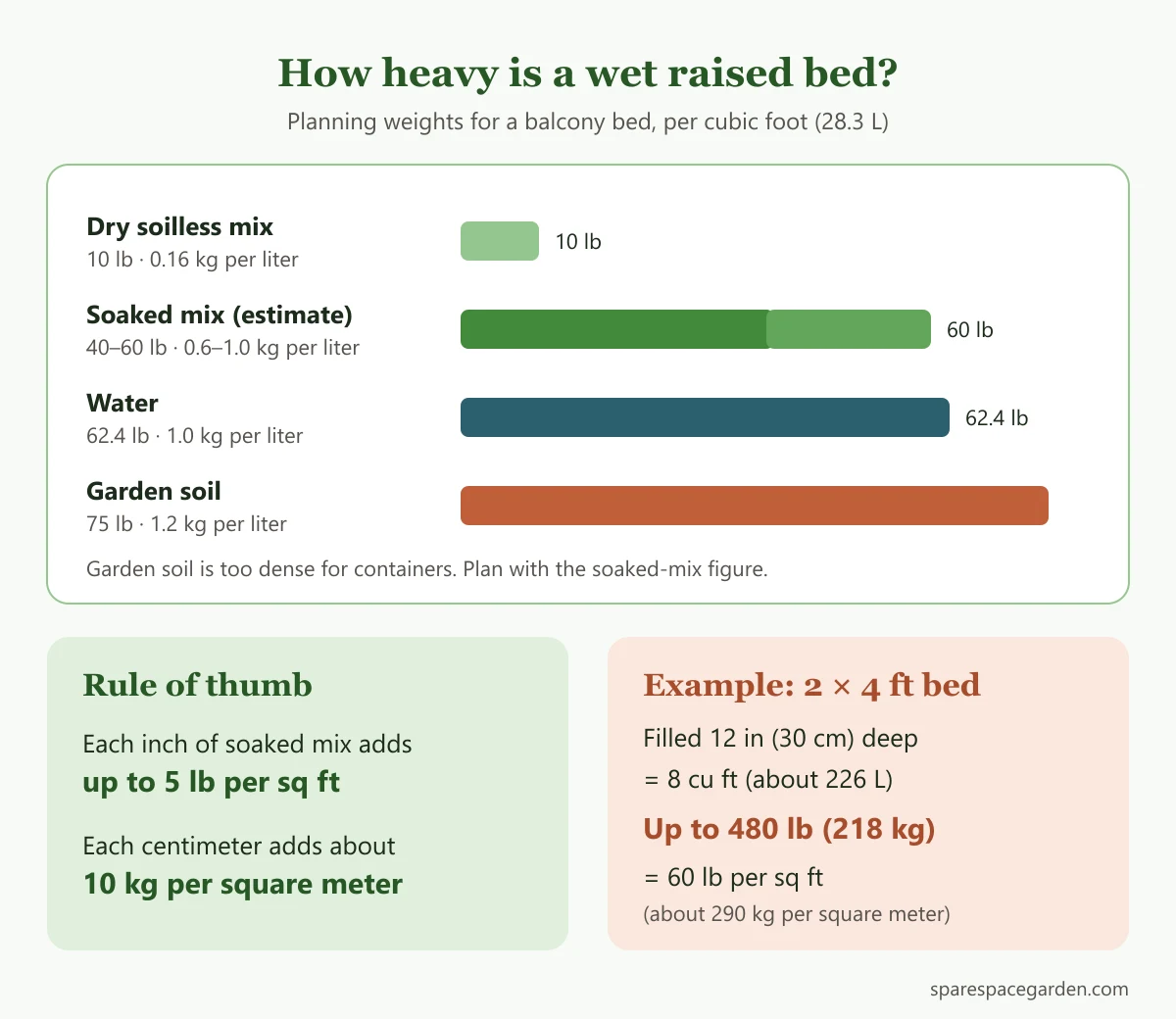 Wet mix can weigh six times its dry weight. Use the soaked figure when you plan.
Check what your balcony can carry
No article can tell you whether your particular balcony is strong enough. The numbers above are for a conversation with your building, not a replacement for one.
The RHS guide to roof gardens and balconies says to find out how much weight a structure can take before you start, and recommends a chartered structural engineer or surveyor for that check. It also places heavy containers near load-bearing walls or over a beam. Brooklyn Botanic Garden adds a step renters often skip: get permission from your landlord, co-op board or building superintendent before you plant anything.
Whatever limit you're given has to cover furniture and people too, not only the bed. A smaller bed plus a few separate pots spread around the space is often an easier request than one large box.
Watch out: The RHS warns of strict weight restrictions on balconies that are suspended out from the building. If yours sticks out from the wall with no posts underneath, get a clear answer from the building before you fill a large bed.
Legged beds vs floor beds
Raised beds for balconies come in two broad styles, and each one handles weight and water differently.
Floor-standing beds
A trough or frame that sits on the floor can be deep enough for tomatoes and peppers. The trade-off is weight: a deep floor bed is the heaviest option, and it spreads that weight across its whole footprint. It can also trap water against the floor unless you raise it slightly, which is covered in the drainage section below.
Legged beds and planter tables
A bed on legs puts the growing surface at a comfortable working height and leaves air underneath. UMD's salad table design is a good reference point: the frame is 58 inches long, 33 inches wide and 3½ inches high (about 147 × 84 × 9 cm), and the table stands 36 inches (91 cm) tall. It holds 2.8 cubic feet (about 22 gallons or 80 L) of mix, enough for lettuce and other greens.
Even that shallow table could weigh around 170 lb (77 kg) when soaked, using the 60 lb figure, and all of it travels down through the legs. UMD says a deeper 9- to 10-inch (23–25 cm) frame is needed for dwarf tomatoes, peppers and bush cucumbers, which nearly triples the volume and the weight.
For heavy floor containers, UMD suggests plant caddies, which are low wheeled platforms, so you can move them for cleaning or to chase the sun. If you're still deciding what to grow, the balcony vegetable garden guide covers sun and crop choices.
How deep should a balcony raised bed be?
A bed on a balcony floor has no ground beneath it, so the frame is the entire root zone. UMD's raised bed guidance gives depths for beds on exactly this kind of hard surface, and Oregon State adds figures for root crops.
- Lettuce and salad greens: about 3½ inches (9 cm) works on a salad table.
- Radishes: 4–6 inches (10–15 cm), according to Oregon State University Extension.
- Leafy greens, beans and cucumbers: at least 8 inches (20 cm).
- Beets and carrots: at least 12 inches (30 cm).
- Tomatoes, peppers and squash: 12–24 inches (30–60 cm).
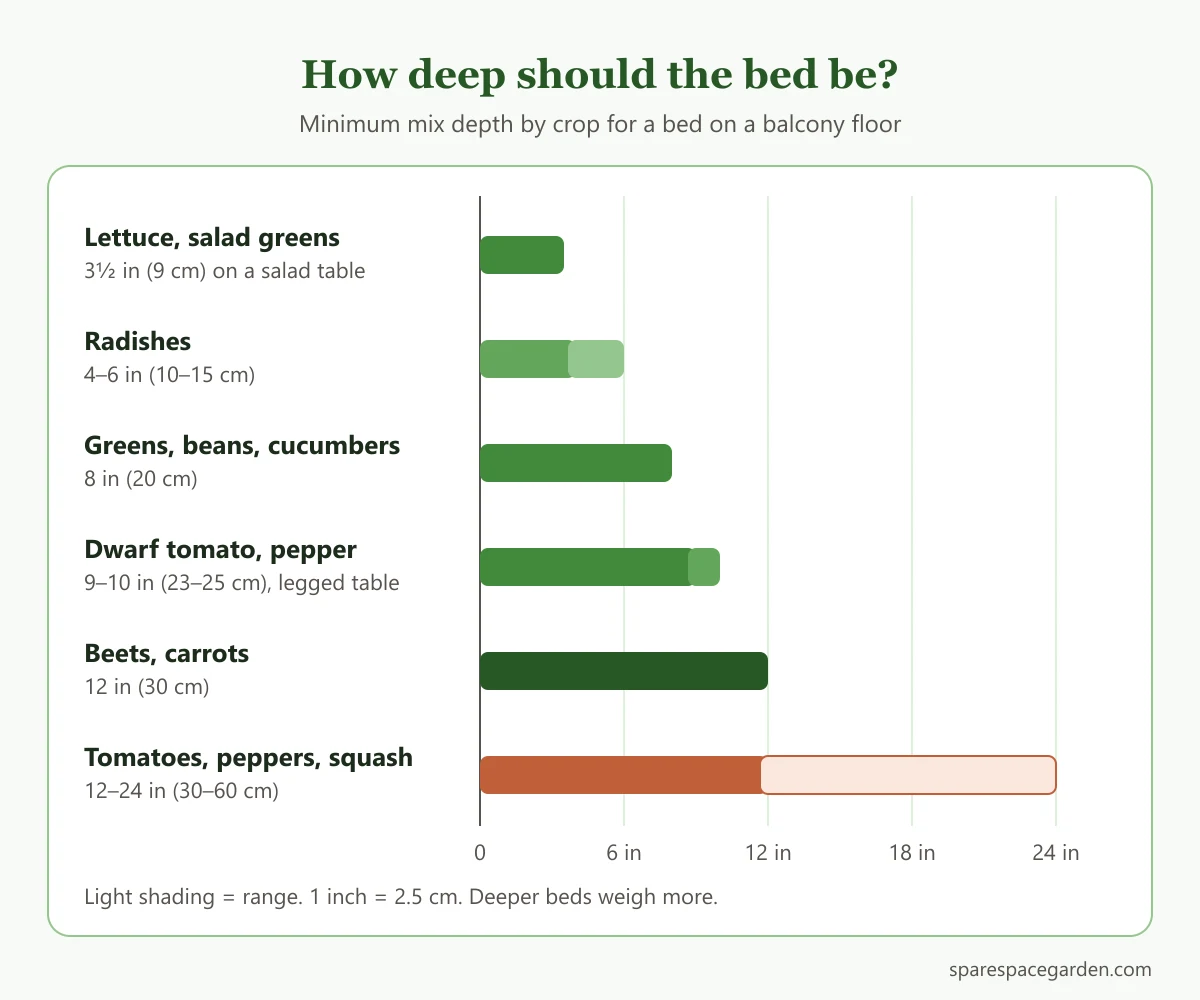 Minimum depth by crop for a bed on a hard surface.
Depth is where weight adds up fastest. Going from 8 to 12 inches adds about 20 lb per square foot when the mix is soaked, or about 100 kg per square meter for the extra 10 cm. One practical layout is a shallow bed for greens and herbs, with tomatoes and squash in their own deep pots. See how many tomato plants per container for pot sizes.
Liners, trays and drainage that protect the floor
Every gallon you pour in has to go somewhere. On a balcony, that somewhere might be the neighbor's table one floor down.
- Drain holes first. UMD says every container needs drainage holes or slits. A bed without them turns into a heavy tub of waterlogged mix.
- Liners with an exit. If you line a wooden bed, UMD advises either drilling drainage holes in the base of the liner or lining only the sides so the bottom stays open.
- Skip the gravel. UMD notes that gravel or pot shards in the bottom don't improve drainage. On a balcony they also add weight for no benefit.
- Use a tray or saucer. UMD says saucers prevent stains on decking and pavement and can help if you are gardening above a neighbor's balcony. Empty them regularly so standing water doesn't cause root rot or breed mosquitoes. Detached saucers are easier to empty.
- Lift the bed slightly. UMD suggests pot feet or bricks to raise containers an inch or two (2.5–5 cm). The RHS also recommends raising containers so roots don't become waterlogged.
- Protect the surface. Brooklyn Botanic Garden suggests a buffer such as rubber mats or wooden decking under containers, and says to clear dead leaves so they don't clog the drain.
Tip: Water slowly until the first trickle reaches the tray, then stop. Pouring fast floods the tray before the mix has soaked anything up.
Filling and maintaining your balcony raised garden bed
Choose a lighter mix
For beds on hard surfaces, UMD recommends compost and soilless growing mix in a 1:1 ratio. It allows topsoil at up to 20 percent of the volume, but only in beds at least 16 inches (40 cm) deep. On a balcony, leaving topsoil out keeps the weight down.
Brooklyn Botanic Garden recommends bagged container mixes with sphagnum, perlite and vermiculite for rooftops. The RHS notes that soil-based compost holds water better but is heavier, and that light peat-free mixes can let containers tip in strong winds, so secure them. For more on blends, see the best potting soil for vegetables.
Work out how much to buy
Use the volume from your load estimate. UMD says a 2-cubic-foot (about 57 L) bag fills three 5-gallon buckets, so the 8-cubic-foot example bed takes four of those bags. Fill to within about an inch (2.5 cm) of the rim to leave room for watering.
Water and feed
UMD advises checking containers daily in summer, and notes a large container may need several gallons at a time. The RHS says roof and balcony plants often need watering twice a day in summer, and warns that the balcony above can stop rain from reaching yours. A drip line or self-watering containers can take some of the load.
UMD says slow-release fertilizer lasts two to three months, and that you can cut fertilizer by half if the mix is 50 percent compost. Follow the label on any product you use.
Refresh it each year
Potting mix breaks down over time. UMD explains that particles get finer and settle, which shrinks the volume and the pore space. The RHS suggests top-dressing every year by replacing the top few centimeters with fresh compost. If the whole bed has slumped, read can you reuse potting soil before you throw the old mix out.
Frequently asked questions
Can you put a raised garden bed on a balcony?
Usually, yes, as long as your building allows it and the wet weight stays within the balcony's limit. Estimate the soaked weight first, then ask your building manager or landlord. The RHS points out that balconies hanging off the building have strict weight limits, so start small on those.
How much soil does a balcony raised bed need?
Multiply length × width × fill depth. A 2 × 4 ft bed filled 12 inches deep needs 8 cubic feet (about 226 L), or four 2-cubic-foot bags. A bed filled 6 inches deep needs half that.
What goes in the bottom of a raised bed on a balcony?
Nothing heavy. UMD says gravel doesn't improve drainage, so fill the bed with potting mix all the way down. If the bed has a liner, make sure it has drainage holes or covers only the sides, and put a tray underneath.
How deep should a balcony planter be for tomatoes?
UMD recommends 12–24 inches (30–60 cm) for tomatoes in beds on hard surfaces. Dwarf varieties can manage in a 9- to 10-inch (23–25 cm) frame on a legged salad table. Deeper beds weigh more, so many growers keep tomatoes in separate pots.
Will a raised bed damage a balcony floor?
The main risks are standing water and stains rather than the bed itself. Raise the bed on feet, use a tray, empty it after watering, and keep the balcony drain free of leaves. For wooden decks, see vegetable planters for a deck.