A rooftop greenhouse can stretch your season and protect seedlings, but on a roof the hard questions come before the fun ones. You need permission from the building owner, a structural check of the roof, a plan for wind, and a way to keep the inside from overheating on sunny days.
This guide walks through those checks in the order you'd tackle them, then compares small options such as cold frames and mini greenhouses with full structures, and covers glazing, ventilation, water and crops. It can't tell you whether your roof is strong enough. Only a qualified engineer who has seen the building can do that.
Quick answer: Get written permission and ask about permits first; a greenhouse usually needs a building permit, and some cities require an engineer or architect for a rooftop structure. Have a structural professional confirm the roof can carry the greenhouse, wet soil, snow and wind. Anchor it firmly, choose light, impact-resistant glazing such as twin-wall polycarbonate, and plan on vents equal to about 20% of the floor area. The RHS warns that plant damage can start above about 81°F (27°C).
Permission and permits come first
Start with the people who control the roof. Renters need the landlord's or board's written approval, and owners in shared buildings usually need the association's. Then check with your local building department, because rules vary widely by city.
University of Georgia Extension's guide to hobby greenhouses says a building permit is usually required to put up a greenhouse, and that plumbing and electrical work should be done by professionals to local codes. On a roof, the bar tends to be higher. The City of Victoria in British Columbia publishes a clear example in its rooftop greenhouse guide:
- Rooftop greenhouses are allowed only on multi-unit buildings with at least four units.
- Zoning sets limits on height and floor area, such as staying under 3.65 m (about 12 ft) tall.
- A building permit requires an engineer or architect to design and review the project and confirm the building can carry the extra roof loads and wind.
- Heating a greenhouse brings extra permits, such as electrical or gas.
In New York City, the Department of Buildings says that permitted greenhouse work requires a registered design professional to submit construction plans before a permit is issued. Your city may differ, but expect similar questions.
Structural load: get a professional assessment
A greenhouse frame may be light, but everything inside it isn't. Wet potting mix, filled containers, water, benches and people add up quickly, and snow can sit on the roof panels in winter. The RHS advice on roof gardens says to find out how much weight the roof can take, to use a chartered structural engineer or surveyor, and to confirm that the roof is waterproof before you add anything.
The RHS also suggests placing heavy containers near load-bearing walls or over a beam or joist. For the weight of wet mix, our guide to balcony raised garden beds shows how to estimate it in pounds per square foot or kilograms per square meter. Bring those numbers to the engineer. Don't treat them as approval.
Watch out: This article can't confirm that any roof, kit or anchoring method is safe for your building. Treat every number here as background for a conversation with a structural engineer, not a substitute for one.
Wind and anchoring
Wind is usually the biggest force a greenhouse faces. UConn Extension's article on wind loads says that in most of the United States, wind load is the greatest force a greenhouse will be subject to. Wind flowing over the roof can act like an aircraft wing and lift the structure, and an open door or vent on the windward side can build pressure inside that adds to the lift unless the greenhouse is well anchored.
Height makes this worse. UConn notes that design wind speeds are measured at 33 feet (10 m) above open ground, and that buildings lower than that get a reduction. A greenhouse on a multi-story roof often sits above that height, with little to slow the wind.
Practical steps that follow from this:
- Anchor to something the engineer approves. Ask how to secure the frame without puncturing the roof's waterproof layer.
- Close the windward door and vents in a storm. This reduces the inside pressure that lifts the structure.
- Use filtering screens, not solid walls. The RHS says solid walls cause turbulence on the sheltered side, while slatted or mesh screens slow the wind more gently.
- Keep back from the edge. Victoria recommends setting a rooftop greenhouse at least 2 m (about 6.5 ft) from the edge of the building where space allows.
- Weigh down or fix small units. The RHS advises fixing lightweight containers so they don't blow over. Shelf-style mini greenhouses with plastic covers are especially easy to tip.
Small options vs full structures
You don't have to start with a walk-in greenhouse. Smaller covers need less permission, less money and less structural margin, and they still extend the season.
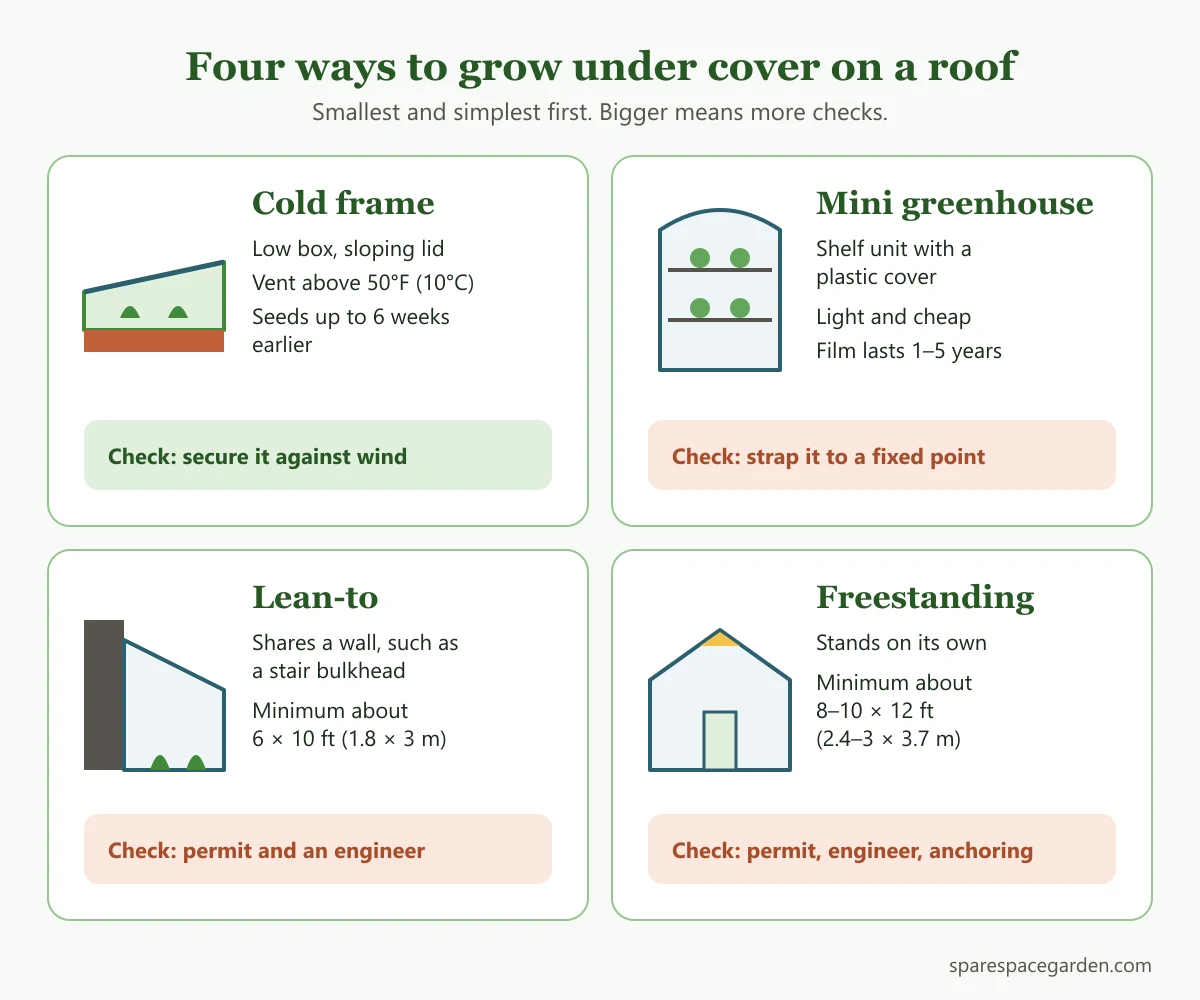 From cold frame to full greenhouse: bigger means more growing room but more checks.
Cold frames
A cold frame is a low box with a clear, sloping lid. Colorado State University Extension's cold frame guide suggests a south-facing spot protected from wind, a lid you lift on days above 50°F (10°C), and closing it in late afternoon to hold warmth overnight. It says you can start seeds up to six weeks earlier in a cold frame. On a roof, use plastic glazing rather than old windows: CSU notes old windows can have fragile glass and paint that may not be lead-free.
Mini greenhouses
Shelf units with zip-up plastic covers are cheap and light, which is exactly their weakness in wind. Strap them to a fixed point, keep them low, and expect the cover to need replacing every few seasons, since polyethylene film is the shortest-lived glazing.
Lean-to greenhouses
A lean-to shares one wall with the building, often a stair or elevator bulkhead on a roof. Clemson's hobby greenhouse fact sheet calls it the least expensive greenhouse structure and suggests a minimum of 6 ft by 10 ft (1.8 × 3 m), useful where space is limited to a width of about 7 to 12 feet (2.1–3.7 m). The shared wall blocks light from one side, so face the open side south if you can.
Full freestanding greenhouses
Clemson suggests at least 8 or 10 ft wide by 12 ft long (2.4–3 × 3.7 m) for an even-span or freestanding house. On a roof, this is the option most likely to need a full permit, engineered drawings and anchoring.
Choosing glazing for a rooftop greenhouse
On a roof, you want glazing that is light, stands up to impacts and storms, and won't leave sharp shards if something hits it. The figures below come from the University of Arkansas greenhouse course and UGA. They vary by product, so check the specification for anything you buy.
| Glazing | Light transmission | Typical life | Rooftop notes |
|---|---|---|---|
| Glass | 85–94% (single layer) | 25+ years | Heavy, needs strong supports, low impact resistance. Clemson says tempered glass is 2–3 times stronger |
| Twin-wall polycarbonate | About 83–87% | 7–25 years, by product | Light, rigid, insulates better than single glass; scratches easily |
| Acrylic (twin-wall) | 87–93% | 20+ years | Light and clear, but costly, scratches and is flammable |
| Polyethylene film | 85–87% (single layer) | 1–5 years | Cheapest and lightest; drips condensation; replace often |
Alabama Cooperative Extension System lists heat-loss values that explain why twin-wall panels help in cold months: 8 mm twin-wall polycarbonate scores 0.65, against 1.13 for single glass and 1.2 for single-layer film (lower means less heat lost). For most rooftop growers, twin-wall polycarbonate is the practical middle ground. Victoria also advises choosing UV-resistant materials, since translucent glazing becomes less clear over time.
Overheating, ventilation and roof heat
A greenhouse on a roof gets hit from two sides: full sun from above and heat from the roof surface around it. The EPA notes that on a warm day, conventional roofing materials can be as much as 66°F (37°C) warmer than the surrounding air.
The RHS guide to greenhouse ventilation and shading gives the targets most hobby growers use:
- Vent area: one square meter of ridge vent per five square meters of floor, or 20%. Smaller greenhouses need proportionally more because they have more glass per square foot of floor.
- Roof vents first: side louvers are less effective than roof vents.
- Automatic openers: fit them so roof vents open when you're not there. They open slowly, so keep the door and side vents as backup.
- Temperature: watch a maximum-minimum thermometer. Plant damage can occur above about 81°F (27°C), and shading should keep temperatures below about 77–81°F (25–27°C).
- Shading: usually needed from mid-spring to early autumn. External blinds cool best; shade paint is less suitable for polycarbonate and acrylic.
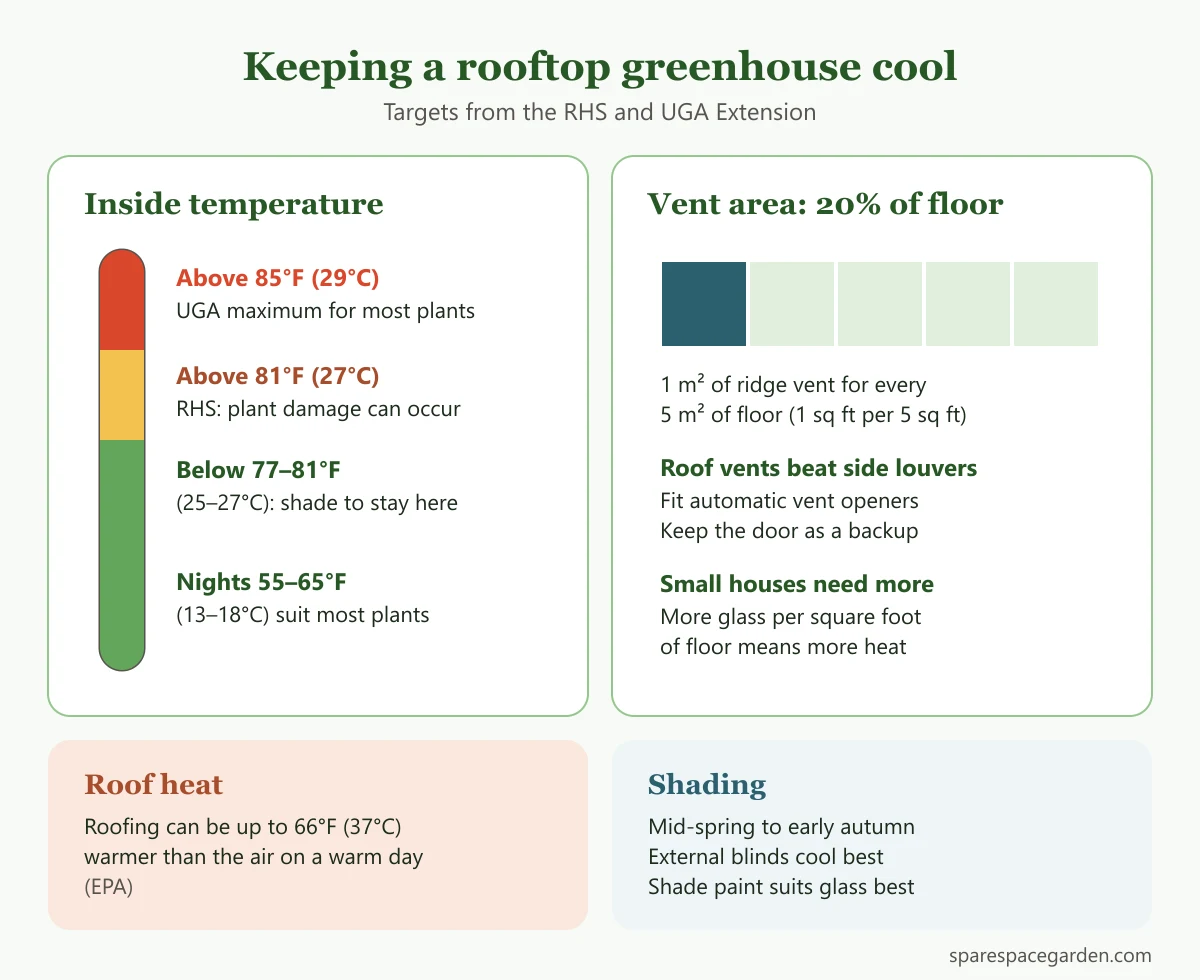 Ventilation and shading targets for a small greenhouse.
UGA gives 85°F (29°C) as a maximum for most plants and 55–65°F (13–18°C) as an adequate night temperature, with 40°F (4°C) as the minimum. Alabama Extension notes that shade cloth comes in grades such as 30%, 50% and 60%, and that the percentage refers to light blocked, not heat removed.
Tip: Fans count only if you have power, and running wiring to a roof usually means an electrical permit. Vent area and shading are the cheapest cooling you'll get.
Water access
Every liter of water weighs about a kilogram, and carrying it up stairs gets old fast. The RHS says container plants on roofs often need watering twice a day in summer, and suggests an irrigation system for larger areas. Before you build, find out:
- Whether there's a hose bib or tap on the roof, and whether you're allowed to use it.
- Where overflow and drainage water will go, so it reaches the roof drains instead of pooling around the greenhouse.
- Whether a timer-controlled drip system is practical. Clemson notes automatic systems can run on time clocks.
Large containers with reservoirs reduce trips. Our guide to self-watering containers for vegetables explains how they work, and lighter rooftop planters help keep the load down.
What to grow in a rooftop greenhouse
Many small rooftop greenhouses earn their keep as seedling nurseries. Victoria's guide shows a Montreal rooftop greenhouse used mostly to grow seedlings for the rooftop garden around it. Starting tomatoes and peppers under cover in spring is a good use of a small space; see how to grow tomatoes in pots from seed for timing. Bright light from all sides also helps prevent leggy seedlings.
For cool months, UGA lists lettuce, chives, endive, parsley and green onions as crops that can be grown through winter in a converted cold frame. In summer, warm-season crops can grow inside, but only if ventilation holds temperatures under that 85°F (29°C) limit. On an exposed roof in July, that may mean opening the structure fully or moving crops outside.
Frequently asked questions
Do you need a permit for a rooftop greenhouse?
Usually, yes. UGA says a building permit is usually required for a greenhouse, and cities such as Victoria require a building permit with an engineer or architect for rooftop structures. Small cold frames may not need one, but ask your building department and your landlord or board before you buy anything.
How much weight can a roof hold for a greenhouse?
There is no general answer. It depends on the roof's construction, its age and the local snow and wind loads. The RHS recommends a chartered structural engineer or surveyor, and the engineer will want to know the weight of the frame, containers, wet mix and water.
What is the best greenhouse material for a windy roof?
Twin-wall polycarbonate is a common choice: it's light, rigid and insulates better than single glass. Glass lasts longest, but Arkansas notes it is heavy and has low impact resistance. Polyethylene film is cheapest but tears and degrades within 1 to 5 years.
How do you stop a rooftop greenhouse from overheating?
Provide roof vents equal to about 20% of the floor area, fit automatic openers, add external shading from mid-spring, and keep a thermometer inside. The RHS says plant damage can occur above about 81°F (27°C).
Is a cold frame a good alternative to a rooftop greenhouse?
For many people, yes. A cold frame is low, light and cheap, and CSU says it lets you start seeds up to six weeks earlier. It still needs securing against wind and venting on days above 50°F (10°C).