Growing onions in containers comes down to one decision first: green onions or bulb onions. Green onions (scallions) are the easy option. They fit a pot 6–9 inches (15–23 cm) deep, grow close together, and are ready in about two months. Bulb onions need a wide, deep container, the right day-length type for where you live, and a full season of steady water.
Both are worth a try on a sunny balcony or patio. Onions are shallow-rooted and don't need staking, so they suit pots better than many vegetables.
This guide covers day-length types, sets versus transplants versus seed, pot size and spacing, care, and how to harvest and cure the bulbs.
Quick answer: For green onions, use a pot at least 6 in (15 cm) deep and thin plants to about 1–2 in (2.5–5 cm) apart. For bulb onions, the RHS suggests a container at least 18 in (45 cm) wide and deep, with plants 4–5 in (10–13 cm) apart, 6+ hours of sun, and a day-length type that suits your latitude.
Bulb onions or green onions: which to grow in a pot
Start with what you want to eat. Green onions are harvested young, for their leaves and slim white base, so the plants never need room to swell. Bulb onions are the storage onions you buy by the bag, and each one needs its own patch of soil to grow to full size.
| Green onions (scallions) | Bulb onions | |
|---|---|---|
| Minimum pot depth | 6–9 in (15–23 cm) | About 18 in (45 cm) deep and wide (RHS) |
| Spacing | About 1 in (2.5 cm) for salad onions; 2–2½ in (5–6 cm) if thinning from transplants | 4–5 in (10–13 cm) for large bulbs |
| Sun | Tolerate about 5 hours | At least 6 hours, 8–10 preferred |
| Time to harvest | About 2 months from sowing | 85–120 days to mature bulbs |
| Day length matters? | No | Yes, pick the right type |
If you're new to growing onions in containers, start with green onions: they give far more food per square foot on a small balcony. Bulb onions in a pot are possible, but a wide container that could hold a pepper or a tomato will produce roughly a dozen onions. If you have the space and the patience, it's a satisfying crop.
Chives are a third option if you mainly want mild onion leaves; see our guide to growing chives in pots.
Pick the right day-length type for your latitude
Bulb onions don't swell on a timer. They start forming bulbs when daylight reaches a set number of hours, and that number depends on the variety. Iowa State University Extension sorts onions into three groups: short-day types need 10 to 12 hours of daylight, intermediate types 12 to 14 hours, and long-day types 14 hours or more.
Where you live sets how long your summer days get. A University of Maryland Extension article on onions and day length uses 36° N latitude as the rough dividing line: short-day onions are grown mainly south of it, and long-day onions do best north of it. In the US, the 36th parallel passes close to Nashville and Las Vegas.
| Type | Daylight to start bulbing | Best fit | If you plant it in the wrong place |
|---|---|---|---|
| Short-day | 10–12 hours | Southern US and other warm, lower-latitude areas | Bulbs too early and stays small in the north |
| Intermediate-day | 12–14 hours | Middle latitudes, the band around 36° | The most flexible choice for many areas |
| Long-day | 14+ hours | Northern US, Canada, the UK | May not bulb at all in the Deep South |
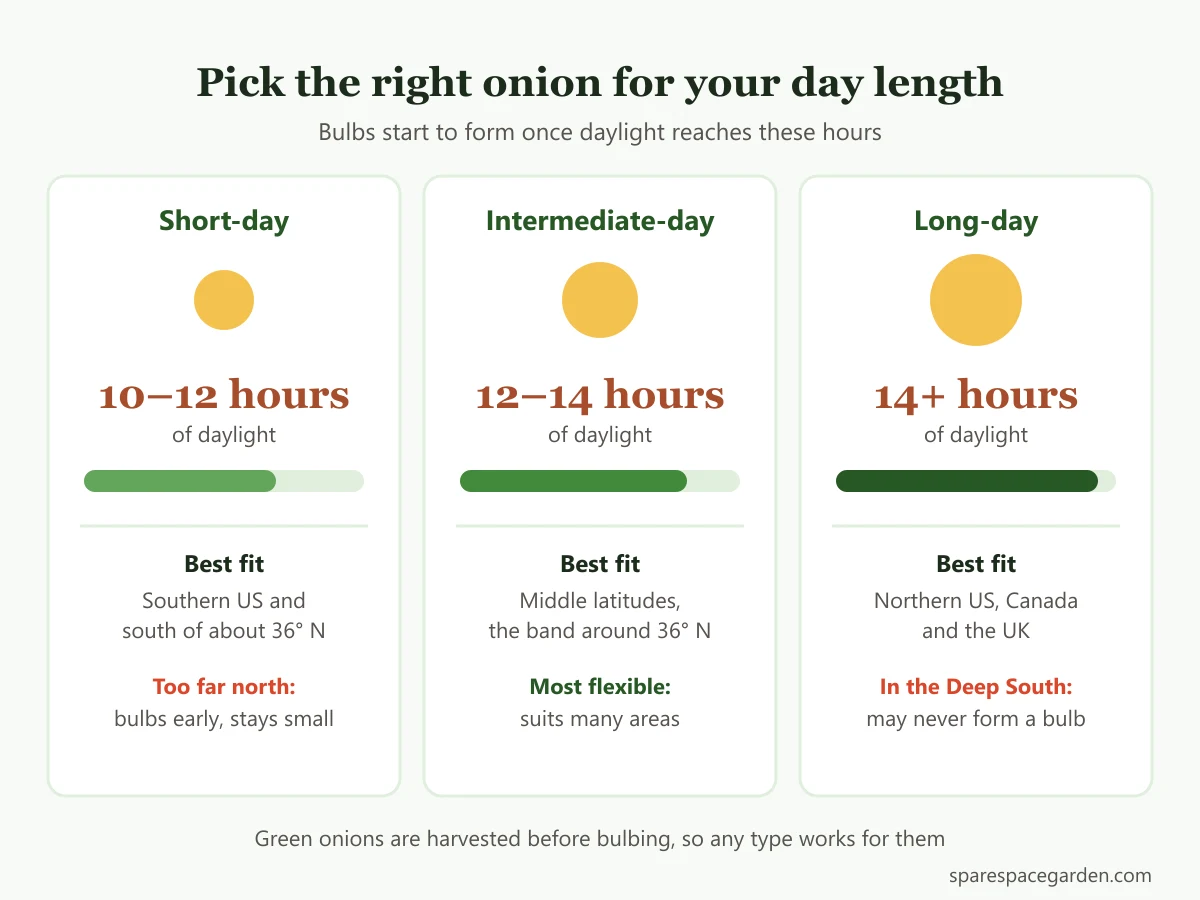 Match the onion type to your summer day length before you buy.
Illinois Extension's onion guide notes that long-day types may not form bulbs in the Deep South and should be avoided there, while short-day types can do acceptably in the North if planted very early. The same latitude logic applies south of the equator, so gardeners in Australia should match the type to how far they are from the equator.
Tip: Day length only matters for bulbs. If a seed packet or set bag doesn't list the type, grow those onions as green onions and pull them young.
Sets, transplants or seed
You can start bulb onions three ways, and each has a trade-off.
Sets
Sets are small, dormant bulbs grown the year before. The RHS calls them the easiest and fastest route. Illinois Extension recommends small sets, under the size of a US dime (about 18 mm across), for dry bulbs, and saving large sets for green onions. Plant small sets about 1 inch (2.5 cm) deep; the RHS says the tip should sit just at the surface.
The catch is bolting. Sets can send up a flower stalk, and the RHS links this to low spring temperatures; heat-treated sets reduce the risk. A bolted onion won't store well, so use it right away.
Transplants
Transplants are young plants sold in bundles; Illinois Extension says a bundle usually holds 60 to 80 plants. Nebraska Extension calls transplants the easiest option for large storage onions, and University of Maryland Extension recommends them for most of its gardeners. Set them 1 to 1½ inches (2.5–4 cm) deep. Leftover plants from a bundle make good green onions in a second pot.
Seed
Seed is cheapest and offers the widest choice of varieties. Maryland Extension suggests starting seed indoors about 8 weeks before planting out and sowing ¼ to ½ inch (0.6–1.3 cm) deep. Seed is also the standard way to grow green onions: sow thickly, then thin and eat the thinnings.
Pot size and spacing for growing onions in containers
Depth and width both matter. For bulb onions, the RHS onion guide recommends a container at least 45 cm (18 in) wide and deep. That's generous, but a big volume of potting mix holds more water, and bulb size depends heavily on steady moisture.
Spacing controls bulb size. Illinois Extension recommends 4 to 5 inches (10–13 cm) between plants for large bulbs and notes that closer spacing reduces bulb size. Maryland Extension gives 4 inches (10 cm) for moderate bulbs and 8 inches (20 cm) for large ones. At 4 inches apart, an 18-inch pot fits roughly a dozen onions.
Green onions are far less demanding. Washington State University Extension lists them among shallow-rooted crops that need a container 6 to 9 inches (15–23 cm) deep, and the RHS suggests a pot at least 30 cm (1 ft) wide for salad onions. Thin them to about 1 inch (2.5 cm) apart; the RHS warns that closer spacing may encourage downy mildew.
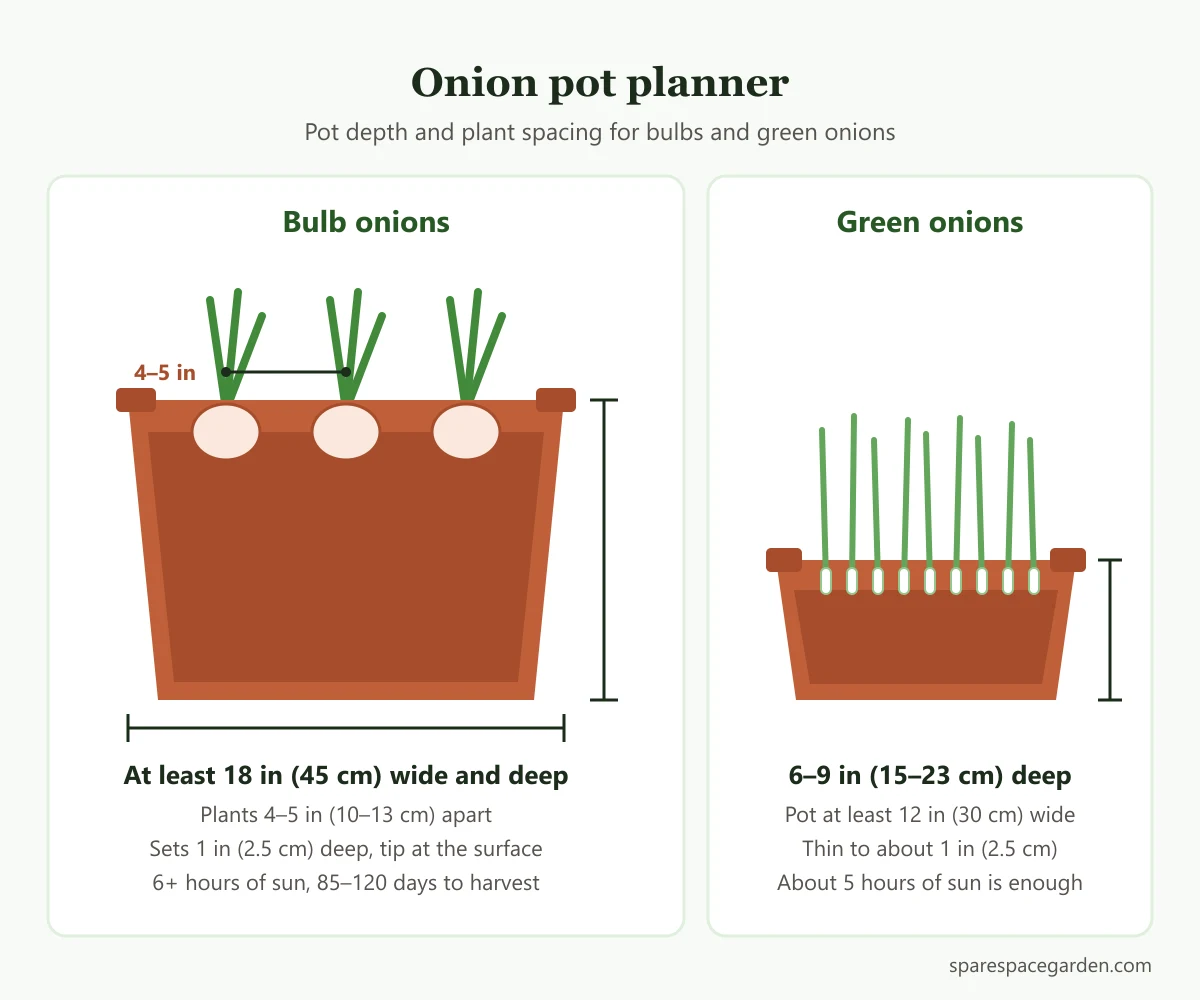 Pot depth and spacing for bulb onions and green onions.
Any pot needs drainage holes. Fill it with a loose commercial potting mix, not garden soil, which packs down in a container. Our guide to the best potting soil for vegetables explains what to look for.
How to plant onions in a pot, step by step
Onions like cool weather at the start. Illinois Extension says to plant in spring as soon as the soil can be worked, and notes that late plantings give small bulbs or none at all.
- Fill the container to about 1 inch (2.5 cm) below the rim with moist potting mix.
- Mark your spacing. For bulbs, set plants 4–5 in (10–13 cm) apart in a grid. For green onions from sets, Illinois Extension suggests planting large sets 1½ in (4 cm) deep, touching one another.
- Plant sets pointed end up, 1 in (2.5 cm) deep. Plant transplants 1–1½ in (2.5–4 cm) deep.
- Water well until water runs out of the drainage holes. Illinois Extension suggests a cup of starter fertilizer solution per transplant, mixed at the label rate.
- Place the pot in full sun. Maryland Extension says bulb onions need at least 6 hours of direct light and prefer 8 to 10; green onions tolerate about 5 hours.
- Sow green onions in batches. The RHS suggests small sowings every couple of weeks for a steady supply.
Watch out: Don't pile extra soil around bulb onions. Illinois and Maryland Extension both warn that hilling bulb onions can cause neck or stem rot.
Watering and feeding onions in pots
Water is the part of growing onions in containers that needs the most attention. Onion roots are shallow, and a pot dries out much faster than a garden bed. Maryland Extension states that bulb size is directly proportional to the water the plants get, especially once bulbs begin to swell.
Clemson's Home & Garden Information Center advises checking containers at least once a day, and twice on hot, dry or windy days. Water until it drains from the bottom, but don't let the mix stay soggy. A quick test from Washington State University: push a finger 2 to 3 inches (5–8 cm) into the mix, and water if it feels dry.
The RHS adds one exception: stop watering bulb onions once the bulbs have swollen in midsummer, so they can start to ripen before harvest.
Feeding is simple. Maryland Extension describes onion nutrient needs as high. Clemson notes that a potting mix with added fertilizer supplies nutrients for about 8 to 10 weeks, after which a water-soluble fertilizer every two to three weeks keeps container plants going. Follow the product label for the rate. Our article on fertilizer for potted plants compares the main types.
Harvesting and curing onions from containers
Green onions
Illinois Extension says green onions are ready to pull once the tops are about 6 inches (15 cm) tall, and scallions when the leaves are 8 to 10 inches (20–25 cm) high. The RHS puts salad onions at about two months from sowing, with the bulb no more than 1 inch (2.5 cm) across. Flavor gets stronger as they grow.
Bulb onions
Maryland Extension gives 85 to 120 days to mature bulbs. The sign is the foliage: harvest when about two-thirds of the tops have fallen over, according to Maryland, or when the tops fall over and turn brown, according to Illinois. Don't bend the tops over early; Illinois Extension says this stops bulb growth and leaves smaller bulbs that store poorly.
Curing dries the outer skins and seals the neck so the onions keep. Sources give slightly different times:
| Source | Curing time | Conditions |
|---|---|---|
| University of Maryland Extension | 1–2 weeks | Tops on, well-ventilated porch or attic, out of direct sun |
| RHS | About 2 weeks | On racks in sun, or a greenhouse or shed if damp |
| Illinois Extension | 2–3 weeks | Full air circulation, under shelter |
When the necks are dry and the skins papery, trim the tops to about 1 inch (2.5 cm), as Maryland suggests, or 1½ to 2 inches (4–5 cm), as Illinois suggests. Illinois recommends storing them at 50 to 60°F (10–16°C) in a dry place with good air flow, and discarding any bruised bulbs or bulbs with thick necks, since those rot first.
Frequently asked questions
Can you grow onions in a 5-gallon bucket?
Yes, especially green onions. A 5-gallon (19 L) bucket can also hold a few bulb onions, but it's smaller than the 18 in (45 cm) container the RHS suggests, and its narrow top fits only a handful of plants at 4–5 in (10–13 cm) spacing. Drill drainage holes in the bottom first, and expect to water often.
How deep does a container need to be for onions?
Green onions need about 6–9 inches (15–23 cm) of potting mix, according to Washington State University Extension. For bulb onions, the RHS recommends a container at least 18 inches (45 cm) deep and wide, mainly so the mix holds enough water.
Why are my container onions not forming bulbs?
The most common reason is the wrong day-length type: a long-day onion grown in the South may never get enough daylight to bulb. Late planting and crowded spacing also give small bulbs or none, according to Illinois Extension.
Can you grow onions in containers indoors?
Green onions can grow on a bright windowsill, since Maryland Extension says they tolerate about 5 hours of direct light. Bulb onions need at least 6 hours of sun and the long days of summer to bulb, so they're a poor choice indoors.
Is it better to grow onions from sets or seed in pots?
Sets are the simplest and fastest, according to the RHS, but they can bolt in cold springs. Seed gives more variety choice and is the usual route for green onions. For large bulb onions, Nebraska and Maryland Extension both favor transplants.