Growing cucumbers vertically means giving a vining variety a trellis, net or string to climb, so the plant uses wall height instead of floor space. On a balcony or patio, one large pot can carry a column of leaves with the fruit hanging where you can see it.
The support matters most. It has to be tall enough, have openings tendrils can grip and your hand can reach through, and be fixed so a leafy vine can't pull it over in wind.
Quick answer: Plant one vining cucumber per pot at least 12 in (30 cm) wide and deep and put the support in at planting. A trellis about 6 ft (1.8 m) tall with openings no wider than 4 in (10 cm) suits most varieties. Tie the stem loosely at first, let the tendrils take over, pinch out side shoots that carry no flowers, and pick often.
Why growing cucumbers vertically works
University of Maryland Extension lists the gains from trellising: more fruit per square foot, longer and straighter fruit, no fruit rotting on damp soil, and easier picking over a longer harvest. Virginia Tech's cucumber fact sheet adds that a trellis lifts the leaves off the ground so they dry off faster after dew or rain, and that working among wet leaves can spread disease.
Straightness comes from gravity. A cucumber lying on the ground picks up a pale ground spot where it rests, while one hanging free grows straight down. Illinois Extension notes that trellised fruit avoids ground spots and that cucumbers grow straighter, and the RHS makes the same point about fruit that hangs downward.
A trellis can't fix poor pollination, though. Maryland Extension says each flower needs 8 to 12 bee visits for a straight, full-size fruit, so a crooked cucumber on a trellis usually points to too few bees rather than the support.
Pot and variety basics
Pick a vining variety. WSU Clark County Extension advises buying the vining types of cucumbers for vertical gardens, not the bush types, and the RHS vertical veg feature names 'Marketmore' and 'Mini Munch' as cucumbers to train tall. Plant one per pot at least 12 inches (30 cm) wide and deep; about 5 gallons (19 L) gives you more water between checks. Pot sizes, watering, feeding and pollination are covered in detail in cucumber plants in pots.
Four trellis types for growing cucumbers vertically
The right style depends on whether you can fix anything to the building and how much floor you have.
A-frame
Two panels lean together and join at the top. It stands on its own, so nothing has to be screwed into a wall, which suits renters. Illinois Extension notes that an angled trellis gives plants more sunlight and lets fruit hang freely underneath, which makes picking easier. The catch is footprint: an A-frame takes more floor depth than a flat panel.
Netting on a frame
The RHS suggests stout netting held up on upright stakes, or a trellis or wires fixed against a wall or fence. Virginia Tech lists plastic netting, wood lattice, nylon fencing and woven wire as climbing surfaces. Netting is light and cheap, but it needs a rigid frame around it, because a soft net strung loosely will sag under a mature vine.
Cattle panel arch
A cattle (livestock) panel is a stiff welded-wire panel sold at farm stores. WSU Ferry County Extension recommends fencing or cattle panels over decorative garden trellises because they're stouter and cheaper. Its arch method: drive a couple of T-posts into the ground on each side, bend the panel into an arch, and fasten it to the posts with zip ties, so fruit dangles from above where it's easy to find. This works on a patio or ground-level yard. On a narrow balcony there's rarely room for an arch.
String trellis
Clemson's Home & Garden Information Center describes a trellis about 6 feet (1.8 m) high with a top and bottom wire and plastic twine tied between them at each plant, and notes that the top wire must be tight. University of Wisconsin Extension describes the same idea with twines dropped from an upper support and tied at the plant base. Strings take almost no space, but on a balcony you need a solid overhead fixing, which many buildings won't allow.
| Trellis type | Best spot | Strengths | Drawbacks |
|---|---|---|---|
| A-frame | Patio, deck, wide balcony | Freestanding; fruit hangs free underneath | Wider footprint |
| Netting on a frame | Against a wall or railing | Light, cheap, easy to fix | Needs a rigid frame; can sag |
| Cattle panel arch | Patio, yard, rooftop | Very sturdy; fruit hangs from above | Needs posts and space on both sides |
| String trellis | Under a beam or pergola | Takes almost no floor space | Needs a strong overhead fixing |
Trellis height and mesh size
Aim for about 6 feet (1.8 m) of climbing height, the height of Clemson's trellis. The RHS uses taller 8 ft (2.5 m) poles pushed 12 in (30 cm) into the ground for cucumbers and other tall climbers, while University of Georgia Extension suggests a simple fence of 4-foot (1.2 m) fencing wire for garden cucumbers. On an exposed balcony, a shorter frame is safer, and you can stop the vine when it reaches the top.
Opening size matters as much as height. Virginia Tech's vertical gardening guide says holes shouldn't exceed 4 inches (10 cm) across, and that 4-inch mesh is wide enough to reach through for picking; with finer mesh, you'll need to cut larger access holes. Wisconsin Extension uses nylon mesh or hog wire with a 4-inch (10 cm) grid. If a panel's openings are much wider, tie a few runs of twine across them so young tendrils have something to grab.
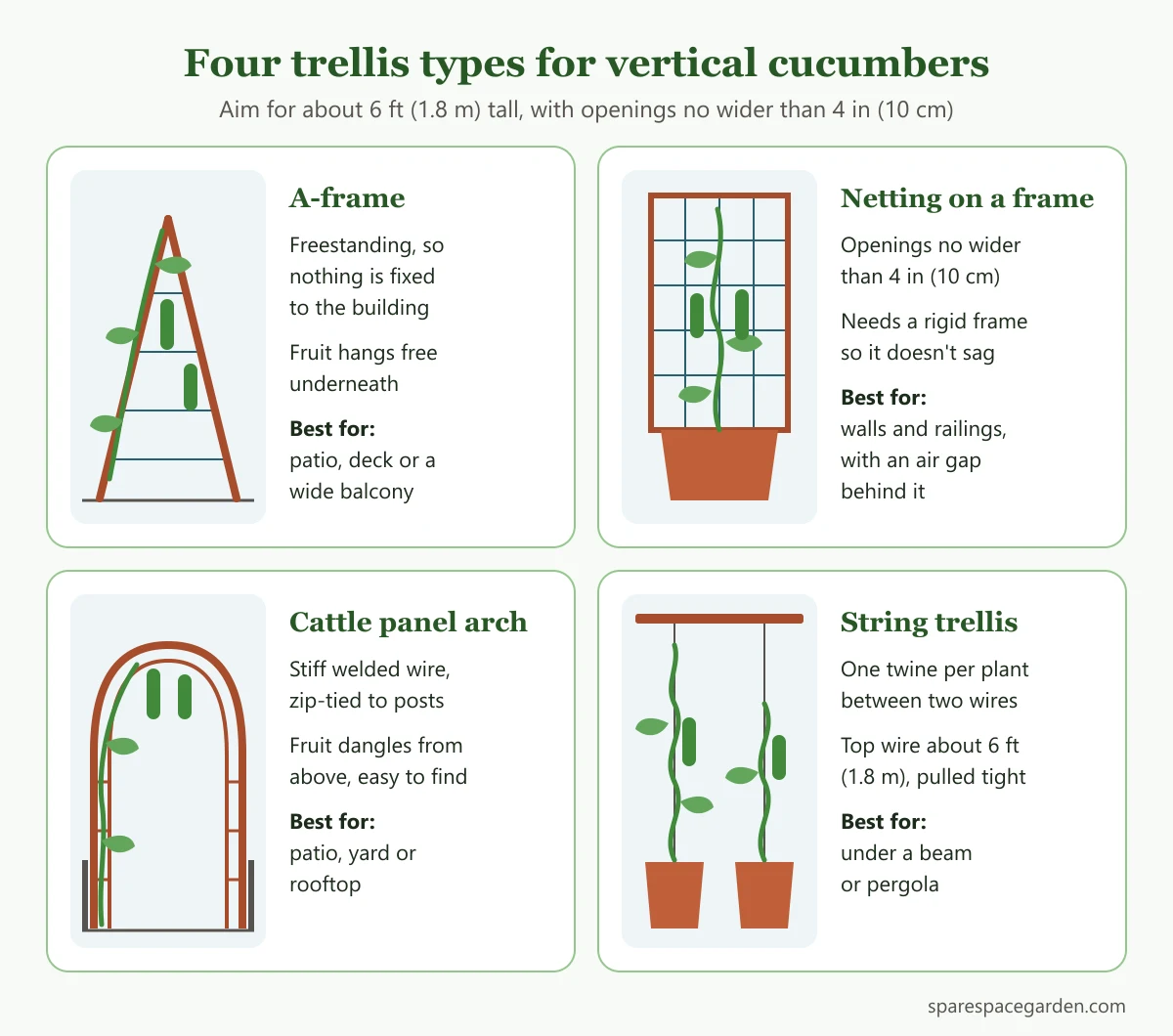 Four ways to grow cucumbers up instead of out, with the height and mesh to aim for.
Check the fruit as it grows. North Dakota State University Extension and Wisconsin Extension both warn that a cucumber can wedge itself in the wire as it swells. Steer small fruit to hang in an open gap.
Attaching a trellis to a railing or wall safely
A cucumber vine in full leaf catches a lot of wind, and the fixings carry that load. Before you start, check your lease or building rules; many restrict anything fixed to railings or walls, as our small balcony garden ideas guide explains.
- Know the load limit. The RHS balcony and roof garden guide says balconies can take only a certain weight, suggests asking a chartered structural engineer or surveyor if unsure, and recommends placing heavy containers near load-bearing walls.
- Fix climbers to something solid. The same RHS guide says climbers need fixing securely to buildings or rails. A frame held only by the potting mix will lean as the vine grows.
- Build for wind. NDSU Extension suggests planning for winds of about 40 mph (64 km/h), driving stakes at least 1 foot (30 cm) deep in open ground, and using strong connections such as staples, zip ties or wire.
- Install first, plant second. WSU Clark County Extension advises anchoring the structure before planting so you don't damage roots later.
- Leave an air gap at walls. WSU also says to leave space between a trellis and a wall for air circulation.
Watch out: Keep the frame, pot and vine on the inside of the railing. A trellis that tips or a cucumber that drops from a balcony can hit someone below.
Training tendrils: when to guide and when to tie
Cucumbers climb with tendrils, but they need help for the first few weeks. After that, most of your job is redirecting strays.
- Put the support in at planting. The RHS cucumber guide says this gives the tendrils something to cling to.
- Plant close to the base. The first shoots should reach the net or string without wandering across the pot.
- Tie the stem in at the start. The RHS notes that stems need tying in initially. Use jute string in a loose figure-eight; the RHS warns that tight string can choke the hollow stems of cucumbers and squash.
- Guide the tip early. NDSU advises gently guiding young vines to the trellis; once there, they climb on their own. On netting, weave the growing tip through an opening every few leaves.
- Re-tie when fruit sets. The RHS says stems may need help later if they come loose, especially outdoors and when carrying fruit.
- Check a few times a week. NDSU recommends redirecting any stray vines during the season. A shoot that has grown sideways for days is hard to move without snapping.
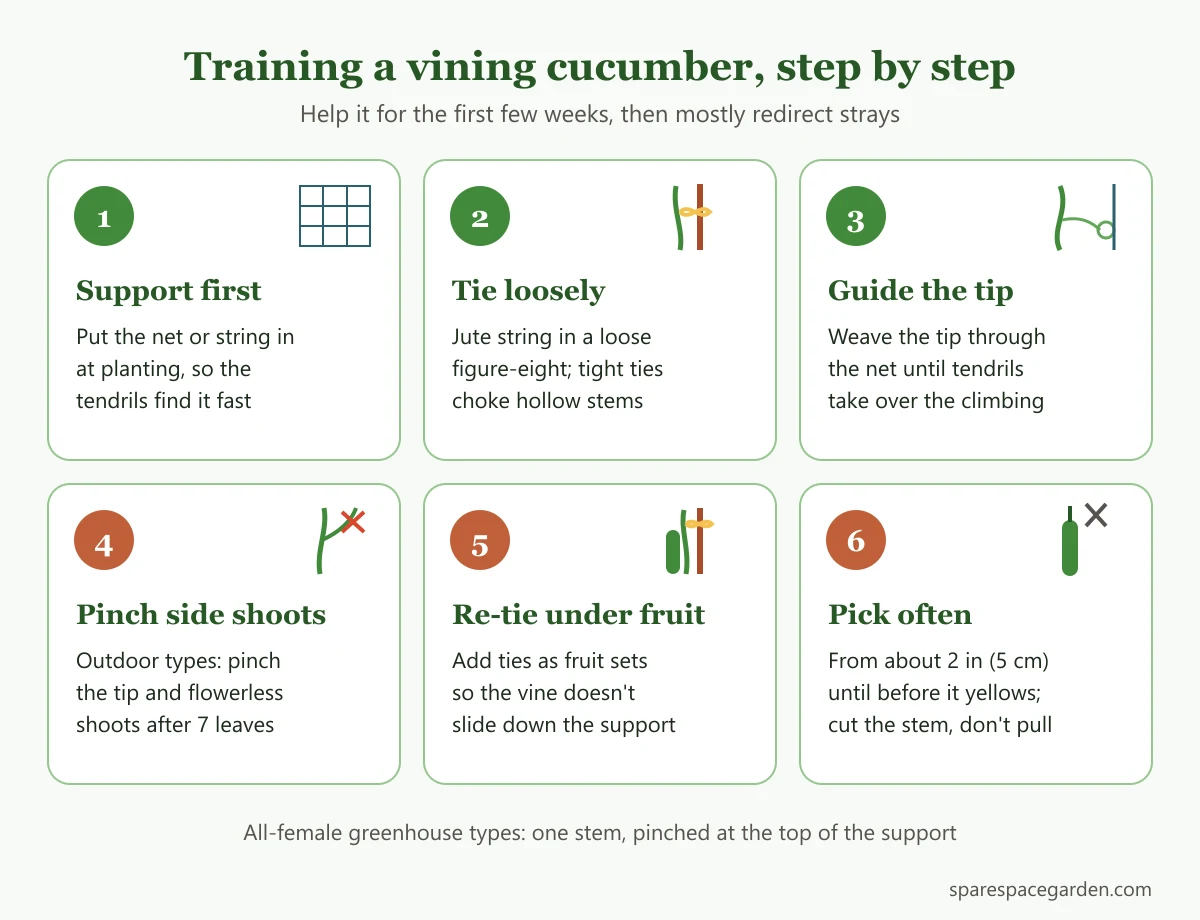 From planting to picking: when to tie, guide and pinch.
Pruning side shoots on vining cucumbers
How much you prune depends on the type of cucumber. Get this wrong and you can cut off the shoots that carry the fruit.
Outdoor (ridge) types, which have male and female flowers, get light pruning. The RHS pinches out the growing tip once the plant has seven leaves and pinches the tips of flowerless side shoots after seven leaves.
All-female greenhouse types are trained as a single stem on a cane or string. The RHS pinches the growing point when it reaches the top of the support, pinches side-shoot tips two leaves beyond a female flower, and stops flowerless side shoots once they reach 2 ft (60 cm).
Training to a single leader only suits parthenocarpic (seedless, no-pollination) varieties. Cornell Cooperative Extension explains why: these varieties carry a flower, a leaf and a shoot at the same node, so you can remove shoots and keep flowers. Field types such as 'Marketmore 76' and 'Dasher' flower along their side shoots, so stripping them leaves no fruit. In Cornell's 2014 high tunnel trial, single-leader plants of the same variety gave 1,275 fruits against 1,014 for mesh-trellised plants, with slightly less labor.
| Cucumber type | How to train | What to pinch |
|---|---|---|
| Outdoor (ridge), male and female flowers | Netting, A-frame or arch; let side shoots climb | Main tip after 7 leaves; flowerless side shoots after 7 leaves |
| Parthenocarpic or all-female | Single stem up a string or cane | Main tip at top of support; side shoots 2 leaves past a female flower; flowerless shoots at 2 ft (60 cm) |
| Bush or compact | Short cage or stake | Little or none |
Tip: When you're unsure which type you have, check the seed packet for "parthenocarpic," "all-female" or "greenhouse." If it says none of these, treat it as an outdoor type and prune lightly.
Harvesting cucumbers from a trellis
One advantage of growing cucumbers vertically is that hanging fruit is easy to spot, so you're less likely to miss one that turns yellow and seedy. Virginia Tech gives 50 to 70 days to maturity and says you can pick from about 2 inches (5 cm) long up to any size before the fruit starts to yellow. Clemson recommends picking as often as needed to avoid oversized fruit, and the RHS says regular harvesting encourages more fruiting.
Cut the stem with a sharp knife or pruners, as Clemson and the RHS advise, and hold the vine with your other hand so you don't drag it off the support. Maryland Extension's alternative is to turn the cucumber parallel to the vine and snap it off cleanly. Target sizes for each type are in the harvest table of our cucumber plants in pots guide.
Common problems on a trellis
| Problem | Likely cause | Fix |
|---|---|---|
| Fruit stuck in the mesh | Fruit swelled inside a small opening | Use 4 in (10 cm) openings; steer small fruit into gaps |
| Vine sliding down | Too few ties as fruit adds weight | Add loose jute ties under heavy sections |
| Frame leaning | Held only by the pot | Tie it to the railing or a wall fixing |
| Curved or stubby fruit | Poor pollination | Hand-pollinate or grow a parthenocarpic variety |
| White powder on leaves | Powdery mildew | Water at the base; grow resistant varieties |
On hot, sheltered balconies, spider mites are the other usual suspect; see cucumber spider mites. For pairing cucumbers with beans or squash on one wall, read climbing vegetable plants.
Frequently asked questions
How tall should a cucumber trellis be?
About 6 feet (1.8 m) suits most vining varieties, which is the height of Clemson's twine trellis. The RHS uses 8 ft (2.5 m) poles for tall climbers, and University of Georgia uses 4-foot (1.2 m) fencing. On a windy balcony, go shorter and pinch out the tip when the vine reaches the top.
Do cucumbers climb a trellis on their own?
Mostly, yes. Once a young vine reaches the support, its tendrils grip and it climbs on its own, according to NDSU. You'll still need to tie the stem at the start, guide stray shoots back, and add ties when heavy fruit sets.
How many cucumber plants can share one trellis?
In pots, one plant per container is the standard. In the ground, Clemson thins trellised cucumbers to 9 to 12 inches (23–30 cm) apart, and Cornell sets high tunnel plants 12 inches (30 cm) apart in a single row. Several pots can sit along one wide trellis if each has its own section of net.
Can bush cucumbers be grown vertically?
Not really. Bush types stay compact and don't produce long vines, so for growing cucumbers vertically WSU advises vining types. A short cage or stake is enough for a bush cucumber.