Climbing vegetable plants let you grow far more food in a small space because they use height instead of floor area. Pole beans, runner beans, climbing peas, cucumbers, indeterminate tomatoes, small winter squash and Malabar spinach all grow well in containers, as long as each one gets a big enough pot and the right kind of support.
The trick is matching the support to the way the plant climbs. Beans twine, peas and cucumbers grab with tendrils, and tomatoes have to be tied. Get that right and a single pot against a sunny railing can hold a wall of leaves and pods.
Quick answer: The best climbers for small gardens are pole beans (one plant per 5-gallon / 19 L pot on 6–8 ft canes), dwarf climbing peas, cucumbers, cordon tomatoes, small-fruited winter squash and Malabar spinach. Give them at least 6 hours of direct sun, put the support in at planting time, and pick a support that suits how each crop climbs.
How climbing vegetables hold on to a support
Vegetable vines climb in one of three ways, and each way calls for a different support. Choosing the wrong one is the most common reason a trellis stays empty while the plant flops over the pot rim.
Twiners: beans and Malabar spinach
The whole stem spirals around whatever it touches. North Carolina State Extension's plant database lists both runner beans and Malabar spinach as twining climbers. Twiners go up most easily on something vertical and slim enough to wrap around: a bamboo cane, a pole or a taut string.
Tendril climbers: peas, cucumbers and squash
Peas, cucumbers and squash send out thin, coiling tendrils that grab nearby supports. The RHS advises putting cucumber supports in at planting time so the tendrils have something to cling to. Netting and twine suit them best, and Virginia Tech Extension's vertical gardening guide recommends mesh with holes no wider than 4 inches (10 cm).
Tied climbers: indeterminate tomatoes
Tomatoes have neither tendrils nor twining stems. Left alone, the long stems sprawl, so you tie the main stem to a cane or wind it around a string as it grows.
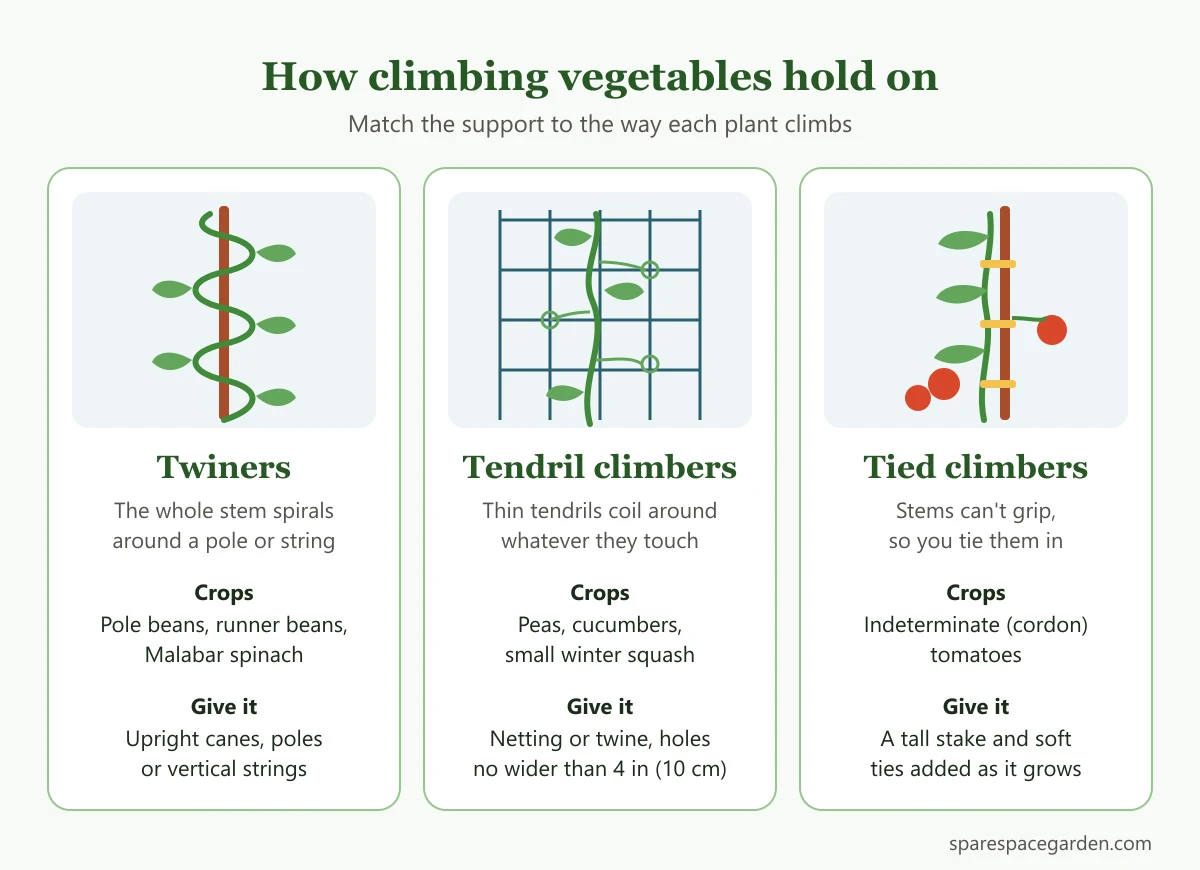 Three ways vegetables climb, and the support each one needs.
The best climbing vegetable plants for pots and balconies
These seven crops cover warm and cool seasons, fruit and leaves. Start with one or two that you like to eat.
Pole beans
Pole beans are the easiest climber for most beginners because they start twining with little help. Oregon State University Extension suggests one seedling per 5-gallon (19 L) container with a pole or trellis, while Texas A&M AgriLife Extension lists a 2-gallon (7.6 L) minimum for green beans with plants 3 inches (7.5 cm) apart. Vines can climb past 6 feet (1.8 m), and the RHS uses 2.5 m (8 ft) canes for climbing French beans. Texas A&M names 'Blue Lake' and 'Kentucky Wonder' as pole types. For the bush versus pole choice, see growing beans in containers.
Runner beans
Runner beans are vigorous twiners with scarlet or white flowers, and NC State Extension lists them at 8 to 12 feet (2.4–3.7 m). The RHS runner bean guide calls for a container at least 30 inches (75 cm) wide and 18 inches (45 cm) deep for climbing varieties, with a wigwam of canes and seeds 6 inches (15 cm) apart. Sow outdoors once frost has passed and the soil has reached 54°F (12°C). When the vines reach the top of the canes, cut off the extra growth to keep the crop within reach.
Climbing peas
Peas are the cool-season climber. They hold on with tendrils and, according to NC State Extension, stop growing above 85°F (29°C), so sow them early in spring. The RHS pea guide says tall varieties reach up to 6 feet (1.8 m) while dwarf types stay near 18 inches (45 cm). For pots, it recommends a container at least 18 inches (45 cm) wide with seeds 3 inches (7.5 cm) apart, and notes that dwarf varieties and mangetouts do best. Expect a modest harvest from one container.
Cucumbers
Cucumbers climb with tendrils and take readily to netting. Pot advice varies: the RHS asks for at least 12 inches (30 cm) wide and deep, Texas A&M lists 1 gallon (3.8 L) per plant, and Illinois Extension lists 1-gallon containers for compact bush types. Oregon State suggests bush varieties for containers, with a small trellis in the pot. Outdoors, the RHS pinches out the growing tip once a plant has seven leaves. More detail is in growing cucumbers vertically.
Indeterminate (cordon) tomatoes
Indeterminate tomatoes keep growing all season, which makes them natural candidates for a tall support. The RHS tomato guide suggests one cordon plant per 12–18 inch (30–45 cm) pot, a tall cane tied at regular intervals, and pinching out side shoots. Outdoors, it removes the growing tip two leaves above the fourth truss (flower cluster). Texas A&M recommends 5 gallons (19 L) per plant. The RHS uses stakes of about 6 feet (1.8 m), and Virginia Tech suggests 8-foot (2.4 m) stakes for indeterminate types in the ground. See how many tomato plants per container before you crowd a pot.
Small winter squash
Winter squash climbs with corkscrew tendrils, but the vines and fruit are heavy, so tie them in as well. The RHS squash guide recommends a container at least 18 inches (45 cm) wide, a sturdy support and smaller-fruited varieties. Its vertical veg advice names 'Red Kuri' and 'Tromboncino' and uses 2.5 m (8 ft) poles. WSU Clark County Extension notes cucurbit vines can reach 25 feet (7.6 m), with heavy fruit needing slings. For frame ideas, read how to trellis squash in small spaces.
Malabar spinach
Malabar spinach is a leafy green that grows in hot weather when true spinach does poorly. It's a soft-stemmed twining vine: University of Wisconsin–Madison Extension says it can reach 10 feet (3 m) as an annual and is best grown on a sturdy trellis. NC State describes a typical six-foot (1.8 m) vine and lists containers and hanging baskets as suitable spots. Plant it a few weeks after the last frost, space plants at least 1 foot (30 cm) apart, and expect slow growth while nights stay below 60°F (16°C). Keep the soil evenly moist, since dry soil pushes it into flower and the leaves turn bitter.
Pot size, support height and sun at a glance
Use this table to plan a balcony or patio before you buy pots. Where sources disagree, the range is shown.
| Crop | How it climbs | Container (minimum) | Support height | Sun |
|---|---|---|---|---|
| Pole beans | Twining | 5 gal (19 L) for 1 plant; 2 gal (7.6 L) minimum | 6–8 ft (1.8–2.5 m) | Full sun, 6+ hours |
| Runner beans | Twining | 30 in (75 cm) wide, 18 in (45 cm) deep | 8 ft (2.5 m) canes | Full sun, sheltered |
| Climbing peas | Tendrils | 18 in (45 cm) wide; 2 gal, 12 in (30 cm) deep | 18 in–6 ft (45 cm–1.8 m) by variety | Full sun, 6+ hours |
| Cucumbers | Tendrils | 12 in (30 cm) wide and deep | Up to 8 ft (2.5 m) | Full sun |
| Indeterminate tomatoes | Tied in | 12–18 in (30–45 cm) pot or 5 gal (19 L), 1 plant | About 6 ft (1.8 m) | Full sun |
| Small winter squash | Tendrils plus ties | 18 in (45 cm) wide | Up to 8 ft (2.5 m), very sturdy | Full sun |
| Malabar spinach | Twining | Containers suitable; 1 ft (30 cm) apart | 6 ft (1.8 m) or more | Full sun, 6+ hours |
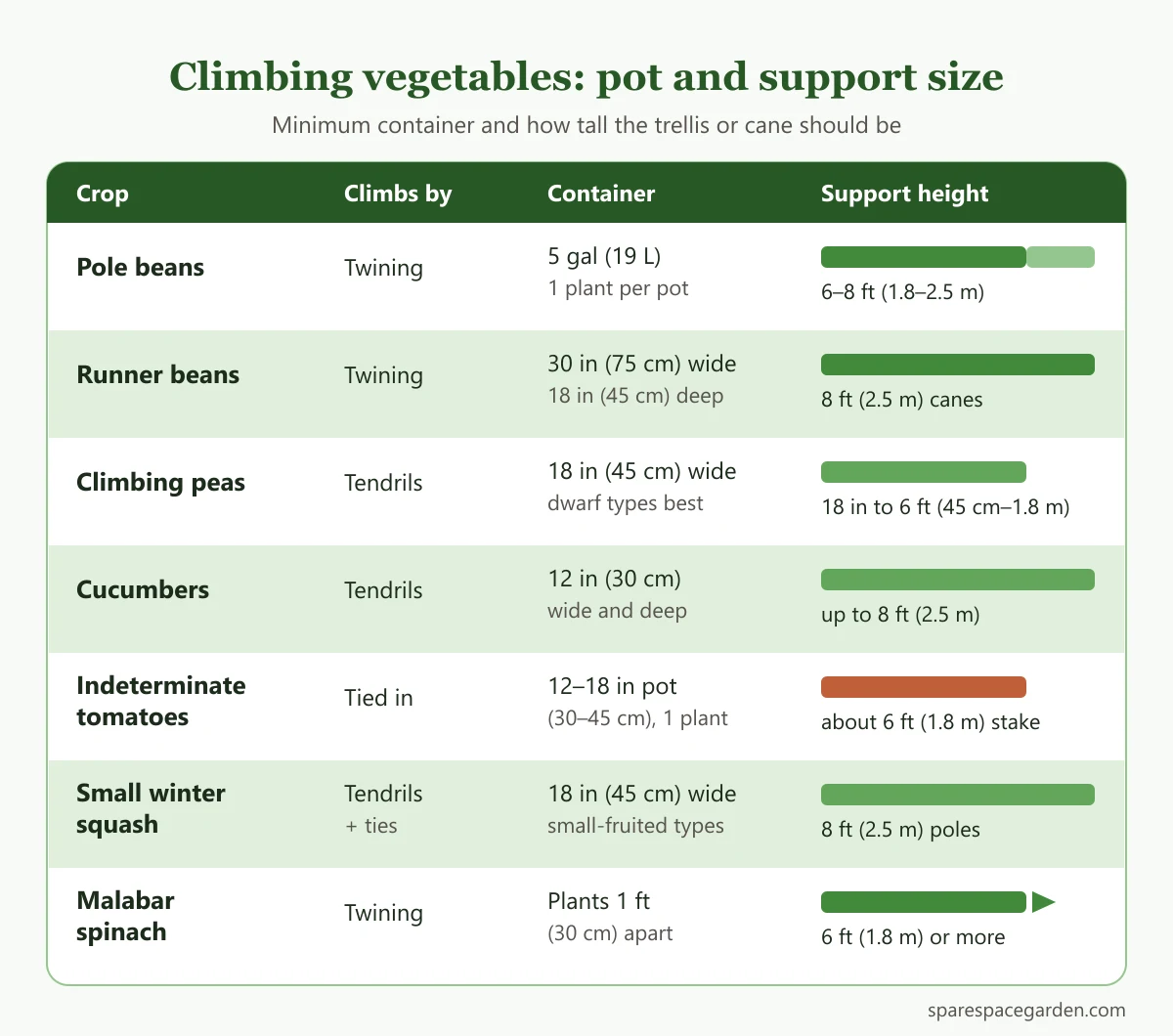 Minimum container and support height for seven climbing vegetables.
Illinois Extension defines full sun as at least six hours of direct light a day. Texas A&M adds that fruiting crops such as cucumbers and tomatoes need the most sun of all, so give your sunniest wall to those and the slightly shadier corner to peas.
Setting up a support in a container
With climbing vegetable plants in pots, the support goes in before the plant. WSU Clark County Extension advises putting the structure in place and anchoring it before planting so you don't damage roots later.
- Beans: a wigwam of three or more canes tied at the top. The RHS uses canes 6–12 inches (15–30 cm) apart at the base, and Virginia Tech suggests a tripod of stakes for pole beans.
- Peas and cucumbers: netting, twine or chicken wire fixed to canes, with holes no wider than 4 inches (10 cm). Dwarf peas can make do with twiggy sticks.
- Tomatoes: one tall, sturdy cane per plant, pushed deep into the pot before you fill around the root ball.
- Squash: an arch, strong trellis or panel fixed to a wall or railing, not a pot-only frame.
If the trellis sits against a wall, leave a gap behind it for air to move, as WSU Clark County Extension recommends. For bigger layouts, see how to plan a vertical vegetable garden.
Watch out: A tall, leaf-covered wigwam acts like a sail. The RHS warns that tall peas can become top-heavy and that potted cordon tomatoes are best stood against a sheltered, sunny wall. On an exposed balcony, use wide, stable pots and tie the frame to the railing, after checking your building's rules and weight limits.
How to train climbing vegetables, step by step
Training takes a few minutes at a time. Beans, peas and cucumbers mostly need help while they are young, while tomatoes and squash need ties all season.
- Plant right at the base of the support. Seeds or seedlings should sit within a few inches of the cane or netting so the first shoots find it.
- Guide young shoots by hand. Virginia Tech notes that small plants may need to be gently guided or tied to the trellis. Wrap a bean tip once around its cane, or tuck a cucumber shoot behind the netting.
- Use soft ties. The RHS recommends jute string over plastic ties and warns that tight string can choke the hollow stems of cucumbers and squash. Tie in a loose figure-eight.
- Tie tomatoes as they grow. Illinois Extension suggests starting ties once a staked tomato is about 12 inches (30 cm) tall. Pinch out side shoots on cordon types as you go.
- Add ties on heavy crops. The RHS says cucumber stems may need extra tying as fruit forms, especially outdoors.
- Stop the top. Cut runner beans back at the top of their canes, stop outdoor cordon tomatoes after four trusses, and pinch outdoor cucumbers after seven leaves.
- Cradle heavy fruit. Virginia Tech suggests slings made from old T-shirts or mesh bags for squash and melons, and Wisconsin Extension mentions nylon socks.
Tip: Check your plants a few times a week in early summer. A shoot that has wandered sideways for days is hard to redirect without snapping it.
Watering and feeding vertical crops in pots
Climbing vegetable plants in containers dry out faster than you might expect. WSU Clark County Extension points out that plants grown up a structure catch more sun and wind, and that containers usually need watering daily and sometimes more often in hot weather. Texas A&M AgriLife Extension says once a day is usually enough, but leafy plants may need water twice a day.
Water the soil, not the leaves. The RHS suggests this for cucumbers to reduce powdery mildew, and it suits every crop here. A good mix holds water better, so start with the best potting soil for vegetables, and consider self-watering containers if you're away during the day.
Feeding schedules from the RHS for container crops:
- Cucumbers: a general liquid feed every 10–14 days, switching to a high-potash feed once flowering starts.
- Tomatoes and squash: a high-potassium liquid feed every 10–14 days once the first fruits begin to swell.
- Peas: a high-potassium feed about every two weeks once the first flowers appear.
Follow the label on any fertilizer for dilution and frequency.
Frequently asked questions
What is the easiest climbing vegetable for a beginner?
Pole beans are the simplest place to start. They twine up a cane on their own once guided, need only one plant per 5-gallon (19 L) pot, and Texas A&M lists 45 to 65 days from seeding to harvest for beans. Cucumbers are a close second if you have a hot, sunny spot.
Can climbing vegetables grow in a 5-gallon bucket?
Yes, for several of them. Oregon State recommends a 5-gallon container for a single bean plant, and Texas A&M uses the same size for one tomato or squash plant. Runner beans want more room, about 30 inches (75 cm) wide by the RHS's measure. Whatever you use, drill drainage holes first.
Which climbing vegetables tolerate some shade?
Very few. Texas A&M notes that all vegetables grow best in full sun and that fruiting crops need the most, while NC State says peas need full sun to flower and set pods. If your balcony gets under six hours of direct light, leafy crops such as lettuce or spinach are a better fit than climbers.
How tall should a trellis be for climbing vegetables in pots?
About 6 feet (1.8 m) covers pole beans, tall peas, cordon tomatoes and Malabar spinach. Runner beans and trained squash use 8-foot (2.5 m) canes, while dwarf peas need only 18 inches (45 cm). If a vine outgrows its support, pinch out the tip rather than adding height on a windy balcony.
Do I need to tie beans and cucumbers to the trellis?
Usually only at the start. Beans twine and cucumbers grip with tendrils once they find the support, though the RHS says cucumber stems may need tying again when loaded with fruit. Tomatoes and winter squash are different: tie them in regularly all season.