Pepper plant leaves turning yellow is a symptom, not a diagnosis. The cause is usually on a short list: the plant is short of nitrogen or magnesium, the roots are too wet or too dry, the nights are too cold, or a leaf disease, virus or sap-sucking pest is at work. Peppers in containers are more prone to the first three, because a pot holds little food and swings quickly between soggy and dry.
The fastest way to narrow it down is to look at which leaves turned yellow first, what the veins are doing, and whether there are spots or speckles.
Quick answer: Even yellowing on the oldest, lowest leaves usually means nitrogen shortage. Yellow between green veins on older leaves points to magnesium. Spots with gray to tan centers followed by yellowing and leaf drop suggest bacterial leaf spot, fine pale speckling points to spider mites, and yellow-and-green mottling on a stunted plant suggests a virus. Nights below 50 to 55°F (10 to 13°C) can also turn leaves yellow.
Pepper plant leaves turning yellow: read the pattern first
Don't reach for fertilizer first. Feeding a plant that's waterlogged, cold or infected won't help, and in one case covered below it can make things worse.
Old leaves, new leaves or the whole plant?
Some nutrients can move inside the plant and some can't. When nitrogen or magnesium runs short, the plant pulls them out of older leaves to feed new growth, so the bottom of the plant yellows first. The RHS guide to nutrient deficiencies notes that iron deficiency works the other way and mainly affects the youngest leaves.
Yellowing scattered across the whole plant at once points away from nutrients and toward roots or weather: a soggy pot, a dry pot, or a cold night.
Look at the veins, the spots and the undersides
Check three things on a yellow leaf:
- Veins: Is the whole leaf pale, veins included, or are the veins still green with yellow between them?
- Spots: Are there brown spots, water-soaked patches or rings?
- Underside: Turn the leaf over. Clusters of small insects, fine webbing or tiny moving specks change the diagnosis completely.
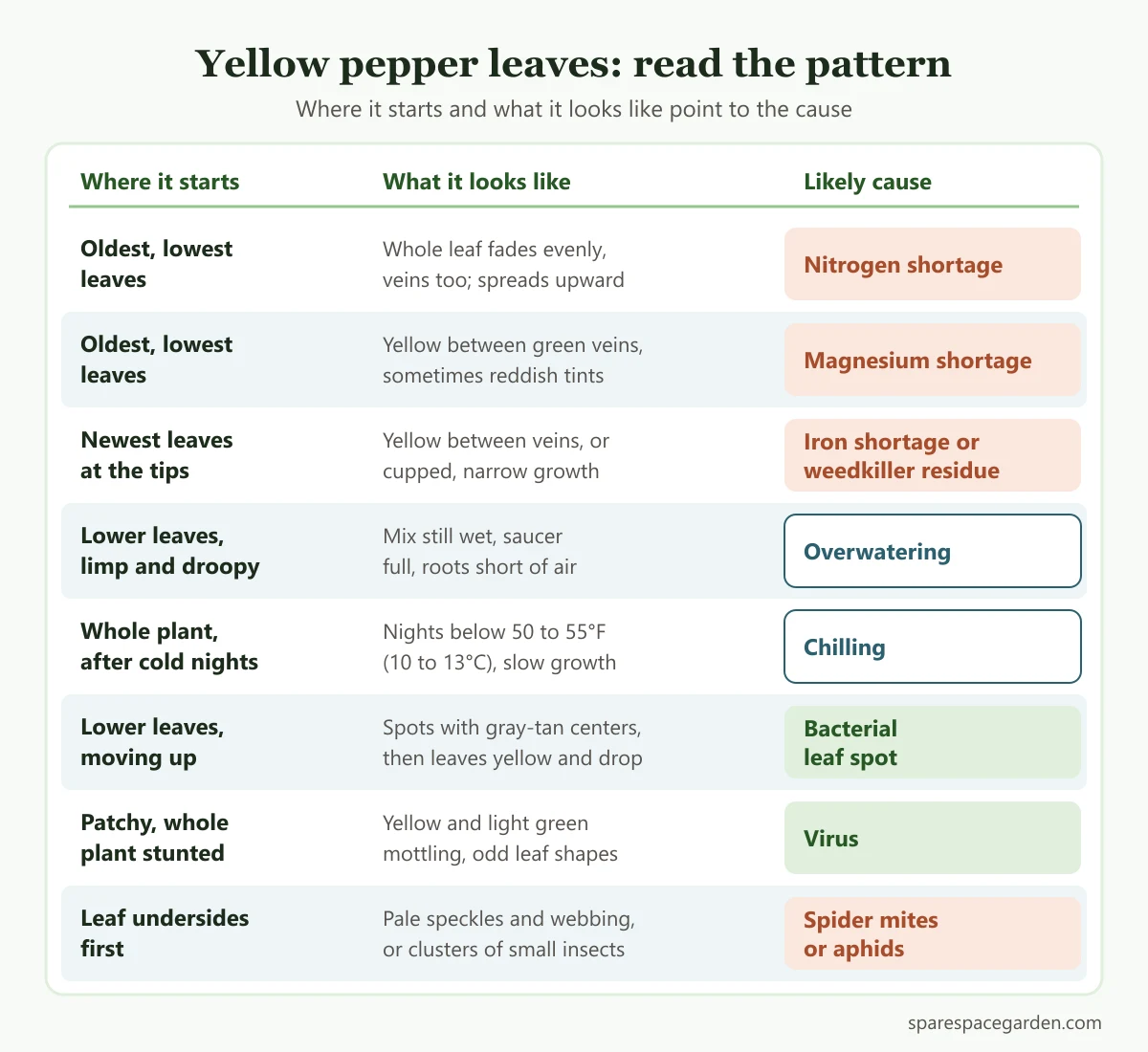 Where the yellowing starts, what it looks like, and the most likely cause.
Nutrient shortages: nitrogen, magnesium and iron
Nitrogen shortage
This is the most likely cause when the oldest leaves fade evenly and the plant otherwise looks healthy. Iowa State University Extension describes older, lower leaves turning pale green to yellow first, weak growth and thin stems, with more of the plant yellowing over time. Pots run out sooner than you might expect: the RHS says container plants use up the nutrients in their compost in roughly 6 to 8 weeks.
Fix: Start a regular feeding routine with a water-soluble fertilizer, following the label. Our guide on how to grow peppers in pots gives a feeding schedule from planting to flowering, and fertilizer for potted plants compares product types. Don't overdo it: University of California IPM notes that high nitrogen levels favor aphid reproduction.
Magnesium shortage
Here the tissue between the veins turns yellow while the veins stay green, starting on older leaves. The RHS adds that you may see reddish-brown tints, and that affected leaves later brown and drop early.
Fix: For a quick boost, the RHS suggests a foliar spray of Epsom salts (magnesium sulfate) at 20 g per liter of water, about 2.7 oz per US gallon, repeated two or three times. Spray only in dull, overcast weather, since leaves can scorch in bright sun.
Watch out: Don't add Epsom salt "just in case." The UConn IPM program's page on bacterial leaf spot reports that high magnesium and calcium levels in the leaves have been linked to greater pepper susceptibility to that disease, and it advises against dolomitic lime. Treat magnesium only when the pattern matches.
Newest leaves yellow: iron or weedkiller
If only the youngest leaves at the tips are yellow between the veins, iron is a candidate. Also think about weedkiller. The RHS lists chillies among the plants damaged by manure contaminated with hormone weedkillers, which shows up as cupped, narrow, distorted new growth. Our article on the cause of tomato leaf curl explains how that contamination gets into compost and how to test for it.
Watering problems in containers
Water is the other common reason for pepper plant leaves turning yellow in pots, and both too much and too little can do it.
Overwatering. Colorado State University Extension's container garden guide warns that plants won't grow in soil that is continually waterlogged, because water fills the pore spaces and starves roots of oxygen. Suspect this when the lower leaves yellow and droop while the mix still feels wet.
Fix: Water only when the top of the mix feels dry, make sure the pot has working drainage holes, and empty any saucer after watering. Colorado State suggests watering until about 10 percent of the water runs out the bottom, which also flushes out fertilizer salts.
Underwatering. Colorado State also cautions that letting a container dry out completely kills fine roots, and very dry mix shrinks away from the pot wall so water runs straight past the roots. The RHS notes that container chilies can need water every day in hot, dry weather.
Fix: Check pots daily in summer. If the mix has pulled away from the sides, water slowly in two or three passes so it rewets. Illinois Extension's pepper guide calls a uniform moisture supply essential for peppers.
Cold nights, chilling and sunscald
Peppers dislike cold more than many gardeners expect. Illinois Extension says that when night temperatures are below 50 to 55°F (10 to 13°C), the plants grow slowly, the leaves may turn yellow and the flowers drop. The RHS gives a minimum night temperature of about 12°C (54°F) for chilies and says they grow better above 15°C (59°F).
Cold yellowing tends to show up across the plant after a chilly spell. The University of Minnesota Extension pepper diagnosis tool describes frost or chilling injury as whole leaves, young shoots or the entire plant becoming discolored and wilted.
Fix: Bring pots into a sheltered spot or indoors on nights forecast below about 55°F (13°C). Leaves that were badly chilled may not recover, so judge the plant by its new growth.
Sunscald is not the same as yellowing
Pale patches on a plant that just moved outside are often sunscald, not a nutrient problem. University of Minnesota Extension says young leaves of transplants turn gray with irregular bands, and that sunscald occurs only on tissue exposed to the sun. On fruit, it shows as a tan or white patch on the exposed side.
The giveaway is position. Sunscald is bleached rather than yellow and sits only on the sun-facing surfaces. Harden young plants off gradually before they go out for good.
Diseases: bacterial leaf spot, wilt and viruses
Bacterial leaf spot
This is the disease most likely to cause yellowing with spots on peppers. University of Maryland Extension describes small, pimple-like spots on the underside of older leaves and small water-soaked spots on top. The spots develop gray to tan centers with darker borders, then the leaves turn yellow, then brown, and drop.
UConn's IPM program notes that severe outbreaks can strip 50 to 100 percent of the foliage. The disease favors humidity above 85 percent and nights above 70°F (21°C), while nights below 61°F (16°C) slow it down. It spreads through splashing water and handling wet plants, and can arrive on seed or transplants.
Fix: Remove badly spotted leaves, water at the base, and mulch the surface. Maryland Extension suggests fixed copper every 10 to 14 days to slow the spread; follow the label. UConn warns that many strains resist copper, so prevention matters more. Discard debris at the end of the season and choose resistant varieties next time.
Verticillium wilt
University of Minnesota Extension describes yellow, wedge-shaped patches on the leaves, often with a brown center, with yellowing and wilting on one side of the plant and the lower leaves going first. Cut the stem lengthwise near the soil: tan veins around a green center confirm it. It's most common at 68 to 75°F (20 to 24°C).
Fix: There's no cure. Remove the plant and don't reuse that mix for peppers or tomatoes. See can you reuse potting soil for what to do with old mix.
Viruses
University of Minnesota Extension lists cucumber mosaic virus, potato virus Y and tomato spotted wilt virus among those that infect peppers. Leaves are mottled with yellow and light green patches and may be misshapen, sometimes long and thin like a shoestring. The plant stays stunted even when its neighbors look healthy.
Fix: Infected plants can't be cured, so pull and bin them. Aphids spread several of these viruses, and UC IPM's aphid pest note says transmission takes only a few minutes of feeding, so prevention means keeping aphids in check from the start. Illinois Extension also advises tobacco users to wash their hands with soap and water before handling pepper plants, because of tobacco mosaic virus.
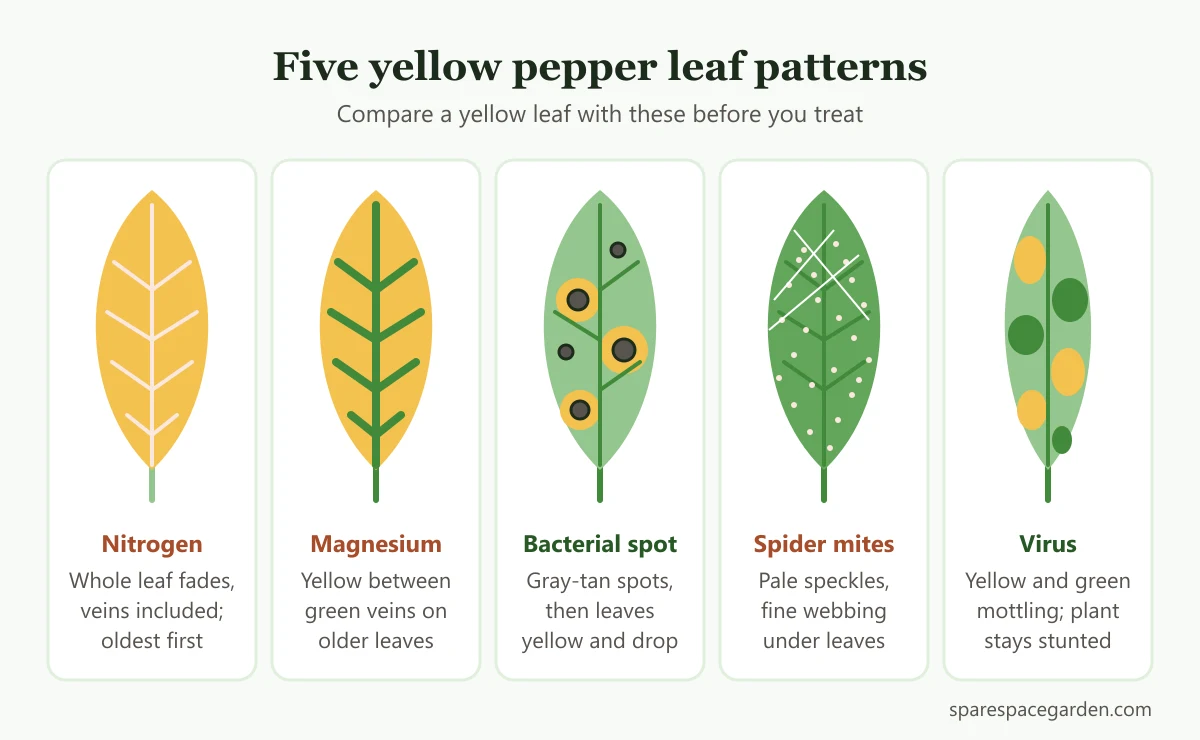 Even fading, yellow between veins, spots, speckling and mottling point to different causes.
Sap-sucking pests: aphids and spider mites
Aphids
University of Minnesota Extension notes that large numbers of aphids feeding on pepper leaves can cause yellowing and wilting. Illinois Extension suggests checking the undersides of leaves, especially near the branch tips, and looking for sticky honeydew on the lower leaves and fruit.
Fix: UC IPM suggests knocking them off with a strong stream of water early in the day, or using insecticidal soap, which kills only the aphids it touches, so repeat applications may be needed. Don't use soap above 90°F (32°C) or on water-stressed plants, and follow the label. Our guide on how to get rid of aphids naturally covers more options.
Spider mites
Spider mites are less than 1/20 inch (about 1 mm) long and live on leaf undersides. UC IPM's spider mite pest note describes early damage as a stippling of light dots, sometimes with a bronze tint, followed by yellow leaves that drop. Heavy infestations produce fine webbing. Damage is usually worst on water-stressed plants in hot, dusty spots, which describes many sunny balconies in midsummer.
Fix: UC IPM recommends misting the undersides of the leaves with water at least once a day while plants are infested, then insecticidal soap or oil if needed. Our guide to spider mites on cucumbers covers the same approach.
Tip: If the plant also has bacterial leaf spot, use a gentle spray rather than a hard blast. UConn notes that high-pressure sprayers can force the bacteria into leaves.
Symptom, cause and fix at a glance
Use this table as a quick check whenever you find pepper plant leaves turning yellow, then read the matching section above.
| What you see | Likely cause | What to do |
|---|---|---|
| Oldest leaves evenly pale, veins too, spreading up | Nitrogen shortage | Feed regularly with water-soluble fertilizer |
| Yellow between green veins on older leaves | Magnesium shortage | Epsom salt spray at 20 g per liter, only if the pattern fits |
| Youngest leaves yellow between veins | Iron shortage | Check feeding; rule out weedkiller |
| New growth cupped, narrow and distorted | Weedkiller residue or drift | Test the mix; replace contaminated compost |
| Lower leaves yellow and droop, mix stays wet | Overwatering | Water when the top is dry; empty saucers |
| Wilting, mix shrunk from the pot | Underwatering | Check daily; rewet slowly |
| Yellowing across the plant after cold nights | Chilling | Protect pots below about 55°F (13°C) |
| Gray or bleached patches on sun-facing leaves | Sunscald | Harden off; protect exposed fruit |
| Spots with gray to tan centers, then yellow leaves that drop | Bacterial leaf spot | Remove spotted leaves; no overhead watering; copper per label |
| Yellow wedge on leaf, one side wilts, tan stem veins | Verticillium wilt | Remove plant; don't reuse the mix |
| Yellow and light green mottling, stunted plant | Virus | Remove plant; control aphids |
| Insects under leaves, sticky honeydew | Aphids | Water spray or insecticidal soap |
| Fine pale speckling, webbing | Spider mites | Daily water spray under leaves; soap or oil |
Frequently asked questions
Should I pick off yellow pepper leaves?
Remove leaves with spots, since Maryland Extension advises getting rid of badly infected plant parts, and bin them rather than composting. Leaves yellowed by a nutrient or watering problem can stay until they wither. Avoid stripping lots of foliage at once, because heavy leaf loss leaves the fruit open to sunscald.
Will Epsom salt fix yellow pepper leaves?
Only if magnesium is the problem, which shows as yellow between green veins on older leaves. It won't fix nitrogen shortage, watering trouble, cold or disease. UConn's IPM program also links high magnesium levels to greater bacterial leaf spot risk, so don't apply it as a general tonic.
Why are my new pepper transplants turning yellow?
Cold is the usual suspect. Maryland Extension says peppers planted before the soil reaches 65°F (18°C) tend to sit and do nothing, and Illinois Extension links nights below 50 to 55°F (10 to 13°C) to yellow leaves. Gray, bleached patches that appear right after a move outdoors are more likely sunscald.