Planting garlic in pots is mostly a matter of timing. Garlic goes in during fall, sits through the winter cold it needs to form a bulb, and is ready to dig the following summer. Set each clove pointed end up, about 2–3 inches (5–8 cm) deep and 4–6 inches (10–15 cm) apart, in a container at least 8–10 inches (20–25 cm) deep.
It's one of the least demanding crops you can grow in a container. The hard part is patience, plus keeping the pot from freezing solid or drying out over winter.
Below you'll find when to plant, which type to choose, how many cloves fit in a pot, and how to harvest and cure the bulbs.
Quick answer: Plant garlic in fall, about 1–2 weeks after your first killing frost. Use a pot at least 8–10 in (20–25 cm) deep, set cloves pointed end up 2–3 in (5–8 cm) deep and 4–6 in (10–15 cm) apart, and harvest the next June or July when about half the leaves have turned brown.
When to plant garlic in pots
Fall is the main planting season, because garlic needs a cold spell to form a proper bulb. The RHS garlic guide says most varieties need one to two months at 32–50°F (0–10°C) for good bulb development. University of Maryland Extension gives the same range and explains that spring-planted garlic makes smaller bulbs because the cloves miss that cold period.
Local timing varies. Illinois Extension suggests planting within one to two weeks after the first killing frost. Maryland Extension recommends mid to late October, so cloves can root and grow a few leaves before hard cold arrives. Oregon State University Extension gives September through mid-November for most of Oregon.
Planting in a warm climate
If your winters never get cold, the cloves may not get enough chilling outdoors. A University of Hawaii CTAHR guide to growing garlic reports that refrigerating cloves at 40°F (4°C) for 1 to 2 months can stand in for natural winter cold. If you garden somewhere with similarly mild winters, the same approach is worth trying.
Can you plant in spring?
You can, but expect smaller bulbs. The RHS notes that some varieties are suited to late winter or early spring planting, and those give a harvest later in the summer than fall-planted garlic.
Hardneck or softneck garlic for containers
Both types grow well in pots. The choice mostly affects how long the bulbs keep and whether you get scapes.
| Hardneck | Softneck | |
|---|---|---|
| Flower stalk (scape) | Yes | Rarely, under poor conditions |
| Cloves | Fewer, larger cloves in a single ring | More, smaller cloves |
| Climate | Often suggested for northern areas | Widely grown; some types also suit cold climates |
| Storage after curing | About 3–4 months (Illinois) to 4–6 months (RHS) | About 6–8 months (Illinois), up to a year (RHS) |
| Can be braided | No, the stiff stem won't bend | Yes |
Illinois Extension's garlic guide notes that hardneck types are often suggested for northern growing areas, while some softneck varieties also suit cold climates. In a small space, hardneck has a bonus crop: the scapes, which you can cook.
Whichever you pick, buy seed garlic from a garden supplier. Maryland and Illinois Extension both advise against planting grocery store garlic, and Maryland recommends certified, disease-free bulbs.
Pot size and how many cloves to plant
The container needs depth more than anything. The RHS recommends pots at least 25 cm (10 in) deep, and Oregon State University Extension gives a minimum of 8 inches (20 cm). Every pot needs drainage holes, since cloves sitting in wet mix over winter can rot.
Spacing is where sources differ. The RHS uses 15 cm (6 in) between cloves in pots, the same as in the ground. Oregon State suggests 4 inches (10 cm), and Maryland Extension gives 3 to 6 inches (8–15 cm). Wider spacing gives each bulb more room and more water to draw on, so use 6 in (15 cm) if you want the largest bulbs.
The table below shows roughly how many cloves fit in a round pot. These counts are worked out from the spacing above, keeping cloves about 2 in (5 cm) from the rim, so treat them as a guide rather than a rule.
| Pot width | Cloves at 6 in (15 cm) apart | Cloves at 4 in (10 cm) apart |
|---|---|---|
| 8 in (20 cm) | 1 | 2 |
| 12 in (30 cm) | 3 | 7 |
| 16 in (40 cm) | 7 | 11 |
| 18 in (45 cm) | 8 | 14 |
A long window box or trough works too: plant a single row down the middle, with the same spacing between cloves.
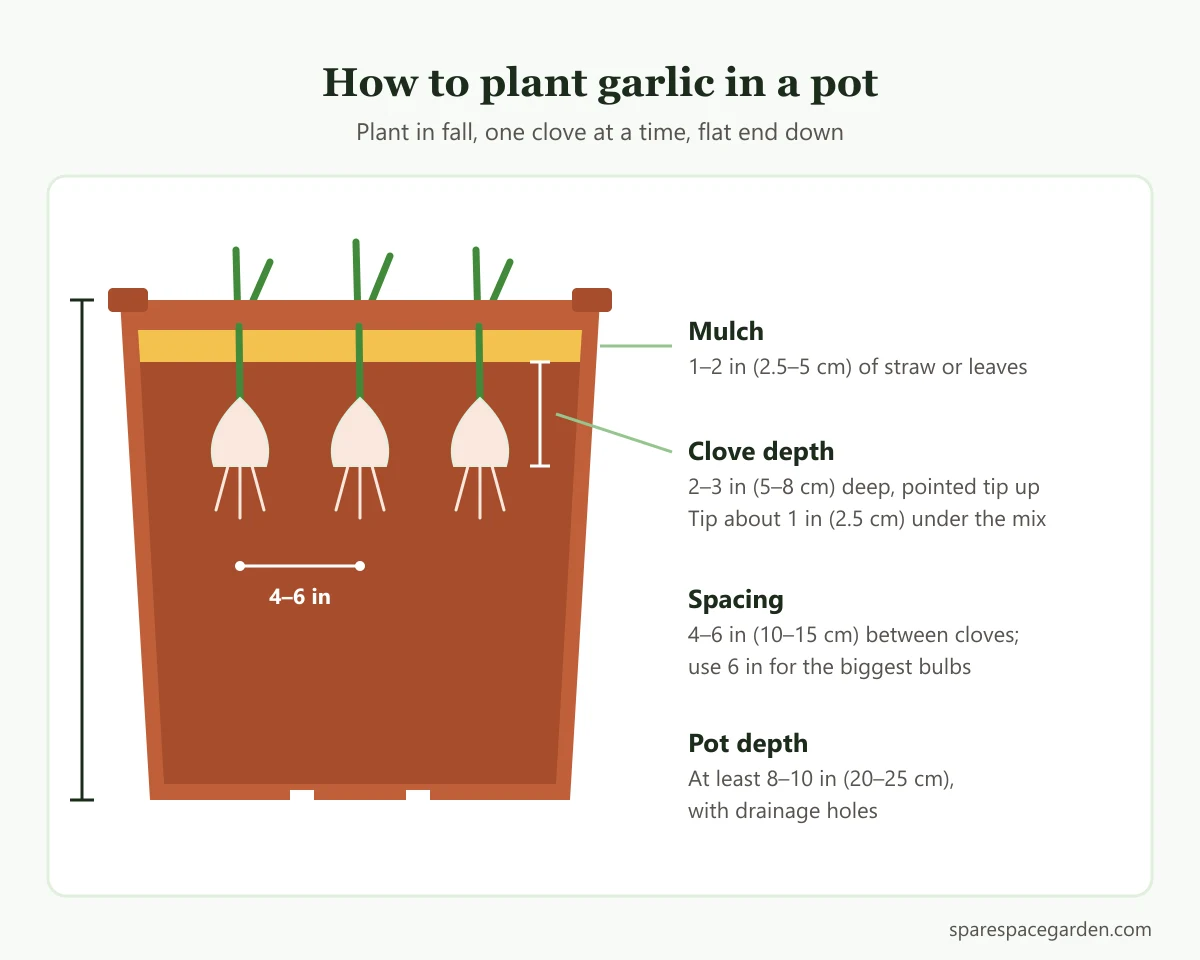 Clove depth, spacing and pot depth for container garlic.
Planting garlic in pots, step by step
- Fill the pot with a loose, free-draining potting mix, not garden soil. Our guide to the best potting soil for vegetables covers what to look for.
- Split the bulb into cloves just before planting. Keep the papery skins on. Plant the largest cloves; Maryland and Illinois Extension both note that large cloves produce larger bulbs.
- Set each clove flat end down, pointed tip up. Maryland Extension notes that orientation matters most for hardneck types.
- Plant at the right depth. Illinois Extension gives 2–3 inches (5–8 cm) deep. The RHS suggests the tip sit about 1 inch (2.5 cm) below the surface, a little deeper in light, sandy mixes.
- Water once to settle the mix, then let the top dry slightly between waterings.
- Mulch the surface with 1–2 inches (2.5–5 cm) of straw or shredded leaves, as a regional Extension answer on container garlic suggests. The RHS uses a mulch at least 2 in (5 cm) thick in the ground.
Tip: Label the pot with the variety and planting date. A pot of bare mulch looks the same in January as an empty one, and it's easy to reuse it by mistake.
Overwintering garlic pots
Cold is the whole point, but a pot gets colder than garden soil. Iowa State University Extension points out that roots are far less cold-hardy than the parts above ground, and that container plants left above ground in winter can be damaged or killed. Its advice is written for trees and shrubs, but the same logic protects garlic roots in a pot.
Ways to protect a pot through a hard winter:
- Sink the pot into a garden bed after the cloves have rooted and before the ground freezes, as Iowa State suggests for potted shrubs.
- Group pots together in a sheltered corner, out of the wind, so they insulate each other.
- Use an unheated garage or shed during severe cold. Iowa State recommends a spot that stays between 20 and 45°F (-7 to 7°C). Bring the pots back out once the worst weather passes, since the leaves need light.
- Ease off watering. The mix should stay barely moist, not wet. Regional Extension advice for container garlic is to water less in winter.
In mild-winter areas, none of this is needed. The pot can sit outside in full sun all season.
Spring care: water, feeding and scapes
Garlic starts growing quickly as the days lengthen. Illinois Extension describes it as shallow-rooted and sensitive to dry soil, and says bulbing, roughly May to June in Illinois, is the most important time for water. Pots dry out faster than beds, and Clemson's Home & Garden Information Center advises checking containers at least once a day during the growing season.
For feeding, Oregon State suggests a side-dressing of fertilizer in early spring and again in May, as the days lengthen. Maryland Extension feeds before planting, in April, and again in late May if needed. In a pot, a water-soluble fertilizer used at the label rate is the easiest way to follow that schedule. Our guide to fertilizer for potted plants compares options.
Hardneck garlic sends up a curling flower stem, called a scape, in late spring. The RHS recommends removing scapes as soon as they form so the plant puts its energy into the bulb, and Maryland Extension says pinching them back increases bulb size. Illinois Extension notes that scapes picked before they straighten are tender enough to cook. They can be sautéed or roasted, or used in place of green onions.
Watch out: Stop watering about two weeks before harvest, as Illinois Extension advises. Maryland Extension says to water less often as harvest approaches to avoid disease, and the RHS warns that wet conditions once bulbs are well formed can cause rot.
When to harvest and how to cure garlic
Fall-planted garlic is usually ready in early to midsummer. Maryland Extension puts the central Maryland harvest around July 1, and the RHS says fall-planted garlic is ready from late spring to early summer in the UK.
Watch the leaves rather than the calendar. Illinois Extension says to harvest when the lower leaves begin to brown, ideally while half or slightly more than half of the leaves are still green. Maryland gives a similar sign: about half the foliage brown. Harvested too early, bulbs are small and store poorly; harvested too late, the cloves start to pop out of their skins.
A pot makes harvest easy. Tip the container on its side and slide the root ball out, instead of digging and risking bruised bulbs.
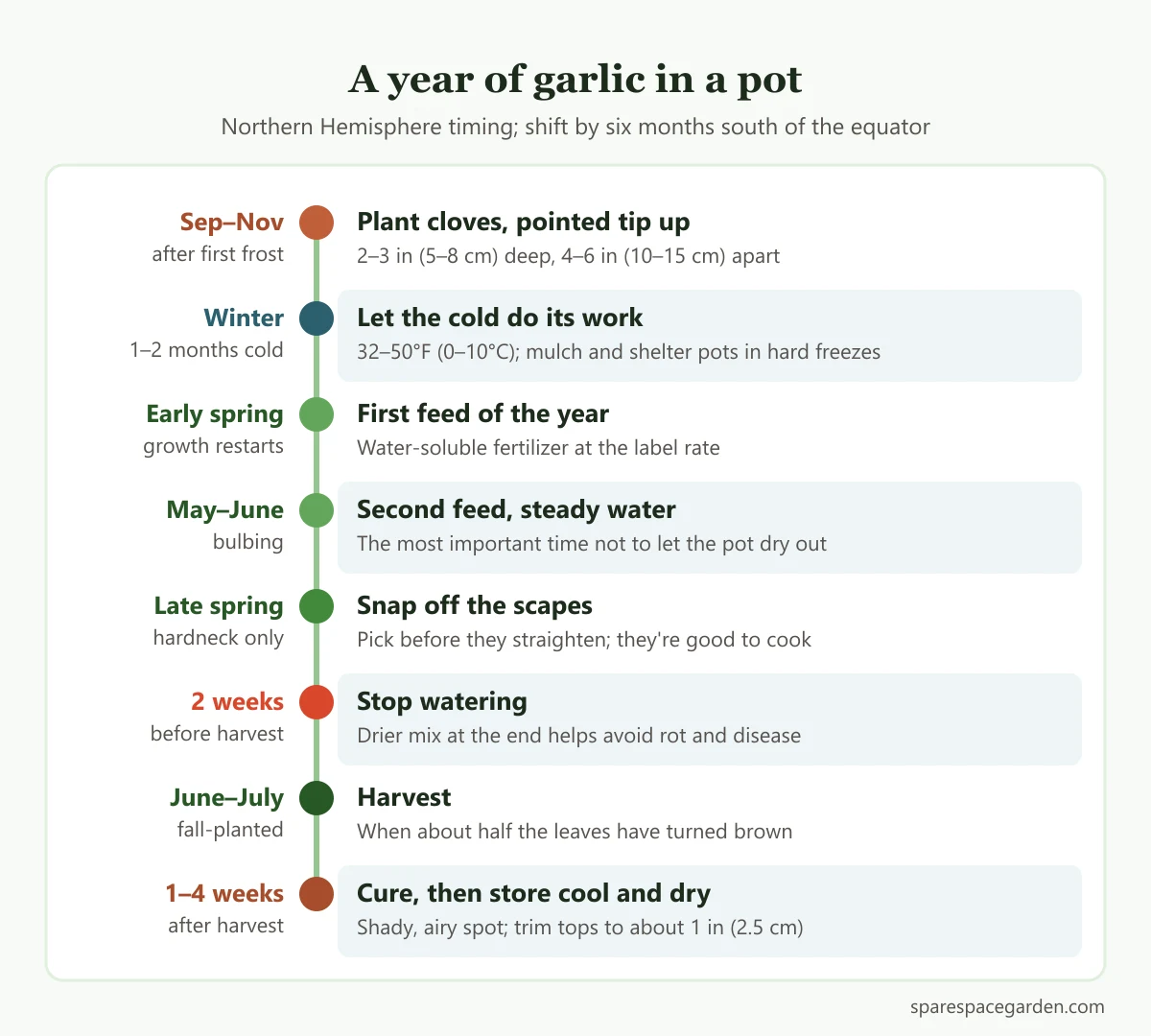 A year of container garlic, from fall planting to cured bulbs. South of the equator, shift the months by about six.
Curing dries the skins so the bulbs keep. Keep the leaves attached and spread the bulbs out somewhere dry, airy and shaded. Sources give different lengths:
| Source | Curing time | Notes |
|---|---|---|
| University of Maryland Extension | 7–14 days | Out of direct sun, then cut the tops |
| Oregon State University Extension | 2–3 weeks | Shady, warm, dry spot with airflow |
| RHS | 2–4 weeks | Avoid temperatures above 86°F (30°C) |
| Illinois Extension | 3–4 weeks | Dry area with good air circulation |
Once the leaves are dry and papery, trim the tops to about 1 inch (2.5 cm) and the roots close to the base, as Illinois suggests. Maryland Extension recommends storing bulbs cool and dry at 32–38°F (0–3°C), where they typically keep 6 to 9 months; the RHS suggests 41–50°F (5–10°C). Save a few of the largest bulbs to plant next fall.
Frequently asked questions
How deep should a pot be for garlic?
Aim for at least 8–10 inches (20–25 cm). Oregon State University Extension gives 8 inches (20 cm) as the minimum, and the RHS recommends 25 cm (10 in). A deeper pot holds more water and stays more even in temperature over winter.
How many garlic cloves can I plant in one pot?
It depends on the pot width and spacing. At 6 in (15 cm) apart, a 12 in (30 cm) pot holds about 3 cloves, and an 18 in (45 cm) pot about 8. Closer spacing of 4 in (10 cm) roughly doubles that, but each bulb will be smaller.
Can I plant garlic from the grocery store?
Maryland and Illinois Extension both advise against it. Maryland recommends certified, disease-free seed garlic instead, and notes that grocery store garlic is usually a softneck type that may carry disease without showing symptoms. Seed garlic from a garden supplier is a safer start.
Can garlic grow in pots indoors?
Bulbs are unlikely to form indoors, because the cloves need one to two months at 32–50°F (0–10°C), as the RHS and Maryland Extension note. Keep the pots outdoors or in an unheated, protected spot over winter.
Why are my potted garlic bulbs small?
The usual causes are too little cold, spring planting, small cloves, a pot that dried out during bulbing, or harvesting too early. Maryland Extension notes that spring-planted garlic, which misses the cold period, makes smaller bulbs, and Illinois Extension says early-harvested bulbs are small and store poorly.