Cucumber plants in pots do well as long as you give them three things: a container at least 12 inches (30 cm) wide and deep, a sunny spot, and water that never runs out. Bush varieties are the easiest fit for a balcony or patio, while vining types need a trellis but give a longer harvest from the same floor space.
Most of the trouble with potted cucumbers comes from dry spells. A pot that dries out stresses the plant, and stressed plants are more likely to produce bitter fruit. Pollination is the other common snag, especially on a high balcony with few bees.
Quick answer: Plant one cucumber per pot at least 12 in (30 cm) wide and deep, or about 5 gallons (19 L) for less watering, and two per standard growing bag. Choose a bush variety, or a vining one with a support put in at planting. Keep the mix evenly moist, feed every 10–14 days, and expect the first fruit about 50–70 days from seed.
Bush or vining: choosing cucumber varieties for pots
Your first decision is plant habit. Most cucumbers produce long, vigorous vines, as University of Maryland Extension's cucumber page notes, but there are also dwarf-vined and bush types bred for small spaces.
Bush types are the easiest choice for containers. A University of California home vegetable fact sheet lists 'Bush Champion', 'Salad Bush' and 'Spacemaster' as suitable for containers, 'Pickle Bush' as a compact pickling type, and 'Pot Luck' for containers only. Oregon State University Extension also recommends a bush variety over a vine variety for pots, with a small pole or trellis for support.
Vining types need a trellis but tend to keep cropping over a longer season. They suit a sunny railing or wall where the vine can climb instead of spreading across the floor.
Two other labels on seed packets matter for containers:
- Bitter-free (often sold as "burpless"). Purdue University's Indiana Yard and Garden lists cultivars bred without the bitter genes, including 'Diva', 'Marketmore 76', 'Sweet Slice' and 'Sweet Success'.
- Parthenocarpic (seedless, sets fruit without bees). Clemson's Home & Garden Information Center names 'Diva', 'Excelsior' and 'Sugar Crunch'. These are covered in the pollination section below.
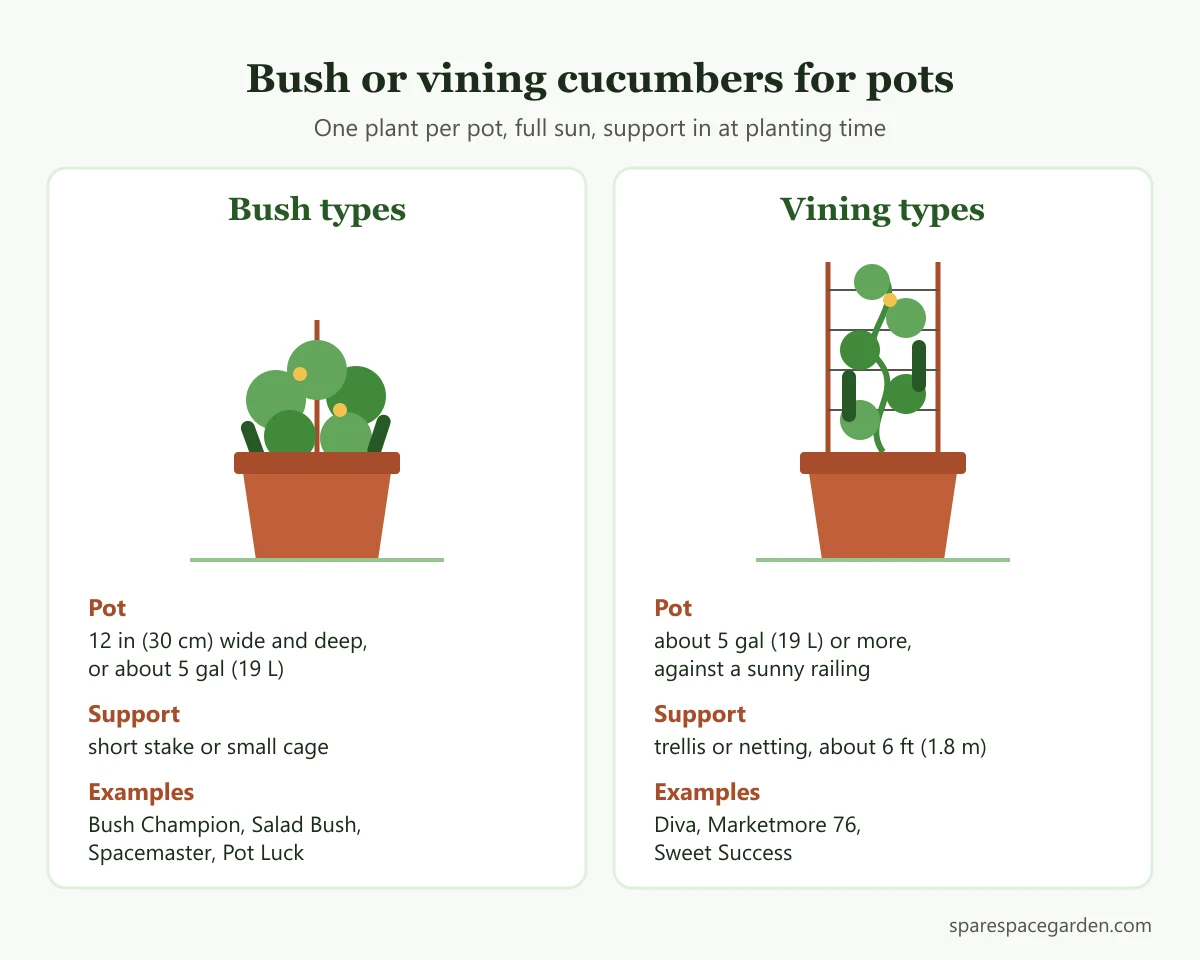 Bush types stay compact; vining types need a tall support.
What size pot do cucumbers need?
Advice varies more for cucumbers than for most container crops. The RHS cucumber guide asks for a pot at least 30 cm (12 in) wide and deep with one plant in the center, or two plants in a standard growing bag. Colorado State University Extension lists cucumbers among the crops that need a minimum 5-gallon (19 L) container. Texas A&M AgriLife's container table is the smallest, at 1 gallon (3.8 L) for one plant, but it also notes that cucumbers need considerably more space than most container crops because of their vines.
| Source | Container for one plant | Notes |
|---|---|---|
| RHS | At least 12 in (30 cm) wide and deep | Two plants per standard growing bag |
| Colorado State University Extension | 5 gal (19 L) minimum | Same as tomatoes and peppers |
| Oregon State University Extension | 2–5 gal (8–19 L), at least 12 in (30 cm) deep | General guide for most vegetables; choose bush types |
| Texas A&M AgriLife Extension | 1 gal (3.8 L) | Lists 'Burpless', 'Liberty', 'Early Pik' and others |
A practical middle ground is one plant in a pot of about 5 gallons (19 L). It meets every source's minimum, and a bigger volume of mix holds more water between checks, which matters for a crop that turns bitter under drought stress. Whatever you choose, make sure it has drainage holes and is filled with fresh potting mix; see the best potting soil for vegetables for what to buy.
Planting and adding a trellis in the pot
Cucumbers are tender and need warmth. Clemson advises planting once the soil reaches 70°F (21°C) and notes that seeds won't germinate below 50°F (10°C). The RHS plants outdoor cucumbers out once temperatures are reliably above 12°C (53°F), after hardening them off. For light, Maryland Extension defines full sun as at least 6 hours of direct light a day, preferably 8 to 10.
- Put the support in first. The RHS advises adding supports at planting time so the tendrils have something to cling to. Pushing a stake in later can damage roots.
- Plant one cucumber in the center of the pot. Firm it in and water well.
- Tie the stem in loosely at first. After that, tendrils do most of the climbing.
- Pinch out the tip on outdoor types. The RHS pinches out the growing tip after seven leaves, and pinches flowerless side shoots after seven leaves too.
- Mulch the surface. The RHS suggests a mulch around the base, leaving a gap around the stem to prevent rot.
For a bush type, a short cage or a single stake is usually enough. A vining type needs a taller frame: Clemson's garden trellis is about 6 feet (1.8 m) high. For frame styles, netting sizes and training on a balcony, see our guide to growing cucumbers vertically, and for pairing cucumbers with other climbers, read climbing vegetable plants.
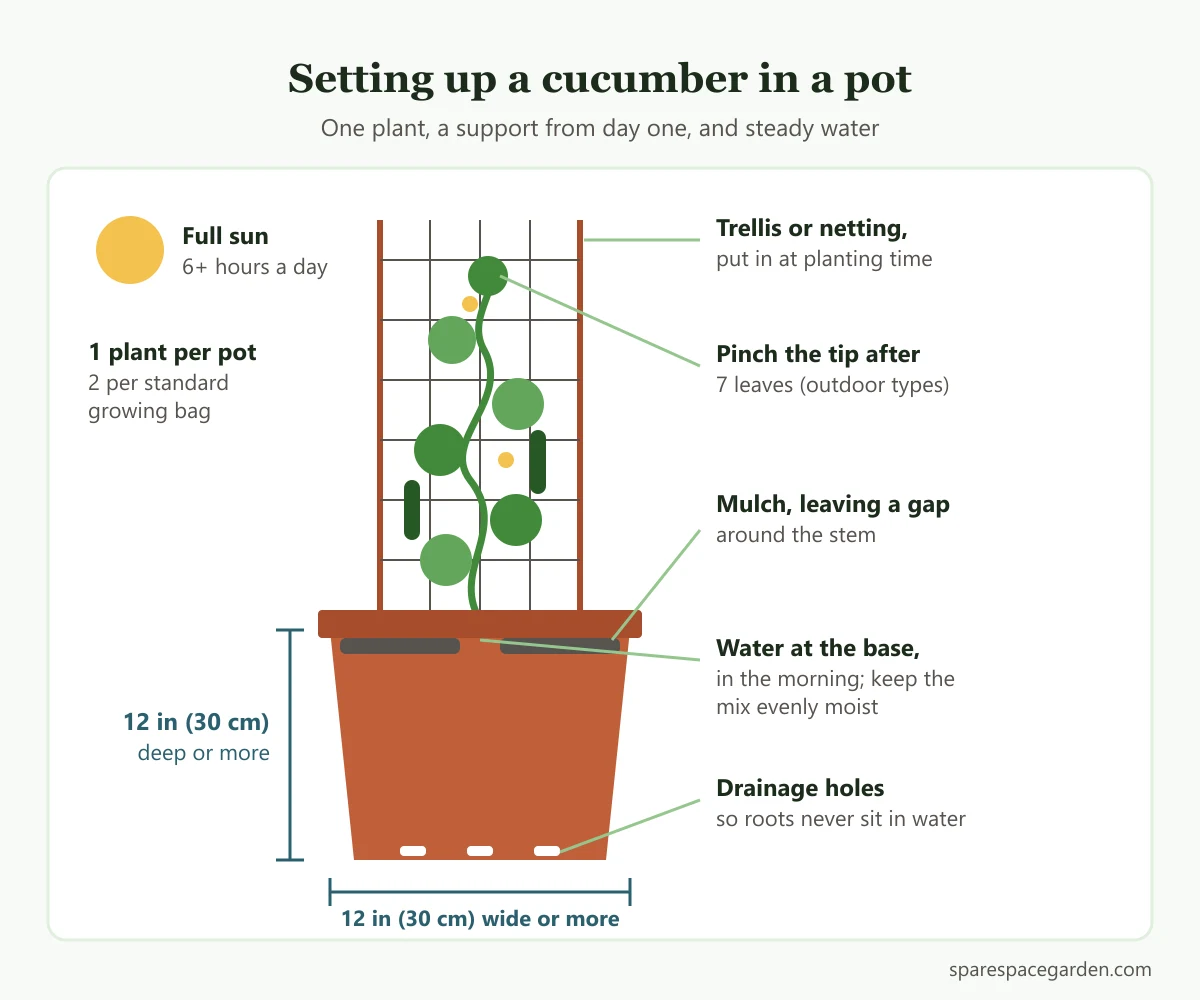 A simple setup for one cucumber plant in a container.
Watering and feeding cucumber plants in pots
Steady moisture is the single most useful thing you can give potted cucumbers. Clemson recommends keeping soil moisture uniform, especially while fruit is setting and developing, and watering at the base of the plant in the morning. The RHS says container plants may need watering every day in hot spells and asks you to keep leaves dry.
In a pot, the simplest check is your finger. University of Illinois Extension suggests watering when the top 1 inch (2.5 cm) of mix feels dry, then watering until it trickles out of the drainage holes. In warm, dry weather, Illinois notes that containers may need water more than once a day.
What makes cucumbers bitter
The bitterness comes from compounds called cucurbitacins. Iowa State University Extension explains that these are normally found in the leaves, stems and roots, and spread into the fruit when plants are under stress, usually from hot, dry weather. Purdue adds high temperatures and poor nutrition to the list, and both Clemson and the UC fact sheet mention temperature swings of more than 20°F (11°C).
Variety matters as much as care. The UC sheet notes that fertilization, plant spacing and irrigation frequency have shown little consistent effect on the number of bitter fruits, while varieties vary widely. Its advice: avoid cool or shady spots, give uniform moisture and ample nutrients, and choose newer hybrids, where bitterness is much less of a problem. Maryland Extension adds that misshapen fruit and fruit on stressed, insect-damaged or diseased plants are more likely to be bitter.
If you do pick a bitter cucumber, cut off the stem end and peel it. Iowa State says the compounds concentrate there and just under the skin.
Tip: If you're out all day in summer, a self-watering container keeps a reserve of water under the mix, which helps smooth out the dry-wet swings that stress cucumbers.
Feeding cucumbers in containers
Potting mix holds only a small store of nutrients, and frequent watering washes them out. The RHS recommends feeding container cucumbers every 10–14 days with a general liquid fertilizer, then switching to a high-potash feed, such as tomato feed, once flowering starts.
Don't overdo the nitrogen. Clemson warns that excess nitrogen encourages vine growth and reduces fruit. Texas A&M AgriLife also suggests watering containers with plain water at least once a week until it drains freely, to flush out unused fertilizer salts. Always follow the product label for rates. For more on product types, see fertilizer for potted plants.
Pollination and parthenocarpic varieties
Standard cucumbers carry separate male and female flowers. Female flowers have a tiny cucumber behind the petals; males don't. Clemson and Maryland Extension both note that the first 10 to 20 flowers on a plant are male, so a young plant covered in blossoms but no fruit is normal at first.
For fruit to form, pollen has to move from a male flower to a female one. Maryland Extension says each flower needs 8 to 12 bee visits to set fruit. On a high-rise balcony, in cool weather, or during rainy spells when bees are inactive, that may not happen. Clemson suggests hand-pollinating in the morning, since each flower opens for only one day: transfer pollen from a male flower's anthers to the female flower's stigma. The UC fact sheet suggests a small artist's paintbrush for the job.
Parthenocarpic varieties avoid the problem. They set fruit without pollination, so they're a good choice for enclosed balconies, sunrooms and greenhouses. Maryland Extension and the UC sheet note that if they're grown near other cucumbers, pollination can still happen and the fruit will then contain seeds.
Watch out: Most greenhouse cucumber varieties are all-female. The RHS warns that their flowers must not be pollinated or the fruit may be bitter, and advises removing any occasional male flowers. Outdoor varieties are the opposite: leave the male flowers on.
Harvesting cucumbers from pots
Clemson gives about 50 to 70 days to harvest depending on cultivar, and Maryland Extension gives 50 to 65 days from seed. Pick young and often; Clemson recommends frequent harvests to avoid oversized fruit.
| Cucumber type | Harvest length | Source |
|---|---|---|
| Mini cucumbers | About 3 in (8 cm) | RHS |
| Pickling types | 2–6 in (5–15 cm) | Clemson; Maryland says 2–4 in (5–10 cm) |
| Small-fruited slicers | About 6 in (15 cm) | RHS |
| Full-size slicing and burpless types | 6–10 in (15–25 cm) | Clemson; RHS gives 8–10 in (20–25 cm) |
Cut the stem cleanly with a knife or pruners rather than pulling, as both the RHS and Clemson advise. Check plants every few days. The RHS says fruit that's yellowish, bulbous or soft is overripe.
Common problems with potted cucumbers
Most problems trace back to water, pollination or a few familiar pests. Use this table to match what you see with the likely cause.
| Symptom | Likely cause | Fix |
|---|---|---|
| Bitter fruit | Drought or heat stress, a bitter-prone variety, or a pollinated all-female greenhouse type | Water evenly; choose bitter-free varieties; peel and trim the stem end |
| Lots of flowers, no fruit | Early male flowers, or too few bees | Wait for female flowers; hand-pollinate; try a parthenocarpic variety |
| Small, misshapen fruit | Poor pollination or plant stress | Hand-pollinate; keep the mix evenly moist |
| Big vines, little fruit | Too much nitrogen, or plants too close together | Switch to a high-potash feed; one plant per pot |
| White powder on leaves | Powdery mildew | Water at the base; grow resistant varieties; clear old plant debris |
| Fine speckling and webbing under leaves | Spider mites | See the fix below |
| Holes in leaves, scarred fruit, striped beetles | Cucumber beetles | Pick off beetles; use a labeled insecticide if needed |
The UC fact sheet notes that powdery mildew is less severe in hot, dry weather and recommends resistant varieties. The RHS lists powdery mildew and red spider mite as the main problems, especially under cover with low humidity. Because mites favor dry conditions, a hot, sheltered balcony can suit them too; our guide to cucumber spider mites covers how to spot and control them. If you use any spray, organic or not, follow the label.
Frequently asked questions
Can you grow cucumbers in a 5-gallon bucket?
Yes. A 5-gallon (19 L) bucket meets Colorado State's minimum for cucumbers and is larger than the RHS's 12-inch (30 cm) pot. Plant one cucumber per bucket, drill drainage holes first, and add a stake or small trellis at planting.
Do cucumbers in pots need a trellis?
Vining types do, and bush types benefit from a little support. Oregon State recommends a pole or trellis in the pot even for bush varieties, since it supports the plant and improves airflow around the leaves. The RHS advises putting supports in at planting time so tendrils can grab them.
How often should you water cucumbers in containers?
Check daily and water when the top inch (2.5 cm) of mix is dry, as Illinois Extension suggests. In hot spells, the RHS says that may mean watering every day, and Illinois notes containers sometimes need water more than once a day. Water until it drains from the bottom.
Why are my cucumber flowers falling off without making fruit?
Early on, it's usually because the first 10 to 20 flowers are male and drop naturally, according to Clemson. Later, female flowers that fall or shrivel usually weren't pollinated. Hand-pollinate in the morning or grow a parthenocarpic variety.
How many cucumber plants can go in one pot?
One per pot is the standard in the RHS, Texas A&M and Colorado State guidance. The RHS allows two in a standard growing bag. Planting too close encourages excess leafy growth, according to the UC fact sheet, so more plants rarely means more fruit.