To grow tomatoes in pots from seeds, sow them indoors 5 to 8 weeks before you plan to move plants outside, keep the seed tray warm until they sprout, then grow the seedlings under strong light in a cooler room. Move each one into a bigger pot once true leaves appear, harden them off for a week or two, and plant them deep in a container of at least 5 gallons (19 L) after your last frost.
Starting from seed costs little and gives you a far wider choice of compact and patio varieties than most garden centers stock as plants. The process is simple, but timing and light make the difference between stocky transplants and weak, stretched ones.
Quick answer: Sow seeds about 1/8 in (3 mm) deep, 5–8 weeks before planting out. At a soil temperature of 77–86°F (25–30°C), Oregon State's data shows seedlings appear in about 6 days. Give seedlings 14–16 hours of light a day, pot up at the first true leaves, harden off over about 2 weeks, and plant out 1–2 weeks after your last frost, burying the stem up to the first true leaves.
When to start tomato seeds for pots
Count backward from the date you plan to set plants outside, not from today. Sources differ a little on how long tomatoes need indoors:
- Iowa State University Extension and University of Maryland Extension say 5–6 weeks before the planned outdoor planting date.
- Cornell's tomato growing guide and Clemson Extension say 6–8 weeks.
Planting out comes after your last frost. Cornell suggests waiting at least one to two weeks after the last frost date, until nights stay consistently above 45°F (7°C). The RHS tomato guide sets a higher bar: plant out once temperatures are reliably above 60°F (16°C).
Starting too early is a common mistake. Plants that wait too long indoors outgrow their pots and stretch toward the light, turning into leggy seedlings. If you're unsure, the shorter end of the range is safer.
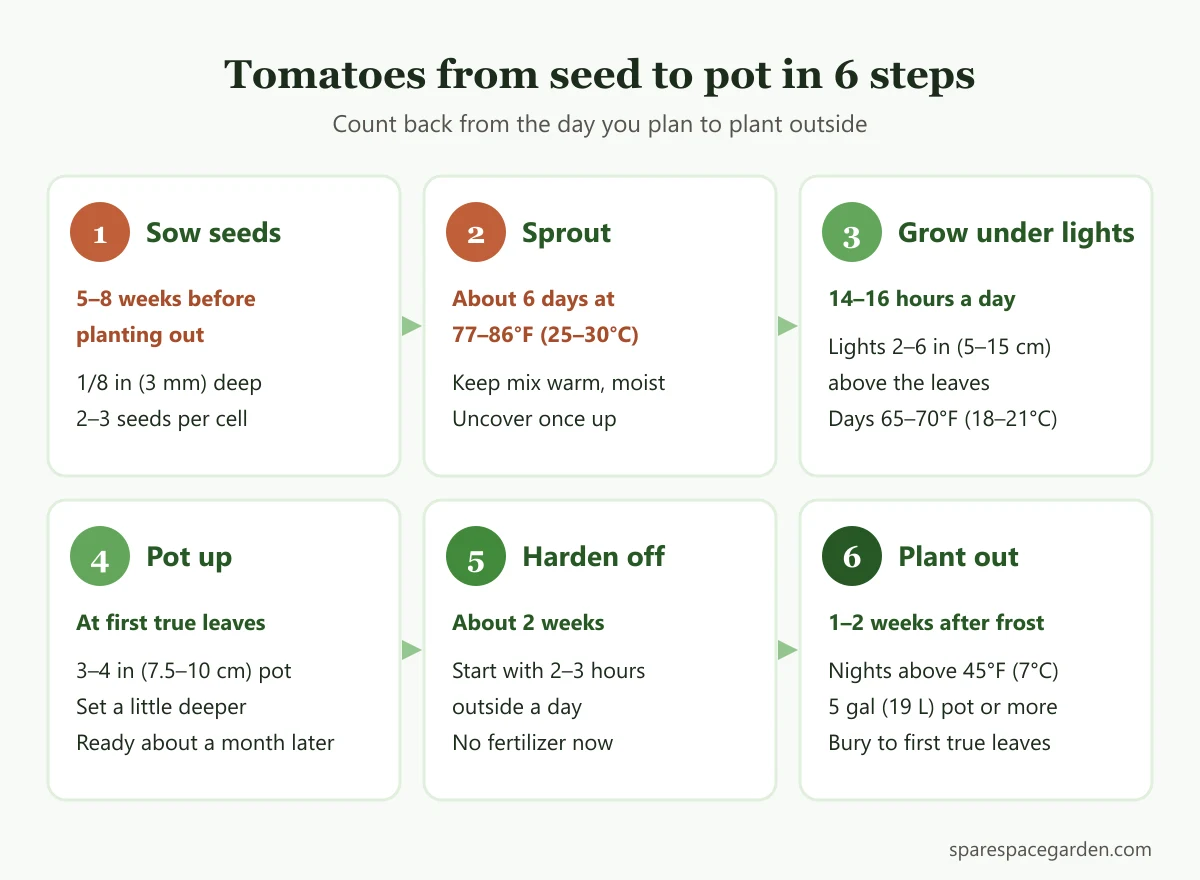 A typical indoor schedule, counted back from your planting-out date.
What you need to start tomato seeds
You don't need much, but each item has a job:
- Seed-starting mix. Clemson recommends a sterile, soilless mix for sowing. It drains well and is less likely to carry disease than garden soil.
- Small containers. A cell tray or small pots for sowing, plus pots of about 3–4 in (7.5–10 cm) for potting up. Maryland Extension suggests 9–16 square inches per seedling, roughly a 3 x 3 in to 4 x 4 in cell.
- A clear cover. A plastic dome or wrap holds in moisture until the seeds sprout.
- Warmth. A seedling heat mat helps in a cool house, since tomato seeds sprout much faster in warm mix.
- Light. A sunny window rarely gives enough light in late winter, so most growers use shop lights or LED grow lights on a timer.
- The final container. About 5 gallons (19 L) per plant for most varieties, less for dwarf types. See the last section for sizes.
How to grow tomatoes in pots from seeds: sowing and germination
- Moisten the mix first. Fill cells or pots to within about 1 in (2.5 cm) of the top, as Iowa State suggests, and water so the mix is evenly damp but not dripping.
- Sow two or three seeds per cell. Iowa State recommends this for individual containers, so you still get a plant if one seed fails.
- Cover lightly. Cornell gives a sowing depth of about 1/8 in (3 mm). Iowa State's general rule is one to two times the seed's diameter.
- Cover the tray and keep it warm. Use the dome or plastic wrap, and set the tray on a heat mat or in a warm spot.
- Uncover as soon as seedlings appear. The RHS says seedlings usually emerge within two weeks. Move them under light straight away.
- Thin to one per cell. Snip extra seedlings at soil level with scissors rather than pulling, which can disturb the one you keep.
Temperature controls how fast seeds sprout. Oregon State University Extension's germination table shows how strongly it matters for tomatoes (the seeds in that data were sown 1/2 in, or 13 mm, deep):
| Soil temperature | Days for seedlings to appear |
|---|---|
| 50°F (10°C) | 43 days |
| 59°F (15°C) | 14 days |
| 68°F (20°C) | 8 days |
| 77°F (25°C) | 6 days |
| 86°F (30°C) | 6 days |
| 95°F (35°C) | 9 days |
| 104°F (40°C) | Little or no germination |
Cornell says tomatoes germinate best at 75–90°F (24–32°C) and usually emerge in 6–12 days. The RHS gives a lower target of about 64°F (18°C), which still works but takes longer.
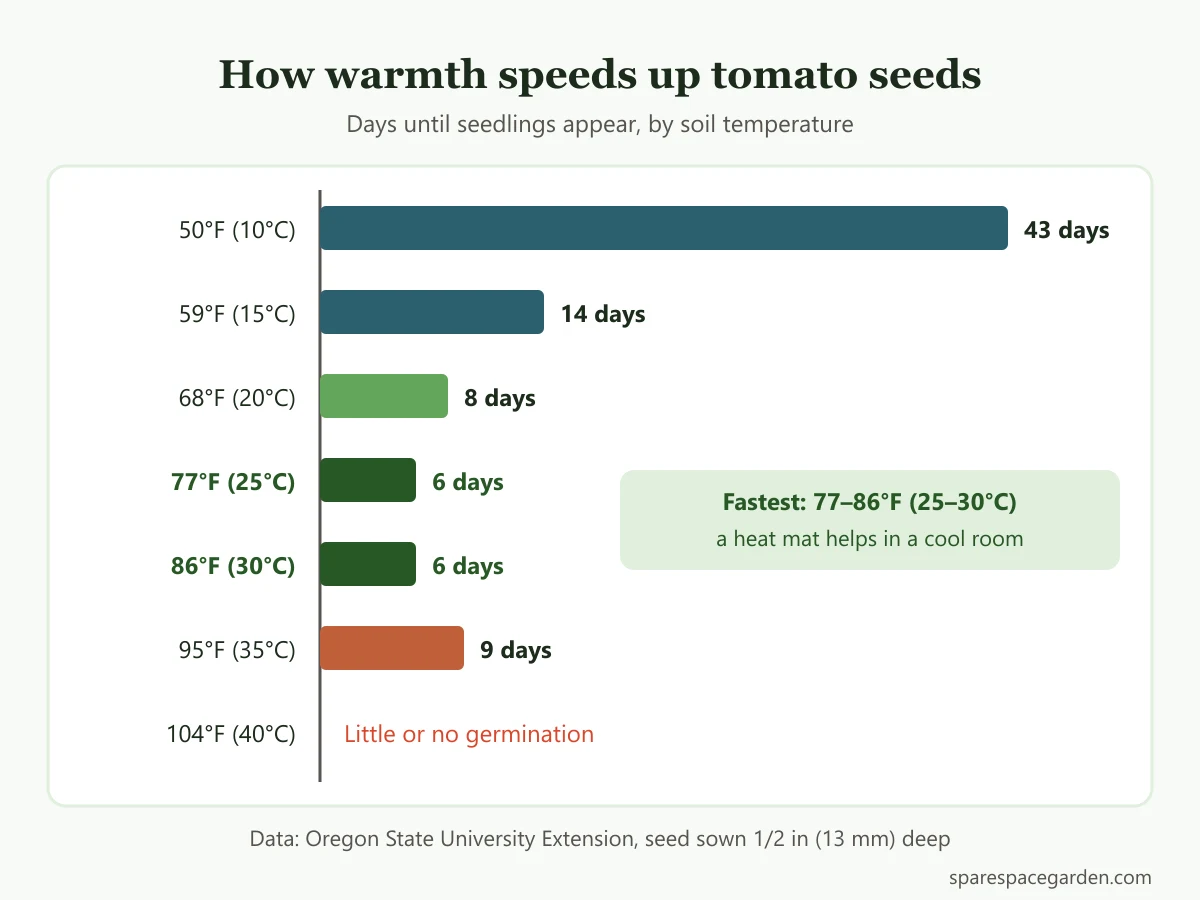 Days for tomato seedlings to appear at each soil temperature, from Oregon State University Extension.
Watch out: Heat mats dry the mix quickly. Check moisture every day and take the tray off the mat once most seedlings are up. Iowa State notes that seedlings grow best at about 10°F (6°C) cooler than the best germination temperature.
Light and temperature for tomato seedlings
Once seedlings are up, they need lots of light and less heat. This combination keeps them short and sturdy.
Light. University of Maryland Extension recommends 14–16 hours of light a day on an outlet timer, and Clemson suggests 16–18 hours. Keep the lights close: Clemson says 2–4 in (5–10 cm) above the seedlings, Maryland gives 2–6 in (5–15 cm), and Iowa State suggests 4–6 in (10–15 cm). Raise the lights as the plants grow so the gap stays the same. LED fixtures run cooler than old fluorescent tubes, so check the maker's guidance on distance.
Temperature. Maryland Extension's seed-starting guide suggests 65–70°F (18–21°C) during the day and 55–60°F (13–16°C) at night after germination. Cornell grows tomato transplants at about 70°F (21°C), and the RHS says to keep them at no less than 60°F (16°C). A cool room with bright light gives stockier plants than a warm room with weak light.
Air movement. Clemson suggests a fan gently moving the seedlings once they have two true leaves. The motion helps stems thicken.
Tip: Water from below when you can. Clemson suggests setting the tray in 1–2 in (2.5–5 cm) of water for 3–10 minutes, then letting it drain. This keeps the surface drier and the stems clean.
Feeding seedlings
Many seed-starting mixes include some fertilizer. Maryland Extension says soilless mixes often supply nutrients for 6–8 weeks after germination, which covers most of a tomato's time indoors. If your mix has no fertilizer, Clemson suggests starting a water-soluble feed once the first true leaves appear, at every other watering, and Iowa State recommends diluting it to about 1/4 strength. Check the product label before mixing.
Potting up tomato seedlings
Potting up means moving each seedling from its small cell into a bigger pot. It gives the roots room to grow before the plant goes outside.
Iowa State suggests doing it when the first true leaves appear (the jagged leaves that come after the two smooth seed leaves). Clemson says when one or two sets of true leaves have formed, and Maryland Extension usually pots tomatoes up 2–3 weeks after germination.
- Water the seedlings beforehand so the root ball holds together.
- Fill the new pot partway with fresh potting mix.
- Lift the seedling by a leaf, not the stem. A torn leaf can be replaced; a crushed stem can't.
- Set it a little deeper than before. Tomatoes grow roots along any buried stem, as Maryland Extension notes, so this is a good chance to firm up a slightly stretched seedling.
- Firm the mix gently and water in.
The RHS says plants are usually ready for their final position about a month after this step. Keep them bright and at no less than 60°F (16°C) in the meantime.
Hardening off before moving outside
Seedlings raised indoors have never felt wind, full sun or cool nights. Hardening off gets them used to these conditions gradually, so they don't scorch or stall after planting.
University of Illinois Extension recommends starting about 2 weeks before transplanting:
- Set plants outside for 2–3 hours in the warmest part of the day, typically noon to 5 p.m.
- Add time each day.
- Once they cope with 10–12 hours outside for a few days, leave them out day and night for a couple of days.
- Water a little less often, but don't let them wilt, and skip fertilizer during this period.
Clemson allows 2–3 weeks for the process, and Iowa State suggests starting in shade and out of the wind, then moving plants into more sun after a few days. On a balcony, a sheltered corner works well for the first few sessions.
Planting into the final pot
This is where container tomatoes start to need their summer setup. Choose the pot before planting day:
| Source | Final container per plant |
|---|---|
| Colorado State University Extension | 5 gallons (19 L) minimum |
| Clemson Extension | 14–20 in (36–51 cm) container, or a 5-gallon bucket with drainage holes, for compact cultivars |
| RHS | 12–18 in (30–45 cm) pot |
Bigger is easier to look after, because it holds more water. Our guide to how many tomato plants per container covers sizes for different varieties.
How deep to plant
Plant tomatoes deeper than most vegetables. Iowa State says to set them deeply, up to the first true leaves, and the RHS says the first set of leaves should sit just above the surface. Maryland Extension suggests burying the stem so only two or three sets of true leaves show. Roots form along the buried part, giving a stronger root system.
In a tall pot, you can bury the stem straight down. For a leggy plant in a wide, shallower container, Iowa State describes a trench method: pinch off the lower leaves, lay the stem on its side, and gently bend the top upward so the upper few inches stay above the soil. Maryland Extension notes this also helps leggy plants, and suggests avoiding setting the root ball deep into cold soil.
Put the stake or cage in at the same time, then water thoroughly. For everything that happens next, from feeding to pruning suckers, see our guide to tomato plant care in pots.
Frequently asked questions
How long does it take to grow tomatoes from seed in pots?
Plan on about 5–8 weeks indoors from sowing to planting out, depending on which extension guide you follow. After transplanting, Maryland Extension puts tomatoes at 65–90 days to mature, depending on the variety. Early and cherry varieties sit at the short end of that range.
Do tomato seeds need light to germinate?
Light isn't the main factor for sprouting; warmth and moisture are. Most guides cover the tray to hold in moisture, then remove the cover and give strong light as soon as seedlings appear, as the RHS advises. Seedlings left without strong light quickly start to stretch.
Can you sow tomato seeds directly in the final pot?
You can, but it's rarely worth it in a short season. Seeds need warm mix to sprout quickly, and Oregon State's data shows emergence slows to 14 days at 59°F (15°C) and 43 days at 50°F (10°C). Starting indoors gives plants a head start of several weeks before the weather outside is warm enough.
Why are my tomato seedlings tall and floppy?
Too little light, too much warmth, or both. Move lights closer, keep the room cooler after germination, and add a gentle fan. Our guide to leggy seedlings explains the fixes, and tomatoes have the advantage that you can bury a stretched stem when potting up or planting out.