Growing cilantro in pots works well as long as you plan around the plant's short, cool-season life. Cilantro switches from making leaves to making flowers when days get long and warm, so the date you sow, where the pot sits and how evenly you water matter more than any fertilizer.
A container also gives you something a garden bed can't: you can pick it up and move it into shade when a hot spell arrives. Below you'll find pot sizes, sowing steps, a succession plan, slow-bolting varieties and what to do with the seeds once a plant does flower.
Quick answer: Use a pot with drainage holes that holds at least 1 to 3 gallons (4 to 11 L) of mix, sow seeds 1/4 to 1/2 inch (6 to 13 mm) deep and keep the mix evenly moist. Start picking at 4 to 6 inches (10 to 15 cm) tall, and sow a fresh pot every 2 to 3 weeks in spring and again from late summer.
Why cilantro bolts, and what you can control
Bolting is the plant doing exactly what it was built to do. Oregon State University Extension explains that both temperature and day length influence when cilantro flowers. Plants sown in midsummer typically bolt into small white flowers and set seed within four to six weeks, while plants growing in the cooler, shorter days of spring or fall can keep producing leaves for several weeks or months.
The RHS lists hot, dry weather and long dry spells as the main triggers outdoors, and low light or too much heat as the triggers indoors. That gives you four levers:
- Sowing date: grow your main crops in spring and fall, not in the longest, hottest weeks.
- Location: a pot in afternoon shade stays cooler than one on a sun-baked balcony floor.
- Water: a pot that dries out stresses the plant and pushes it toward flowering.
- Variety: slow-bolting types buy you extra picking time.
Day length is the one factor you can't change outdoors. You work around it by sowing often, so there's always a young plant coming along when an older one starts to flower.
Growing cilantro in pots: size, depth and mix
The University of Maryland Extension container guide groups cilantro with small herbs and gives a minimum of 1 to 3 gallons (4 to 11 L) of growing media and a depth of 4 to 6 inches (10 to 15 cm). Treat those figures as a floor, not a target.
Cilantro grows a long taproot, which is why Oregon State notes that it's hard to transplant. A larger pot at the top of that range holds more mix, and more mix stays moist longer between waterings. Since drought stress is one of the bolting triggers, a bit of extra volume is cheap insurance when growing cilantro in pots. Several small pots are also more useful than one big trough, because you can sow them a few weeks apart.
A few container details make a real difference:
- Drainage holes are required. UMD advises raising pots on pot feet or a brick and emptying saucers after watering.
- Skip the gravel layer. According to the same UMD guide, gravel or broken pot pieces in the base don't improve drainage and can raise the water table inside the pot.
- Use a rich, free-draining potting mix, not garden soil. If you blend your own, our guide on how to make potting soil covers the basic recipe.
- Light-colored or glazed pots heat up less in sun than thin black plastic, which helps keep roots cool.
 Pot setup for cilantro: sow where it will grow, and give the taproot room.
How to sow cilantro in a pot
Direct sowing in the final container is the simplest route, because the taproot doesn't like being moved. Here's the sequence:
- Fill the pot with moist potting mix, leaving a little space below the rim so water doesn't run off.
- Scatter the seeds about 2 inches (5 cm) apart if you want leaves. Utah State University and the RHS both use this spacing for leaf crops.
- Cover with 1/4 to 1/2 inch (6 to 13 mm) of mix and press it down lightly.
- Keep the surface moist until the seedlings appear. Seed supplier Johnny's lists 7 to 10 days at 65 to 70°F (18 to 21°C). In cooler conditions it's slower: the RHS gives 1 to 3 weeks outdoors, and Utah State says about three weeks.
- Thin the seedlings to 2 inches (5 cm) for a leaf pot. For a seed crop, thin to about 8 inches (20 cm), the spacing used by the RHS and Oregon State.
Oregon State notes that cilantro seed germinates at soil temperatures of 55 to 68°F (13 to 20°C), which is another reason spring and early fall sowings do so well.
If you buy nursery plants instead, the RHS suggests planting them about 4 inches (10 cm) apart at the same depth they were growing. When starting seeds indoors to transplant later, Utah State University Extension advises sowing 4 to 6 weeks before moving them out and disturbing the roots as little as possible. Seedlings started on a dim windowsill tend to stretch, so see our notes on leggy seedlings if yours flop over.
Tip: Biodegradable pots or soil blocks let you start cilantro early indoors without pulling the taproot out of a plastic cell at transplant time.
When to sow: a succession plan that avoids the heat
Cilantro gives you its best leaf harvest in cool weather, so the calendar does most of the work. Oregon State recommends sowing in early spring and again in late summer as temperatures cool and days shorten, sowing small batches every few weeks, and avoiding planting during peak summer heat. Mature plants tolerate light freezing, so fall pots can keep going into cold weather.
How often you sow depends on the source. Johnny's suggests every 2 to 3 weeks for a continuous leaf harvest, while the RHS suggests a sowing every month or so. If you're growing cilantro in pots, every 2 to 3 weeks works nicely: by the time the oldest pot starts to flower, the next one is ready to pick.
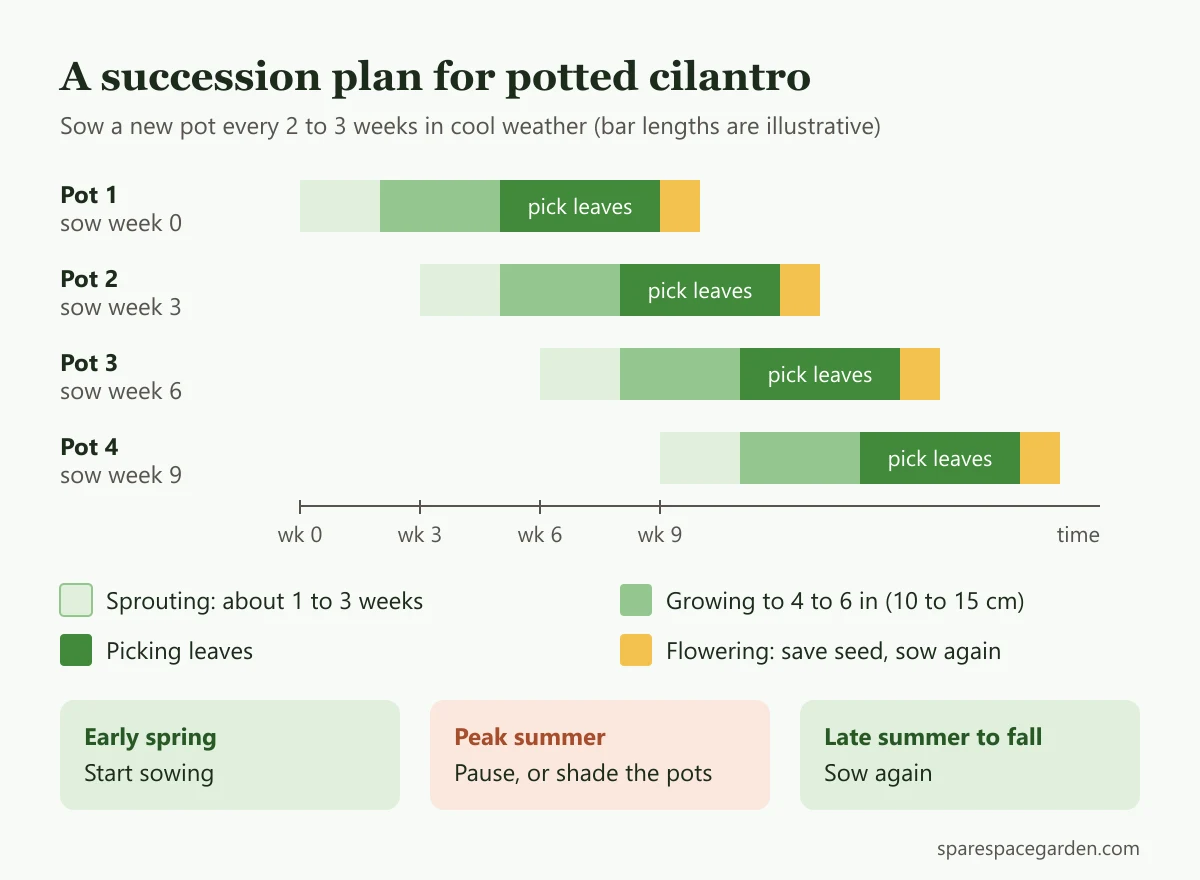 Sow a new pot every 2 to 3 weeks in cool weather so a young plant is always ready to pick.
Your climate shifts the timing:
| Climate | Main sowing window | Summer plan |
|---|---|---|
| Cold winters, warm summers | Early spring, then late summer into fall | Pause sowing in peak heat, or keep pots in afternoon shade |
| Mild, frost-free winters (Florida, coastal areas) | Fall and winter | Expect quick bolting once days get long and warm |
| Cool, mild summers (such as much of the UK) | Spring through early fall | Shade from midday sun; sow every month or so |
| Indoors | Year-round | Keep the mix below 75°F (24°C) and give bright light |
UF/IFAS Gardening Solutions recommends growing cilantro in fall and winter in Florida, since it flowers and goes to seed quickly when days get long and warm. The RHS adds that autumn sowings under cloches or in a greenhouse can stretch leaf harvests into early winter.
Watch out: A pot sown in late June or early July will almost certainly bolt fast. Oregon State notes that plants sown then flower during the long, hot days of summer. Save that slot for a seed crop instead of leaves.
Light, water and feeding
Light. Cilantro does best in full sun to part shade, according to UF/IFAS. In summer, the RHS recommends a cooler spot shaded from midday sun. On a balcony, that might mean the east side, where the pot gets morning sun and afternoon shade.
Water. The RHS advises checking containers daily and keeping the compost moist but not soggy, watering in the early morning or evening. A fully dried-out pot is one of the fastest ways to trigger flowering. On the other hand, Utah State warns against overwatering, since damp, humid conditions cause problems. Water deeply when the top of the mix feels dry, and let the excess drain away.
Keeping roots cool. Utah State suggests mulching to keep the soil cool and growing plants close together. In a pot, a thin layer of mulch on the surface and close spacing both shade the mix. Grouping pots together also helps, because they shade each other's sides.
Indoors. Utah State recommends keeping the soil of indoor plants below 75°F (24°C), so keep pots away from radiators, heat vents and hot south-facing glass. Low light is also a trigger indoors, so put the pot in your brightest window. Our list of the best herbs to grow indoors compares cilantro with easier windowsill herbs.
Feeding. Cilantro likes moderately rich soil, but Utah State notes that excess nitrogen reduces flavor. A fresh potting mix with some compost usually carries a short crop. If you feed at all, use a diluted liquid fertilizer occasionally and follow the label.
Slow-bolting cilantro varieties
Variety choice doesn't stop bolting, but it can delay it. The RHS names 'Cruiser' and 'Calypso' as slow to bolt; both hold the RHS Award of Garden Merit. Utah State recommends 'Slow Bolting' and 'Leisure' for leaf harvests.
Look for words such as "slow bolt" or "long standing" on the seed packet when you're buying for leaves. If you mostly want coriander seed, any standard cilantro will do, since you want it to flower anyway.
Harvesting leaves and coriander seed
Picking leaves
Start picking when plants reach 4 to 6 inches (10 to 15 cm) tall, the range used by the RHS and Utah State. UF/IFAS says you can then keep picking until the plant dies. The RHS recommends taking a few leaves from each plant, then letting it recover for about two weeks before the next round.
Cut the larger outer stems near the base and leave the center to keep growing. Leaves are most flavorful when young and tender, according to Oregon State, so frequent light picking beats one big cut.
When a thick central stalk with finer, feathery leaves appears, the plant has started to bolt. The RHS suggests removing flower stems as soon as they show to prolong leaf production. This buys some time, but it won't reset the plant, so that's your cue to sow the next pot.
Saving coriander seed
Coriander is simply the dried seed of the same plant. Both UF/IFAS and Johnny's put mature seed at about three months after planting. Wait until the seed heads turn brown, then:
- Cut the whole stems before the seeds drop (Oregon State stresses timing here).
- Hang them upside down in a paper bag, or lay them on paper in a warm room for about a week, as the RHS describes.
- Rub the dry heads to free the seeds, and store them in a dry, airtight container.
Johnny's notes that green, immature seeds can also be picked once they form. The flowers attract beneficial insects, so a bolting pot still has a job to do on the balcony. Oregon State adds that the roots are valued in Thai and Vietnamese cooking and are best dug in autumn.
Frequently asked questions
Can you grow cilantro indoors in a pot?
Yes, but it needs your brightest window and a cool room. Utah State advises keeping the soil below 75°F (24°C), and the RHS lists low light and heat as indoor bolting triggers. If your windows are dim, cilantro microgreens are an easier option; see our guide on how to grow microgreens indoors.
Can you stop cilantro from bolting once it starts?
No. Removing the flower stems as they appear can extend leaf picking a little, but the plant won't go back to full leaf production. Pick what you can, let it flower for seed, and rely on a younger pot for leaves.
How long does cilantro take to grow in a pot?
Seeds take about 1 to 3 weeks to come up, depending on temperature. You can start picking once plants are 4 to 6 inches (10 to 15 cm) tall, and the RHS says harvests can begin in as little as 10 weeks from sowing. Mature seed takes about three months.
Why are my cilantro seedlings yellowing and dying?
Utah State lists damping off as a cause of seedling death and yellowing, and wet, poorly drained mix makes it worse. Use fresh potting mix, make sure the pot drains freely, and water only when the surface starts to dry. Our parsley guide on how to grow parsley in pots covers a related herb with similar soil needs.
How many cilantro plants fit in one pot?
That depends on the pot and what you want from it. For leaves, the 2 inch (5 cm) spacing used by the RHS and Utah State lets you fit many plants in a small container. For seed, plants need about 8 inches (20 cm) each, so a small pot holds only a few.