Learning how to make potting soil comes down to one idea: a container mix has to hold water and air at the same time, and garden soil can't do both inside a pot. Homemade mixes start with a spongy base such as sphagnum peat moss or coconut coir, add a coarse material like perlite or vermiculite for air, and get a little lime and fertilizer to set the pH and feed young roots.
Extension services publish simple recipes you can measure with a bucket. Below are three of them, one for vegetables, one for herbs that like it on the dry side and one for seed starting, plus what each ingredient does so you can adjust a recipe instead of guessing.
Quick answer: For vegetables, mix equal parts sphagnum peat moss (or coir) and vermiculite. Texas A&M AgriLife adds 10 tablespoons of limestone, 5 tablespoons of superphosphate and 1 cup of garden fertilizer to every 2 bushels (about 18½ gallons or 70 L) of that blend. For seeds, use equal parts peat or coir, vermiculite and fine perlite, with no fertilizer.
Why garden soil doesn't work in pots
Soil that grows great vegetables in a bed behaves badly in a container. University of Nebraska–Lincoln Extension explains that clay soils are made of tiny particles that hold too much water when wet, which cuts off oxygen to roots, and that they pull away from the sides of the pot as they dry. Field soil can also bring in weed seeds and disease organisms.
University of Maryland Extension calls garden soil too dense for the job. Its guide to growing media for containers allows topsoil only in very large containers, and then at no more than 5–10% of the volume. Clemson's Home & Garden Information Center adds that garden soil contains too many bacteria and is generally not recommended for container plants.
That's why every recipe below is "soilless." These mixes contain no field soil at all, which keeps them light, porous and free of most weed seeds.
What each potting soil ingredient does
University of Maryland Extension lists three jobs for any growing medium: supply roots with nutrients, air and water, leave room for root growth, and hold the plant up. Each ingredient in a homemade mix covers one or two of those jobs.
| Ingredient | Main job | What to watch for |
|---|---|---|
| Sphagnum peat moss | Holds water; light, spongy base | Very acidic, so lime is usually added; hard to rewet once bone dry |
| Coconut coir | Holds water; a peat alternative | Rinse before use to remove salts; close to neutral pH |
| Composted pine bark | Adds air space; breaks down slowly | Use aged bark; holds little water |
| Compost | Adds nutrients, holds water | Much heavier than peat or coir; quality varies |
| Perlite | Drainage and air; sterile, pH-neutral | Very dusty when dry |
| Vermiculite | Holds water and some air | Compacts if handled roughly |
| Coarse sand or grit | Air space, plus weight for top-heavy plants | Fine or plaster sand makes the mix dense |
| Dolomitic limestone | Raises the pH of peat-based mixes | Usually not needed with coir |
| Starter fertilizer | Feeds plants for the first weeks | Too much burns roots |
Most of these notes come from University of Florida IFAS Extension's homemade potting mix guide, which says to use coarse builder's sand rather than plaster or fine sand, to age pine bark before use, and to wash coir because salt water is used in processing. Clemson gives the same advice to rinse coir thoroughly to avoid salinity problems.
 Each ingredient in a homemade mix does one or two jobs.
Peat or coir: cost and sustainability
Peat moss is widely available and inexpensive, according to UF/IFAS, and it soaks up a lot of water. The trade-off is environmental. The RHS guide to peat-free growing describes peatlands as important carbon stores that release carbon dioxide when drained for extraction. Peat bogs also support unique wildlife and absorb excess rainfall, which helps reduce local flooding.
Coir is made from coconut husk fiber, mostly imported from Sri Lanka and India, according to the RHS. It holds water very well and stays light and porous, but it doesn't hold nutrients, so plants in a coir mix need regular feeding. University of Georgia Extension calls coir the more sustainable of the two. For apartment growers it has a practical bonus too: it's sold as a compressed brick that expands when soaked, which is easy to carry home and store.
Colorado State University Extension notes that coir is pH-neutral while peat is acidic. That changes the recipe: if you swap coir for peat, cut back the lime or leave it out, and test the pH.
Three homemade potting soil recipes
All recipes are measured by volume. A "part" is any scoop you use consistently, whether that's a coffee can, a quart pot or a bucket.
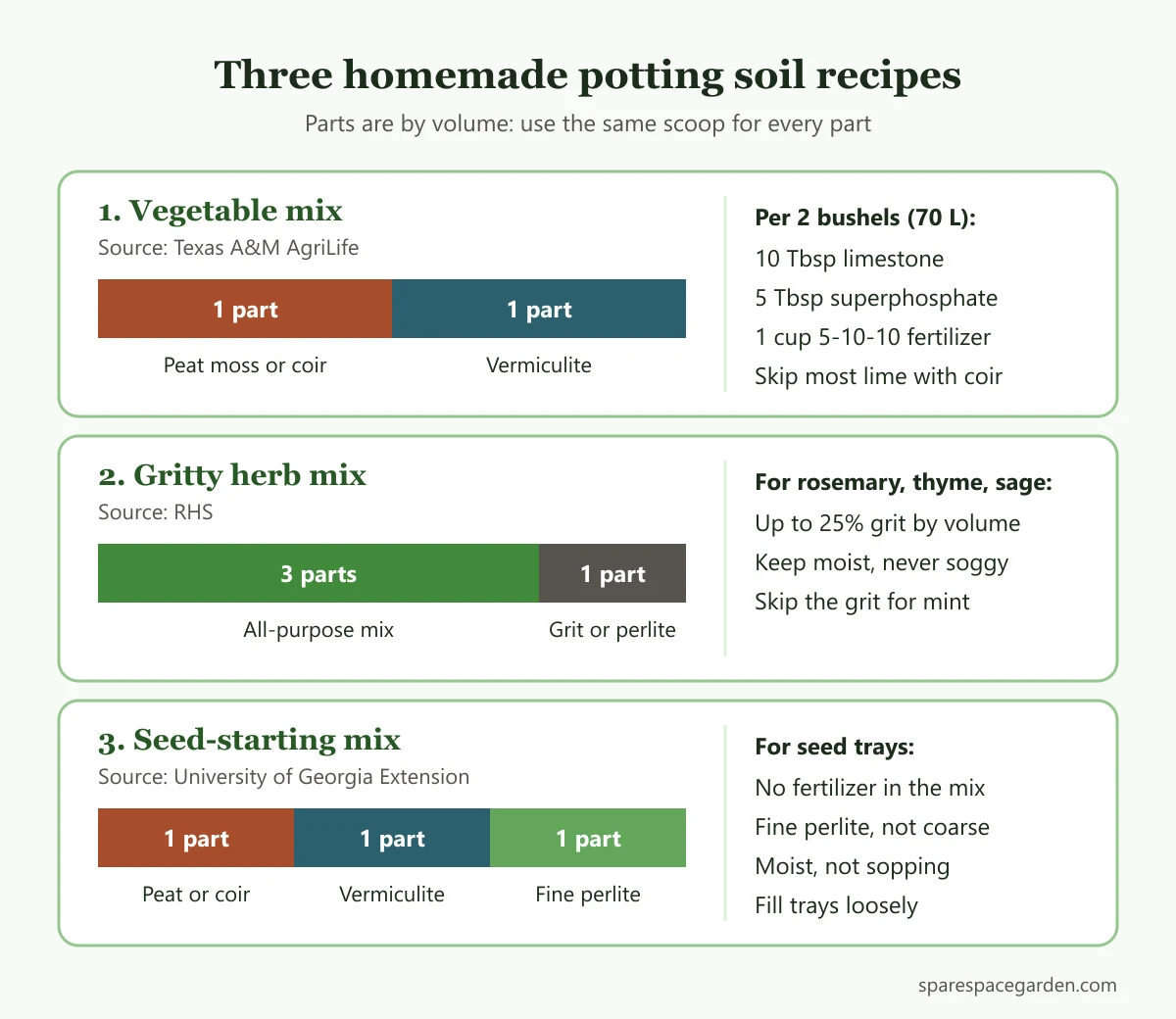 Three extension-based recipes, measured by volume.
1. All-purpose vegetable mix
The Texas A&M AgriLife guide to vegetable gardening in containers gives a classic soilless recipe:
- 1 bushel horticultural-grade vermiculite
- 1 bushel sphagnum peat moss
- 10 tablespoons limestone
- 5 tablespoons superphosphate (0-20-0)
- 1 cup garden fertilizer, such as 5-10-10 or 6-12-12
A US bushel is about 1.24 cubic feet (35 L), so a full batch makes roughly 2½ cubic feet (70 L), enough for three or four 5-gallon (19 L) pots. For a quarter batch, about 4½ gallons (17 L) of finished mix, scale down to 2½ tablespoons of limestone, 1¼ tablespoons of superphosphate and ¼ cup of fertilizer.
Want a richer, heavier mix for tomatoes and squash? University of Maryland Extension lists a 50/50 blend of soilless mix and compost as a good container medium. If you want a lighter result, a smaller share such as 2 parts of the mix above to 1 part compost still adds some richness. Alabama Extension's homemade blend uses peat moss, vermiculite or perlite, thoroughly finished compost and coarse builder's sand.
Leave pine bark out of this one. Maryland notes that bark fines are high in carbon, low in nutrients and not recommended for container vegetables.
2. Gritty herb mix
Rosemary, thyme, sage and oregano rot in mixes that stay wet. The RHS advice on growing herbs in containers is to add up to 25% by volume of coarse grit or perlite to the potting mix. In parts, that's:
- 3 parts all-purpose mix (homemade or bagged)
- 1 part coarse grit or perlite
The RHS now prefers locally sourced grit or gravel over perlite because of perlite's environmental impact. Keep the mix moist but never soggy. Mint is the exception: the RHS says it wants rich potting media, so skip the grit for mint. For more on one of these herbs, see our guide to growing thyme in pots.
3. Seed-starting mix
Seedlings need a fine, clean, low-fertility mix. University of Georgia Extension's recipe is equal parts:
- 1 part peat moss or coconut coir
- 1 part vermiculite
- 1 part fine perlite
UGA recommends fine perlite because coarser particles get in the way of young roots, and it warns that too much fertilizer can burn seedlings' roots and encourage damping-off. Fill trays loosely rather than pressing the mix down. Texas A&M's advice fits with that: water seeds with plain water until they germinate, then start feeding once the plants emerge. UF/IFAS offers a compost-based alternative of 2 parts compost, 2 parts peat moss and 1 part pre-wet vermiculite.
How to make potting soil, step by step
- Set up outside or in a garage. Work on a tarp, in a wheelbarrow or in a large tub. UGA recommends wearing a mask when handling perlite because it is lightweight and dusty.
- Prepare the base. Break up compressed peat. Soak a coir brick in water until it expands, then rinse it.
- Measure with one container. UF/IFAS measures its soil-block mix with a standard 10-quart bucket. Any scoop works if you use the same one for every part.
- Add lime and fertilizer to the base first. Sprinkle them evenly over the peat or coir and mix well, so they spread through the whole batch.
- Fold in perlite, vermiculite or grit. Turn the pile gently. UF notes that rough handling compacts vermiculite and reduces the air it holds.
- Add water as you mix. Texas A&M suggests adding a little water while mixing to reduce dust, then wetting the mix thoroughly before seeding or transplanting. UGA's target is moist but not sopping.
- Test before scaling up. UF/IFAS advises trying a small batch of any new blend before mixing a large one.
Tip: Alabama Extension suggests filling a container about three-fourths full, moistening the mix thoroughly, letting it settle and then topping it up. That way the level doesn't sink well below the rim after the first few waterings.
Store leftovers in a lidded bin or a closed bag so the mix doesn't dry out completely. A dry peat mix is much harder to rewet than a damp one.
Getting pH and fertilizer right
Peat is highly acidic, so peat-based recipes include lime. Alabama Extension suggests a pH range of 6.0 to 6.8 for container mixes and recommends sending a sample to a soil testing lab to find out how much lime your blend needs. University of Maryland Extension says commercial soilless mixes sit at about pH 6.2 and that vegetables generally grow best between 5.5 and 7.0.
Lime rates vary between sources. Texas A&M uses 10 tablespoons per 2 bushels of mix, while a Cornell foliage-plant recipe published by Clemson uses 8 tablespoons of dolomitic lime per single bushel. That spread is one more reason to test, especially if you change the base from peat to coir or add compost, which Maryland notes is often above pH 7.0.
For fertilizer, University of Nebraska–Lincoln Extension points out that soilless media are sterile and contain few nutrients. It recommends a balanced slow-release fertilizer such as 10-10-10 or 14-14-14 at ½ tablespoon per gallon of container capacity (about 7.5 mL per 3.8 L), or 2½ tablespoons (about 37 mL) for a 5-gallon (19 L) pot. Don't add this on top of the Texas A&M recipe, which already includes fertilizer.
Watch out: Alabama Extension reminds gardeners that fertilizers are salts. Overusing them can burn or kill plants, and the salts build up in containers over time. Follow the label rate.
Starter fertilizer in a mix runs out within weeks, so plan to feed later in the season. Our guide to fertilizer for potted plants covers liquid and slow-release options.
Common mistakes with homemade mixes
Most problems with DIY potting soil trace back to one ingredient used too heavily or prepared badly:
- Using peat alone. Alabama Extension warns that peat or peat-lite mixes used by themselves compact, get too light and become difficult to wet. Nebraska adds that 100% peat may be too light to support plants all season, and light pots tip over in wind.
- Fine sand. Play sand and plaster sand fill the air spaces you're trying to create.
- Fresh bark. Unaged bark should be composted before it goes in a mix.
- Unrinsed coir. Salt left from processing can damage roots.
- Too much compost. Maryland Extension describes compost as heavy, so it makes large pots hard to move, and the RHS notes that green waste compost can vary in nutrients through the year. Keep it to between a third and half of the mix.
- Double-dosing fertilizer. Check whether your recipe already contains it before adding a slow-release product.
If you're refilling last year's containers instead of starting fresh, our guide to whether you can reuse potting soil explains how much new material to blend in.
Frequently asked questions
Is it cheaper to make your own potting soil?
Usually, if you're filling a lot of containers. Nebraska Extension notes that prepackaged mixes can become expensive for large container gardens, and suggests a homemade blend of equal parts peat moss, potting soil and perlite to cut the cost. For two or three small pots, a single bag is simpler. Our guide to the best potting soil for vegetables explains how to judge a bagged mix.
Can I make potting soil from compost alone?
University of Maryland Extension lists 100% compost as one acceptable container medium. The drawbacks are weight and variability: compost is heavier than soilless media, its pH is often above 7.0, and its nutrient content depends on what went into it. Blending it with peat or coir and perlite gives a lighter, more predictable mix.
Do I need to sterilize homemade potting soil?
Not if it's soilless. Maryland notes that peat, perlite and vermiculite mixes are generally free of diseases, weed seeds and insects. If you add garden soil, Clemson suggests baking it until the coolest spot reaches 180°F (82°C) for 30 minutes, while UF/IFAS bakes it at 200°F (93°C) for 20 minutes, stirring every five minutes.
Is perlite or vermiculite better in potting soil?
Use perlite where drainage matters most, such as herbs and plants that dislike wet roots; UF/IFAS describes it as improving drainage. Use vermiculite where you want more moisture held, as in vegetable and seed mixes; UGA notes that it holds water while still letting excess drain. Many recipes use both.
How long does homemade potting soil keep?
Unused mix stores well in a closed container for a season. The RHS notes that bagged compost left longer than one growing season can start to break down, and that compost over a year old is better used as a soil improver. Mix only what you'll use in the coming season, and add fertilizer close to planting time.