Can you reuse potting soil from last year's containers? In most cases, yes. If the plants that grew in it were healthy, extension horticulturists generally say old mix is fine to use again for a season or two, as long as you loosen it, remove old roots and blend in fresh material.
The catch is that used mix is not the same product you bought. It has lost most of its nutrients, its particles have broken down, and it may carry salts or disease from the last crop. A few minutes of sorting and mixing fixes most of that.
Quick answer: Reuse potting soil only if last season's plants were free of root rot, wilt and other soilborne disease. Pull out the roots, loosen the mix, then replace 30–50% of it with fresh potting mix or compost and add fertilizer before planting.
When you can reuse potting soil and when to discard it
The deciding question is what happened to the plants that grew in it. University of Maryland Extension's Home and Garden Information Center advises leaving out mix from any plants that had diseases, particularly edible crops. Spores of problems like powdery mildew and Fusarium wilt can survive in or on the mix and infect next year's plants.
On the other hand, the RHS notes in its guide to reusing spent compost that plants grown in pots are unlikely to suffer soil-borne diseases, so compost from container plants is generally safe to reuse. A plant that simply finished its season, like an annual flower or a harvested bean, leaves behind perfectly usable mix.
| What you see | Reuse it? | What to do |
|---|---|---|
| Healthy plants all season | Yes | Remove roots, loosen, refresh with fresh mix or compost |
| Plants wilted or collapsed with rotting roots | No | Use fresh mix; keep the old mix away from vegetables |
| Grubs or vine weevil larvae in the mix | Yes, after cleaning | Spread it thin on a tarp so birds can pick out the larvae |
| White crust on the surface | Yes, after cleaning | Scrape off the crust, then rinse and refresh |
| Mix stays soggy and packed down | Partly | Blend at least half fresh mix, or use the old mix as mulch |
| Mix from seedlings that died of damping-off | No | Start seeds in new seed-starting mix |
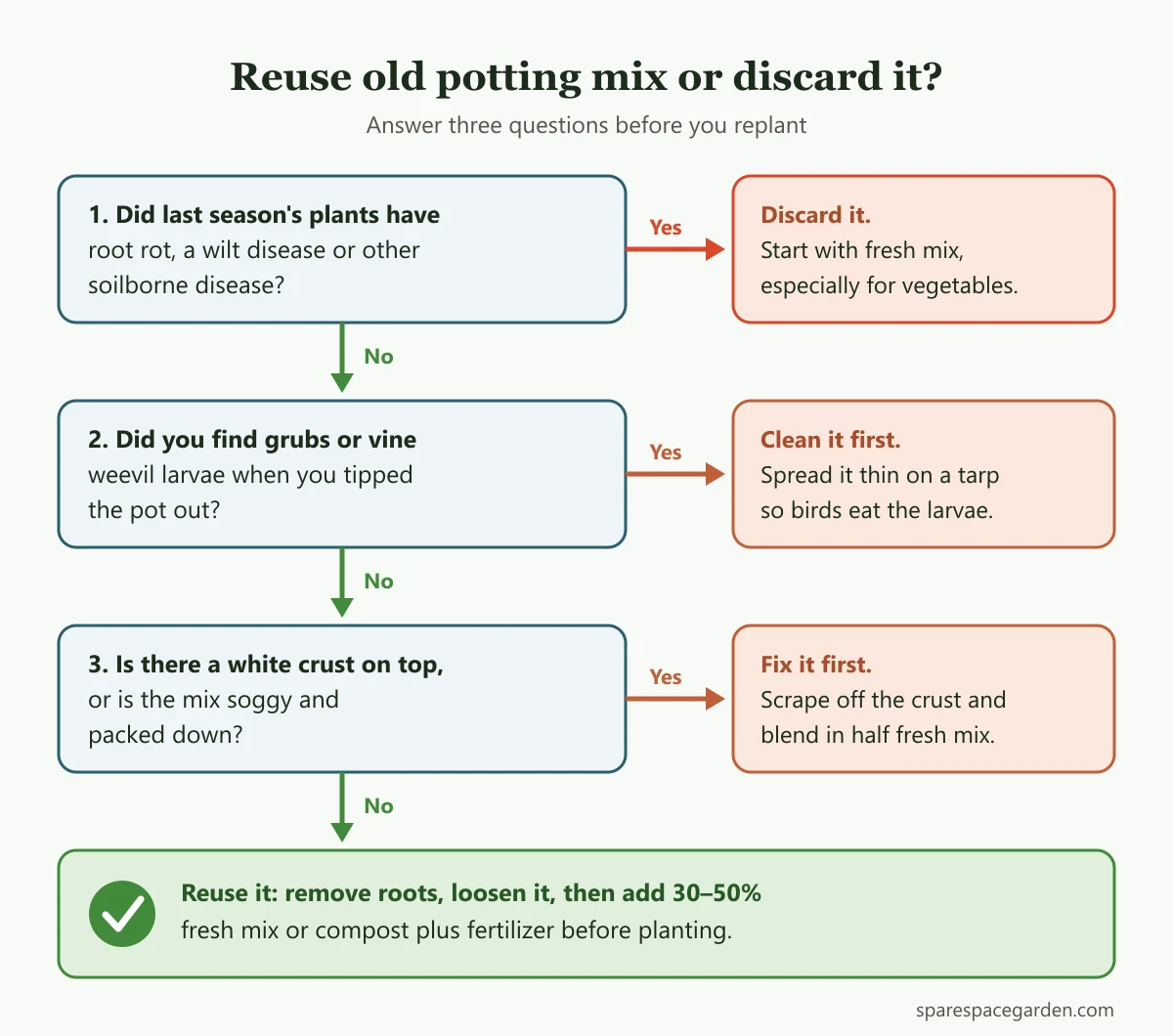 Three questions to ask before you reuse old potting mix.
If you're not sure what killed a plant, look at the roots. Healthy roots are white or tan and firm. Brown, mushy roots that slip apart point to rot, and that mix belongs in the discard pile.
Why old potting mix wears out
Potting mix is made mostly of organic ingredients such as peat moss, coir and bark, mixed with perlite or vermiculite. The organic parts slowly decompose. The RHS describes how spent compost breaks down and compacts over time, and Maryland Extension explains that the components wear down into smaller particles, which reduces the pore space that holds air for roots. The result is mix that stays wet longer and drains poorly.
Nutrients are the second problem. Maryland Extension notes that used potting soil has been largely depleted of nutrients, so new plants in it need regular feeding. Every watering pulls a little more fertilizer out of the drainage holes.
Salts are the third. Fertilizer and some tap water, especially softened water, leave dissolved salts behind as the mix dries. Colorado State University's PlantTalk describes the white or tan crust on the surface as a buildup of soluble salts, and lists wilting, yellowing and scorched leaf tips and edges as symptoms of too much salt.
How to reuse potting soil, step by step
Do this on a tarp or in a large tub, on a dry day if you're working outdoors. Damp mix is easier to handle than bone-dry mix, which can be dusty and hard to rewet.
- Empty the container. Tip the whole root ball out rather than digging around it.
- Pull out roots and debris. The RHS suggests removing large root sections. Pick out old stems, leaves and any stray labels at the same time.
- Break up clumps. Rub the mix between your hands until it is loose and fluffy again.
- Deal with any crust. If there was a white crust, scrape it off and throw it out before mixing.
- Blend in fresh material. Use one of the ratios below.
- Add fertilizer. Mix in a slow-release fertilizer or plan to feed with a liquid one once plants are growing. Our guide to fertilizer for potted plants covers types and timing.
- Moisten and plant. Water the refreshed mix and let it drain before planting.
How much fresh mix or compost to add
Sources agree that old mix needs new material, but the exact ratio varies:
- Half fresh potting mix. Maryland Extension suggests mixing in about 50% new material, which improves drainage and dilutes salts. In practice that's one bucket of old mix to one bucket of new.
- About 30% compost. The RHS suggests a blend of roughly 70% spent compost with organic matter such as garden compost or well-rotted manure.
- Don't overdo compost. Maryland Extension says you can add compost up to 50% by volume, but warns that too much compost can make the mix settle and hold too much water.
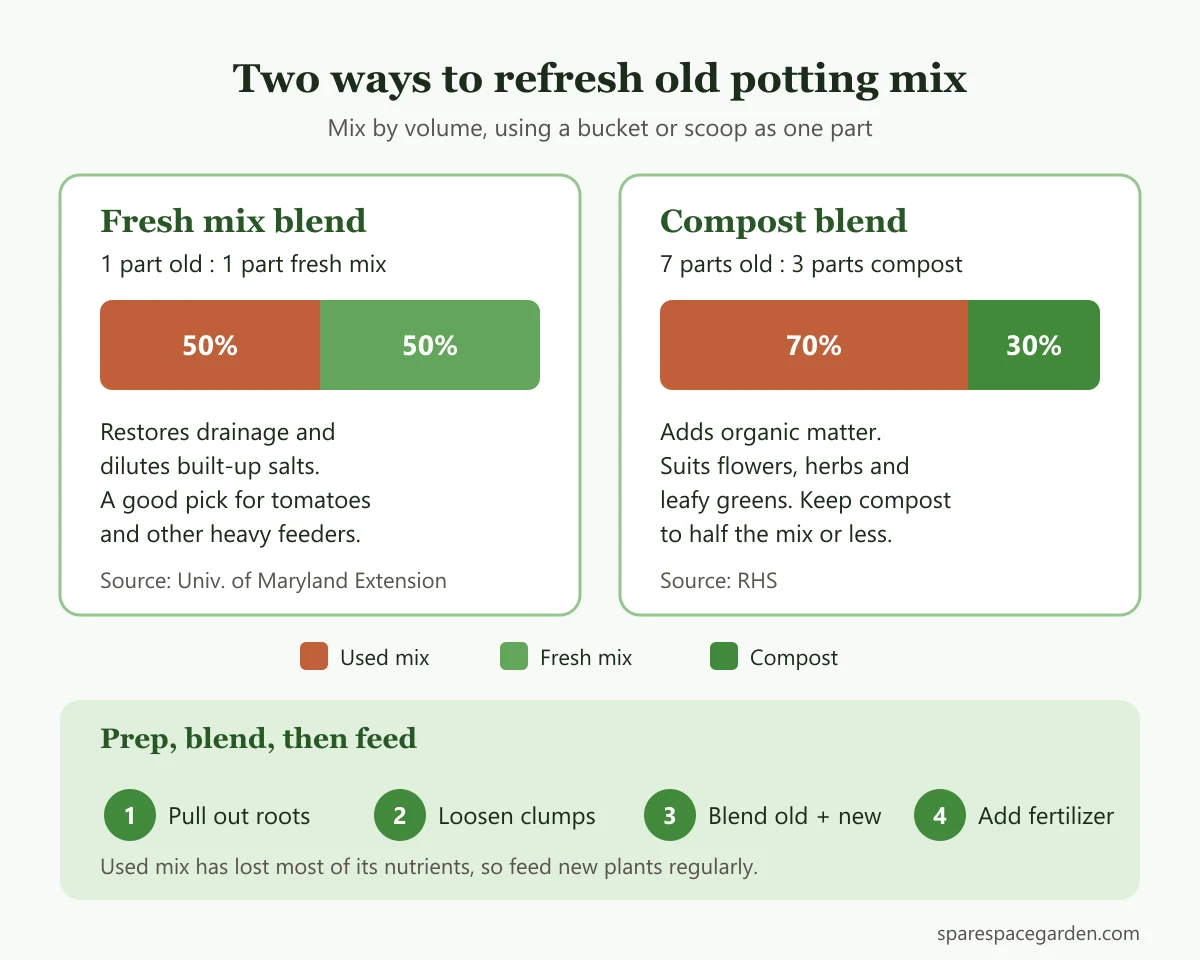 Two simple ways to refresh used mix, plus the order of work.
For thirsty, heavy-feeding crops like tomatoes, lean toward the 50/50 fresh-mix blend, since it restores more drainage and dilutes more salt. For flowers, herbs and leafy greens, the 70/30 compost blend works well. If you'd rather mix your own fresh component, see how to make potting soil.
Tip: In very large containers, you don't have to empty the whole thing. Scoop out the top portion, mix fresh potting mix into what's left as you refill, and save the heavy lifting for smaller pots.
Should you sterilize or solarize old potting soil?
For most home gardeners, sterilizing isn't needed. Maryland Extension does not recommend trying to sterilize used mix at home: it's impractical at any real volume, and microbes from the air recolonize the mix soon after it goes back into use. If you suspect root or wilt disease, their advice is simpler: clean the pot and start with fresh mix.
If you still want to heat-treat a small batch, solarization uses summer sun. The University of California IPM guide to soil solarization describes two methods for small amounts of soil:
- Put moist mix in pots, buckets or bags, set them on wooden pallets so heat reaches them from all sides, and cover them with a double layer of clear plastic.
- Or put moist mix in closed black trash bags and set them on pallets in full sun.
UC's guideline for eliminating pests is holding the soil at 158°F (70°C) or higher for 30 minutes. In warm parts of California, soil in black plastic bags can pass 160°F (71°C). Do it during the hottest weeks of summer, keep the mix moist because wet soil heats better, and check the center of the bag with a soil thermometer.
There are limits. UC notes that some heat-tolerant fungi and bacteria are harder to kill, and clouds, wind and shade all reduce heating. In a Florida trial funded by the USDA's SARE program, solarized used media reached 159°F (about 70°C) under two sheets of plastic, and research cited in that project found target temperatures could be reached in as little as a day in small bags. The solarized media caused no growth differences when it made up as much as 66% of the potting mix for two ornamental species.
Watch out: Solarizing deals with pests and weed seeds, but it won't fix compacted, worn-out mix. You still need to blend in fresh material afterward.
Rotate plant families between seasons
Crop rotation isn't just for in-ground beds. Iowa State University Extension explains that vegetables in the same botanical family are often affected by the same diseases and insects, and recommends not planting the same family in the same place for two or three years. The same logic applies to a pot of reused mix.
The families that matter most for container growers:
- Nightshade family: tomato, pepper, eggplant, potato
- Mustard family: cabbage, broccoli, cauliflower, Brussels sprouts, kale, collards
- Gourd family: cucumber, squash, melons, pumpkin
- Pea family: peas, snap beans
- Onion family: onions, garlic
- Carrot family: carrots, parsnips
A simple rule: if a container grew tomatoes or peppers this year, refill it with refreshed mix and plant beans, lettuce or herbs next year. Write the crop on a label or a strip of tape on the pot so you remember.
How to store used potting mix over winter
Maryland Extension says keeping used mix dry in a sealed container is fine. A lidded storage bin, a trash can with a lid, or heavy bags closed tightly all work. Keep the container somewhere it won't fill with rain or snowmelt.
Before storing, pull out the roots and old stems. Decaying plant debris in damp mix can feed fungus gnats and molds, both covered in our guides to gnats in potted plants and fungus in indoor plant soil. Wait to add fertilizer or fresh mix until spring, when you're ready to plant.
Don't save old mix for seed starting. NC State Extension says seed-starting mix more than a year old, and potting media that is wet and soggy, should go on the compost pile rather than be used for seeds. Seedlings are the most vulnerable to damping-off, so they deserve clean, new mix. If you reuse seed trays, NC State suggests rinsing them in about 1 tablespoon of household chlorine bleach per 1 gallon (roughly 15 mL per 3.8 L) of water. Follow the safety directions on the bleach label, never mix bleach with other cleaners, and rinse the trays with clean water afterward.
What to do with spent potting mix
Mix that is too old or tired for pots still has uses. None of these require it to be perfect:
- Mulch. The RHS suggests very old or tired compost as a mulch around established trees and shrubs, and spreading spent compost about 3 inches (7.5 cm) deep on beds and borders.
- Dig it into beds. Adds little in the way of nutrients, but the RHS notes it improves structure, drainage and aeration.
- Add it to a compost pile. Layer it between other materials. If you compost indoors, see our guide to composting in an apartment.
- Fill low spots. Maryland Extension suggests using it as fill for low spots in lawns.
- Bottom of deep planters. Old mix can fill the lower part of a large container, with refreshed mix on top for the new plants.
Keep mix from diseased plants out of all of these, especially anywhere you grow vegetables.
Frequently asked questions
How many times can you reuse potting soil?
Maryland Extension says reusing mix for a season or two may be reasonable if the previous plants had no serious disease. After that, the particles are usually so broken down that drainage suffers, even with fresh mix blended in. At that point, retire it to mulch or the compost pile.
Can you reuse potting soil from a dead plant?
It depends on why the plant died. If it dried out, froze or was simply an annual at the end of its life, the mix is fine to refresh and reuse. If the roots were rotten or the plant collapsed from a wilt disease, use fresh mix instead.
Can I reuse potting soil for vegetables?
Yes, if the earlier plants were healthy. Refresh it with about half fresh mix, add fertilizer, and avoid planting the same vegetable family in it two years running. Our guide to the best potting soil for vegetables explains what to look for in the fresh portion.
How do I get rid of the white crust on old potting soil?
Colorado State University's PlantTalk suggests scraping off the crust and about ½ to 1 inch (1.3–2.5 cm) of the surface mix, then filling the pot to the top with lukewarm water and letting it drain, about three times in all. To prevent it coming back, feed at the label rate and don't let pots sit in saucers of water.
Do I need to add fertilizer to reused potting soil?
Yes. Used mix has lost most of its nutrients, and compost releases nutrients too slowly to cover the gap by itself, according to Maryland Extension. Mix in a slow-release fertilizer at planting or feed regularly with a liquid fertilizer, following the label.