The best soil for strawberries in pots is a light, fast-draining potting mix with some organic matter and a slightly acidic pH, roughly 5.5 to 6.5. Strawberries have shallow roots that suffer when the mix dries out, and crowns that rot when it stays wet. The right blend holds moisture without ever turning soggy.
You don't need a special "strawberry soil." A good general potting mix gets you most of the way, and a few small changes make it suit a pot, a stacked tower or a hanging basket. How deep you set the crown, and how you keep fruit off the mix, matter almost as much as the mix itself.
Quick answer: Use a light potting mix rather than garden soil, and aim for pH 5.5 to 6.5. For pots, Oregon State University Extension suggests 2 parts potting soil, 1 part perlite and 1 part finely ground fir bark. Set each crown level with the surface, and plan on fresh mix each spring for small containers.
What strawberries need from potting soil
Three things matter more for strawberries than for most container crops: pH, drainage and steady moisture. Get those right and almost any decent bagged mix will work.
A slightly acidic pH
Extension ranges sit close together. University of Nebraska–Lincoln Extension says a pH of 5.5 to 6.5 is best, Oregon State gives 5.6 to 6.5, and the UConn home garden fact sheet on strawberries aims for 5.8 to 6.5. University of Maryland Extension notes that commercial soilless mixes usually sit around pH 6.2, which falls inside all three ranges.
That's good news, because most bagged mixes start in the right zone. What pushes a mix out of range is usually what you add to it. Maryland points out that many composts have a pH over 7.0, so a pot that is mostly compost can end up less acidic than strawberries prefer.
Drainage that protects the crown
The crown is the short, thick stem where the leaves meet the roots, and wet mix is its biggest threat. University of Kentucky's guide to Phytophthora crown and root rot describes the cause as a soilborne water mold that is worse in poorly drained sites and wet seasons. Infected crowns turn brown from the top down, and whole plants can collapse within a few days. UConn lists good drainage first among its controls.
Oregon State's container advice is direct: both the potting mix and the container need to drain well. Check that every pot has open drainage holes, and tip out saucers after watering.
Organic matter for steady moisture
Iowa State University Extension notes that strawberry roots are shallow and don't tolerate drying out. UConn says strawberries in the ground prefer soil with about 6% organic matter. In a pot, peat, coir, bark and compost do that job, holding water between waterings while perlite keeps air spaces open.
The best soil for strawberries in pots, towers and baskets
Each type of container dries out at a different speed, so the mix shifts a little. Here is what extension services suggest for each one.
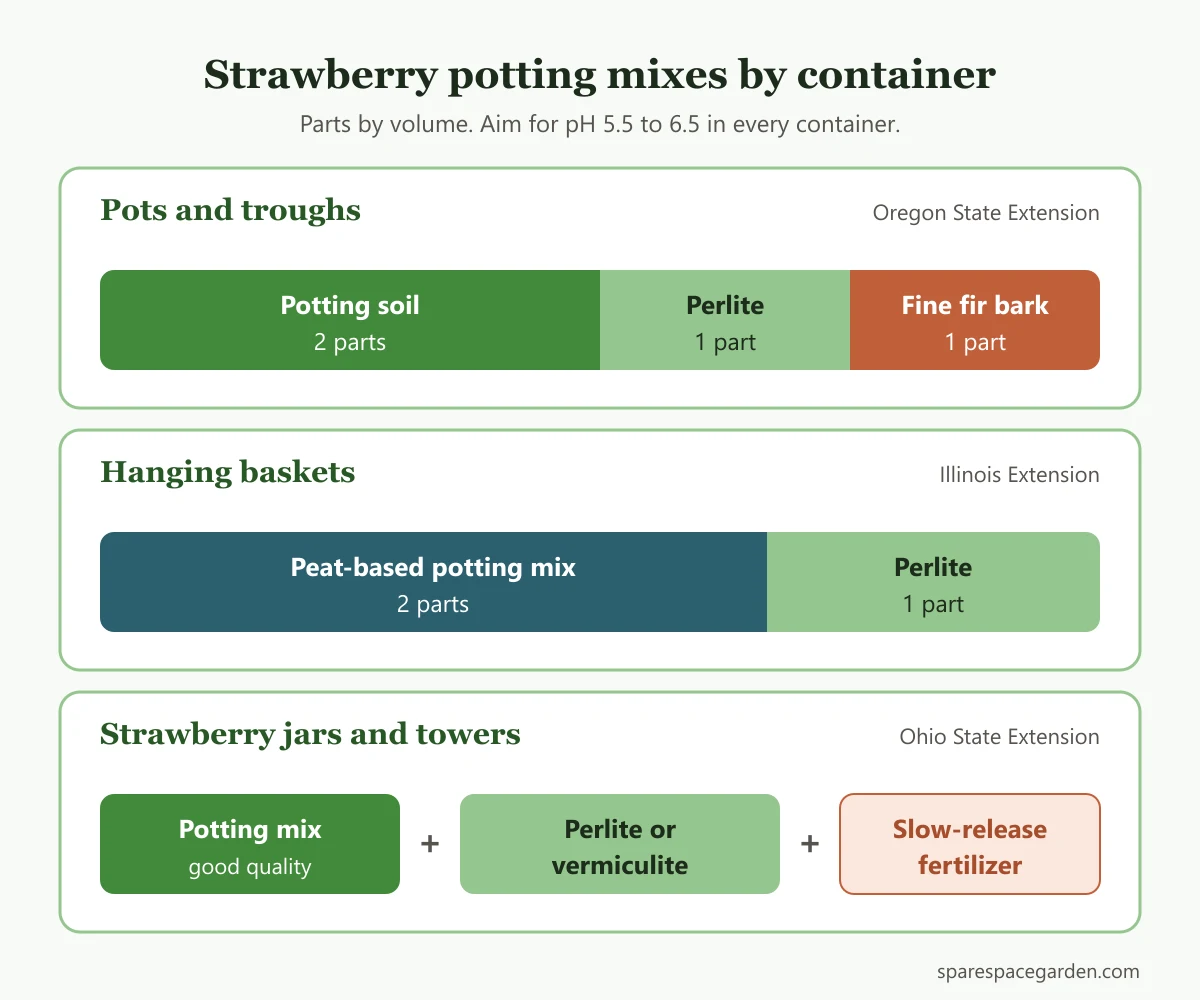 Extension-based strawberry mixes for three common containers, measured by volume.
| Container | Suggested mix | Why it suits |
|---|---|---|
| Pots, troughs, window boxes | 2 parts potting soil, 1 part perlite, 1 part finely ground fir bark (Oregon State) | Drains freely but has enough body to hold water |
| Pots, simpler option | Bagged potting mix with some compost worked in (Nebraska) | Adds nutrients and organic matter |
| Hanging baskets | 2 parts peat-based mix, 1 part perlite (Illinois), or peat-free multipurpose compost (RHS) | Light enough to hang, holds water |
| Strawberry jars and towers | Potting mix with slow-release fertilizer and a moisture-control agent, plus perlite or vermiculite (Ohio State) | Keeps many small pockets loose |
Pots and troughs
Oregon State University Extension's strawberry guide gives the most specific container recipe: one part perlite, one part finely ground fir bark and two parts garden or potting soil. It notes that yard centers may sell a similar blend in bulk. For a balcony, use potting soil for that share rather than garden soil, since the crown rot organism lives in soil and can persist there for years.
If you'd rather keep it simple, Nebraska suggests a high-quality, well-drained potting mix with some compost mixed in. Maryland lists blends of up to half compost as acceptable for containers in general, but given the pH point above, a smaller share is the safer choice for strawberries.
Size matters too. Iowa State suggests containers at least 12 inches (30 cm) across and 8 inches (20 cm) deep, which hold 3 or 4 plants spaced about 8 inches (20 cm) apart. Oregon State suggests 10 to 18 inches (25 to 46 cm) deep. Our guide to the best container to grow strawberries compares the options.
Hanging baskets
Illinois Extension suggests two parts peat to one part perlite, with day-neutral plants set about 3 inches (7.5 cm) apart so they spill over the edges. Plain sphagnum peat is acidic, which is why commercial mixes include small amounts of lime, so using a bagged peat-based potting mix for the "peat" share is the easy route.
In the UK, the RHS says a good peat-free multipurpose compost is fine for a basket that only has to last a year. Loam-based compost suits longer plantings but adds weight, which matters on a bracket. Baskets are a demanding home for strawberries: Iowa State notes they dry out quickly and run hot, and fruit tends to get smaller as the root zone warms. See growing strawberries in hanging baskets for the full setup.
Strawberry jars and towers
Multi-pocket containers are the hardest to keep evenly moist. Iowa State notes that the upper plants dry out faster, so water from both the top and the side pockets. Ohio State University Extension in Butler County suggests a good-quality potting soil with slow-release fertilizer and a moisture-control agent, plus some perlite or vermiculite to keep the mix loose.
Many growers also stand a perforated pipe in the center before filling, so water reaches the lower pockets. Oregon State adds that pre-planted pocket planters are generally suitable for only one growing season.
How to fill the pot and set the crown at the right depth
Planting depth is where good soil can still go wrong. The RHS warns that planting too deeply causes the crown to rot, while planting too shallowly makes the plant dry out quickly.
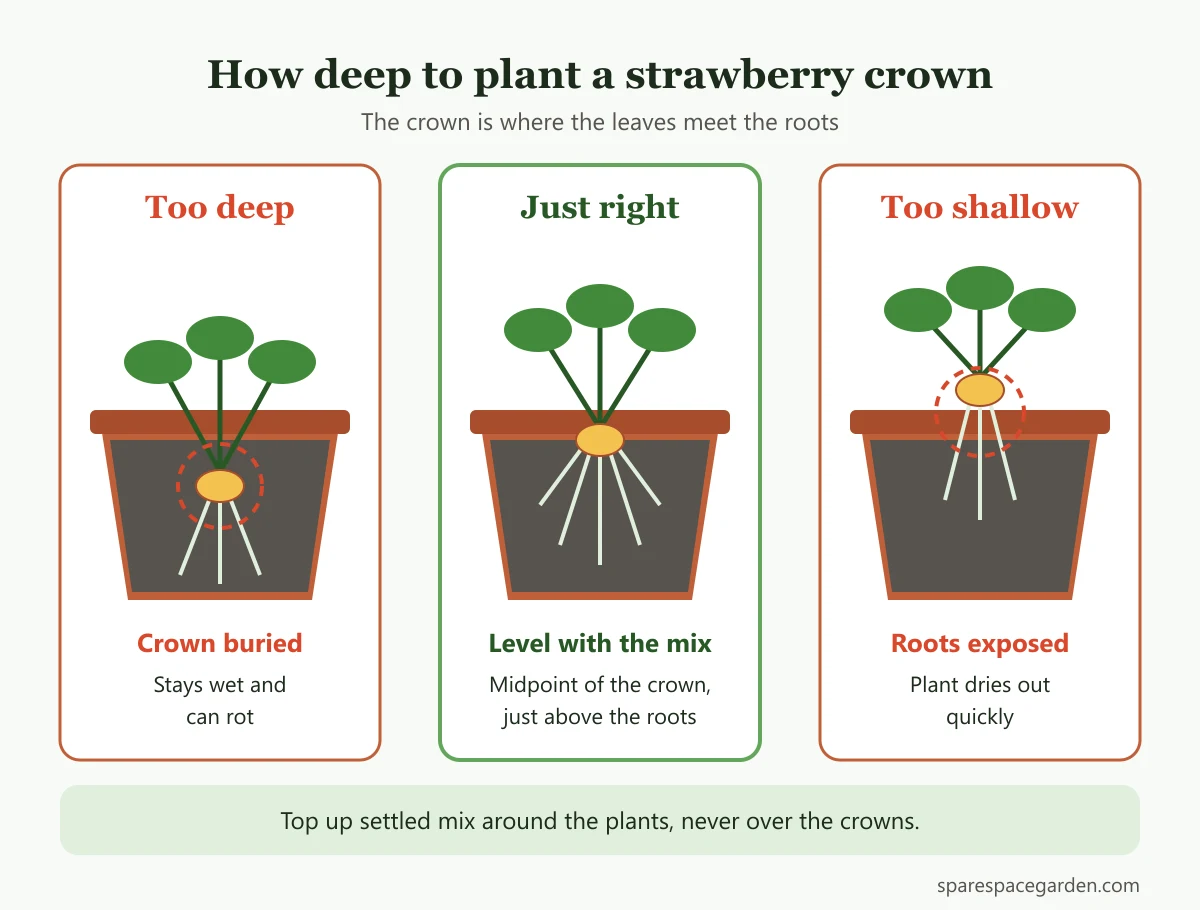 Set the crown level with the surface of the mix, not above or below it.
- Fill the container loosely. Bring the mix to a little below the rim, as the RHS suggests for baskets, so water has room to soak in.
- Prepare the plants. Nebraska suggests soaking bare-root plants for a few hours. If roots are very long, the RHS says they can be trimmed to 4 inches (10 cm).
- Dig a hole deep enough for straight roots. Nebraska and UConn both say the roots shouldn't bend or fold over in the hole.
- Set the crown level with the surface. Iowa State and the RHS both say the crown should be even with the soil. UConn puts it a little more precisely: just above the highest roots, at the midpoint of the crown or slightly higher. Potted plants go in at the same depth they grew in the nursery pot.
- Firm gently and water in. After the first watering, check that no crown has sunk below the surface.
Watch out: Potting mix settles over the first few weeks. When you top it up, fill around the plants, never over the crowns. Oregon State warns that buried crowns can rot or die.
Mulching to keep fruit off the soil
Berries resting on damp mix stay wet and dirty. The RHS strawberry growing guide says straw keeps fruit clean and dry, and suggests mulch mats or reusable collars around individual plants. UConn adds that straw mulch helps control leather rot, a soil-borne fruit disease favored by wet conditions.
Keep any mulch thin and away from the crown. The RHS says to leave a slight gap around the crown, because mulch over it can cause rotting. Oregon State also advises against deep straw, since it buries crowns.
In a pot, a thin layer of clean straw tucked under the fruit clusters is enough. Towers and baskets handle this on their own, because the fruit hangs over the edge. The RHS also recommends watering in the morning and avoiding the crown and fruit to reduce the risk of gray mold.
Feeding a strawberry mix through the season
Fertilizer in a bagged mix runs out long before the season ends, and extension schedules vary. The RHS suggests a general-purpose liquid feed every two weeks for container plants, switching to a high-potassium feed when the first flower buds form. Illinois Extension suggests every three to four weeks, Nebraska a balanced liquid fertilizer every 4 to 6 weeks, and Iowa State two or three feedings a season, just after each flush of fruit is picked.
Whichever schedule you follow, dilute and apply each product at the rate on its label. Don't overdo nitrogen. UConn lists a low-nitrogen fertilizer among its controls for Phytophthora crown rot, since it limits soft new growth. For products and dilution, see our guides to fertilizer for potted plants and fertilizer for hanging baskets.
Refresh or replace the mix each year
For most small containers, start fresh every spring. Iowa State recommends treating container strawberries as annuals: compost the plants at the end of the season and buy new ones the following spring. University of Wisconsin–Madison Extension also gives that as one of two choices, the other being to overwinter the containers.
Larger containers can go longer. Oregon State says bigger containers make it more likely plants will last beyond one season, and the RHS notes that soil-based compost can last 3 to 4 years without being replaced.
| Situation | What to do with the mix |
|---|---|
| Small pot, jar, tower or basket at season's end | Replace with fresh mix next spring |
| Large container, plants healthy | Keep, or blend 50:50 with fresh mix and compost (Maryland) |
| Plants wilted and collapsed, crowns brown inside | Discard the mix; don't reuse it for strawberries |
| Grubs found among the roots | Replace the mix; the RHS says vine weevil larvae are a greater threat in containers |
Maryland's general rule for reused media is to blend last year's mix 50:50 with fresh mix or compost, and not to reuse it at all if root diseases were a problem. That second point matters here, because Kentucky notes the crown rot pathogen can survive in soil for years. Our guide on whether you can reuse potting soil explains how to refresh healthy mix.
Tip: Mixing a fresh batch each spring is also a chance to check pH. If you've been adding compost every year, a fresh potting mix base brings it back into the 5.5 to 6.5 range.
Frequently asked questions
Can garden soil go in strawberry pots?
It's better not to. Oregon State's recipe allows garden soil as part of a mix, but garden soil drains poorly in containers and can carry soilborne diseases, including the water mold behind crown rot. A bagged potting mix avoids both problems. Our guide to the best potting soil for vegetables explains how to pick a good bag.
Do strawberries need acidic soil like blueberries?
Only slightly acidic. Extension ranges run from about 5.5 to 6.5, and a standard potting mix at around pH 6.2 already fits. You don't need an acid or ericaceous mix, and you shouldn't need to add sulfur to a fresh bagged mix.
What is the best soil for strawberries in pots on a budget?
A plain bagged potting mix with a scoop of perlite stirred in. If you're filling several containers, Oregon State's 2:1:1 blend of potting soil, perlite and fine fir bark stretches each bag further. To blend from raw ingredients, see how to make potting soil.
How deep should the soil be for potted strawberries?
Iowa State suggests at least 8 inches (20 cm) deep and 12 inches (30 cm) across. Oregon State suggests 10 to 18 inches (25 to 46 cm) deep, with larger pots giving plants a better chance of lasting more than one season.
Should I add compost to strawberry potting mix?
A little helps. Nebraska Extension suggests mixing some compost into a quality potting mix for nutrients. Keep it to a modest share, since Maryland notes that many composts sit above pH 7.0, which is less acidic than strawberries prefer.