The best soil to grow tomatoes in pots isn't really soil at all. It's a light, soilless potting mix that drains freely but still holds plenty of water, often with some compost blended in. Garden soil packs down in a container and starves roots of air, which is why extension services advise against it.
Tomatoes ask more of a mix than most container crops. They're big, thirsty plants that carry heavy fruit for months, and a pot gives their roots only a few gallons to work with. The right blend, enough of it, and steady watering do most of the work.
Quick answer: Fill each pot with a good soilless potting mix, or blend about 3 parts mix to 1 part compost. Aim for a slightly acidic mix, around pH 6.3 to 6.8, and give each plant at least 5 gallons (19 L) of space, which takes roughly 20 to 25 quarts (19 to 24 L) of mix. Don't use plain garden soil.
What the best soil to grow tomatoes in pots does
A tomato mix has to balance water and air. Colorado State University Extension's container garden guide says a good potting mix drains well while holding water and nutrients. Soilless mixes are based on peat moss or ground bark, with vermiculite added to hold water and perlite to let air move through.
For tomatoes, each part of that balance matters more than usual:
- Water holding. Clemson Cooperative Extension notes that container tomatoes can need daily watering at the height of summer, and Colorado State says plastic pots may need water once or twice a day as plants grow. A mix with too little organic matter dries out between waterings.
- Drainage and air. Roots sitting in soggy mix run short of oxygen. Colorado State warns that clay-based soil compacts in containers and cuts the oxygen supply to roots.
- Even moisture. The RHS links blossom end rot and split fruit to swings between wet and dry. A mix that rewets easily and doesn't turn to dust overnight helps keep things steady.
Soilless mixes are also two to three times lighter than soil-based ones, according to Colorado State, which helps when you need to move a large pot into the sun. In the UK, the RHS suggests a peat-free, loam-based or multi-purpose compost for tomatoes in containers (in British usage, "compost" means potting mix).
For a general comparison of bagged mixes and how to read the labels, see what makes the best potting soil for vegetables. The rest of this guide covers what's specific to tomatoes.
Tip: A tall tomato in a light mix can blow over. Colorado State suggests adding clean, coarse sand at up to 10 percent of the container volume for extra weight.
Why garden soil doesn't work in a tomato pot
Soil that grows great tomatoes in a bed behaves very differently in a pot. Iowa State University Extension explains that garden soil compacts once it's in a container, drains poorly, and pulls away from the sides of the pot as it dries. Water then runs down that gap instead of soaking the roots.
Colorado State goes further and says not to use native soil even if it has been pasteurized, because its clay still compacts. Garden soil can also bring in disease organisms, insects and weed seeds that a fresh bagged mix shouldn't have.
Some homemade recipes do include a little loam. Iowa State offers equal parts garden soil, peat moss and perlite as one option, and University of Wisconsin Extension notes that real soil can be part of a tomato mix but makes containers much heavier and slower to drain. For any pot you'll need to move, or a balcony with a weight limit, a soilless mix is the easier choice.
pH, lime and calcium for container tomatoes
Tomatoes like a slightly acidic root zone. Colorado State describes a good potting mix as slightly acidic, and University of Maryland Extension recommends keeping soil pH in the 6.3 to 6.8 range as one way to reduce blossom end rot. Peat moss is naturally acidic, which is why from-scratch recipes, such as University of New Hampshire Extension's, include lime.
Does a tomato mix need extra calcium?
Blossom end rot, the dark, sunken patch on the bottom of the fruit, comes from a shortage of calcium in the developing fruit. Sources disagree on how much the mix itself is to blame:
- The RHS says on its blossom end rot page that it's very rare for soils, growing bags or potting media to actually lack calcium. Calcium moves through the plant in water, so irregular watering is the real problem, and plants in pots or growing bags are most at risk.
- University of Wisconsin Extension recommends adding garden lime to soilless mix, about 1 cup (240 mL) per 5-gallon (19 L) container, so enough calcium is available. It still calls uneven watering a very common cause in containers.
- University of Maryland Extension suggests mixing 1/4 cup (60 mL) of gypsum (calcium sulfate) into the soil of each planting hole, since it supplies calcium without changing pH.
- New Mexico State University notes that tap water usually supplies enough calcium unless you water with distilled water, and that a pot which dries out completely by evening is probably too small.
The practical takeaway: check the bag. If lime or limestone is listed, the pH has already been adjusted. If you're mixing your own from peat, a modest lime addition makes sense, and gypsum adds calcium without raising pH; follow the package directions for either. No amendment will stop blossom end rot if the pot keeps drying out, though.
Watch out: Don't feed a dry pot. The RHS warns that concentrated fertilizer in dry compost restricts water uptake and can make blossom end rot worse, so water first and feed second.
How much compost to add to tomato soil
Compost adds nutrients and organic matter, but a pot full of it can stay too wet. University of New Hampshire Extension says adding up to 50 percent compost to potting mix before planting gives plants some nutrients for a good start, so treat half as the ceiling rather than the goal.
University of Wisconsin Extension's tomato container fact sheet is more generous. It says high-quality compost can be a major part of the mix, and that larger containers with more than 25 percent compost likely need no extra fertilizer. Other extension guides, including Clemson's and Colorado State's, still recommend regular feeding for container tomatoes, so watch the leaves. Pale lower leaves are an early sign the plant needs more, as explained in yellow leaves on tomato plants in pots.
A share of about one quarter to one third compost sits comfortably inside that range. It adds organic matter and some slow nutrients without making the mix heavy. Use finished compost that looks dark and crumbly, not half-rotted scraps.
A simple potting mix recipe for tomatoes
You can make the best soil to grow tomatoes in pots by upgrading a bag of mix, or by blending your own from raw ingredients.
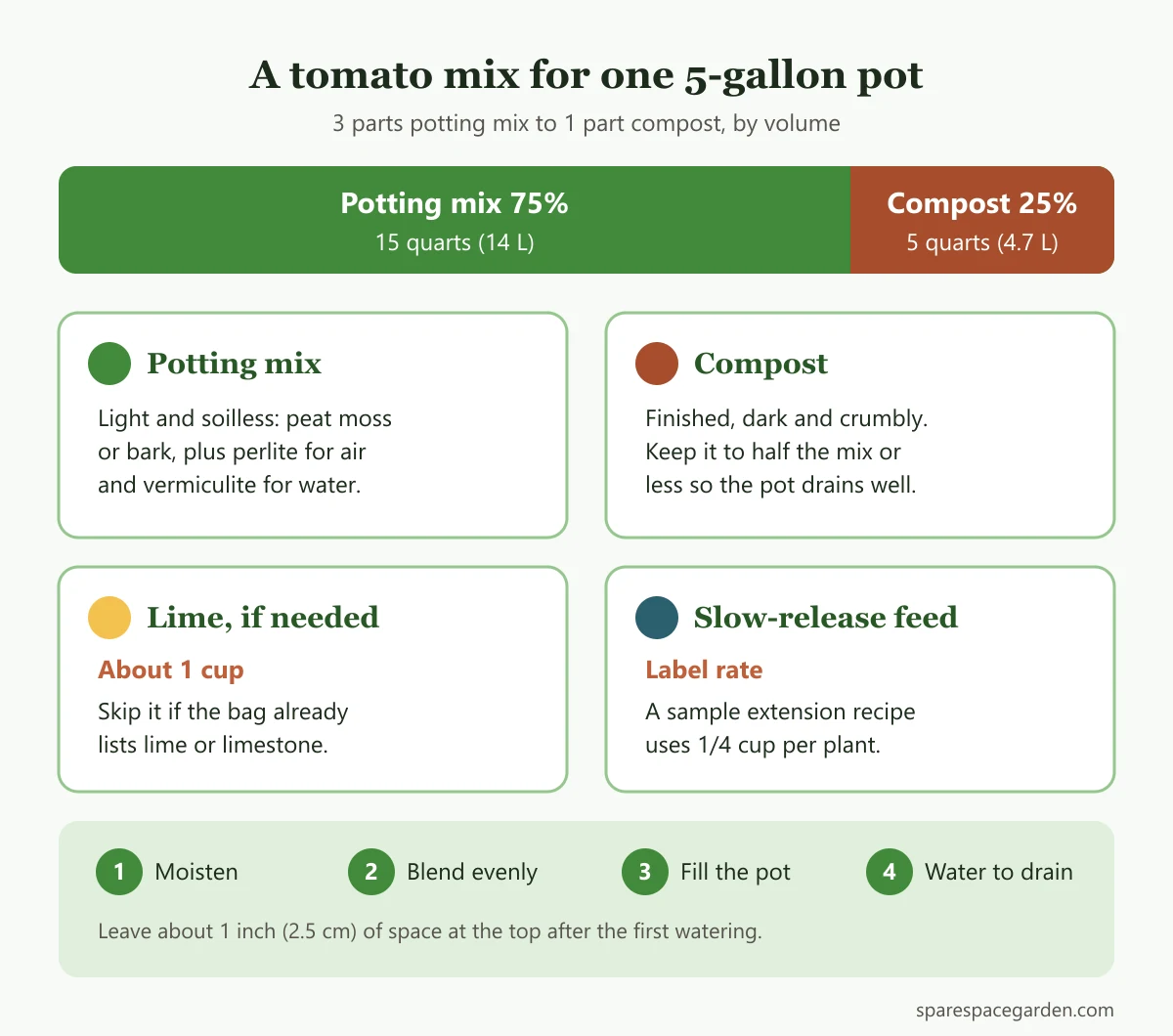 A 3-to-1 blend of potting mix and compost fills one 5-gallon (19 L) pot.
Option 1: Upgrade a bagged mix
For one 5-gallon (19 L) pot, blend:
- 15 quarts (14 L) soilless potting mix
- 5 quarts (4.7 L) finished compost
- About 1 cup (240 mL) of garden lime, only if the bag doesn't list lime (University of Wisconsin's rate; check the package directions too)
- Slow-release fertilizer at the label rate. Wisconsin's sample recipe uses 1/4 cup (60 mL) per plant.
That works out to 3 parts mix to 1 part compost, or 25 percent compost.
Option 2: Mix from scratch
University of New Hampshire Extension gives an organic recipe of equal parts vermiculite, peat moss and high-quality compost, with 0.6 oz (17 g) blood meal, 0.4 oz (11 g) rock phosphate and 0.4 oz (11 g) greensand added per gallon (3.8 L) of mix. For more ingredient options and ratios, see how to make potting soil.
Mixing and filling the pot
- Moisten the mix first. UNH notes that soilless mixes can be very dry and hard to wet, and suggests soaking them at least a day before use.
- Blend on a tarp or in a wheelbarrow until the compost is evenly spread through.
- Fill the pot, firming gently but not packing it down. Wisconsin recommends about 1 inch (2.5 cm) of space at the top after the first watering.
- Water until it drains. Colorado State suggests watering until about 10 percent of the water runs out the bottom.
How much soil each tomato pot needs
Pot size matters as much as the mix. A bigger pot holds more water, which smooths out the wet-dry swings tomatoes hate. Colorado State gives 5 gallons (19 L) as the minimum for tomatoes. Wisconsin says compact determinate types can grow in a 5-gallon bucket, while indeterminate types that keep growing all season need something bigger. Clemson suggests a 14 to 20 inch (36 to 51 cm) container for most compact cultivars, and the RHS suggests a 30 to 45 cm (12 to 18 in) pot for one plant.
Bagged mix is sold by volume, so convert your pot size before you shop:
| Pot size | Volume | Mix to buy | Typical use |
|---|---|---|---|
| 5 gallons | 19 L | 20 quarts (0.7 cu ft) | One determinate or patio tomato |
| 7 gallons | 26.5 L | 28 quarts (0.9 cu ft) | A determinate with more water in reserve |
| 10 gallons | 38 L | 40 quarts (1.3 cu ft) | One indeterminate tomato |
| 15 gallons | 57 L | 60 quarts (2 cu ft) | A large indeterminate |
| 20 gallons | 76 L | 80 quarts (2.7 cu ft) | A large indeterminate with extra buffer |
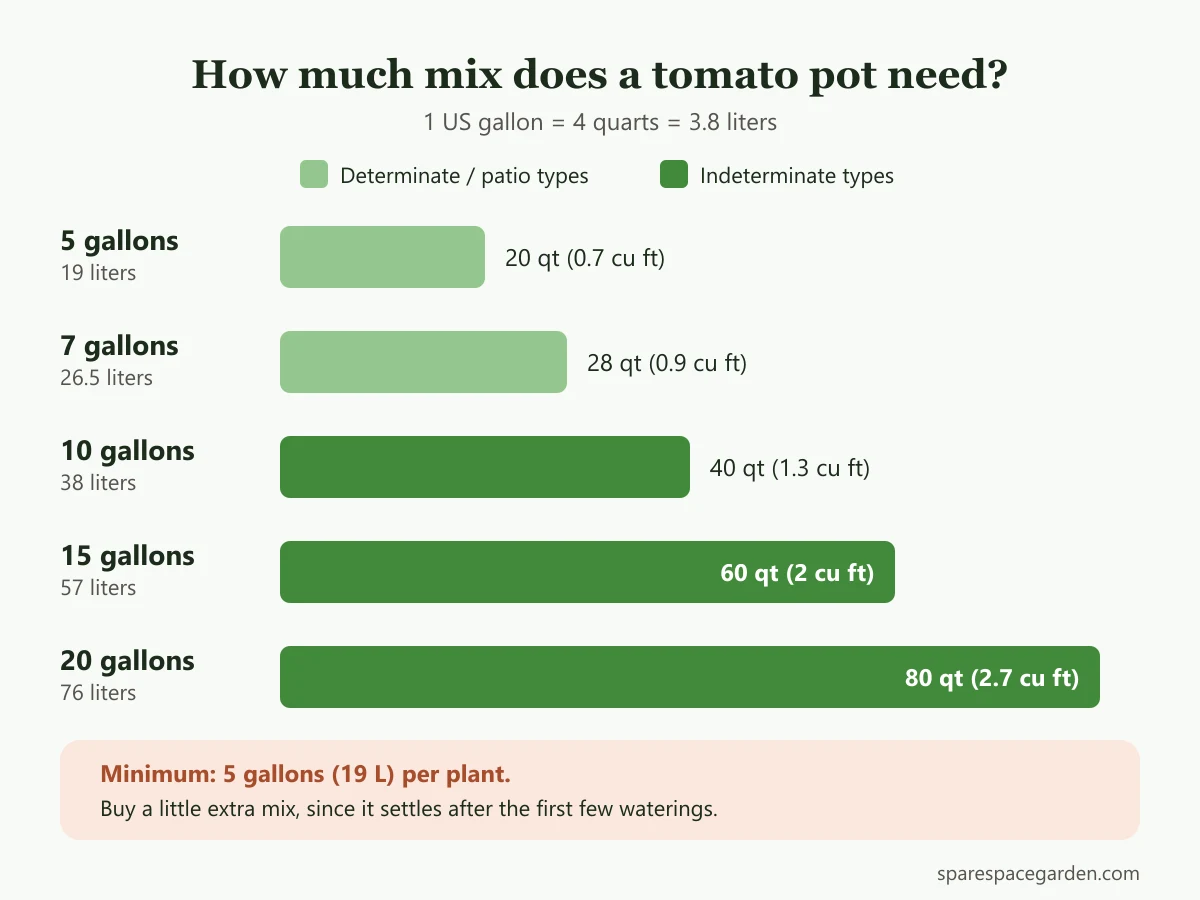 How much mix to buy for common tomato pot sizes.
Buy a little extra. Mix settles after the first few waterings, and Wisconsin's own recipe pairs a 25-quart bag with a 5-gallon container. If you're unsure how many plants a pot can hold, see how many tomato plants per container.
Tip: If your pot dries out completely between morning and evening, New Mexico State University's advice is to move the plant to a larger container rather than change the mix.
Refreshing tomato soil for next season
Opinions differ on reusing tomato mix. Colorado State advises never reusing potting soil from the previous season because it may carry disease organisms. Other extension services allow reuse if the plants were healthy, and our guide to whether you can reuse potting soil covers how to refresh it, with a half-and-half blend of old and fresh mix suggested for heavy feeders like tomatoes.
A few tomato-specific rules apply either way:
- Discard mix after wilt disease. If a plant had Fusarium or Verticillium wilt, don't reuse that mix for tomatoes.
- Clear out leaf debris. Wisconsin notes that early blight and Septoria leaf spot overwinter on diseased plant material, and recommends starting over with new media after severe leaf disease.
- Rotate plant families. Plant refreshed tomato mix with beans, lettuce or herbs next year, not tomatoes, peppers, eggplant or potatoes.
Whichever mix you use, the plant will run through its nutrients within weeks. Our guide to the best fertilizer for tomatoes in pots covers what to feed and when.
Frequently asked questions
Is potting mix or potting soil better for tomatoes in pots?
Choose a soilless potting mix. Products labeled "potting soil" vary, and Iowa State notes that cheap mixes tend to be heavy and drain poorly. Look for a light, fluffy mix, free of weed seeds and disease, that holds moisture without staying soggy.
Can you use raised bed soil or topsoil in a tomato pot?
Not on its own. Topsoil is essentially garden soil, and it compacts in containers the same way. If a bag is labeled for beds rather than containers, blend it with plenty of potting mix, or save it for in-ground planting.
Do tomatoes need a special tomato potting mix?
No. The best soil to grow tomatoes in pots is usually just a good general soilless mix, with or without added compost. What matters more is pot size, steady watering and regular feeding once the plant starts setting fruit.
Should I add lime to the soil for tomatoes in pots?
Only if your mix needs it. If the label lists lime, the pH has already been adjusted. University of Wisconsin Extension suggests about 1 cup (240 mL) of garden lime per 5-gallon (19 L) container of soilless mix, while the RHS says potting media rarely lack calcium. Steady watering matters more than either.
How often should I replace the soil in my tomato pots?
Replacing it every year is the safest choice, especially after any disease. If the plants were healthy, you can refresh used mix with about half fresh mix and grow a different plant family in it the next season.