The best fertilizer for citrus trees in pots is a nitrogen-rich product with trace elements such as iron, zinc and manganese, fed while the tree is actively growing. University of Maryland Extension suggests an N-P-K ratio of 2-1-1 or 3-1-1, or a product labeled "citrus fertilizer."
Potted lemons, limes, oranges and kumquats depend on you for almost everything they eat. Frequent watering carries nutrients out of the drainage holes, and the small root zone has little in reserve. That's why container citrus show hunger faster than trees in the ground, usually as yellow leaves.
Quick answer: Use a citrus fertilizer or a 2-1-1 to 3-1-1 product with micronutrients. Feed at least three times from spring to late summer (or use a slow-release product such as a 12-6-6 two to three times a season), stop by early fall, and water before every feed, dosing at the label rate. Indoors in winter, feed little or nothing.
What potted citrus need from fertilizer
Nitrogen comes first. UC IPM's guide to fertilizing citrus says most mature citrus need regular nitrogen, while other nutrients are usually present in adequate amounts in garden soil. A pot is different. Potting mix starts with a limited supply, and every watering washes some of it away.
The second need is micronutrients. UC IPM notes that citrus occasionally run short of zinc or iron, and University of Florida IFAS also describes shortages of manganese and magnesium. UF/IFAS lists the deficiency signs for each in its citrus nutrition management guide, and most of them show up as yellowing in a specific leaf pattern. A complete citrus fertilizer with trace elements prevents most of these problems before they start.
Here's what each nutrient does for a potted citrus tree:
| Nutrient | Why citrus need it | Where a shortage shows first |
|---|---|---|
| Nitrogen (N) | Leaf and shoot growth, green color | Whole older leaves turn yellow |
| Potassium (K) | Flowering, fruiting, hardiness | Yellowing at leaf tips and edges |
| Magnesium (Mg) | Green leaf color; moved into fruit | Older leaves, often near fruit |
| Iron (Fe) | Green color in new growth | Youngest leaves |
| Zinc (Zn) | Normal leaf size and shape | New growth, small narrow leaves |
| Manganese (Mn) | Green color between veins | Leaves show a mottled pattern |
For general container feeding, including how the three N-P-K numbers work, see our guide to fertilizer for potted plants.
Choosing a fertilizer for citrus trees in pots
Look at the first number on the label. Maryland Extension's growing dwarf citrus guide recommends a fertilizer with nitrogen in a 2-1-1 or 3-1-1 ratio, which means two or three times as much nitrogen as phosphorus or potassium. A Washington State University Extension Master Gardener column also names 3-1-1 as the best choice for indoor citrus.
You have three main formats:
- Slow-release granules. Clemson Cooperative Extension's container citrus production fact sheet recommends a slow-release fertilizer such as a 12-6-6 or 12-4-6, because frequent watering flushes nutrients from containers. It notes that release speeds up in warm, moist conditions.
- Labeled citrus fertilizer. Maryland Extension lists products labeled "citrus fertilizer" as a good option. These usually include trace elements, but read the label to confirm.
- Liquid feeds. Maryland also mentions liquid fertilizer such as fish emulsion, applied when you water. Liquids act quickly and are easy to dilute, which suits a tree indoors.
Clemson adds a detail many labels skip: most water-soluble fertilizers lack calcium and magnesium. It suggests Epsom salt (magnesium sulfate) and/or agricultural gypsum (calcium sulfate) at 1 to 4 ounces per cubic foot of media, roughly 28 to 113 g per 28 liters. Use that only for mixing into potting media, not as a regular top-up.
Tip: A balanced houseplant fertilizer with equal N-P-K numbers supplies proportionally less nitrogen than the 2-1-1 or 3-1-1 that extension guides suggest for citrus. Whatever you buy, check that the label lists iron, zinc and manganese.
When and how often to feed
Feed while the tree is putting out new growth. Maryland Extension says to fertilize only when the plant is actively growing, from spring to late summer, at least three times per season: in spring, early summer and late summer. Stop by early fall so the tree hardens off instead of producing tender new leaves.
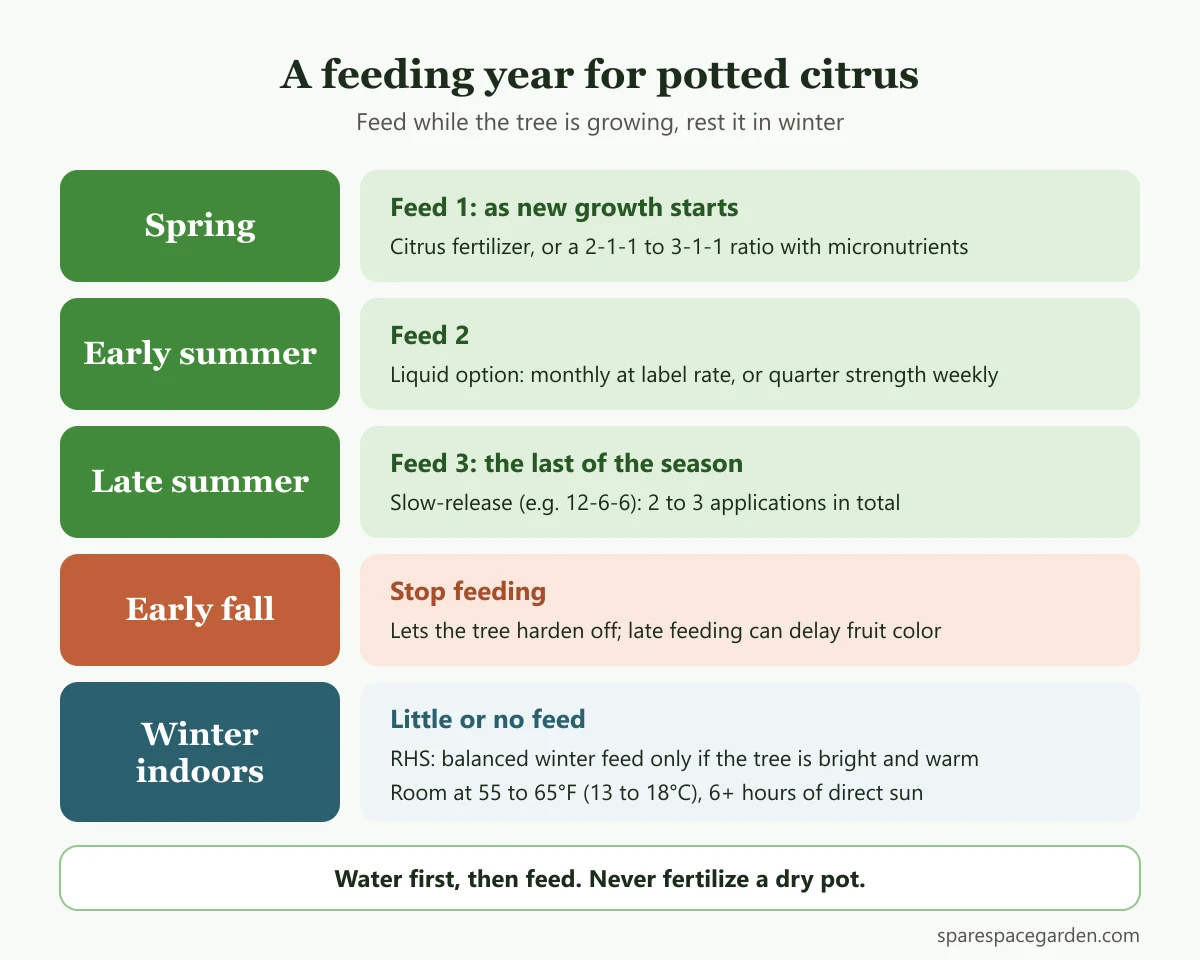 A seasonal feeding plan for potted citrus, based on extension guidance.
How often you apply fertilizer for citrus trees in pots depends on the product:
| Fertilizer type | How often | Source |
|---|---|---|
| Slow-release granules (e.g. 12-6-6) | 2 to 3 applications per growing season | Clemson Extension |
| Granular or labeled citrus fertilizer | At least 3 times: spring, early summer, late summer | Maryland Extension |
| Liquid 3-1-1 at full label strength | About once a month | WSU Extension column |
| Liquid 3-1-1 at quarter strength | Weekly, mid-spring to late summer | WSU Extension column |
Avoid feeding late in the season. UC IPM warns that late-season fertilizing can affect fruit quality, delay fruit coloring and make the rind rough. It also notes that dwarf trees and trees in containers with restricted root space may need less fertilizer than trees in the ground, so don't exceed the label rate to make up for the small pot.
Winter indoors: feed less or not at all
Most US extension guides say to stop using fertilizer for citrus trees in pots during winter. Maryland Extension says no winter fertilizing is needed, and the WSU column says to discontinue feedings in winter. The reasoning is simple: a tree indoors in lower light grows slowly, so it uses little fertilizer, and unused salts build up in the pot.
The RHS takes a different view. Its citrus growing guide calls citrus hungry plants that benefit from feeding all year, with a high-nitrogen summer feed from late March to October and a more balanced winter citrus feed from November to mid-March. That advice is written for trees kept bright and fairly warm, such as in a conservatory.
A practical middle path: if your tree sits in a cool room with no new growth, skip winter feeding. If it's in a bright, warm spot and still putting out leaves, a balanced citrus feed at the label's winter rate is reasonable.
Light and temperature matter more than fertilizer in winter:
- Light. Maryland Extension recommends at least 6 hours of direct sun, preferably 8 to 12, and a south-facing window or grow light in winter.
- Temperature. Clemson suggests keeping the room between 55°F and 65°F (13–18°C). Maryland suggests 65 to 75°F (18–24°C) during the day and 55 to 65°F (13–18°C) at night.
- Minimums. The RHS lists kumquats as often needing 45°F (7°C) or more, limes above 50°F (10°C) and calamondin oranges at least 55°F (13°C).
- Water. The RHS says to let the surface partly dry in winter, then water thoroughly, and warns that overwatering is one of the most common problems.
Reading the leaves: deficiency symptoms
The position of yellow leaves on the tree narrows down the cause. Nitrogen and magnesium shortages usually show on older leaves first, while iron and zinc shortages show on new growth. UF/IFAS notes that with zinc shortage, new leaves become progressively smaller and narrower.
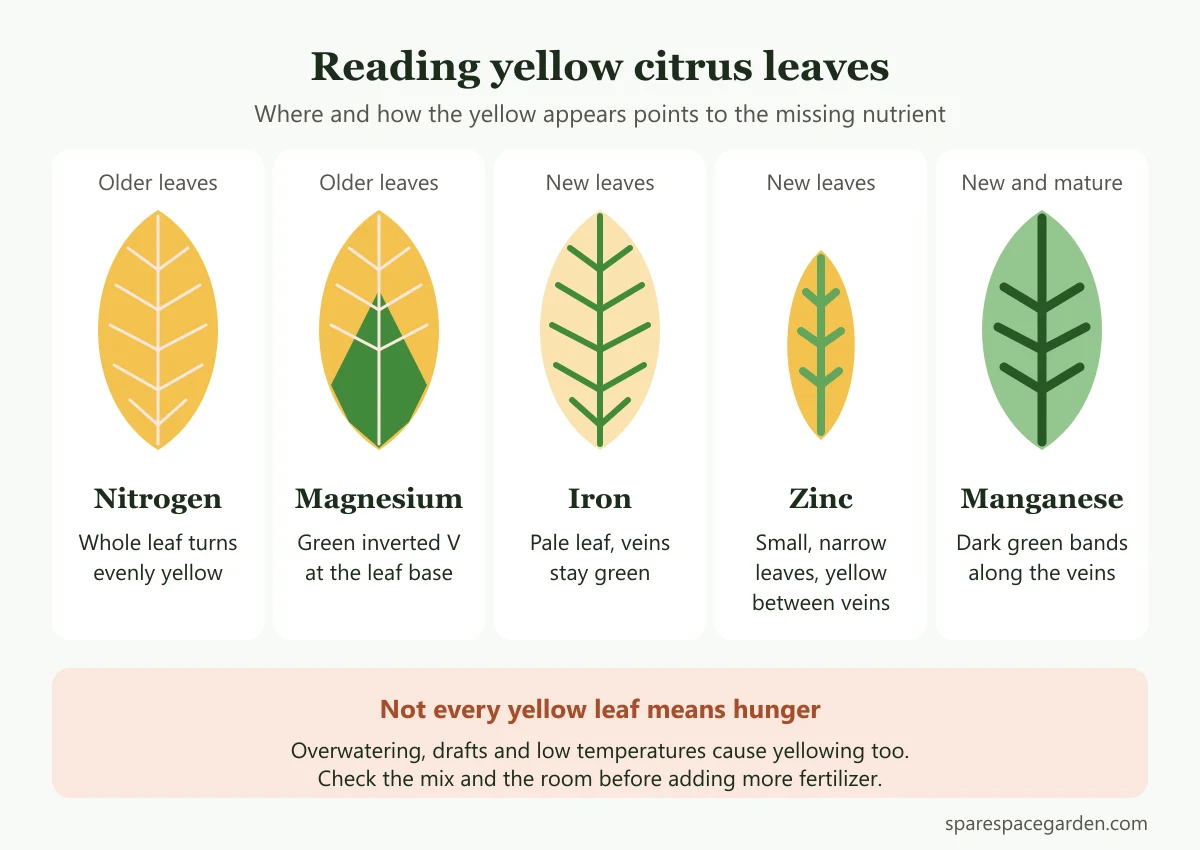 Common yellowing patterns on citrus leaves and the nutrient most often behind each.
| What you see | Likely shortage | What to do |
|---|---|---|
| Whole older leaves turn evenly yellow | Nitrogen | Resume regular citrus feeding |
| Older leaves yellow with a green inverted V at the base | Magnesium | Use a fertilizer that contains magnesium |
| New leaves pale with green veins | Iron | Chelated iron; check pH |
| Yellow blotches between veins; small, narrow new leaves | Zinc | Chelated micronutrient spray in spring |
| Dark green bands along veins, paler between | Manganese | Chelated micronutrient spray in spring |
| Yellowing at tips and edges that spreads | Potassium | Complete citrus fertilizer |
The symptom descriptions come from UF/IFAS. The RHS adds that iron shortage affects the youngest leaves most, while magnesium shortage affects older leaves. For zinc and iron, UC IPM suggests a foliar spray of a liquid chelated micronutrient solution as new growth emerges in spring, or soil-applied sulfated forms such as zinc sulfate or iron sulfate. Follow the product label for any spray.
Yellow leaves aren't always about fertilizer. The RHS lists roots that are too wet or too dry, drafts and low temperatures as other causes, and Maryland Extension notes that leaf drop often signals overwatering. Check the mix and the room before adding more feed.
pH, water and salt buildup
Citrus prefer slightly acidic conditions. Clemson says citrus do well with a soil pH of 5.5 to 6.5, and that rainwater is preferred because it tends to have a lower pH than municipal water. Acidic water-soluble fertilizers with ammonium-based nitrogen and sulfur help keep pH down.
When pH drifts too high, iron becomes harder for roots to take up even if the mix contains plenty. Maryland Extension says yellowing leaves with green veins indicate soil that isn't acidic enough or too little iron, and suggests a sulfur-containing soil acidifier and/or a chelated iron fertilizer, applied as the label directs. If your tap water is hard, collecting rainwater for your citrus is one of the simplest fixes.
Fertilizer salts are the other risk. WSU HortSense says container plants are particularly susceptible to fertilizer damage, with brown leaf tips and a whitish or brownish crust on the mix or pot rim as warning signs. Watering heavily so water runs out of the drainage holes can leach some salts from liquid or quick-release fertilizers. Fresh mix at repotting also resets the pot; our guide on how to make potting soil covers a free-draining blend.
Watch out: Never feed a dry pot. WSU advises against fertilizing plants stressed by heat or drought. Water first, let the pot drain, then apply fertilizer to the moist mix.
Common feeding mistakes
A few habits cause most problems with potted citrus:
- Doubling the dose. UC IPM notes that excess fertilizer causes too much new growth, which makes trees more susceptible to disorders such as bacterial blast. Use the label rate.
- Feeding into fall. Late feeding can delay fruit coloring and roughen the rind, and soft growth suffers when the tree comes indoors.
- Using only a tomato or bloom feed. These are high in potassium or phosphorus. Citrus need nitrogen first, and the RHS warns that heavy use of potassium-rich feeds can reduce magnesium uptake.
- Treating every yellow leaf with fertilizer. Overwatering, drafts and low temperatures cause the same symptom, according to the RHS.
- Skipping micronutrients. A plain 20-20-20 houseplant feed may not contain the iron, zinc and manganese that citrus can run short of.
If you also grow tomatoes, see best fertilizer for tomatoes in pots for why their schedule differs.
Frequently asked questions
How often should I fertilize a lemon tree in a pot?
Maryland Extension suggests at least three feeds per season, in spring, early summer and late summer. With a liquid 3-1-1, the WSU column suggests about once a month, or quarter strength weekly from mid-spring to late summer. Stop by early fall.
Is tomato fertilizer OK for citrus trees?
It isn't a good main feed. Tomato fertilizers are usually high in potassium, while extension guides recommend a 2-1-1 or 3-1-1 ratio with more nitrogen for citrus. The RHS also notes that overusing potassium-rich feeds can lead to magnesium shortage.
Should I fertilize citrus trees in pots in winter?
US extension guides from Maryland and Washington State say to stop feeding in winter. The RHS recommends a balanced winter citrus feed for trees kept bright and warm. If your tree isn't putting out new growth indoors, skip it.
Is Epsom salt good for citrus trees in pots?
Epsom salt supplies magnesium, which citrus can run short of. Clemson suggests Epsom salt and/or gypsum at 1 to 4 ounces per cubic foot of potting media (about 28 to 113 g per 28 liters), since most water-soluble fertilizers lack magnesium and calcium. Don't add it unless the fertilizer you use lacks magnesium or leaves show the inverted V pattern.
Why are the new leaves on my potted lime pale with green veins?
That pattern on new growth usually points to iron shortage, often because the pH of the mix is too high. Maryland Extension suggests a chelated iron fertilizer and/or a sulfur-containing acidifier, and Clemson recommends watering with rainwater where you can.