If you want to know how to grow microgreens indoors, the short version is this: sow seeds thickly on a shallow tray of moist potting mix, keep them covered and dark for a few days, then move them to a bright window or under a light and water from below. Most crops are ready to cut in one to three weeks.
Microgreens are vegetable and herb seedlings cut just as their first true leaves appear. They need no garden, no fertilizer and very little space, which makes them a good fit for a kitchen windowsill or a shelf in an apartment.
Quick answer: Use a tray 1 to 2 inches (2.5 to 5 cm) deep with drainage holes, nested in a second tray without holes. Sow large seeds like radish at 6 to 8 seeds per square inch, cover for 1 to 4 days, then give bright light and water from below. Cut 1/4 to 1/2 inch (6 to 13 mm) above the mix when plants are 1 to 3 inches (2.5 to 7.5 cm) tall, usually 7 to 21 days after sowing.
What you need to grow microgreens indoors
- Two shallow trays. University of Illinois Extension recommends containers 1 to 2 inches (2.5 to 5 cm) deep, which saves on mix. The top tray needs drainage holes; the bottom one has none and catches water. Plastic flats, foil pans and clean takeout trays all work.
- A cover. A clear lid, a second tray turned upside down, or damp paper towels keep the seeds dark and humid while they germinate.
- Growing medium. Illinois suggests a basic potting soil with a little added fertility. Utah State University Extension also lists seed-starting mix, coconut coir and hydroponic grow mats.
- Seeds. Clemson Extension advises buying seeds labeled for microgreens or marked "untreated," since some garden seed is coated with fungicide.
- A spray bottle, clean scissors and a sunny window or a simple light.
Clemson and Cornell Cooperative Extension both warn against garden soil, manure or compost, which may carry bacteria. Purdue Extension puts it more bluntly: never use garden soil indoors unless it has been sterilized. Use fresh mix for every tray.
Tip: A standard 10 by 20 inch (25 by 50 cm) tray is the size most seed rates are written for. Colorado State University Extension notes the same area can be split into two 10 by 10 inch trays or eight 5 by 5 inch trays, which suits a narrow windowsill better.
Easy microgreens for beginners
UConn Extension lists pea shoots, sunflower, broccoli, kale, radish and arugula as the most popular choices. The brassicas need no soaking and are among the fastest; peas and sunflowers are big seeds that get a soak first. The table combines figures from Utah State University Extension with harvest times from Cornell.
| Crop | Seed per 10x20 in tray | Presoak | Days covered | Days to harvest | Flavor |
|---|---|---|---|---|---|
| Radish | 42 g (1.5 oz) | None | 1–2 | 6–12 | Spicy, peppery |
| Broccoli | 28 g (1 oz) | None | 2–4 | 8–12 | Mild broccoli |
| Kale | 28 g (1 oz) | None | 1–2 | 8–15 | Mild to strong |
| Arugula | 10 g (0.35 oz) | None | 1–2 | 6–8 | Peppery |
| Pea | 150 g (5.3 oz) | 6 hours | 3 | 8–15 | Sweet pea |
| Sunflower | 48 g (1.7 oz) | 12 hours | 3 | 8–12 | Nutty |
| Basil | 28 g (1 oz) | None | 4–7 | 12–25 | Strong basil |
| Cilantro | 28 g (1 oz) | None | 7–14 | 21–28 | Cilantro |
Basil and cilantro are slow and less predictable, so save them for a second or third tray. If cilantro is what you're after, our guide to growing cilantro in pots covers the full-size plant.
How to grow microgreens indoors, step by step
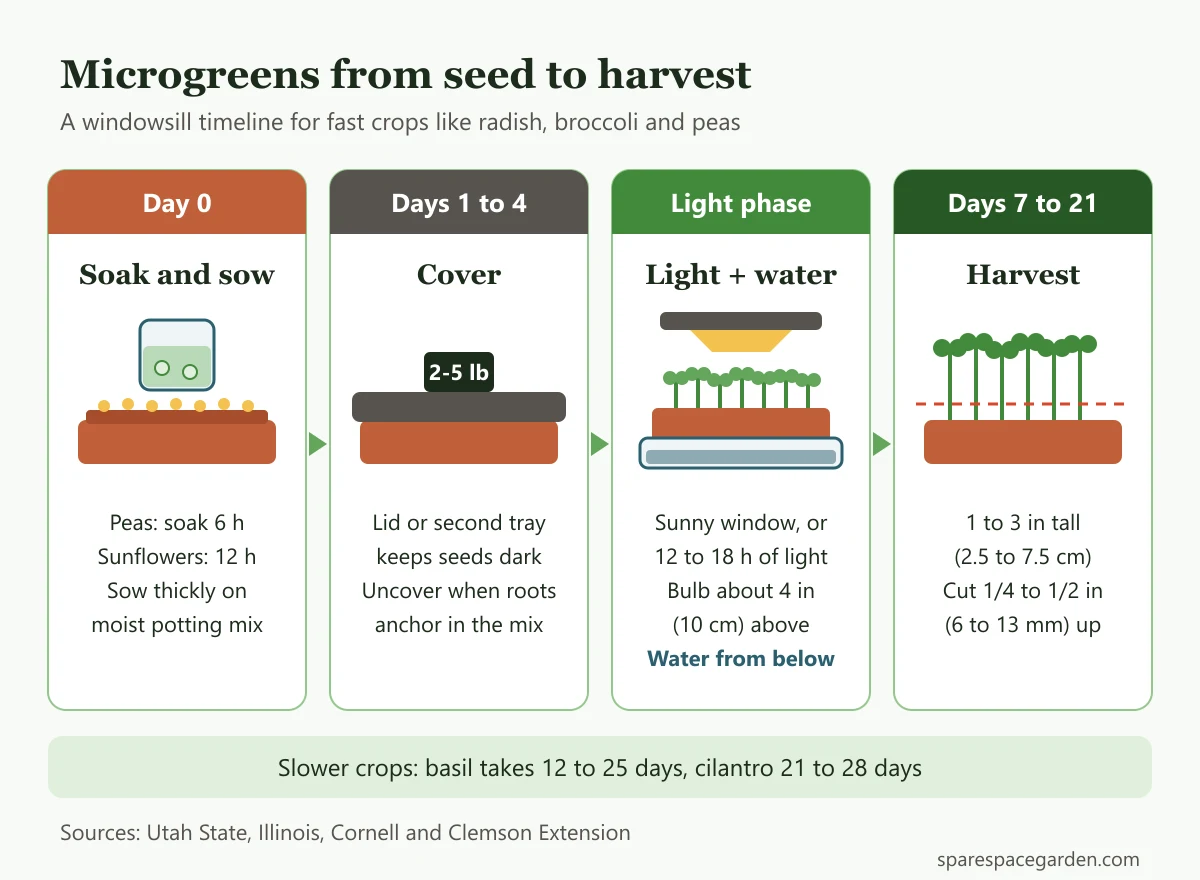 The basic microgreen timeline. Exact days depend on the crop.
- Soak large seeds. Peas get about 6 hours in water and sunflowers about 12, according to Utah State. Small seeds go in dry.
- Fill the tray with moist mix. Moisten the potting mix before filling, level it about 1/2 inch (1.3 cm) below the rim, and press it flat. Illinois suggests the bottom of a tissue box as a tamper.
- Sow thickly and evenly. Scatter seed over the whole surface, paying attention to the edges, and press it gently into the mix. Seeds can touch; that's normal for microgreens.
- Mist and cover. Spray the seeds until evenly moist, then cover with a lid, an upside-down tray or damp paper towels.
- Keep them dark for 1 to 4 days. Check daily and mist if the surface dries out.
- Uncover and give light once the roots have pushed into the mix.
- Water from below from then on, and cut when the first true leaves appear.
How much seed to sow
Illinois Extension gives two ways to judge density. By volume, use 2 to 2.5 tablespoons of large seed such as radish, or 0.5 to 1 tablespoon of small seed such as brassica mixes, per 10 by 20 inch (200 square inch, about 1,290 square cm) tray. By eye, aim for 6 to 8 large seeds per square inch (about 1 per square cm) or 10 to 12 small seeds per square inch (about 1.5 to 2 per square cm).
For a smaller container, measure its area and scale down. A 5 by 10 inch tray is 50 square inches, a quarter of the standard tray, so it needs about a quarter of the seed. Illinois recommends sowing at the lower end of the range if you plan to grow the plants on to the true-leaf stage.
The blackout period
Covering the tray keeps humidity high and pushes the seedlings to stretch upward, which gives you longer stems to cut. Utah State goes a step further: it stacks a second tray on top with 2 to 5 pounds (about 1 to 2.3 kg) of weight for the first half of the covered time, then flips the cover so it sits over the seedlings without touching them.
How long to keep the tray dark depends on the crop. Utah State's covered times run from 1 to 2 days for radish, kale and arugula to 3 days for peas and sunflowers, and much longer for cilantro. Colorado State's general guideline is about 3 days. The practical signal is the same everywhere: when roots are clearly anchored in the mix and the seedlings start lifting the cover, it's time for light.
Light: windowsill or grow light
A sunny window is enough for many home growers. Illinois Extension simply places the tray in a sunny window and rotates it as the seedlings lean toward the glass. Purdue notes that home growers may only need extra lighting when bright to medium sunlight isn't available.
Winter is where windows fall short. Utah State points out that Utah can get as little as 8 hours of daylight in winter, and recommends lights on for 18 hours and off for 6, set on a timer. UConn Extension suggests 12 to 16 hours of sunlight or artificial light a day.
You don't need an expensive fixture. Clemson and Cornell say a simple fluorescent bulb will do, kept about 4 inches (10 cm) above the sprouts to prevent leggy seedlings. Since the trays hold water, keep the fixture, cords and plugs dry and clear of spills, and follow the light maker's instructions. If your greens are pale, floppy and leaning hard, they need more light or a closer bulb; our guide to leggy seedlings explains the cause in more detail.
| Sunny window | Grow light | |
|---|---|---|
| Cost | Free | A simple fluorescent or LED fixture |
| Hours of light | Limited by season and window direction | Set by timer: 12 to 18 hours in extension guides |
| Distance | Tray right at the glass | About 4 in (10 cm) above the sprouts |
| Common issue | Seedlings lean; rotate the tray daily | Too far away gives pale, stretched stems |
| Best for | Spring and summer, south- or west-facing windows | Winter, dim rooms, shelves away from windows |
Temperature matters less than light, but Utah State aims for about 74°F (23°C) during germination, 72°F (22°C) with lights on and 68°F (20°C) with lights off. Purdue says to keep trays away from heating and cooling vents.
Bottom watering and mold prevention
Water from below once seeds have sprouted. Illinois Extension calls bottom watering the best way to keep microgreens dry and less prone to disease: pour water into the solid bottom tray and let the mix soak it up through the drainage holes.
Don't leave the tray sitting in a puddle. Utah State discards any water left in the bottom tray after 30 minutes. Colorado State starts with about 16 fluid ounces (475 ml) in the bottom tray of a full-size setup, adds about 8 ounces (240 ml) as plants grow, and says the bottom tray should be almost dry each time you water. Illinois advises waiting until the mix starts to dry a little, which shows first around the edges.
Mold or root hairs?
Fine white fuzz around the base of new seedlings alarms a lot of first-time growers. Often it's root hairs, which Purdue Extension describes as normal, unlike mold. Growers commonly describe root hairs as soft and feathery, growing evenly along the young roots, and easiest to see when the mix is a bit dry. A light misting usually makes them flatten or disappear.
Mold behaves differently. It tends to spread in patches across the mix and seed hulls, looks webby or gray, may climb the stems and often smells musty. If a tray shows mold, don't eat it: compost the whole batch and start again with a clean tray and fresh mix.
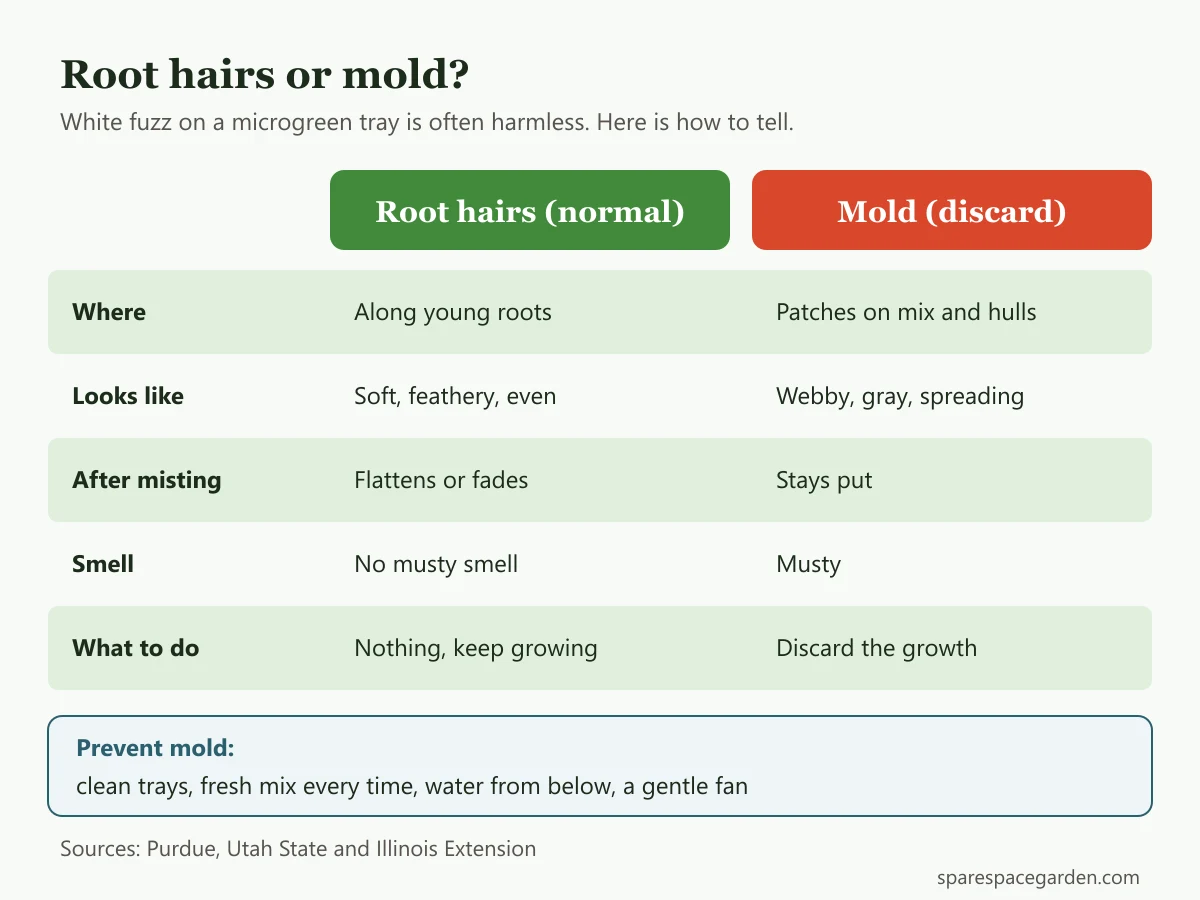 How to tell harmless root hairs from mold on a microgreen tray.
To keep mold away:
- Start clean. Purdue calls sanitation of all supplies the main defense against mold and pathogens. Colorado State washes both trays with dish soap before every batch.
- Use fresh mix each time. Purdue notes that reusing growing media raises the risk of mold.
- Don't oversow. Stay within the seed rates above; a solid mat of seed holds moisture at the base of the stems.
- Keep air moving. Utah State recommends a gently blowing fan, especially near a sunny window.
If tiny flies show up around the trays, that's usually a sign the mix is staying too wet; see our guide to getting rid of gnats in potted plants.
Harvesting and storing microgreens
Harvest when the seed leaves are fully open or the first true leaves are just starting to show. Cornell describes the usual height as 1 to 3 inches (2.5 to 7.5 cm), and Purdue says most crops are cut at 2 to 4 inches (5 to 10 cm). Pea shoots are the exception: Purdue lets them grow taller, with two or more sets of true leaves.
Hold a handful of stems and cut with clean scissors or a sharp knife about 1/4 to 1/2 inch (6 to 13 mm) above the mix, as Illinois suggests. Don't wait too long. Purdue notes that flavor turns more bitter the longer microgreens grow, especially sunflowers.
Most microgreens won't regrow after cutting, so compost the roots and mix and start a fresh tray. UF/IFAS Extension notes that pea shoots and wheatgrass can regrow, while broccoli, radish, kale, mustard and sunflower generally don't. For a steady supply, Illinois recommends sowing a new tray every week.
Storage. Cornell and Clemson recommend keeping microgreens unwashed in a clean plastic bag in the refrigerator and washing them just before eating. UConn gives a fridge life of 5 to 7 days, and Purdue about a week. Rinse in a colander or salad spinner to remove soil and stuck seed hulls.
Microgreens vs sprouts: a food safety note
Microgreens and sprouts are often lumped together, but they're grown differently. Sprouts are germinated seeds grown in water and eaten whole, root and all. Microgreens grow in a medium with light, and only the parts above the soil line are eaten, as Clemson Extension explains.
That difference matters for safety. UConn's food safety program explains that the warm, humid conditions used to grow sprouts can also support Salmonella or E. coli, and it repeats the FDA's advice that children, older adults, pregnant women and people with weakened immune systems avoid raw sprouts of any kind. UConn Extension's microgreens guide says the potential for bacterial growth is much lower in microgreens than in sprouts.
Lower risk isn't zero risk. UConn notes that bacteria can already be on the seed or be introduced while it grows, so sprout safety depends on clean seed and sanitary handling. The same habits protect a microgreen tray: buy seed from a reputable supplier, use clean trays and fresh potting mix, water from below so leaves stay dry, cut above the mix, and rinse before eating.
Frequently asked questions
Can you grow microgreens without soil?
Yes. Utah State lists coconut coir and hydroponic grow mats as alternatives, and Purdue mentions mats made from coir, hemp and other fibers. Bottom watering and a clean tray matter just as much on a mat as in potting mix.
Do microgreens need direct sunlight?
They need bright light, but not hours of hot direct sun. Purdue says bright to medium sunlight may be enough for home growers, and notes that trays grown outside in summer usually need shade from direct sun. In winter or in a dim room, a light about 4 inches (10 cm) above the tray gives more even results.
Why are my microgreens falling over?
Stems that flop are usually stretched from too little light, or weak from mix that stays too wet. UF/IFAS Extension notes that seedlings collapse when conditions are too damp or too dark. Move the tray closer to the light, let the bottom tray run nearly dry between waterings, and improve airflow.
How long do microgreens take to grow indoors?
Most are ready 7 to 21 days after sowing. Radish and arugula can be cut in about a week, peas and sunflowers in 8 to 15 days, and basil and cilantro can take two to four weeks. For full-size herbs on the same windowsill, see our list of the best herbs to grow indoors.