The most reliable fertilizer for hanging baskets is a two-part routine: slow-release granules mixed into the potting mix at planting, then a diluted water-soluble feed every one to two weeks through summer. Illinois Extension recommends this combination for baskets that stay full and flowering through the season, and Iowa State gives similar timing.
Hanging baskets are harder to feed than ground-level pots. They dry out from every side, so they get watered more often, and each watering flushes nutrients out of the bottom. A basket that looked lush in June can be pale and sparse by August if the feeding stops.
Quick answer: Mix a 3- to 4-month slow-release fertilizer into the potting mix at planting. Once the plants are growing, add a water-soluble feed every 1 to 3 weeks at the label rate (or half strength more often), always onto moist mix. Use a feed that isn't high in nitrogen for flowering baskets, and stop feeding at the end of summer.
Why hanging baskets need more feeding
Water is the reason. Colorado State University's PlantTalk page on hanging baskets points out that baskets are exposed on the bottom and all sides, so most need checking once or twice a day in summer. A Master Gardener handout from Oregon State University Extension notes that a 10-inch (25 cm) container may need water every 1 to 2 days, and smaller ones even more often.
Every time water runs out of the drainage holes, it takes dissolved nutrients with it. Illinois Extension says frequent watering makes fertilizing important for baskets, and that moss-lined baskets dry out quickly, especially later in the season. The RHS adds that the nutrients in container compost start to run out about six weeks after planting.
There's a second problem: a dry basket can't feed itself. The RHS notes that in dry soils and containers, roots can't take up nutrients. So a basket that is underwatered is also underfed, even if there's fertilizer in the mix.
For a general overview of container feeding, see our guide to fertilizer for potted plants. This article covers what's different about baskets.
Start with slow-release fertilizer at planting
Slow-release (also called controlled-release or timed-release) fertilizer is coated granules that release a little nutrient every time the mix gets wet. That suits baskets well, because they get wet so often.
Oregon State's Master Gardener hanging basket handout suggests these steps:
- Pour out the potting mix you'll need and mix in a 3- to 4-month slow-release fertilizer at the label rate.
- Fill the basket, set the plants in place and top up with mix, leaving about 1 inch (2.5 cm) below the rim for watering.
- Settle the mix around the root balls with water containing half-strength soluble fertilizer.
- Hang the basket in the right sun or shade for the plants.
Check the bag before adding anything. Iowa State notes that some potting mixes already include slow-release fertilizer, and Colorado State suggests asking whether a pre-planted basket from a garden center has already been fertilized, and with what.
A 3- to 4-month product planted in late spring runs out around late summer. Iowa State says slow-release fertilizers may need a second application mid-season, which is where liquid feeding comes in.
Liquid feeding through the season
Liquid or water-soluble fertilizer tops up what the granules provide and lets you respond quickly when plants look tired. The RHS suggests starting liquid feeds for containers about six weeks after planting, as the nutrients in the compost start to run out. After that, the advice varies, so pick one routine and stick to it.
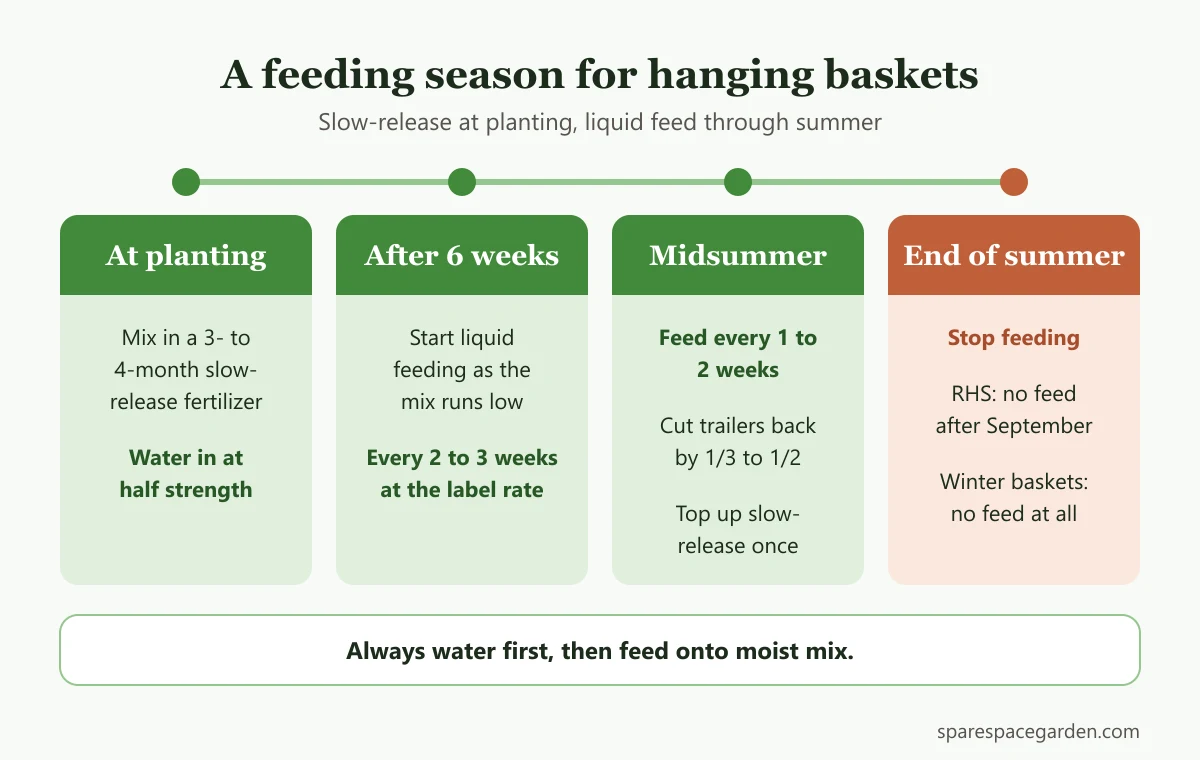 A simple feeding season for summer hanging baskets.
| Source | Liquid feeding advice for baskets |
|---|---|
| Iowa State Extension | Soluble fertilizer every 1 to 3 weeks through summer |
| Illinois Extension | Every two weeks, or slow-release plus a half-strength liquid program |
| Illinois Extension (containers) | Or a half-strength solution at every watering |
| Oregon State handout | If plants lag, water-soluble feed once or twice a week |
| RHS | Liquid feed from April to September; bedding plants 3 or 4 times over summer |
The RHS schedule is the lightest of these. In hot, sunny weather when baskets are watered daily, the more frequent US extension schedules are a better fit, because more water through the basket means more nutrients washed out.
Iowa State Extension's guide to creating and growing hanging baskets gives the widest range, every 1 to 3 weeks. A practical way to use it: feed every 2 to 3 weeks early in summer, then every 1 to 2 weeks in midsummer when you're watering daily and the plants are at their largest.
Tip: Feeding at half strength more often is gentler than full strength less often. Illinois Extension describes both as valid, and a weaker solution is less likely to burn roots in a small basket.
Choosing fertilizer for hanging baskets: flowers, foliage or food
The right fertilizer for hanging baskets depends on what's growing in them. The first number on the label (nitrogen) is the one to watch.
Flowering baskets
Too much nitrogen gives leaves instead of flowers. Iowa State says to avoid high-nitrogen fertilizers because they cause excessive leafy growth at the expense of flowers, and suggests a complete fertilizer with a 1:2:1 N-P-K ratio. Colorado State gives a higher middle number, such as 15-30-10, as an example.
UK advice tends to emphasize potassium instead. The RHS describes potassium as needed for flowering, fruiting and general hardiness. Either way, the shared message is the same: for petunias, calibrachoa, verbena and other bloomers, use a feed where nitrogen isn't the biggest number.
Foliage baskets
Baskets grown for leaves, such as ferns, coleus, ivy or sweet potato vine, have different needs. Illinois Extension says foliage plants do well with high-nitrogen fertilizer, so a balanced or nitrogen-leaning feed suits them.
Edible baskets: strawberries and tomatoes
Fruiting plants need a change of feed partway through the season:
- Strawberries. The RHS strawberry growing guide says to feed plants in containers every two weeks during the growing season, starting with a general-purpose liquid feed and switching to a high-potassium liquid feed when the first flower buds form. It singles out hanging baskets as needing regular watering. Our guide to growing strawberries in hanging baskets covers planting and varieties.
- Tomatoes. The RHS says trailing tomato types can be grown in hanging baskets, and recommends a high-potassium liquid feed every 10 to 14 days once the first fruits start to swell. Keep the mix evenly moist, since uneven watering can cause split fruit and blossom end rot. See best fertilizer for tomatoes in pots for the full schedule.
| Basket type | Feed to choose | When to switch |
|---|---|---|
| Flowering annuals | Low nitrogen; higher P or K (e.g. 1:2:1) | Same feed all season |
| Foliage plants | Balanced or higher nitrogen | Same feed all season |
| Strawberries | General-purpose, then high potassium | When first flower buds form |
| Trailing tomatoes | Balanced, then high potassium | When first fruits swell |
Watch out: The RHS warns that heavy use of potassium-rich feeds such as tomato feed can cause magnesium shortage. If older leaves turn yellow between the veins, ease off the high-potassium feed.
Avoiding fertilizer burn in a dry basket
Never feed a basket that has dried out. The RHS hanging basket guide says to water the basket first before using diluted feed, and notes that roots can be damaged by liquid feed that isn't diluted correctly. Illinois Extension also advises applying fertilizer when the mix is moist rather than bone dry.
Dry roots are already stressed, and a dose of fertilizer salts makes it worse. Washington State University's HortSense page on fertilizer burn advises against fertilizing plants stressed by heat or drought and says container plants are particularly susceptible to fertilizer damage.
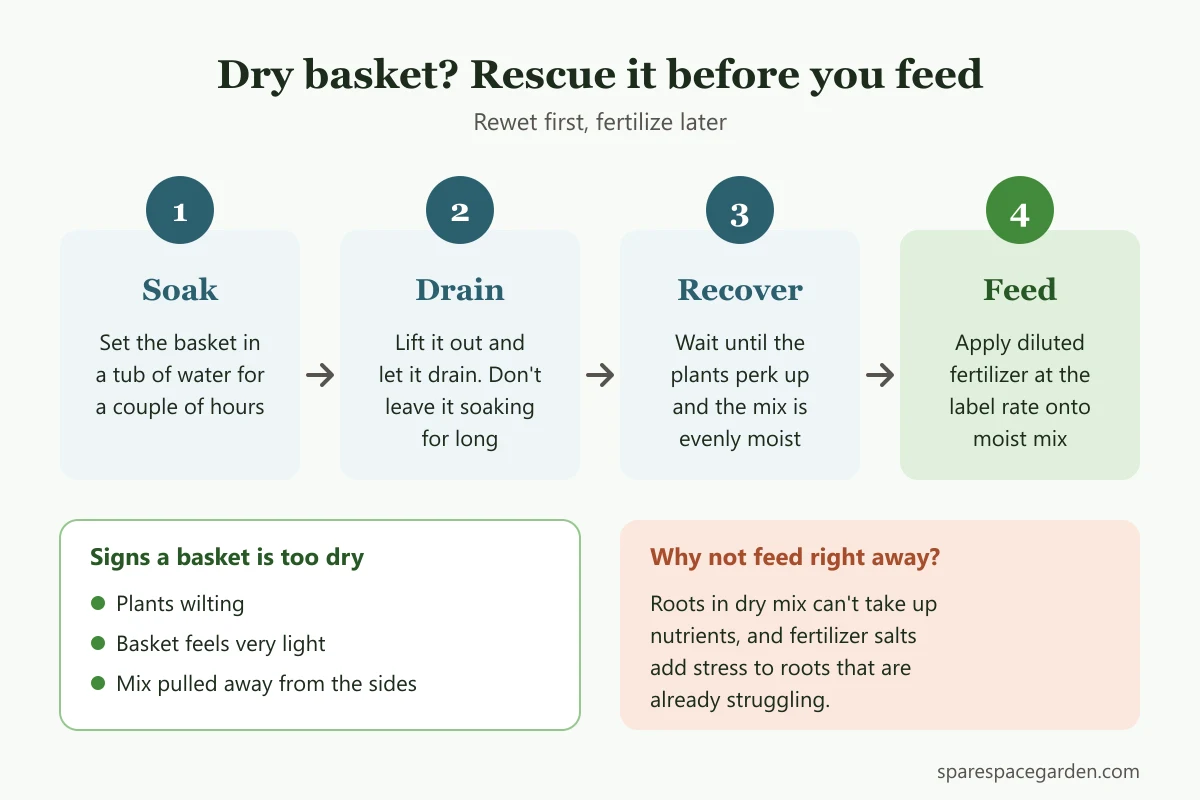 Rewet first, feed later: how to handle a basket that has dried out.
If the mix has shrunk away from the sides of the basket, water will run straight past the root ball. Iowa State suggests taking the basket down and setting it in a tub of water for a couple of hours, without leaving it to soak for long periods, which can cause root rot. Let it drain, wait until the plants perk up, then feed at your normal rate.
Colorado State adds a simple habit: setting the basket on the ground to water it is more efficient than watering it while it hangs.
Signs of hunger and overfeeding
A hungry basket usually looks tired before it looks sick. Watch for fewer new flowers, smaller leaves and pale color, especially in midsummer when the slow-release granules start to run out.
| What you see | Likely cause | What to do |
|---|---|---|
| Pale yellow older leaves, spindly growth | Nitrogen shortage | Resume regular liquid feeding |
| Few flowers, brown edges on older leaves | Potassium shortage | Use a feed higher in potassium |
| Yellow between veins on older leaves | Magnesium shortage, often after heavy tomato feed | Ease off high-potassium feed |
| Lush leaves, few flowers | Too much nitrogen | Switch to a lower-nitrogen feed |
| Brown leaf tips, white crust on the mix | Fertilizer salt buildup | Stop feeding; water heavily to flush |
The deficiency signs come from the RHS guide to nutrient deficiencies, which lists spindly, stunted plants with pale yellow leaves as the classic sign of nitrogen shortage. WSU says a whitish or brownish crust on the mix or along the inside rim signals salt buildup, and heavy watering can flush salts from liquid or quick-release fertilizers.
Wilting needs a second look. If the mix is dry, the basket needs water. If the mix is moist and plants still wilt, salt-damaged or waterlogged roots are more likely than hunger.
Late-season care
Baskets need more attention as summer goes on, not less. Illinois Extension notes that baskets dry out faster later in the season, and that frequent watering keeps depleting nutrients, so keep feeding while plants are still flowering.
A few late-season habits help:
- Cut back and feed. Iowa State suggests cutting trailing plants back by one-third to one-half around midsummer to encourage fresh growth. A liquid feed afterward supports the regrowth.
- Deadhead weekly. The Oregon State handout recommends removing faded flowers at least once a week, and the RHS says deadheading keeps a succession of flowers coming.
- Top up slow-release once. If you rely on granules, a second mid-season application is what Iowa State suggests.
- Stop at the end of summer. The RHS feeding period for baskets runs April to September, and it advises against fertilizing after September because new growth can be damaged by cold.
Winter baskets are the exception. The RHS says winter hanging baskets don't need feeding, because it encourages soft growth that frost easily damages. Perennials and shrubs kept in baskets from year to year get a slow-release fertilizer once in spring instead.
Frequently asked questions
How often should hanging baskets be fertilized?
Iowa State suggests a soluble fertilizer every 1 to 3 weeks through summer, and Illinois says every two weeks. If you mixed slow-release fertilizer in at planting, the lighter end of that range is usually enough. Baskets watered every day in hot weather tend to need the more frequent schedule.
Is tomato feed good for flowering hanging baskets?
It can be. Tomato feed is high in potassium, which the RHS describes as needed for flowering, and some UK garden guides suggest it once baskets start to bloom. Use it at the label rate and don't rely on it alone all season, since the RHS warns that heavy potassium feeding can lead to magnesium shortage.
Can you over-fertilize hanging baskets?
Yes. Too much nitrogen gives leafy growth with few flowers, and excess fertilizer salts can burn roots and leaf tips. A white crust on the mix or browning leaf edges means it's time to stop feeding and flush the basket with plain water.
Do hanging baskets need fertilizer if the potting mix already has it?
Usually, yes, later in the season. Illinois Extension says many slow-release products for annuals last 3 to 4 months, and the RHS notes that container compost starts to run low about six weeks after planting. Start liquid feeding once growth slows or color fades.
When should you stop feeding hanging baskets?
The RHS feeds baskets from April to September and advises against fertilizing after September. Stop when the plants stop flowering well, and don't feed winter baskets at all.