The best herbs to grow indoors are chives, parsley and mint, followed closely by oregano and thyme. They put up with the lower light, drier air and cooler rooms of a typical home better than most. Basil and cilantro can work on a sunny windowsill but need more attention, while rosemary, sage and bay are the hardest to keep happy inside.
Light decides almost everything. This list ranks common kitchen herbs by how well they cope with indoor conditions, gives the light and water each one needs, and points you to our full growing guides instead of repeating them.
Quick answer: Start with chives, parsley and mint, which tolerate a little less light. Add oregano and thyme if you have a south-facing window. Most herbs want 6 to 8 hours of direct sun indoors; if you can't provide that, use a grow light 6 to 12 inches (15 to 30 cm) above the leaves for 12 to 16 hours a day.
How these herbs are ranked
The ranking leans on extension guidance, mainly Iowa State University Extension's guide to growing herbs indoors. It names parsley, mint, chives, basil, oregano, cilantro and thyme as the best herbs to grow indoors when you're starting out, because they tolerate the lower light, low humidity and cooler temperatures found indoors. Rosemary, sage, lemon balm, marjoram, chervil and bay laurel are listed as herbs to try next, since they have higher light needs and/or more pest trouble, such as spider mites.
Within the easy group, the order below reflects three things:
- Light tolerance. Iowa State notes that parsley, mint and chives will tolerate a little less light, while rosemary, thyme and bay laurel may need a grow light.
- How long the plant lasts. Perennials such as chives, mint, oregano and thyme keep producing; annuals such as basil and cilantro need replacing.
- Common indoor problems, like bolting, cold damage or dry roots.
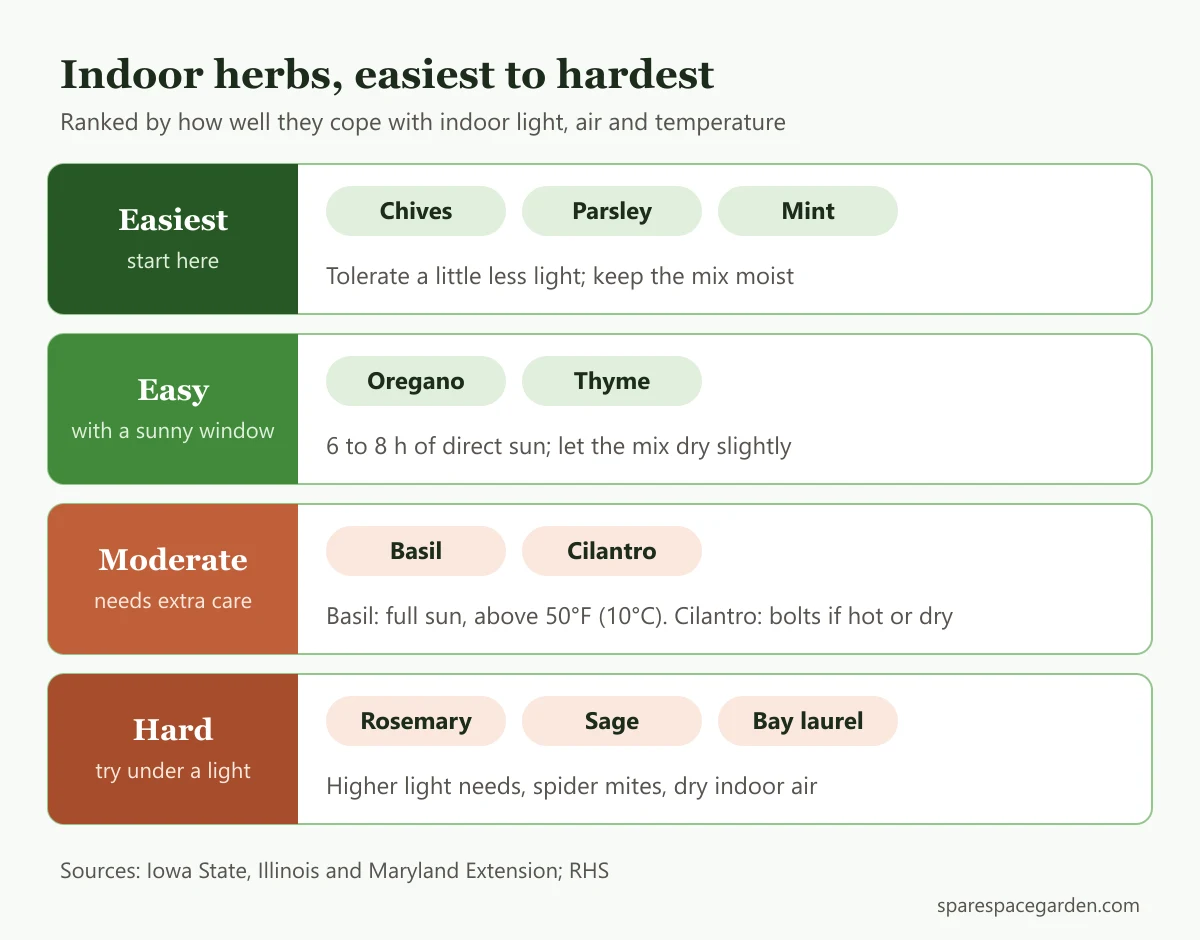 Indoor herbs grouped from most forgiving to most demanding.
The best herbs to grow indoors, ranked
1. Chives
Chives top the list because they tolerate lower light and keep regrowing after every cut. University of Maryland Extension notes they prefer moist soil. The RHS suggests potting up a clump for winter and keeping it on a sunny windowsill to extend the harvest. Our guide to growing chives in pots explains why a clump does better indoors after a spell of cold first.
2. Parsley
Parsley is another herb Iowa State lists as tolerating less light. Maryland suggests a mix with extra moisture-holding material, such as compost and vermiculite. It's slow from seed, so a young plant is the quicker start. See how to grow parsley in pots for pot depth and seed tips.
3. Mint
Mint tolerates less light too, and the RHS mint guide says it's happy in full sun or partial shade. It spreads aggressively, so the RHS recommends growing it in a pot of its own. To keep picking through winter, the RHS suggests bringing potted mint indoors in fall and placing it on a sunny windowsill. Keep the mix evenly moist.
4. Oregano
Oregano is on Iowa State's easy list and is a long-lived perennial. Maryland Extension advises letting it dry out slightly between waterings and adding sand, perlite or fine gravel for faster drainage. Harvest by taking no more than the top third of the growth.
5. Thyme
Thyme is also on Iowa State's easy list, but the same source notes it may need extra light from a grow light. Like oregano, it prefers to dry slightly between waterings in a fast-draining mix. Our guide to growing thyme in pots covers terracotta pots and its sparse watering.
6. Basil
Basil is on the easy lists from Iowa State and Illinois Extension, but it's the most demanding of the group. University of Illinois Extension says it's easily grown as a windowsill herb for fall, winter and early spring, set in full sun. Warmth is the catch: Illinois warns that cold soil and air can stunt basil and even blacken leaves at 50°F (10°C), so keep it off cold glass in winter.
Illinois also suggests sowing new seed every two weeks for a steady supply, with picking starting about 4 to 5 weeks after sowing. The RHS adds that supermarket pots are overcrowded and tend to succumb to fungal diseases or flower early, so divide and repot them. Our guide on how to harvest basil so it keeps growing shows where to cut.
7. Cilantro
Iowa State lists cilantro among the easy herbs, but the RHS coriander guide is more cautious. It says cilantro doesn't last long as a windowsill herb, turns pale in low light, and bolts if it gets too hot or dry. The RHS also warns it can produce an unpleasant odor in enclosed spaces. Sow small batches in succession, and see growing cilantro in pots for ways to delay bolting.
Tip: If your windows are dim, grow cilantro and basil as microgreens instead. The RHS mentions both as microgreen crops, and our guide on how to grow microgreens indoors covers the tray method.
Herbs that struggle indoors
Rosemary is the classic indoor disappointment. Illinois Extension's rosemary page says it needs a sunny spot that is cool, even cold, indoors. Dry indoor air quickly causes brown leaf tips and dieback, and Illinois recommends raising humidity with pebble trays and frequent misting. Watering is a fine balance: Illinois says to keep the soil on the dry side, since extra water can cause root rot, while Maryland warns never to let the mix dry out completely. Water when the top inch (2.5 cm) is dry, and don't wait longer.
Sage, marjoram and bay laurel sit in Iowa State's "try next" group because of their higher light needs and pest problems. They're worth trying under a grow light, but not as a first windowsill herb.
Lavender doesn't appear on the indoor herb lists from Iowa State, Illinois or Maryland Extension. It's better treated as an outdoor container plant.
Indoor herb comparison table
| Herb | Indoor difficulty | Light | Watering |
|---|---|---|---|
| Chives | Easy | Tolerates a little less light | Keep moist |
| Parsley | Easy | Tolerates a little less light | Keep moist |
| Mint | Easy | Tolerates a little less light | Keep evenly moist |
| Oregano | Easy | Sunny window | Dry slightly between waterings |
| Thyme | Easy to moderate | Sunny window; may need a grow light | Dry slightly between waterings |
| Basil | Moderate | Full sun, warm; above 50°F (10°C) | Keep moist |
| Cilantro | Moderate | Bright but not hot | Don't let it dry out |
| Rosemary | Hard | Sunny and cool; may need a grow light | Don't let it dry out completely; never soggy |
| Sage | Hard | Higher than normal light | Dry slightly between waterings |
| Bay laurel | Hard | May need a grow light | Not covered in these sources |
Watering notes come from Maryland Extension's indoor herb sheet, light notes from Iowa State, Illinois and the RHS.
Light: windows and grow lights
Iowa State calls light the most limiting factor for indoor herbs, and even the best herbs to grow indoors stretch and fade without enough of it. Most want about 8 hours of direct light a day, and some tolerate 6. Maryland's indoor herb sheet aims for a southern window with 5 to 6 hours of sun. A south-facing window is ideal, and Iowa State says a bright east or west window can be good as well.
If your herbs grow thin and spindly with small leaves and weak aroma, Maryland says that's a sign of too little light. The fix is a grow light:
- Distance: Iowa State and Illinois both recommend 6 to 12 inches (15 to 30 cm) from the leaves.
- Hours: Iowa State suggests 12 to 16 hours a day on a timer; Illinois gives 12 to 14 hours.
- Fixture: Iowa State suggests a compact fluorescent bulb in a task lamp for a few pots, or a plug-in 4-foot (1.2 m) LED shop light for a larger collection, with full-spectrum bulbs.
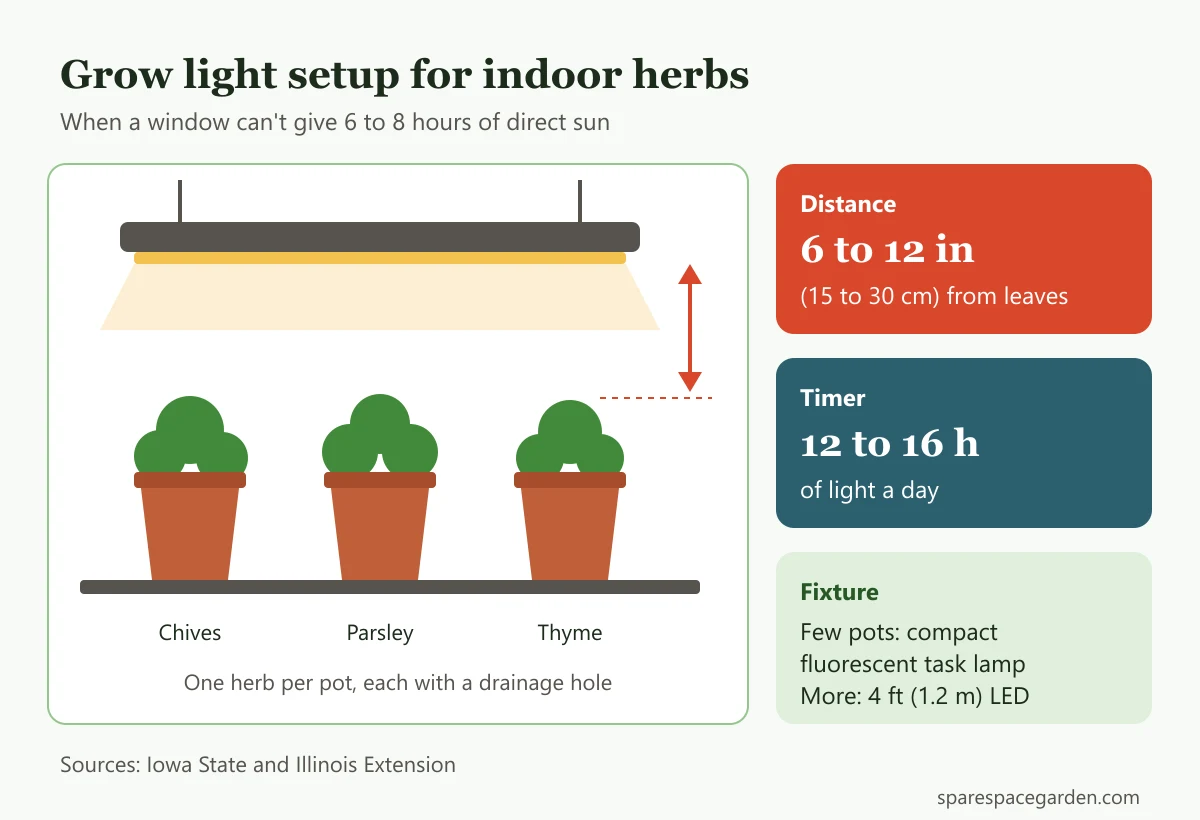 Grow light distance and timing for indoor herbs.
For placing pots by window direction, see our guide to setting up a herb window garden. Leaning, stretched stems are covered in our page on leggy seedlings.
Pots, water and feeding basics
The care routine is similar for all of these herbs, with differences mainly in watering.
- One herb per pot. Iowa State recommends growing each herb in its own container, which lets you water thyme and mint differently. Illinois Extension suggests a pot at least 6 inches (15 cm) across with a drainage hole.
- Don't oversize. Iowa State warns that oversized pots stay wet too long, and recommends clay or terracotta because they dry faster.
- Water by feel. Maryland says to water thoroughly when the mix is dry about 1 inch (2.5 cm) down. Iowa State adds that most herbs don't tolerate wet soil.
- Temperature. Maryland gives 65 to 75°F (18 to 24°C) by day and 55 to 65°F (13 to 18°C) at night. Illinois advises keeping pots away from heat vents, which dry them out.
- Humidity and air. Illinois suggests a shallow tray of pebbles and water under the pots, plus a small fan to limit disease.
- Feeding. Advice varies. Iowa State uses an all-purpose fertilizer at half or quarter strength from early spring through summer and none in winter; Illinois feeds every two weeks. Follow the product label either way.
For a full year-round routine, read our guide to growing herbs indoors year-round.
Frequently asked questions
What is the easiest herb to grow indoors?
Chives, parsley and mint are the easiest, since Iowa State notes all three tolerate a little less light than other herbs. Chives and mint are perennials, so one pot keeps producing for a long time with regular cutting.
Can you grow herbs indoors without a sunny window?
Yes, with a grow light. Iowa State recommends placing it 6 to 12 inches (15 to 30 cm) from the leaves and running it 12 to 16 hours a day on a timer. Without either a sunny window or a light, most herbs grow thin and weak.
Why do supermarket herbs die so quickly?
Supermarket pots are packed with far more seedlings than the pot can support. The RHS says overcrowded basil pots tend to succumb to fungal diseases or flower early, and recommends dividing them into several pots soon after you buy them.
Can you grow different herbs in one pot indoors?
It's easier not to. Iowa State recommends one herb per container, and Maryland's watering advice shows why: basil, chives and mint like moist soil, while oregano, sage and thyme prefer to dry slightly between waterings.