Vertical growing squash works when three things line up: a trailing (vining) variety with small fruit, a frame built for real weight, and a sling for any fruit heavier than the vine can hold. Get those right and a squash that would sprawl across a patio climbs a wall instead.
Not every squash will cooperate. Bush zucchini and other summer squash grow as compact bushes, not vines, and big pumpkins and Hubbard types are far too heavy to hang. This guide sorts the climbers from the ones to leave on the ground, then covers supports, ties, slings, hand pollination and mildew.
Quick answer: Pick a trailing squash with fruit up to about 3 lb (1.4 kg), such as a small acorn or butternut type, 'Tromboncino' or a climbing zucchini. Grow one plant in a container at least 18 in (45 cm) wide, on a frame 6–8 ft (1.8–2.5 m) tall fixed to something solid. Tie stems loosely with jute, put heavier fruit in slings, and hand-pollinate in the morning if bees are scarce.
Which squash suit vertical growing (and which don't)
The first rule comes from the RHS: grow trailing types, not bush types. Its squash guide says trailing varieties can be trained up supports and that smaller-fruited varieties are more suitable. Bush squash stay low and wide, about a square meter (11 sq ft) each, with nothing to climb with.
Weight is the second rule. Illinois Extension says trellising works best for fruit of 3 pounds (1.4 kg) or less, and NDSU Extension gives the same limit for small squash and melons. Virginia Tech's cucumber, melon and squash fact sheet groups winter squash by fruit size, which makes the cut-off easy to see.
| Squash type | Typical fruit size | Grow vertically? |
|---|---|---|
| Acorn and butternut types | 1–4 lb (0.5–1.8 kg) | Yes; sling the larger fruit |
| 'Tromboncino' | About 12 in (30 cm) picked young | Yes; a classic climber |
| 'Red Kuri' | 1.5–3 kg (3.3–6.6 lb) | Yes, with slings |
| Mini pumpkins ('Baby Bear', 'Jack-Be-Little') | Small | Yes |
| Climbing zucchini ('Shooting Star', 'Black Forest') | Picked at 4–5 in (10–12.5 cm) | Yes, to about 6.5 ft (2 m) |
| Bush zucchini, crookneck, pattypan | Picked small | No; stake only |
| Banana, Hubbard, Cushaw, Sweet Meat | 6–12 lb (2.7–5.4 kg) | No |
| Large and giant pumpkins | 15 to 100+ lb (7 to 45+ kg) | No |
Fruit sizes come from Virginia Tech and the RHS plant records. The RHS vertical veg feature names 'Tromboncino', 'Red Kuri', 'Baby Bear' and 'Jack-Be-Little' for climbing, and lists climbing zucchini such as 'Shooting Star' and 'Black Forest' with stems that can reach 2 m (6.5 ft). Standard bush zucchini like 'Defender' and 'Venus' reach only about 60–90 cm (2–3 ft) when staked.
Summer squash vs winter squash
Most summer squash won't climb. Virginia Tech and UC Davis both describe summer squash as growing on non-vining bushes, which is why ordinary zucchini, crookneck and pattypan belong in a pot with a single stake. 'Tromboncino' is the useful exception: the RHS plant record lists it as trailing and climbing, eaten young like a zucchini at about 30 cm (1 ft) long or left to ripen into a winter squash up to 1 m (39 in) long.
Winter squash are mostly vines. Virginia Tech notes that spaghetti squash "vines vigorously and benefits from trellising," and that some small-fruited winter squash have been bred as bush or semi-vining plants, so check the seed packet for the word "vining" or "trailing."
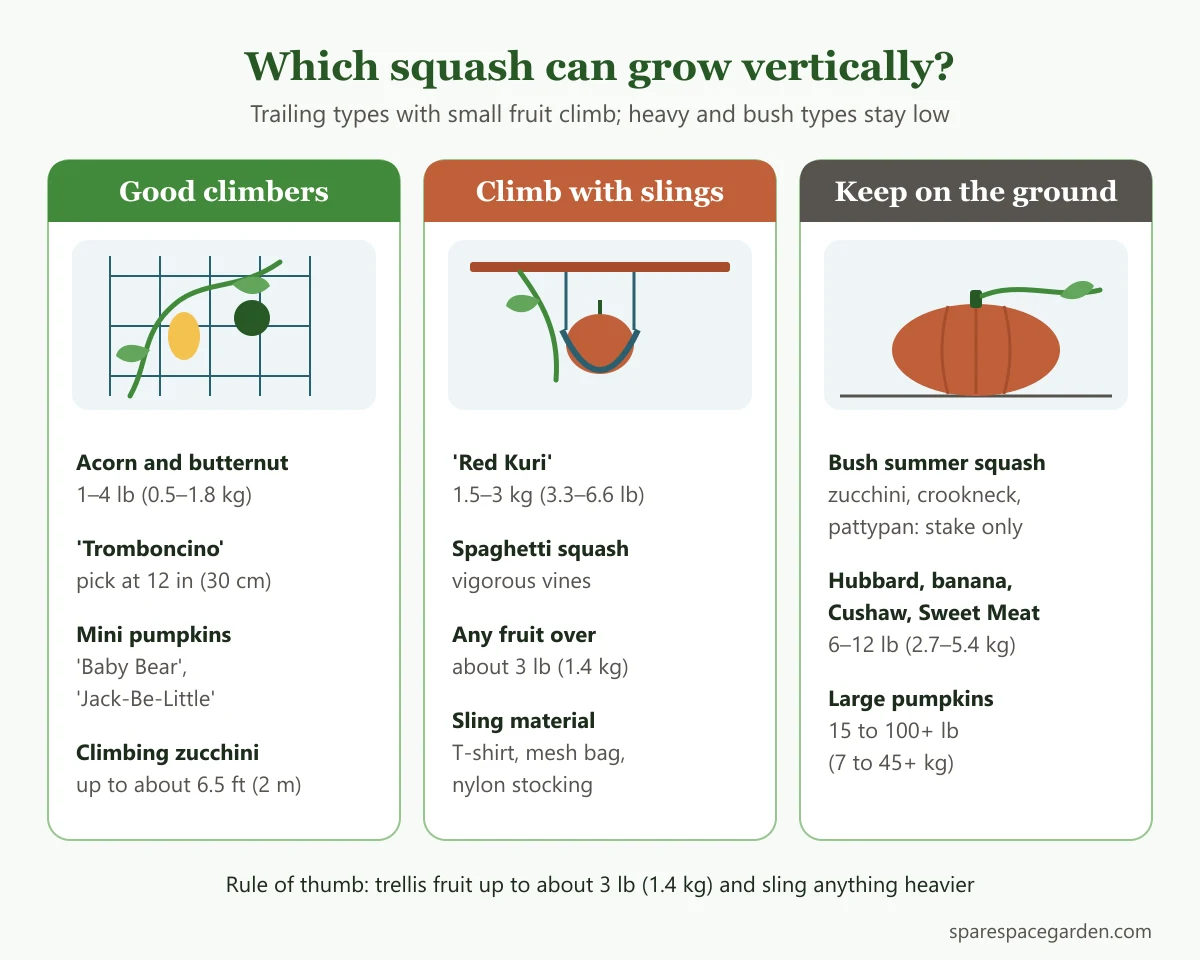 Small, trailing squash climb well; heavy types stay on the ground.
Container size for growing squash vertically
Squash are big plants for a pot. The RHS asks for a container at least 18 in (45 cm) wide for one plant, and Texas A&M AgriLife Extension lists 5 gallons (19 L) per squash plant. Those are minimums. The RHS adds that only compact summer squash really suit containers and most squash do best in the ground, so give a trailing variety the largest pot your balcony can safely hold.
- One plant per pot. Crowded plants get less air, and UC IPM links poor air circulation to powdery mildew.
- Leave space around it. The RHS recommends room around the container for air to circulate.
- Water at the roots. The RHS calls squash thirsty when fruiting and suggests sinking a 6-inch (15 cm) pot beside the plant and watering into it. Containers may need water every day in hot weather.
- Feed once fruit swells. The RHS uses a high-potassium liquid feed every 10–14 days once the first fruits start to swell. Follow the product label.
A big pot of wet mix is heavy, so check what your balcony can carry before you buy; balcony raised garden beds covers weight in more detail. A self-watering container helps if you're out all day.
Building a support strong enough for squash
For vertical growing, a squash support has to carry far more than a cucumber net. WSU Clark County Extension notes that cucurbit vines can grow up to 25 feet (7.6 m) long, and University of Wisconsin Extension stresses that supporting the vines with a proper structure matters more than supporting individual fruits.
Good options, all from extension and RHS advice:
- Strong trellis, arch or pergola. The RHS suggests an arch, a pergola, a wigwam of hazel stakes or a strong trellis, large and sturdy enough to carry the plant and its crop.
- Tall poles. For squash and other tall climbers, the RHS uses 8 ft (2.5 m) poles pushed 12 in (30 cm) into the ground.
- Wire cages. Wisconsin Extension recommends cages 2 or 3 feet (60 or 90 cm) across, made from wire with a 4-inch (10 cm) grid and held by two stakes. Put the cage in at planting and train vines inward.
- Livestock or cattle panels. WSU Ferry County Extension suggests panels from a farm supply store over decorative trellis because they're stouter. Bent into an arch between T-posts, they suit a patio or yard.
Virginia Tech's vertical gardening guide adds that 4-inch (10 cm) mesh is wide enough to reach through at harvest, and that posts in open ground should go 18 to 24 inches (45–60 cm) deep. For trellis styles in more detail, including A-frames and string, see growing cucumbers vertically.
Watch out: On a balcony, the RHS says climbers need fixing securely to buildings or rails, and that balconies can take only a certain weight. A loaded squash frame plus a large pot is a serious load. Ask your building manager first (and a structural engineer if you're unsure), keep everything inside the railing, and don't rely on the pot alone to hold the frame up.
Tying stems and training the vine
Squash climb with corkscrew tendrils, and the RHS notes that tying in helps them along. Stems and fruit are heavy, so plan on tying all season, not just at the start.
- Plant at the base of the support so the first runner reaches it quickly.
- Guide the leading stem onto the frame while it's young and flexible.
- Tie with jute string, not plastic. The RHS warns that tight string easily chokes the hollow stems of cucurbits, so tie a loose figure-eight and leave room for the stem to thicken.
- Add a tie every so often as it climbs. The RHS ties in stems at regular intervals; Wisconsin Extension also suggests ties or plastic plant clips.
- Trim back extra runners. The RHS notes trailing stems can be trimmed back, which helps keep a balcony plant within its frame and lets air through the leaves.
The good news, according to Wisconsin Extension, is that vines usually get stronger as their fruit grows heavier.
Slings for heavier fruit
Fruit over about 3 pounds (1.4 kg) is the problem. NDSU Extension warns that heavier fruit may slip from the vine too early, and recommends lightweight cloth slings to hold it until it ripens. On a balcony, a falling squash is also a safety issue.
Sling materials suggested by extension services:
- Old T-shirts or mesh bags (Virginia Tech)
- Nylon stockings, cheesecloth or other net-like fabric (Virginia Tech)
- Mesh bags or nylon socks (Wisconsin Extension)
- Old pantyhose or rags (WSU Clark County Extension)
Virginia Tech's fact sheet adds one detail for melons that applies to squash too: use a material that dries quickly, to prevent rot. Tie both ends of the sling to the frame, not to the vine, so the frame carries the weight, and slip it under the fruit while it's still small and light. Check each fruit as it grows so it doesn't wedge into the mesh.
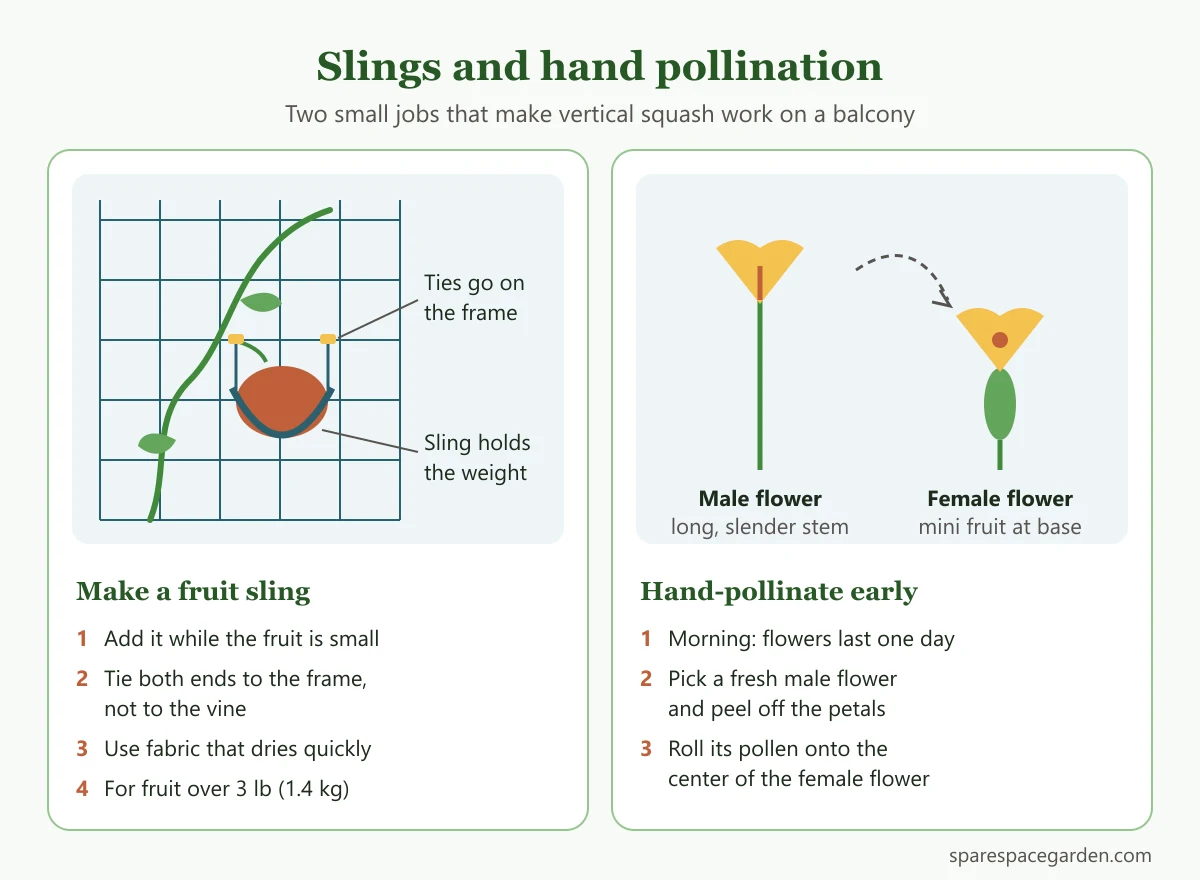 A sling takes the weight off the stem; hand pollination fills the gap when bees are scarce.
Hand pollination when insects are scarce
Squash need pollen moved from a male flower to a female one, and bees do that job. The UC Davis summer squash fact sheet points out that squash pollen is sticky, so wind doesn't move it, and that wild honeybees are rare in some urban neighborhoods. With few bees, you get poor fruit set or misshapen fruit. A high balcony is exactly where that happens.
Tell the flowers apart first. UC Davis explains that the female flower has a miniature fruit at its base and sits on a very short stem, while the male flower has a long, slender stem. Early flowers are usually all male, so don't worry when the first blooms drop without fruit. Hybrid summer squash can do the reverse and open female flowers first.
- Go out early. Flowers open early in the morning and are receptive for only one day, according to UC Davis.
- Use freshly opened flowers of both sexes.
- Collect the pollen. Pick a male flower and peel off its petals, or use a small artist's paintbrush.
- Transfer it. Roll or brush the yellow pollen onto the stigma in the center of the female flower.
- Watch the small fruit. If it swells over the next few days, it worked; if it yellows and shrivels, try again on the next female flower.
If you use any insecticide, Virginia Tech advises applying it late in the evening, when bees aren't foraging, and following the label.
Preventing powdery mildew on vertical squash
Growing squash vertically helps. Virginia Tech and Wisconsin Extension both note that vertical training improves air movement through the leaves, which can reduce disease. It won't stop powdery mildew alone, though, because this fungus doesn't need wet leaves.
The UC IPM powdery mildew guide says moderate temperatures of 60 to 80°F (16–27°C) and shade encourage it, while extreme heat above 90°F (32°C) and direct sunlight work against it. Clemson's Home & Garden Information Center adds that infection can happen between 50 and 90°F (10–32°C) in dry weather with high humidity, and that it's often a problem on late-planted squash.
| Prevention step | Why it helps | Source |
|---|---|---|
| Choose resistant varieties | Available for most cucurbits | Clemson, UC IPM |
| Put the plant in full sun | Spores dislike direct sunlight | UC IPM |
| Thin out crowded leaves | Better air circulation | UC IPM |
| Keep the mix evenly moist | Dry stress encourages mildew | RHS |
| Water the mix, not the leaves | Limits fungal disease | RHS |
| Go easy on nitrogen | Lush, shady growth favors the fungus | UC IPM |
| Remove affected leaves; clear plants after harvest | Less fungus to spread | RHS, Clemson |
If white patches do appear, our guide to zucchini powdery mildew treatment covers sprays and timing. UC IPM warns that sulfur can damage some squash varieties and shouldn't be used near or above 90°F (32°C), so always read the label first.
Frequently asked questions
Can zucchini be grown vertically?
Standard bush zucchini can't climb, though you can tie the main stem to a stake; the RHS says types like 'Defender' reach about 60–90 cm (2–3 ft) that way. For real vertical growing squash of the zucchini kind, choose a climbing variety such as 'Black Forest' or 'Shooting Star', or grow 'Tromboncino' and pick it young.
How heavy a squash can a trellis hold?
Illinois Extension and NDSU both put the comfortable limit at about 3 pounds (1.4 kg) per fruit. Heavier fruit needs a sling tied to the frame. Large winter squash and pumpkins, at 6 pounds (2.7 kg) and up, are better left on the ground.
When do you pick squash grown vertically?
Virginia Tech lists 50 to 65 days to maturity for summer squash and 80 to 140 days for winter squash. Pick zucchini at about 6 to 8 inches (15–20 cm) by Virginia Tech's measure, or 4–5 in (10–12.5 cm) by the RHS. Cut winter squash once the rind is hard and the color is deep and solid, leaving a stem of 2–3 in (5–7.5 cm) per Virginia Tech or at least 4 in (10 cm) per the RHS.
How many squash plants fit on one trellis?
In containers, grow one plant per pot. Each trailing squash can cover a lot of frame, so on a small balcony one plant per trellis is plenty. For more crops that share space on the same wall, see climbing vegetable plants.