The short answer to how many tomato plants per container is one. Extension guides from Iowa State, Texas A&M and the University of Wisconsin all size their pots for a single plant, and the pot size then depends on the type of tomato: about 1–2 gallons (4–8 L) for dwarf types, at least 2 gallons (8 L) for cherries, 4–5 gallons (15–19 L) for bush types, and more than 5 gallons for tall vining types.
There are a few exceptions. The RHS puts two plants in a standard growing bag, and very small trailing types can share a hanging basket or window box. For everything else, one plant per pot gives you a healthier plant and less daily watering.
Quick answer: Plant one tomato per container. Give dwarf varieties 1–2 gallons (4–8 L), cherry tomatoes at least 2 gallons (8 L), determinate bush or patio types 4–5 gallons (15–19 L), and indeterminate vining types more than 5 gallons, ideally around 15 gallons (57 L) or a pot 20 inches (51 cm) wide.
Why one tomato plant per container is the standard
A tomato's roots fill whatever space you give them, and in a pot that space is fixed. Every plant you add shares the same water and nutrients, so the mix dries out faster and runs out of food sooner.
Water is the real limit. The University of Wisconsin Extension's container tomato sheet says container tomatoes may need water twice a day in summer, particularly in smaller containers. Uneven watering is also the classic trigger for blossom end rot, which UW describes as a very common problem in potted tomatoes. A second plant in the same pot pushes you closer to that edge.
That's why, when extension tables say how many tomato plants per container, the answer is "1 plant." Texas A&M AgriLife's container vegetable guide gives "5 gallons, 1 plant," and Iowa State University Extension gives its minimum sizes "for each plant."
Pot size by tomato type
The plant label tells you most of what you need. Look for the words determinate or indeterminate, and for names that include "patio," "bush," "dwarf" or "balcony."
Dwarf and micro tomatoes
These are the smallest plants. Texas A&M AgriLife says 1 to 2 gallon (4–8 L) containers are best for dwarf tomatoes, and University of Illinois Extension lists 'Micro Tom' among varieties bred to grow in small soil volumes. For a sense of scale, Clemson describes the compact 'Patio Choice Yellow' as about 18 inches (45 cm) tall.
Cherry tomatoes
Iowa State recommends at least a 2-gallon pot, about 10 inches (25 cm) across, for each cherry tomato plant. Note that "cherry" describes the fruit, not the plant. Many cherry varieties are tall vining plants, so if the label says indeterminate, size the pot for an indeterminate.
Determinate (bush and patio) tomatoes
Determinate plants grow to a set size, then ripen their crop over a fairly short period. Iowa State gives at least a 4-gallon pot (about 12–14 inches or 30–36 cm wide) for standard tomatoes, and notes that determinate and dwarf types tend to perform better in containers. UW Extension says these smaller varieties can be grown in a 5-gallon (19 L) bucket. Clemson's Home & Garden Information Center suggests a 14 to 20 inch (36–51 cm) container for most compact cultivars.
Indeterminate (vining) tomatoes
Indeterminate tomatoes keep growing and fruiting until frost, so they need the most root space. UW Extension says the container should be bigger than a 5-gallon bucket for these plants, and Clemson shows an indeterminate that "will not be successful" in a 12-inch (30 cm) pot. Texas A&M AgriLife horticulturist Skip Richter has said that while a 5-gallon container may work for a tomato, a 15-gallon (57 L) container results in less watering and a more productive plant. University of Illinois Extension sets a minimum of 20 inches (51 cm) across the top for tomatoes.
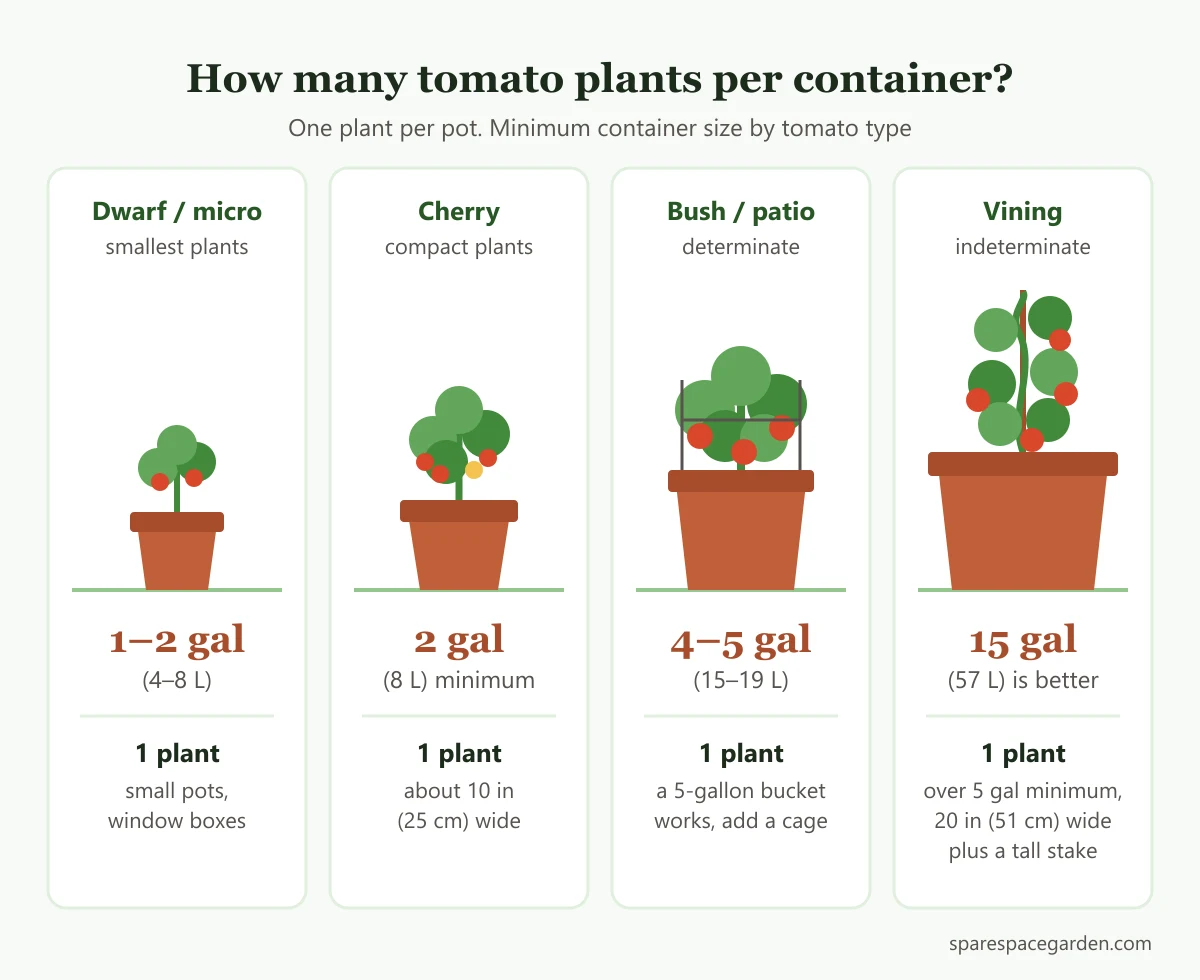 One plant per pot, with the minimum container size for each tomato type.
| Tomato type | Plants per container | Minimum container | Notes |
|---|---|---|---|
| Dwarf or micro | 1 | 1–2 gal (4–8 L) | Check the label for mature height |
| Cherry (compact plant) | 1 | 2 gal (8 L), about 10 in (25 cm) wide | Size up if the label says indeterminate |
| Determinate, bush or patio | 1 | 4–5 gal (15–19 L), 12–20 in (30–51 cm) wide | Cage plants taller than 2 ft (60 cm) |
| Indeterminate (vining) | 1 | More than 5 gal; about 15 gal (57 L) or 20 in (51 cm) wide is better | Needs a tall stake or cage |
| Any type in a standard growing bag | 2 | One bag | RHS guidance |
Reading pot sizes: inches versus gallons
Pots are sold by diameter in some stores and by volume in others, which makes advice hard to compare. The University of Illinois Extension container guide includes a handy conversion for standard-height pots:
| Pot diameter | Soil volume |
|---|---|
| 10 in (25 cm) | 3 gal (11 L) |
| 12 in (30 cm) | 5 gal (19 L) |
| 14 in (36 cm) | 7 gal (26 L) |
| 16 in (41 cm) | 10 gal (38 L) |
| 18 in (46 cm) | 15 gal (57 L) |
| 24 in (61 cm) | 25 gal (95 L) |
Two things stand out. A common 5-gallon bucket holds about the same as a 12-inch (30 cm) pot, which is fine for one bush tomato but small for a vining one. And the 15-gallon size that Texas A&M's Richter mentions is roughly an 18-inch (46 cm) pot, a realistic choice for many balconies, though it's heavy once the mix is wet, so check your balcony's weight limit first.
Other sources size pots a little differently: Iowa State calls a 10-inch pot about 2 gallons, not 3, because pot shapes vary. Treat any inch-to-gallon conversion as approximate.
Shallow "azalea" pots hold much less than standard pots of the same width, so Illinois Extension recommends standard-height pots for vegetables.
How many tomato plants per container type
The same rule holds for most containers, with a couple of exceptions where the container is long and low rather than deep and round.
5-gallon buckets
One plant per bucket. UW Extension's "recipe" for a container tomato is a container at least as big as a 5-gallon bucket and one tomato plant. Choose a determinate or patio variety for this size, and drill drainage holes first. Texas A&M suggests putting the holes along the side, about ¼ to ½ inch (6–13 mm) from the bottom.
Grow bags
The RHS suggests two plants in a standard growing bag (the long, flat bags of compost sold in the UK), with one plant per 12–18 inch (30–45 cm) pot otherwise. Round fabric grow bags sold by volume in the US are better treated like pots: one plant, sized by the chart above. Illinois Extension notes that fabric containers dry out faster than plastic ones, so check them often.
Window boxes
Only compact varieties belong here. The RHS tomato guide lists bush types for patio containers, troughs and windowboxes, and trailing types for windowboxes and hanging baskets. None of the sources give a fixed count per box, so read the variety's spread on the label and leave each plant its full width.
Hanging baskets
Texas A&M AgriLife notes that small-fruited tomato varieties make good hanging baskets, and Clemson names 'Tumbler' for its mounded, trailing habit. Baskets hold little mix, and the RHS notes that container plants may need watering every day in hot weather, so plan to check them daily.
Large tubs and half barrels
A big tub is the one place where two plants can share without much fuss, as long as the soil volume per plant still matches the chart. If you want two indeterminate plants in one container, plan on roughly double the single-plant volume rather than squeezing them into one 15-gallon pot.
Tip: If you want more fruit from a small space, choose more pots rather than more plants per pot. Two 5-gallon buckets with one bush tomato each are easier to water and feed than one bucket holding two.
What happens when you overcrowd a tomato pot
Two plants in one small container rarely give twice the harvest. These are the usual results, according to extension guidance:
- The mix dries out faster. Colorado State University Extension notes that small containers with crowded roots hold less moisture, and that letting a pot dry out completely kills fine roots.
- Blossom end rot becomes more likely. UW Extension links it to inconsistent watering, which is harder to avoid when two root systems drain the same pot.
- Nutrients run out sooner. UW Extension says smaller containers need more added fertilizer. Texas A&M AgriLife lists yellowing from the bottom and poor color among the symptoms of low fertility in containers.
- Leaves stay damp. UNH Extension notes that fungal diseases can start in the humid center of a dense plant, and recommends spacing containers apart and pruning tomatoes to three or four stems.
- The pot gets top-heavy. Illinois Extension warns that lightweight plastic pots can tip over with large, top-heavy plants.
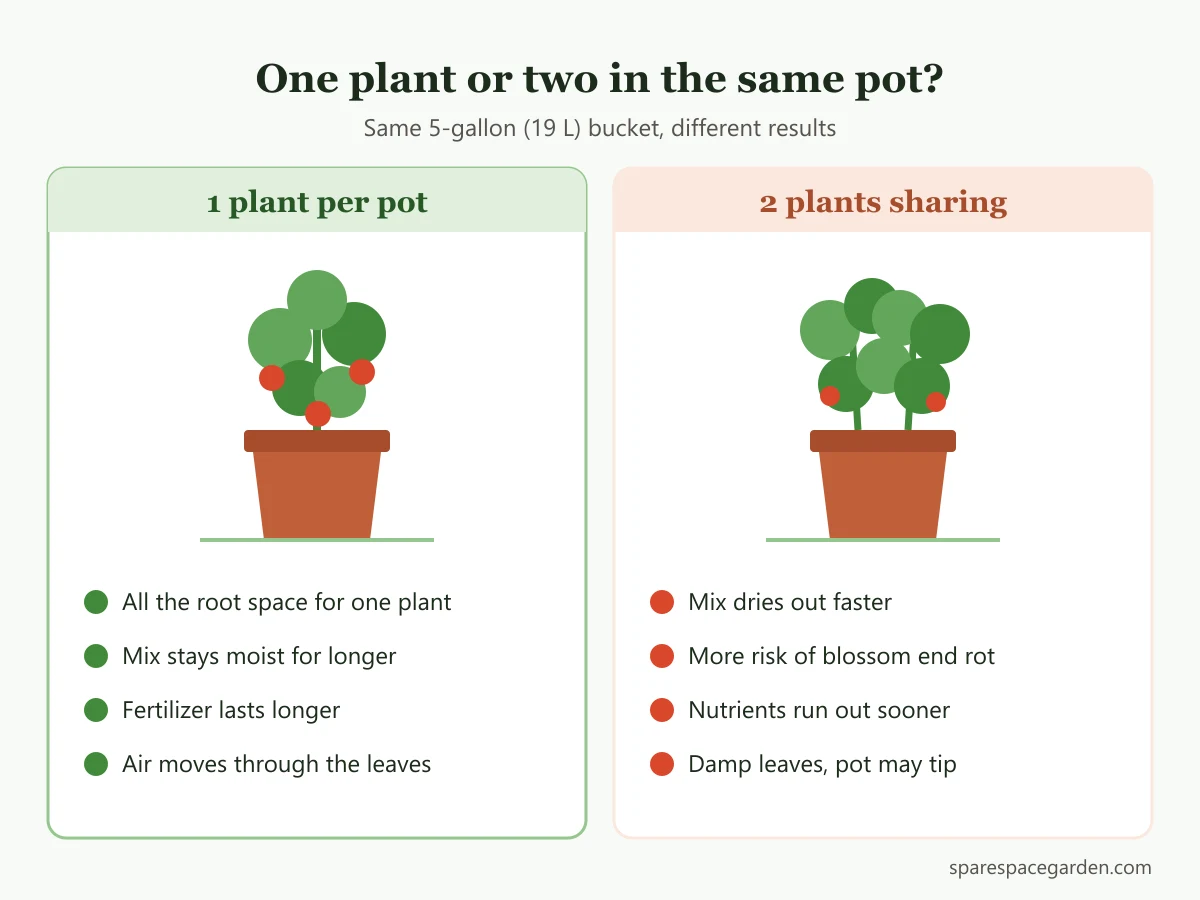 Why one plant per pot usually beats two plants sharing the same soil.
If yellow lower leaves show up on a crowded plant, our guide to yellow leaves on tomato plants in pots helps you sort out whether it's hunger, water or disease.
Setting up the right container, step by step
Once you've settled how many tomato plants per container you'll grow, the setup is simple.
- Read the plant label. Note whether it's determinate or indeterminate and how tall it grows.
- Pick the pot size from the chart. When in doubt, go one size up. Bigger pots hold more water, so the plant is less likely to dry out between waterings.
- Check for drainage holes. UW Extension says the container must drain, and UNH suggests drilling holes ¼ to ½ inch (6–13 mm) from the bottom.
- Fill with fresh potting mix, not garden soil. UW Extension recommends a soilless mix because it's lighter and disease free. See the best soil to grow tomatoes in pots for what to look for.
- Add support at planting time. Clemson recommends a cage or stake at planting for any cultivar taller than 2 feet (60 cm), and Iowa State suggests cages at least 24 inches (61 cm) in diameter.
- Place it in full sun. Iowa State says tomatoes need at least 6 hours of direct sunlight a day.
Watch out: In full sun and raised off the ground, the mix can get too hot. UW Extension suggests placing pots on the ground or where they get shade during the hottest part of the day, and Illinois Extension notes that dark and metal containers absorb more heat.
For watering, feeding and pruning through the season, see our guide to tomato plant care in pots. If you're starting from scratch, growing tomatoes in pots from seed covers the early weeks.
Frequently asked questions
Can I put 2 tomato plants in a 5-gallon bucket?
It isn't recommended. Texas A&M AgriLife and UW Extension both size a 5-gallon (19 L) container for one tomato plant, and UW notes small containers may already need watering twice a day in summer. Two plants in one bucket compete for water and nutrients and usually produce less per plant.
How big a pot does a cherry tomato need?
Iowa State recommends at least a 2-gallon (8 L) pot, about 10 inches (25 cm) across, for each cherry tomato plant. That applies to compact cherry varieties. Tall indeterminate cherry types need the same large container as any other vining tomato.
Is a 3-gallon pot big enough for a tomato?
For a dwarf variety, yes; Texas A&M says 1–2 gallons is enough for those. For a standard bush tomato, a 3-gallon (11 L) pot is below the 4-gallon minimum from Iowa State and the 5-gallon size most extension guides use, so expect more watering and a smaller harvest.
How many tomato plants can go in a raised bed or large planter?
Treat each plant as needing its own share of soil. Using the pot sizes above, a 25-gallon (95 L) planter has room for about five bush tomatoes at 5 gallons each, or one or two indeterminate plants. Leave space between plants so air can move through the leaves.
Do determinate tomatoes need less space than indeterminate ones?
Yes. Determinate plants stop growing at a set size, and UW Extension says they can be grown in a 5-gallon bucket. Indeterminate plants keep growing all season and need a container bigger than that, plus a tall support.