The most effective zucchini powdery mildew treatment starts early. At the first white spots, cut off the worst leaves, give the plant more sun and airflow, and if you want to spray, use a product labeled for powdery mildew on squash, such as potassium bicarbonate, a horticultural oil or sulfur, repeating every 7 to 14 days as the label directs.
Sprays protect healthy leaves far better than they cure badly infected ones, so catch it early and make your container setup less welcoming before it arrives.
Quick answer: Powdery mildew shows up as white, talc-like spots on older and shaded zucchini leaves, usually from midsummer. Remove badly infected leaves, then spray potassium bicarbonate, horticultural oil (including neem) or sulfur at the first sign, covering leaf undersides and repeating every 7 to 14 days per the label. Don't use oil or sulfur near or above 90°F (32°C), and keep the two at least 2 weeks apart.
How to identify powdery mildew on zucchini
Powdery mildew starts as small white spots and spreads into patches. The Colorado State University Extension fact sheet describes the growth as white to grayish and talcum-powder-like. UConn Extension adds that pale yellow spots often appear first on older leaves, and that badly affected leaves turn dull and yellow, then brown and papery.
It usually starts low on the plant. University of Maryland Extension says symptoms begin in midsummer on older leaves, and NC State Extension notes that older or shaded leaves are infected first. Cornell's vegetable program adds that symptoms often show up first on the lower surface of the leaf, so turn a few leaves over when you check.
Powdery mildew or natural silver markings?
Many zucchini varieties have silvery patches on their leaves, and these are easy to mistake for disease. University of Maryland Extension describes them as smooth gray, white or silvery angular blotches with no visible powder or fungal residue, and says no action is needed. Oregon State University Extension also notes that some squash varieties have natural white leaf markings that aren't fuzzy.
| Clue | Powdery mildew | Natural silver markings | Downy mildew |
|---|---|---|---|
| Look | White, dusty spots and patches that spread | Smooth gray, white or silvery angular blotches | Yellowish areas on top of the leaf |
| Texture | Powdery growth on the surface | Flat, part of the leaf; no powder | Fuzzy gray or white growth underneath |
| Where it starts | Older, shaded leaves, top or underside | Part of the variety's leaf pattern | Leaf undersides show the fuzz |
| Over time | Leaves yellow, then turn brown and papery | Not a disease; leaf stays healthy | A different disease with different controls |
| What to do | Act now (see below) | Nothing | Ask your local extension office |
A simple field check: run a fingertip over a spot. Powder that smudges off is fungal growth sitting on the leaf, while silvering is part of the leaf itself and stays put.
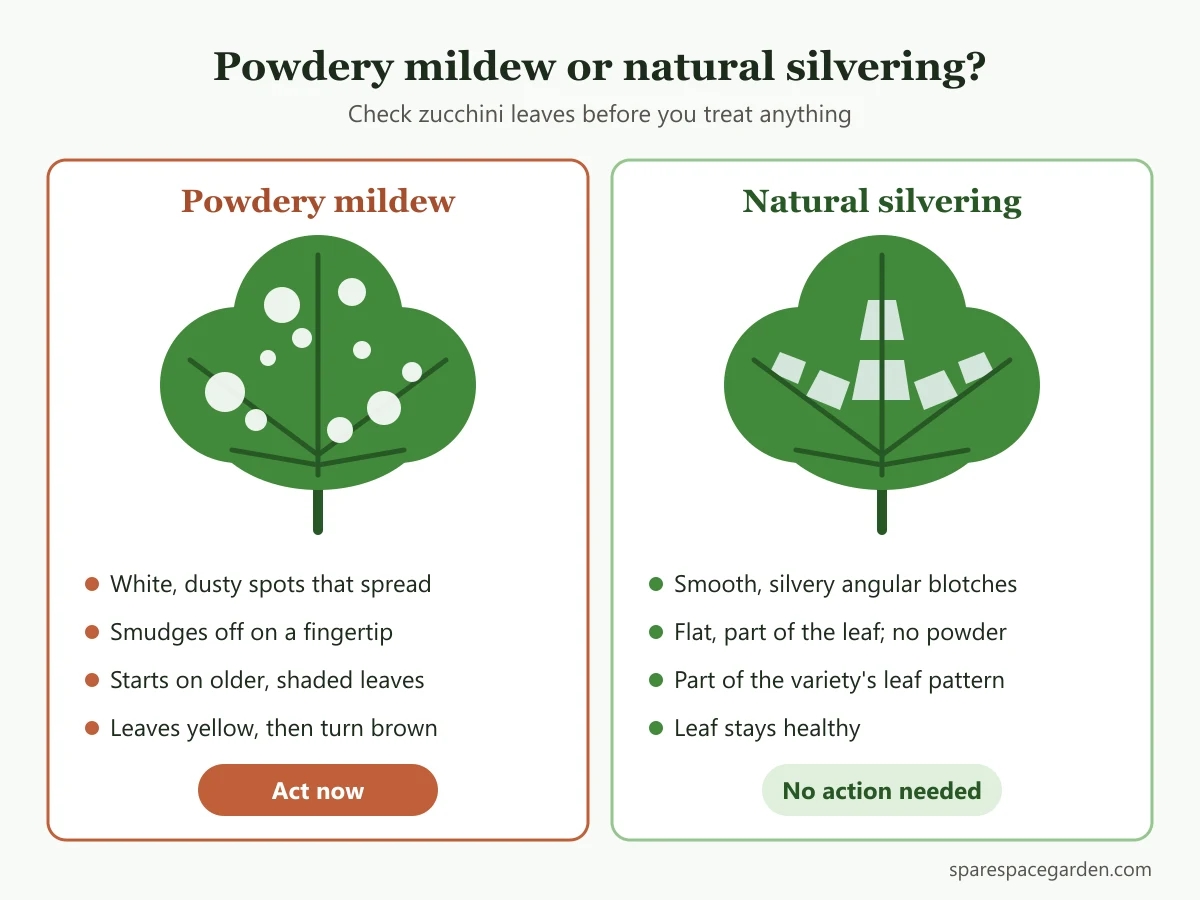 Spotting the difference before you treat anything.
Why zucchini get powdery mildew (it doesn't need wet leaves)
Unlike most leaf diseases, powdery mildew doesn't need rain or wet leaves to infect. UC IPM's powdery mildew page for vegetables explains that spores can germinate and infect without free water, and that water sitting on leaves for long periods can actually kill some spores. Colorado State says infection rises as humidity climbs toward 90% but doesn't happen while leaf surfaces are wet. Cornell notes it favors dry weather, and that long rainy spells slow it down.
What it does like:
- Moderate warmth. UC IPM gives 60 to 80°F (16 to 27°C) as most favorable. The Pacific Northwest disease handbook gives an infection range of 50 to 90°F (10 to 32°C), with 68 to 81°F (20 to 27°C) as the optimum.
- Shade and low light. UC IPM and NC State both list shade; UC IPM says the spores are sensitive to direct sunlight and heat above 90°F (32°C).
- Still, humid air. Colorado State points to humid nights and dry days. The RHS powdery mildew guide warns against sheltered spots near walls or fences where air is still, which describes many balconies.
- Crowding and soft growth. Dense plantings and too much nitrogen both raise the risk.
- Drought stress. The RHS says plants that dry out repeatedly are more susceptible.
The spores travel on the wind, so even a single zucchini on a tenth-floor balcony can catch it.
Preventing powdery mildew in container zucchini
Prevention does more than any spray, and most of it is about where and how you grow the plant.
- Choose a resistant variety. UConn lists zucchini cultivars with resistance, including 'Ambassador', 'Payroll', 'Sebring', 'Senator' and 'Zucchini Elite'. Cornell cautions that resistance in squash is useful but limited, and the Pacific Northwest handbook says resistant plants aren't immune; they just get the disease more slowly.
- Give it the sunniest spot you have. Both UC IPM and UConn say to plant in sun. On a balcony, move the pot away from the wall and out from under overhangs.
- Leave room for air. The RHS courgette guide puts one compact or bush plant in a container at least 18 in (45 cm) wide. Don't squeeze extra plants into the same pot, and space pots so leaves don't overlap. Training the plant upward also helps; see vertical growing squash for how to stake or trellis it.
- Water the mix, not the leaves. The RHS courgette guide says to water the base of the plant and keep the compost consistently moist, since container plants may need water daily in hot weather.
- Go easy on nitrogen. UC IPM warns that too much nitrogen makes lush, shady foliage, and suggests a slow-release fertilizer instead.
Tip: Start checking when the first fruits form. Cornell recommends looking at both sides of older leaves weekly from fruit set onward, since that's when plants become more susceptible.
Zucchini powdery mildew treatment options that sources support
Once you see spots, act on two fronts: reduce the amount of mildew on the plant, and protect the leaves that are still clean. Any zucchini powdery mildew treatment works far better at the first sign than once leaves are covered.
Remove the worst leaves
The RHS advises removing courgette leaves that are tatty or affected by powdery mildew, which also lets more light reach the plant. The Pacific Northwest handbook says removing infected tissue can help in home gardens but takes constant attention. Don't strip the plant bare: UC IPM notes that losing leaves exposes fruit to sunburn. Take the worst older leaves first and leave the healthy canopy.
Potassium bicarbonate
Potassium bicarbonate products are registered for powdery mildew, and Colorado State lists them among the home garden options. They work only where they touch, so the Pacific Northwest handbook says thorough coverage is essential, and Cornell notes that most are contact materials. Spray the undersides of leaves as well as the tops.
Colorado State also describes a homemade baking soda and oil mix but calls it experimental and says to use it at your own risk. A labeled potassium bicarbonate product is the better-documented choice.
Horticultural oils, including neem
UC IPM says horticultural and plant-based oils, including neem and jojoba oil, work best as eradicants on mild to moderate infections. Don't spray oil above 90°F (32°C) or on drought-stressed plants, and the Pacific Northwest handbook adds no spraying below 50°F (10°C) or on wet leaves. Our guide to getting rid of aphids naturally covers safe oil use around bees and beneficial insects in more detail.
Sulfur
Cornell calls sulfur the most effective organic option for cucurbit powdery mildew, but it's a protectant: UC IPM says it prevents infection rather than curing it. It also carries two warnings for zucchini growers. UC IPM says not to apply it when the air is near or above 90°F (32°C), and that it can damage some squash and melon varieties. Cornell reports sulfur injury on cantaloupe above 80°F (27°C). Test it on a few leaves first and follow the label closely.
Watch out: Never combine oil and sulfur. UC IPM says to keep at least 2 weeks between a sulfur spray and an oil spray, in either order. Its spider mite pest note asks for 30 days before sulfur follows an oil spray, and some product labels ask for longer, so check both labels.
Milk sprays: what the evidence says
Milk sprays for zucchini trace back to a 1999 Brazilian study on greenhouse zucchini. A Washington State University Extension review of the research found that milk worked better in greenhouses than in the field, better when applied before infection than after, and that stems and lower leaf surfaces may stay less protected. None of the studies used nonfat milk, and the review notes drawbacks such as smells from breaking-down milk fat and unsightly harmless fungi growing on the film. Its conclusion: milk may be a viable alternative, but too little is known yet to write a reliable spray protocol. If you try it, treat it as an experiment rather than your main zucchini powdery mildew treatment.
| Option | What it does | Main cautions |
|---|---|---|
| Removing infected leaves | Cuts the amount of mildew on the plant | Don't strip so many that fruit gets sunburned |
| Potassium bicarbonate | Contact control of existing spots | Needs full coverage, including undersides; follow the label |
| Horticultural or neem oil | Clears mild to moderate infections | Not above 90°F (32°C), below 50°F (10°C), on wet or stressed plants; 2 weeks from sulfur |
| Sulfur | Protects clean leaves; most effective organic option | Not near or above 90°F (32°C); can injure some squash varieties; 2 weeks from oil |
| Milk | Mixed evidence, mostly from greenhouses | No reliable rate; may smell or grow harmless mold |
Timing: when to spray and how often to repeat
Start at the first spots or just before. UC IPM says protectants must go on before the disease appears or at its earliest stage, and eradicants at the earliest sign. Cornell suggests beginning as soon as symptoms are seen and continuing weekly.
For intervals, follow your product's label. As a guide, UC IPM gives 7 to 10 days for protectants such as wettable sulfur while conditions favor the disease, Colorado State gives every 7 to 14 days, and the Pacific Northwest handbook lists neem oil on 7- to 14-day intervals. New leaves grow fast on zucchini, and they need covering too.
Watch the weather on spray days. Oregon State University Extension suggests applying fungicides only between 50 and 80°F (10 and 27°C), not on wet foliage or heat-stressed plants, and early in the morning or in the evening to protect pollinators. Avoid spraying open flowers, since bees visit zucchini blooms for pollination.
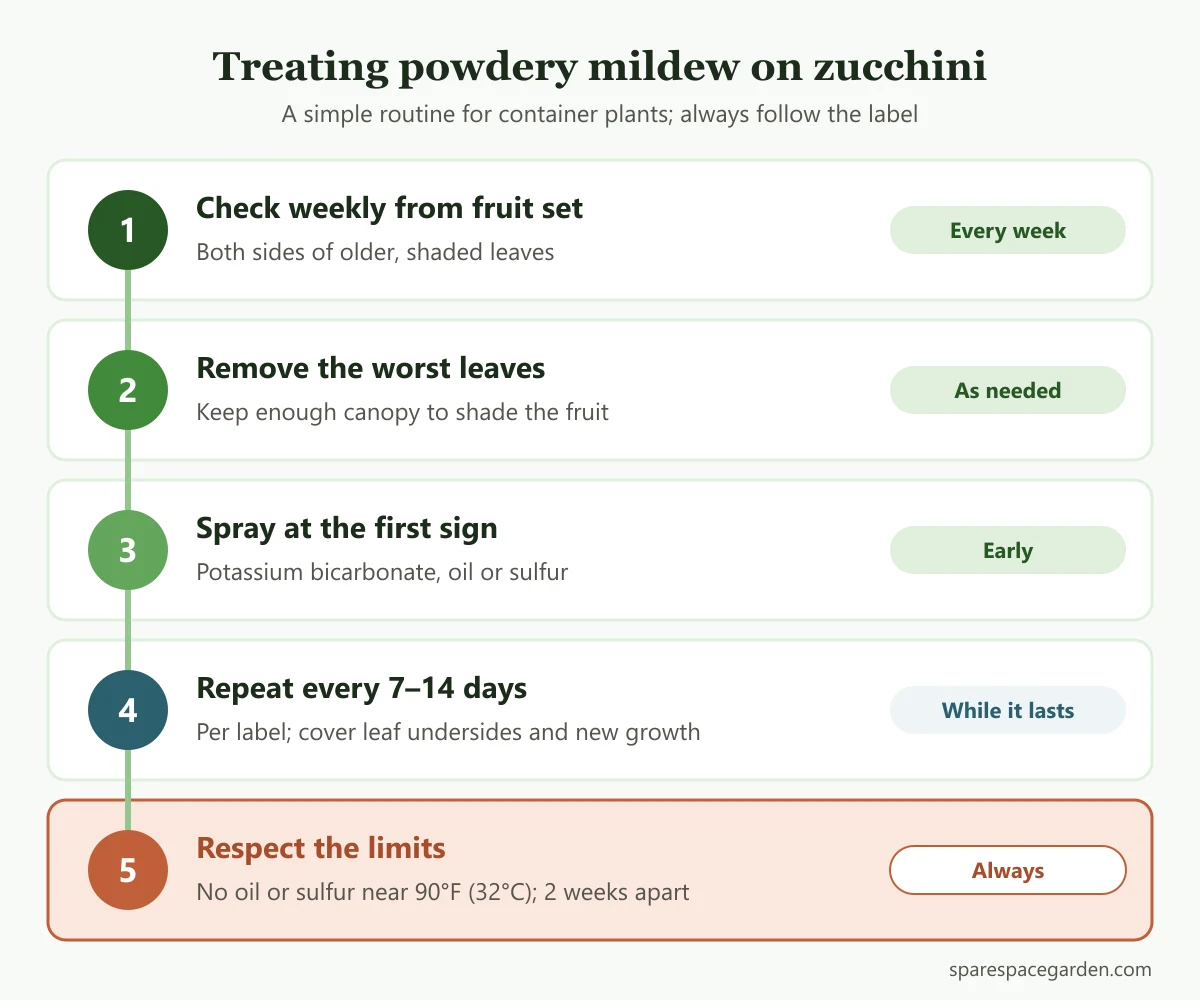 A simple treatment routine for container zucchini.
End-of-season cleanup
Powdery mildew can survive on old plant material, so cleanup protects next year's crop. The RHS says destroying fallen infected leaves in autumn reduces the spores that start spring infections, and the Pacific Northwest handbook notes that the fungus can overwinter on a previous cucurbit crop.
- Pull out heavily infected plants late in the season. Oregon State recommends removing them and clearing all debris.
- Bag it rather than composting it. Colorado State and Oregon State both advise against home composting infected material, because home piles often don't get hot enough. UC IPM also lists municipal green-waste bins and the trash as disposal options.
- Clean your tools. Oregon State recommends cleaning pruners after working on infected plants.
- Think twice about reusing the mix. Spores can survive in or on old potting mix; see can you reuse potting soil for when to replace it.
- Rotate if you can. The Pacific Northwest handbook suggests a 2-year break from cucurbits in the same spot. In containers, that means fresh mix or growing something else in that pot next year.
Frequently asked questions
Can zucchini recover from powdery mildew?
Badly infected leaves yellow and die, as UC IPM notes, but the plant can keep producing if you remove the worst leaves and protect new growth. Maryland Extension warns the disease can spread until whole plants yellow and die, so act early. Late in the season, it's often simpler to keep harvesting and then pull the plant.
Are zucchini with powdery mildew safe to eat?
UC IPM says the fruit itself usually isn't affected. The risk to fruit is indirect: when leaves die, fruit is exposed to sunburn. If you've sprayed anything, wait as long as the product label says before harvesting and wash the fruit.
Does baking soda work on zucchini powdery mildew?
Colorado State describes a baking soda and oil spray as experimental and says to use it at your own risk. Potassium bicarbonate is the related ingredient found in registered powdery mildew products, so it's the better-supported choice. Always follow the label.
Should I spray zucchini leaves with water?
UC IPM notes that long periods of water on leaves can kill some spores, but it doesn't usually recommend overhead watering for vegetables because it can cause other problems. The RHS courgette guide says to water at the base, though its powdery mildew guide notes that overhead watering in mid-morning during dry weather can reduce the disease. If you try it, do it mid-morning so leaves dry quickly.
Do other container plants get the same disease?
Cucumbers, melons and pumpkins are also very susceptible, according to UC IPM. The prevention steps here apply to cucumber plants in pots too, and our pests and plant problems section covers other common container issues.