To care for tomato plants in pots, check the mix every day and water when the top feels dry, feed on a regular schedule, put a stake or cage in at planting, and pinch out suckers only on vining (indeterminate) types. Containers dry out, heat up and run short of nutrients far faster than a garden bed, so a steady routine matters more than any single trick.
This guide picks up after the plant is in its final pot. It covers watering, feeding, support, pruning, mulch, heat, cold and pollination, then pulls everything into a stage-by-stage routine. If you're still at the seed tray, start with growing tomatoes in pots from seed.
Quick answer: Water until about 10 percent drains out the bottom, which usually means daily in midsummer. Feed with a water-soluble fertilizer about once a week, or a high-potassium feed every 10–14 days once the first fruits swell. Support plants at planting, remove suckers on indeterminate types when they're 2–3 in (5–8 cm) long, and give pots afternoon shade when days run above 85–90°F (29–32°C).
Watering tomato plants in pots
Watering is the job you'll do most when you care for tomato plants in pots, and the one that causes most problems when it slips. Clemson's guide to tomatoes in containers says potted tomatoes need daily watering at the height of summer, and that a pot that's too small creates the need for constant watering. Colorado State University Extension adds that even plastic containers may need water once or twice a day as plants grow larger.
How you water matters as much as how often. Colorado State's container garden guide recommends watering until about 10 percent of the water drains out the bottom. That wets the whole root ball and flushes out fertilizer salts. Empty the saucer afterward so the roots aren't sitting in the drained water.
Consistency is the goal. The RHS tomato growing guide warns that irregular watering causes split fruit and blossom end rot, the dark, sunken patch on the bottom of the fruit. A pot that dries out completely and then gets soaked is the classic setup for both.
A few habits help:
- Check by feel, not by the calendar. Push a finger into the mix; if the top inch or so is dry, water.
- Water in the morning and at soil level. Illinois Extension and UNH Extension both suggest keeping leaves dry, since wet foliage favors leaf spot diseases.
- Group pots in summer. They shade each other's sides and dry a little more slowly.
Tip: If you can't check pots every day, a self-watering container holds a reserve of water under the mix. Our guide to self-watering containers for vegetables explains how they work.
A feeding schedule for container tomatoes
Potting mix holds only a small store of nutrients, and daily watering washes them out. Clemson offers two simple routines: a balanced timed-release fertilizer mixed in at planting and topped up as the package directs, or a water-soluble fertilizer once a week. Colorado State gives a third option: a dilute soluble feed with every watering, or full strength every one to two weeks. Follow the product label for rates.
Once fruit forms, the RHS recommends switching container tomatoes to a high-potassium liquid feed every 10–14 days, starting when the first fruits begin to swell.
Two cautions. University of Maryland Extension lists too much nitrogen as a cause of poor fruit set, and Cornell's tomato growing guide advises against fertilizers with three or more times as much nitrogen as phosphorus or potassium. Heat also changes how slow-release products behave: NC State Extension notes that many are designed to release at a mix temperature of about 70–80°F (21–27°C), and hot pots can make them release too fast.
For product types and N-P-K ratios, see our guide to the best fertilizer for tomatoes in pots. If the lower leaves start to fade, our article on yellow leaves on tomato plants in pots helps you tell hunger from watering trouble or disease.
Staking and caging potted tomatoes
Put the support in at planting time. Clemson recommends a cage or other support for any variety that grows taller than 2 feet (60 cm), and adding it on day one avoids spearing roots later.
Match the support to the plant's habit. Illinois Extension suggests cages about 5 feet (1.5 m) tall for indeterminate tomatoes and about 3 feet (0.9 m) for determinate ones, and warns that many store-bought tomato stakes are too small to hold a loaded plant.
If you use a single stake, Cornell's guide to training tomatoes says to tie the plant with twine about every 8–12 inches (20–30 cm) as it grows. Keep the ties loose so they don't cut into the stem as it thickens.
Watch out: A tall tomato in a pot acts like a sail. On a windy balcony, use a heavy container (within your balcony's weight limit, which your building manager can confirm) and tie the stake or cage to the railing so the whole thing can't tip over.
Pruning suckers: determinate vs indeterminate
Suckers are the side shoots that grow in the angle between a leaf and the main stem. Whether you remove them depends on which kind of tomato you have, so check the seed packet or plant label first.
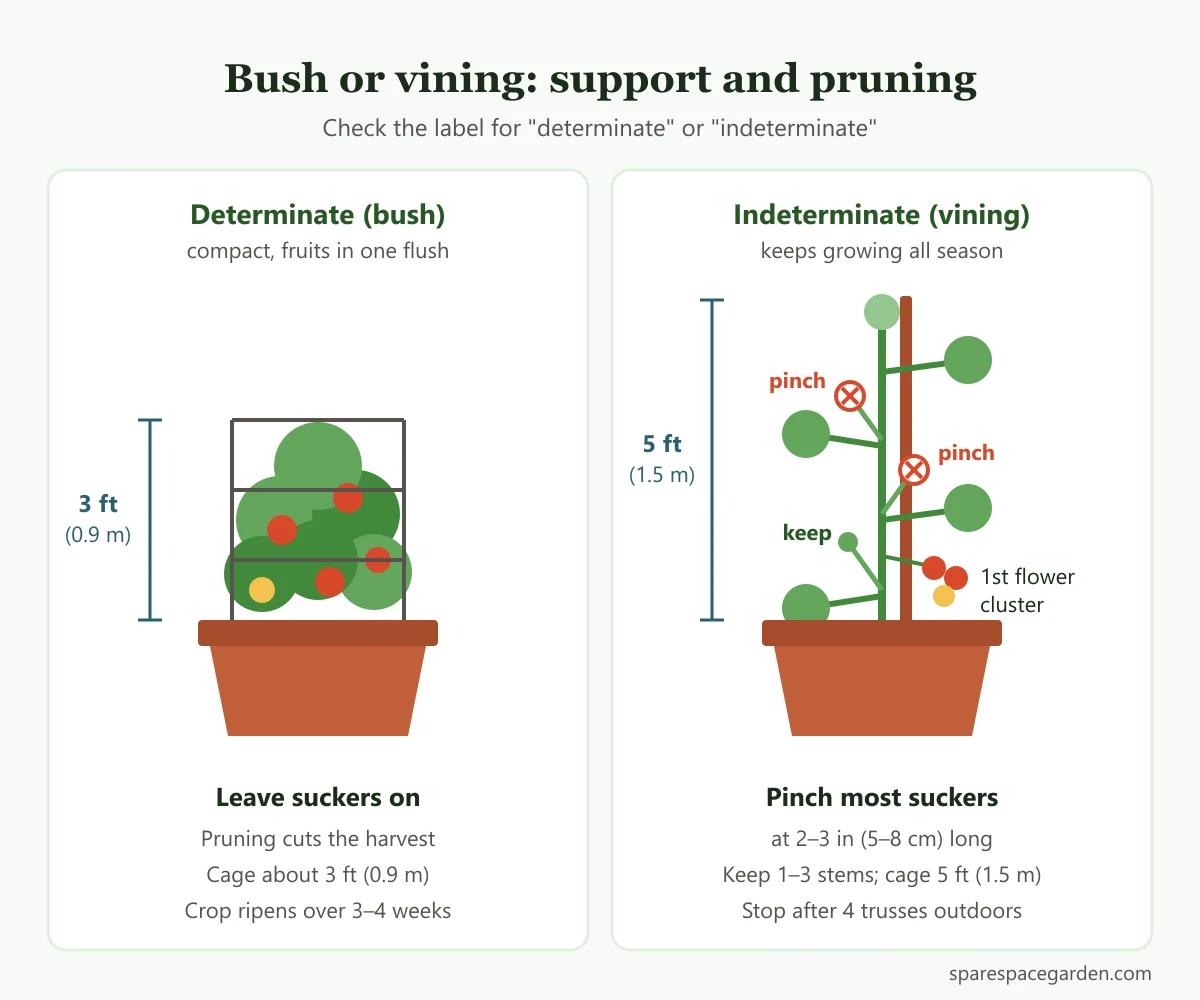 Bush types are left unpruned in a shorter cage; vining types are trained on a tall support with most suckers removed.
Determinate (bush) tomatoes
These stay compact, and Cornell describes each branch as ending in a flower cluster, with the crop ripening over about 3–4 weeks. Cornell's advice is not to prune them, because removing suckers only reduces the harvest. The RHS agrees: leave the side shoots on bush types, and add short canes if a heavy crop makes stems droop. Many compact varieties sold for containers are determinate, but check the label to be sure.
Indeterminate (vining or cordon) tomatoes
These keep growing and fruiting all season, so they need regular pruning to stay manageable in a pot. Cornell's training guide suggests:
- Find the first flower cluster.
- Keep the sucker just below it as a second stem, if you want one. Cornell allows one to three stems in total.
- Remove the other suckers, including any above that first cluster.
- Pinch them out when they're 2–3 in (5–8 cm) long. Bigger suckers can tear the main stem.
For a single-stem plant in a pot, the RHS says to remove side shoots at every watering. Outdoors, it suggests stopping the plant once it has set four trusses (flower clusters) or reaches the top of its support, by removing the growing tip two leaves above the top truss. This sends the plant's energy into ripening fruit it already has.
Cornell's growing guide notes that staking and pruning can bring the first harvest forward by a week or more. While you're pruning, also take off the lowest leaves; UNH Extension says removing them may help prevent leaf spot infections.
Mulching and keeping roots cool
A layer of straw, shredded bark or compost on top of the mix slows evaporation and stops soil splashing onto leaves. UNH Extension recommends mulching under tomatoes to keep fungal spores off the plant, and Cornell suggests waiting until the soil has warmed before you apply it. In a container, keep the mulch a little below the rim so water still has room to pool and soak in.
Root heat is a bigger risk in pots than most people expect. NC State Extension reports that dark containers in full sun can run 20–30°F (11–17°C) hotter than the surrounding air, and that roots can be severely injured when the mix stays above 100°F (38°C) for five hours or reaches 113°F (45°C) for 30 minutes.
Ways to keep roots cooler:
- Choose light-colored pots, or slip a dark pot inside a larger pale one.
- Keep pots off hot concrete and away from reflective, light-colored walls, which Colorado State says can scald plants on western exposures.
- Shade the sides of the pot with other containers while leaving the leaves in sun.
Heat, cold and pollination
Tomatoes set fruit within a fairly narrow temperature window. A University of Minnesota Extension report on heat says sustained heat above 85°F (29°C) by day and 70°F (21°C) at night makes flowers harder to pollinate, and they often drop. Maryland Extension gives a similar daytime figure of 88–90°F (31–32°C), and says nights below 55°F (13°C) interfere with pollen growth.
This is where containers help. Maryland Extension notes that late afternoon shade can help season-long yields, and a pot can simply be moved into it during a heat wave. In cool weather, the RHS advises waiting to plant out until temperatures stay above 60°F (16°C), and Cornell says nights should be consistently above 45°F (7°C). Move pots against a warm wall or indoors if a cold night is forecast.
Helping flowers pollinate
Tomatoes don't need a second plant or a bee to cross-pollinate. Maryland Extension's page on tomato pollination says they self-pollinate about 96 percent of the time, but the heavy, sticky pollen has to be jostled loose by wind or insects. On a sheltered balcony or porch, there may not be enough movement. The RHS suggests tapping or gently shaking fully open flowers to spread the pollen.
A stage-by-stage care routine for tomato plants in pots
Use this table as a checklist for how to care for tomato plants in pots through the season. The stages run into each other, so carry each job forward as the plant grows.
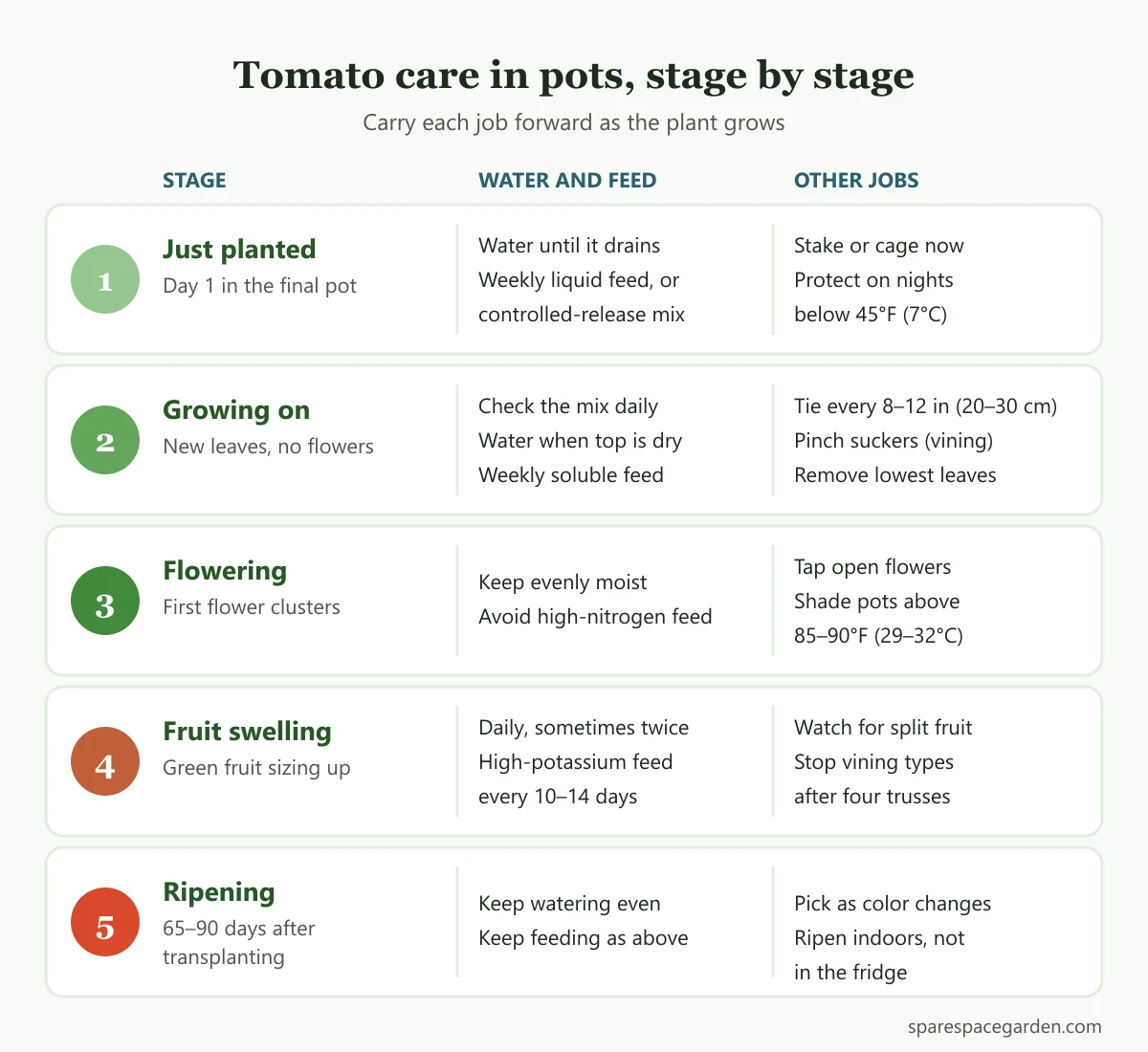 Care jobs by growth stage for a container tomato.
| Stage | Watering | Feeding | Other jobs |
|---|---|---|---|
| Just planted | Water until it drains, then whenever the top dries | Controlled-release mixed in, or weekly liquid feed | Stake or cage now; protect on nights below 45°F (7°C) |
| Growing on | Check daily | Weekly water-soluble feed | Tie in every 8–12 in (20–30 cm); pinch suckers on vining types; remove lowest leaves; add mulch |
| Flowering | Check daily; keep evenly moist | Continue; avoid high-nitrogen feeds | Tap open flowers; shade pots above 85–90°F (29–32°C) |
| Fruit swelling | Daily, sometimes twice | High-potassium feed every 10–14 days | Watch for split fruit and blossom end rot; stop vining types after four trusses |
| Ripening | Keep even | Continue as above | Pick as color starts to change; ripen indoors |
Harvest timing depends on the variety. Maryland Extension puts tomatoes at 65–90 days from transplanting and suggests picking as soon as the fruit color begins to change, then finishing ripening indoors at room temperature rather than in the fridge. University of Minnesota Extension notes that the red pigment isn't produced above 85°F (29°C), which is why fruit can stall at orange in a heat wave.
Frequently asked questions
How often should you water tomato plants in pots?
Check them every day and water whenever the top of the mix feels dry. In midsummer, Clemson says that usually means daily watering, and Colorado State notes large plants may need water twice a day. Water until a little drains from the bottom so the whole root ball gets wet.
Should you prune tomato plants in pots?
Only indeterminate (vining) types. Cornell advises against pruning determinate bush tomatoes because it reduces the harvest. On vining types, pinch out most suckers while they're 2–3 in (5–8 cm) long and keep one to three main stems.
Why are my potted tomato flowers falling off?
Temperature is the usual cause. University of Minnesota Extension links flower drop to sustained days above 85°F (29°C) and nights above 70°F (21°C), and cold nights below 55°F (13°C) cause problems too. Dry mix and too much nitrogen can also reduce fruit set, so check watering and feeding as well.
When should I start feeding tomatoes in containers?
If your potting mix contains controlled-release fertilizer, it covers the first weeks; otherwise Clemson suggests a weekly water-soluble feed. The RHS recommends adding a high-potassium feed every 10–14 days once the first fruits start to swell.
How many tomato plants can go in one pot?
For full-size plants, one per container is the safest choice. Clemson suggests a 14–20 in (36–51 cm) container for most compact varieties. Our guide to how many tomato plants per container covers pot sizes in detail.