Yellow leaves on tomato plants in pots usually come down to one of three things: the plant has run short of nutrients, the roots are getting too much or too little water, or a disease has started on the lower leaves. Containers make the first two more likely, because every watering washes nutrients out of a small volume of mix, and pots swing quickly between soggy and dry.
Each cause leaves a different pattern. Where the yellowing starts, what the veins look like, and whether there are spots will tell you most of what you need to know.
Quick answer: Even, pale yellowing that starts on the oldest, lowest leaves is most often a nitrogen shortage, so feed with a water-soluble fertilizer about once a week, following the label. Yellow between green veins points to magnesium, spots ringed with yellow point to early blight or Septoria leaf spot, and yellowing on one side of the plant with wilting points to Fusarium or Verticillium wilt. Check watering and drainage before you add more fertilizer.
Start by noticing where the yellowing begins
The position of the first yellow leaf narrows things down fast. When nitrogen runs low, the plant pulls it out of its oldest leaves and sends it to new growth, so the bottom yellows first. Texas A&M AgriLife vegetable specialist Joe Masabni notes in an AgriLife Today article on yellow tomato leaves that iron deficiency works the other way, yellowing mainly the youngest leaves.
Leaf spot diseases also start low and move upward, while the soil-borne wilts usually yellow the lower leaves on one side of the plant first.
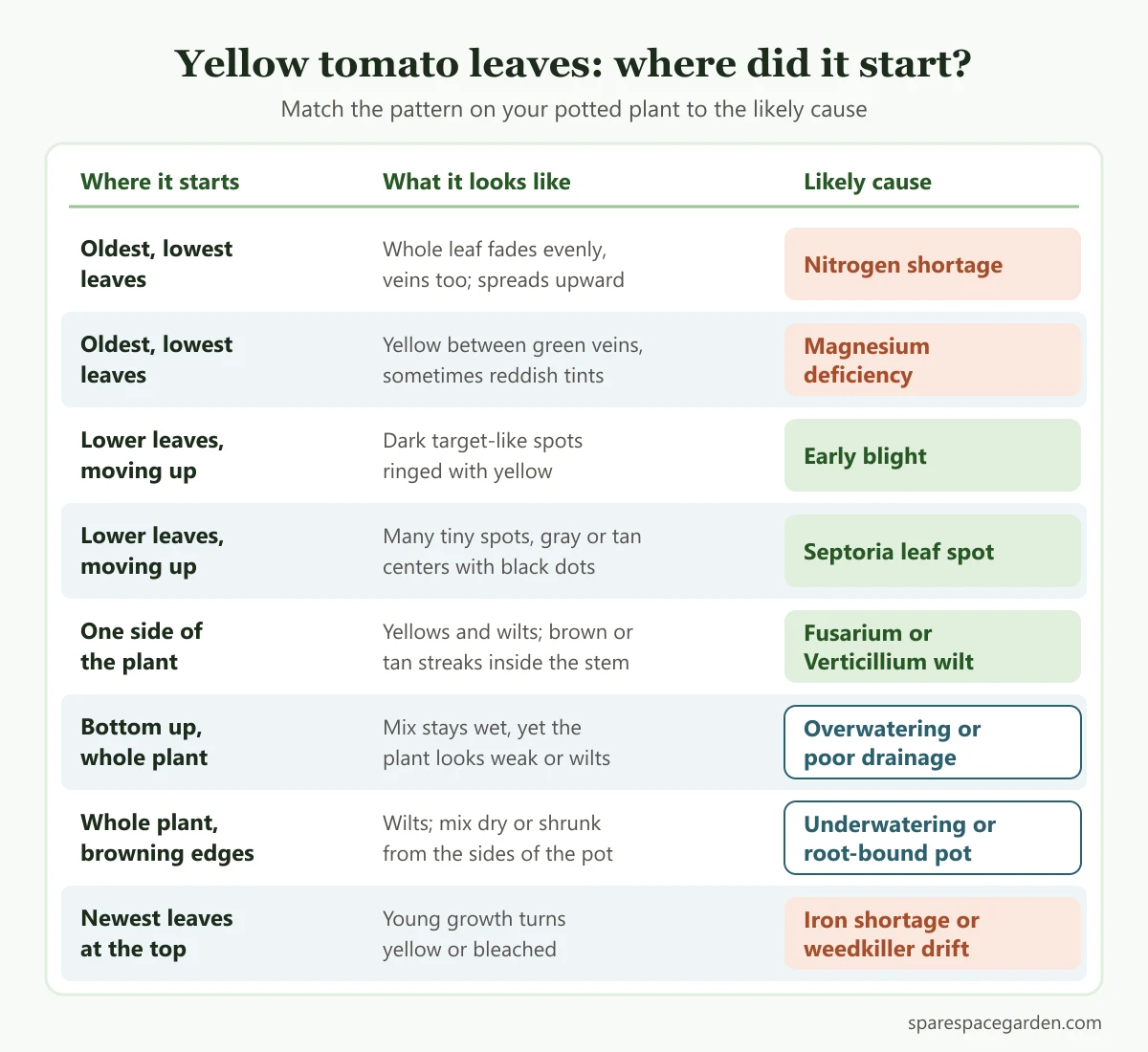 Where the yellowing starts, what it looks like, and the most likely cause.
Is some yellowing normal?
Many gardeners accept a few yellow leaves at the very bottom of a mature plant, especially shaded ones. Masabni disagrees: in his view a healthy, well-fed tomato should stay green from bottom to top. A sensible middle ground: if one or two of the lowest leaves fade while new growth is dark green and fruit is setting, keep watching. If the yellowing climbs the plant, treat it as a problem.
8 causes of yellow leaves on tomato plants in pots
1. Nitrogen shortage
This is the most common cause, and Masabni puts it down to people not fertilizing tomatoes enough. He says they need about twice the fertilizer of cucumbers and four times that of beans.
According to Iowa State University Extension's guide to nitrogen deficiency, the older, lower leaves turn pale green to yellow first, growth slows, stems may be thin, and the yellowing gradually spreads upward. The whole leaf fades, veins included.
Pots run out faster than garden beds. The RHS guide to nutrient deficiencies says container plants use up the nutrients in their compost in roughly 6 to 8 weeks, and University of Illinois Extension points out that frequent watering leaches nutrients out of containers.
Fix: Start a regular feeding routine. Clemson's guide to tomatoes in containers suggests either a balanced timed-release fertilizer at planting, topped up as the package directs, or a water-soluble fertilizer once a week. Our guide to the best fertilizer for tomatoes in pots compares the options.
Watch out: Don't overcorrect. University of Maine Extension lists tall, spindly, unproductive plants as a sign of too much nitrogen, and Illinois Extension notes that fruiting vegetables prefer lower-nitrogen fertilizers than leafy plants do.
2. Magnesium deficiency
Here the tissue between the veins turns yellow while the veins stay green, starting on the older leaves. The RHS adds that you may see reddish-brown tints, and that affected leaves develop brown patches and drop early. Iowa State notes that potassium shortage can look similar but tends to scorch the leaf edges.
The RHS lists tomatoes among the plants where this is common, and it points to a cause many container growers miss: heavy use of high-potassium feeds such as tomato fertilizer, because plants take up potassium in preference to magnesium.
Fix: For a quick boost, the RHS recommends a foliar spray of Epsom salts (magnesium sulfate) at 20 g per liter of water (about 2.7 oz per US gallon), wetting the leaves and repeating two or three times over the following weeks. Spray only in dull, overcast weather, since foliar feeds can scorch leaves in bright sun. Ease off any high-potassium feed at the same time.
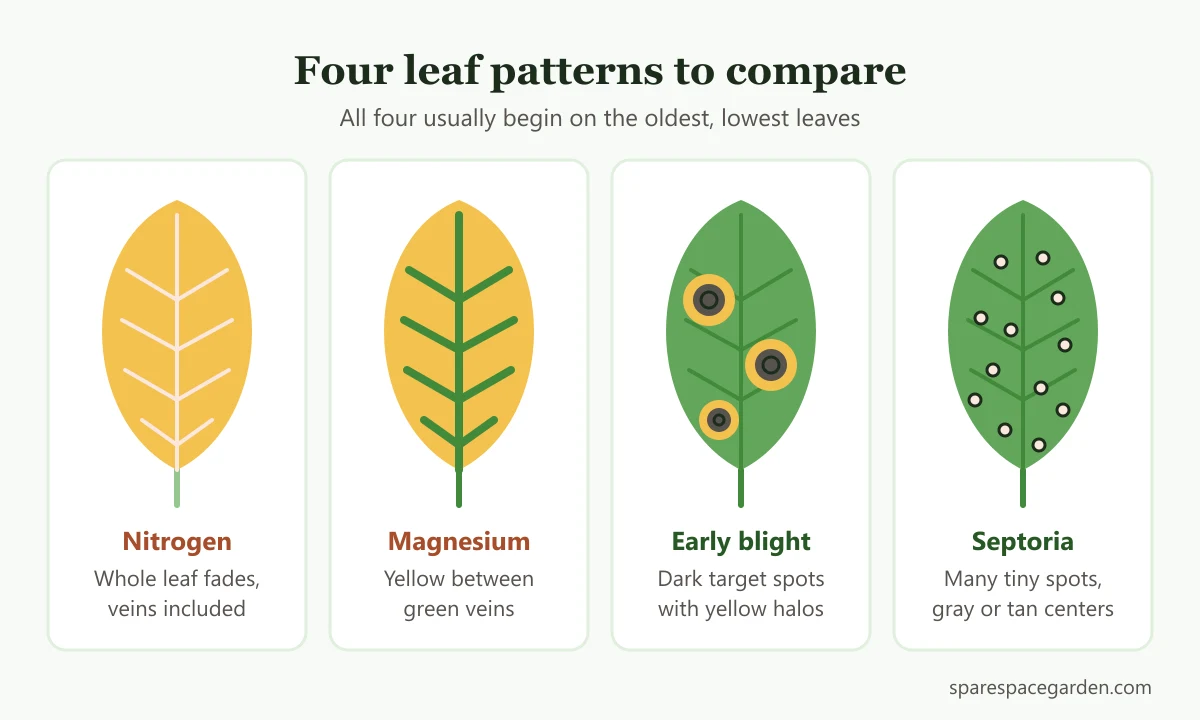 Even yellowing, yellow between veins, target spots and tiny gray-centered spots point to different causes.
3. Overwatering and poor drainage
Waterlogged mix pushes out the air that roots need. Utah State University Extension explains that saturated soil starves roots of oxygen until they die, causing yellowing, wilting and leaf loss. University of Maine Extension links yellowing from the bottom up in containers to excess water. The RHS adds that soggy compost stops roots absorbing nutrients, so an overwatered plant can look hungry even when it's been fed.
Fix: Water only when the top of the mix feels dry. Check that the pot has working drainage holes and empty any saucer that holds water. Colorado State University Extension's container garden guide recommends watering until about 10 percent of the water drains out the bottom, which also flushes out excess fertilizer salts.
4. Underwatering
Container tomatoes dry out fast. Clemson says they need daily watering at the height of summer, and Colorado State notes that even plastic pots may need water once or twice a day as plants grow. Colorado State also warns that letting a pot dry out completely kills fine roots, and very dry mix pulls away from the sides, so water runs straight past the root ball.
Fix: Masabni suggests pushing a finger several inches into the soil near the roots and watering when it feels dry. If the mix has shrunk from the pot walls, water slowly in two or three passes so it rewets.
5. A pot that's too small or root-bound
A crowded root ball can't hold enough water. University of Maryland Extension's page on pot-bound plants says these plants often show signs of drought, with browning leaf tips and margins, because water runs through too quickly and the center of the root ball stays dry. Look for roots circling the inside of the pot or growing out of the drainage holes.
Fix: Colorado State gives 5 gallons (19 L) as the minimum container for tomatoes, and Clemson suggests a 14 to 20 inch (36 to 51 cm) container for most compact cultivars. Clemson also suggests compact varieties labeled "patio," "balcony" or "bush." If a young plant is root-bound, move it to a bigger pot and gently loosen the circling roots. See how many tomato plants per container for sizing.
6. Early blight and Septoria leaf spot
These two fungal diseases are the usual reason for yellow leaves with spots. Both start on the lower leaves and work upward. University of Minnesota Extension's tomato leaf spot diagnosis page describes them this way:
- Early blight: dark, irregular spots, often surrounded by yellow tissue, in warm, wet weather and often late in summer. Colorado State Extension describes the spots as target-like, with concentric rings.
- Septoria leaf spot: small spots under 1/8 inch (3 mm) across with dark edges and tan or gray centers. Tiny black dots appear in the centers. It's most common in high humidity at 68 to 77°F (20 to 25°C).
Fix: The University of New Hampshire Extension recommends removing infected leaves, removing the bottommost leaves, mulching to stop soil splashing onto the foliage, watering the soil rather than the leaves, and improving airflow with staking and pruning. Preventive fungicides may help; always follow the label. Clear away all plant debris at the end of the season, because both fungi survive in it.
7. Fusarium and Verticillium wilt
These soil-borne fungi block the plant's water-conducting tissue. University of Minnesota Extension describes both as causing leaves to yellow and wilt, often on one side only, with the lower leaves going first. UMN lists Fusarium as occurring when air and soil are above 80°F (27°C), and Verticillium is common at 68 to 75°F (20 to 24°C). Verticillium may also cause yellow, wedge-shaped patches on the leaves.
To check, cut the stem lengthwise near the soil line. UMN says Fusarium leaves brown streaks in the veins, and Verticillium tan ones, around a green center. University of Maryland Extension adds that Fusarium symptoms usually appear as fruit begins to ripen, and that plants may partly recover at night.
Fix: There's no cure. Pull and discard infected plants. The pathogen can survive in soil for many years, so don't reuse that potting mix for tomatoes, peppers or eggplant. Next season, start with fresh mix and choose varieties labeled with an "F" (and "V") for resistance. UMN notes that most modern cultivars resist Fusarium, which is mainly a problem in heirlooms.
8. Cold stress after planting out
Tomatoes are sensitive to cold. University of Minnesota Extension describes cold injury below 50°F (10°C) as leaves that look water-soaked and soft, then turn black. Colorado State notes that cold soil early in the season can cause phosphorus deficiency, which turns leaves purple rather than yellow.
Fix: Wait for your frost-free date before setting pots outside, as Clemson advises, and move containers indoors or against a warm wall on nights forecast below 50°F (10°C). Leaves that have already blackened won't recover, so trim them off and judge the plant by its new growth.
Symptom, cause and fix at a glance
| What you see | Likely cause | What to do |
|---|---|---|
| Lowest leaves evenly pale, spreading up | Nitrogen shortage | Feed weekly with water-soluble fertilizer |
| Yellow between green veins on older leaves | Magnesium deficiency | Epsom salt spray, 20 g per liter; less high-potassium feed |
| Bottom-up yellowing, mix stays wet | Overwatering or poor drainage | Water when the top is dry; clear holes; empty saucer |
| Wilting, mix pulls away from the pot | Underwatering | Check daily in summer; rewet slowly |
| Mix dries very fast, roots circle the pot | Pot too small or root-bound | Repot young plants; 5 gallons (19 L) minimum |
| Dark target spots with yellow halos | Early blight | Remove spotted leaves; mulch; water at soil level |
| Many tiny gray-centered spots | Septoria leaf spot | Same as early blight; clear debris |
| One-sided yellowing and wilting, streaked stem | Fusarium or Verticillium wilt | Remove plant; replace mix; grow resistant varieties |
| Soft, water-soaked leaves that blacken | Cold injury | Protect pots below 50°F (10°C) |
| Newest leaves yellow | Iron shortage or weedkiller | Check for weedkiller nearby; review feeding |
Should you pick off yellow leaves?
Yes, in most cases. Masabni recommends removing yellow leaves on tomato plants even when you're not sure of the cause, since they may be diseased. In pots, bin them rather than leaving them on the mix, and wash your hands before handling healthy plants.
Don't strip off large amounts of foliage at once, though. Colorado State points out that when early blight defoliates a plant, the fruit is left exposed to sunburn. Take the worst leaves and any that touch the mix, then judge your fix by the new growth. If fresh leaves come in dark green, the problem is under control.
How to prevent yellowing in containers
Most yellow leaves on tomato plants in pots can be prevented with a steady routine:
- Start with a big enough pot. At least 5 gallons (19 L) per plant, with drainage holes.
- Use fresh potting mix. It carries no disease from last year's crop. Our guide to the best soil to grow tomatoes in pots explains what to look for.
- Feed on a schedule. Clemson suggests weekly water-soluble fertilizer or a timed-release product. Illinois Extension says liquid feeding every two weeks or so suits most containers, or feed at every watering at half strength.
- Water by feel, not the calendar. Check the mix daily in summer and water until some drains out.
- Keep leaves dry. Water at the base, mulch the surface, and remove the lowest leaves so soil can't splash onto them.
- Space pots for airflow. Crowded foliage stays damp longer, which favors leaf spot diseases.
Tip: Flush salts now and then. Masabni notes that excess salts can also cause yellowing and suggests watering containers thoroughly from time to time so salts leach out of the soil.
For the full season of care, from planting to harvest, see our guide to tomato plant care in pots.
Frequently asked questions
Is Epsom salt good for tomato plants with yellow leaves?
Only if the problem is magnesium deficiency, which shows as yellow between green veins on older leaves. Epsom salt won't fix nitrogen shortage, watering problems or disease. The RHS suggests a foliar spray at 20 g per liter of water, applied in dull weather.
Why are the top leaves of my tomato turning yellow?
Yellowing that starts on the newest growth points to a different set of causes than yellowing at the bottom. Texas A&M AgriLife notes that iron deficiency mainly affects the youngest leaves, and that tomatoes are very sensitive to glyphosate weedkillers, which bleach new growth. Check whether any weedkiller has been used nearby.
Can I reuse potting soil from a tomato that had yellow leaves?
It depends on the cause. If the plant simply ran short of nutrients, the mix can often be refreshed, as explained in can you reuse potting soil. If it had Fusarium or Verticillium wilt, don't reuse it for tomatoes, because these fungi can persist in soil for years.