Growing herbs indoors year round is less about which herbs you pick and more about how your home changes with the seasons. A window that's perfect in June can be too dim in December, the glass gets cold, the heating dries the air, and a pot that needed water every few days suddenly stays wet for a week.
This guide follows those changes through the year: how much light herbs need, when to add a grow light, where to keep pots in winter, how to water less, and how to move herbs outside for summer and back in for fall. For which herbs to grow, see our list of the best herbs to grow indoors.
Quick answer: Most herbs need 6 to 8 hours of bright light a day indoors. In winter, use your sunniest south-facing window and add a grow light 6 to 12 inches (15 to 30 cm) above the leaves for 12 to 16 hours a day. Keep foliage off cold glass, let the mix dry between waterings, and skip or cut back feeding until spring.
Why indoor herbs stall in winter
Light is the biggest hurdle to growing herbs indoors year round. Iowa State University Extension explains that indoor light levels are especially low in winter because of short days, the low angle of the sun and frequent overcast weather. Herbs are sun plants, so they feel that drop more than most houseplants.
How much light do they need? Iowa State says most herbs need around eight hours of direct light a day indoors, though some manage with six. Illinois Extension gives six to eight hours of bright light. A Colorado State Extension Master Gardener handout puts the minimum at about 4 hours of sun, with 6 to 8 hours as the goal.
How bright is your window?
Window direction matters more in winter than at any other time. Illinois Extension gives these rough light levels for houseplant windows, measured in foot-candles (a unit of light falling on a surface):
| Spot | Approximate light | Winter verdict for herbs |
|---|---|---|
| South-facing window | About 300 foot-candles (bright) | Best choice; may still need a grow light |
| East- or west-facing window | About 150 foot-candles (medium) | Workable in summer; usually needs a grow light in winter |
| About 5 feet (1.5 m) back from a south window | Roughly medium, like an east or west window | Move pots right up to the glass instead |
| North window, or 8+ feet (2.4 m) from a window | About 75 foot-candles (low) | Too dim without a grow light |
These are reference values, not measurements of your home. Illinois Extension also notes that some north- and east-facing windows become too shaded in winter, while a window shaded by trees in summer can become nearly full sun once the leaves drop.
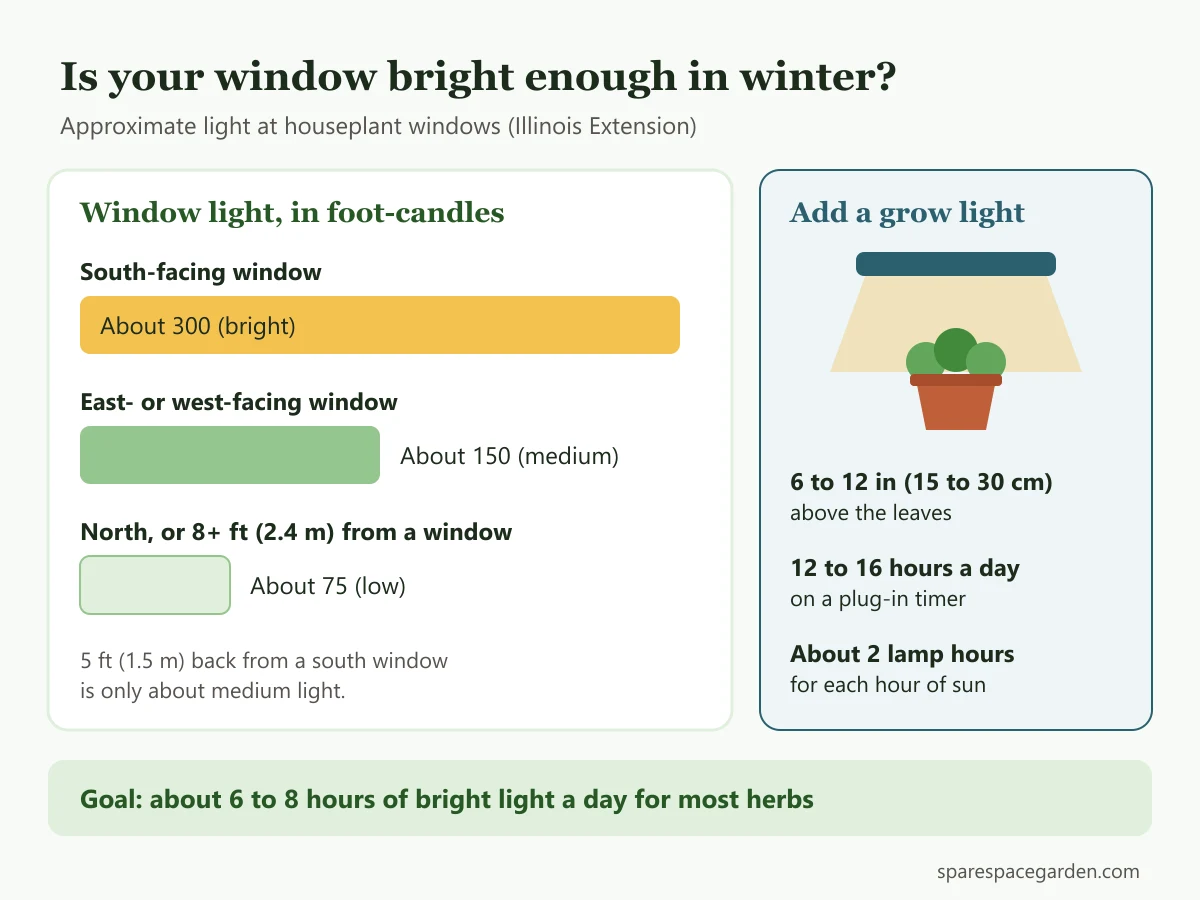 Rough window light levels from Illinois Extension, and the grow light settings that make up for a dim winter window.
Signs of too little light: long, pale stems with leaves spaced far apart. The Colorado State handout says plants growing longer stems and fewer leaves are stretching for light, and the fix is more light, either a brighter spot or a supplemental lamp. Our page on leggy seedlings explains the same stretching in young plants.
When and how to add grow lights
Add a light when your best window can't give herbs about six hours of bright light, or when you see stretched, pale growth. Extension settings are fairly consistent:
- Distance: Iowa State recommends lights within 6 to 12 inches (15 to 30 cm) of the leaves. The Colorado State handout suggests 4 to 6 inches (10 to 15 cm) for clamp-on compact fluorescent bulbs. Light weakens quickly with distance, so raise the light as the plants grow rather than letting the gap widen.
- Hours: Iowa State suggests 12 to 16 hours a day, on a plug-in timer. Illinois Extension uses 14 to 16 hours for two 40-watt cool white fluorescent tubes.
- Why so long: Illinois Extension notes that plants need around two hours of supplemental light for every one hour of natural light, because lamps are weaker than the sun.
For an LED fixture, check the maker's recommended hanging height, since output varies between models. The Colorado State handout points out that brown, scorched spots can mean too much light, though it says that rarely happens indoors.
Lights and water share the same shelf, so follow the fixture maker's safety instructions, keep plugs, timers and power strips above and away from saucers and pebble trays, and move pots to the sink to water rather than pouring near the lamp. If you run out of sill space, a shelf unit with a light on each tier, covered in our guide to a vertical herb garden indoor setup, gives every pot its own lamp.
Tip: Put the light on a timer from the start. Herbs need a dark period too, and a timer keeps the 12 to 16 hour schedule steady when you're away or forget.
Temperature near a winter window
Herbs like roughly the same temperatures people do. The Colorado State Extension handout on herbs for indoors puts the ideal at about 65 to 70°F (18 to 21°C), and notes that nights near a window may drop to 55 or 60°F (13 to 16°C), which most herbs tolerate well.
The problem is the glass itself. The same handout warns that air next to a window is cooler in winter than the rest of the room, and advises keeping foliage from touching the glass so it doesn't get nipped by cold. Our herb window garden guide covers sill setups for both hot and cold glass; for winter, a few practical moves help:
- Leave a small gap between leaves and the pane, even on the sunniest sill.
- Watch heat sources too. Illinois Extension recommends keeping room temperatures at 70°F (21°C) or below for herbs and keeping pots away from direct heat, so avoid radiators and heat vents under the window.
- Pull pots back on very cold nights if your windows are single-glazed or drafty, then return them in the morning.
- Treat basil differently. The Colorado State handout says basil droops on a cool windowsill and prefers the 70s°F (about 21 to 26°C) day and night. Cool-loving herbs such as parsley and cilantro handle a chilly sill better.
Dry air and watering less in winter
Heated homes get very dry. Illinois Extension notes that winter indoor humidity can fall to 10 to 20%, while most houseplants prefer 40 to 50%. Iowa State says herbs tolerate low humidity better than many houseplants, but the Colorado State handout still calls dry air hard on most herbs.
Raising humidity a little
- Group pots together, as Illinois Extension suggests.
- Use a pebble tray, keeping the water just below the top of the stones so pots don't sit in it.
- Rinse the plants. The Colorado State handout suggests a weekly shower in the sink, which also washes off dust and early pests.
- Skip misting. Illinois Extension notes it raises humidity for only a few minutes.
Watering on a winter schedule
This is where most indoor herbs are lost. Illinois Extension says more houseplants die in winter from overwatering than from underwatering, because growth slows and the mix stays wet longer. The Colorado State handout makes the same point for herbs and says the gap between waterings can range from a few days to well over a week.
- Check first. Push a finger 1 to 2 inches (2.5 to 5 cm) into the mix, as Illinois Extension suggests, or lift the pot. A light pot is a dry pot.
- Water thoroughly at the base until water runs from the drainage holes.
- Empty the saucer. Never leave the pot standing in water.
- Expect yellow leaves to mean too much water before too little. The Colorado State handout says to check that first.
Constantly damp winter mix also invites fungus gnats; see how to get rid of gnats in potted plants if they appear.
Feeding. Sources differ. Iowa State recommends half or quarter strength from early spring through summer and none in winter, while Illinois Extension suggests a water-soluble fertilizer every two weeks for herbs indoors over winter. A middle path: herbs growing actively under a grow light can take a light feed, following the label, while herbs resting on a dim sill need none. Our guide to fertilizer for potted plants covers the options.
Moving herbs outdoors in summer and back in fall
A summer outside gives indoor herbs a big boost of light. The two moves are where plants get stressed.
Spring: moving pots outside
Colorado State Extension advises waiting until nights stay above 50°F (10°C) and all danger of frost has passed. Then start pots in a shaded spot for a few days and gradually give them longer periods of sun. Iowa State notes that perennial herbs such as rosemary, bay laurel and marjoram can go out once frost danger is over.
Don't rush the sun. The RHS hardening-off guide says plants raised on windowsills take two to three weeks to adjust, and that the warmer they were grown, the longer it takes. It suggests bringing plants in at night during the first week. Shelter pots from wind, and expect to water much more often outdoors; Colorado State says pots may need water daily in hot spells.
Fall: bringing pots back in
Iowa State Extension recommends moving plants indoors when nights dip consistently into the 50s°F (about 10 to 15°C), and notes that many plants are damaged in the mid-to-low 40s°F (about 5 to 7°C). Illinois Extension uses a similar trigger of consistent temperatures below 55°F (13°C). Hardy herbs follow their own rules: chives, for example, do better indoors after a frost, as our guide to growing chives in pots explains.
- Acclimate. Illinois Extension suggests a week in a shaded outdoor spot, then a day or two indoors at a time, increasing gradually.
- Check for pests. Look under leaves and on stems, rinse the foliage outdoors with a hose and let it dry. Illinois Extension recommends flushing pots with water to drive out ants or earwigs.
- Treat if needed. If rinsing isn't enough, insecticidal soap or neem are options; follow the label.
- Isolate. Keep returning pots away from other houseplants for 3 to 4 weeks. Iowa State says indoor pests usually show up within about a month.
- Expect some leaf drop as plants adjust to lower indoor light, and cut back on water and feeding.
Watch out: Pests such as aphids and spider mites can ride indoors on summer herbs. The isolation period is when you catch them, so check the undersides of leaves every few days.
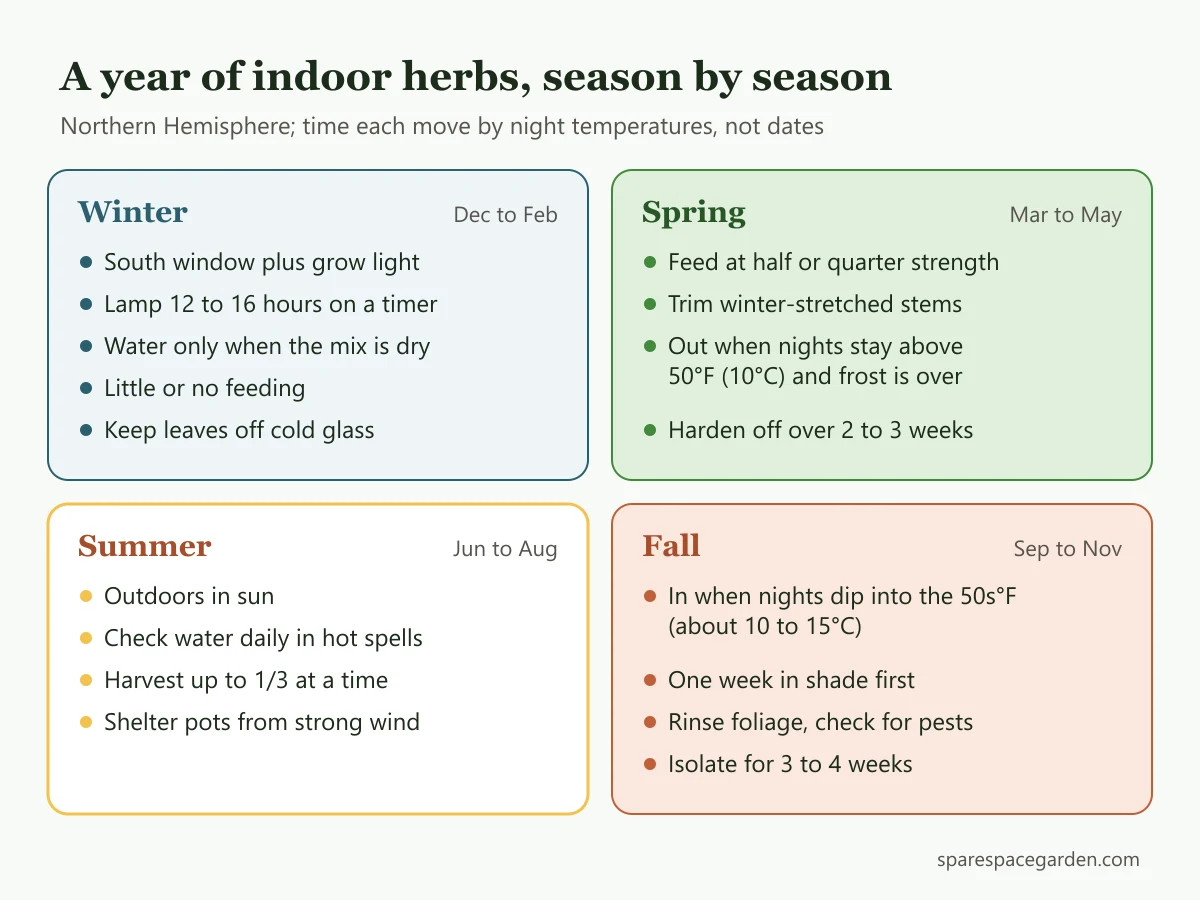 A year in the life of an indoor herb pot (Northern Hemisphere; go by night temperatures, not dates).
A month-by-month routine for growing herbs indoors year round
The calendar below assumes a temperate Northern Hemisphere climate. In the Southern Hemisphere, shift it by six months. In any climate, use night temperatures and frost dates rather than the month to time the moves.
| Months | Light | Water and feeding | Jobs |
|---|---|---|---|
| January to February | Shortest days: sunniest window plus grow light 12 to 16 hours | Water only when the mix is dry; little or no feeding | Rotate pots, rinse leaves, check for pests |
| March to April | Days lengthening; watch for new growth | Start feeding at half or quarter strength | Trim winter-stretched stems; check roots and repot crowded perennials |
| May | Frost passed and nights above 50°F (10°C) | Water more as growth speeds up | Harden off pots over two to three weeks |
| June to August | Outdoors in sun | Check daily in hot spells | Harvest often; keep pots sheltered from strong wind |
| September | Nights falling into the 50s°F (10 to 15°C) | Start reducing water | A week in shade, then rinse foliage and check for pests |
| October | Back indoors in your brightest window | Water less; stop or reduce feeding | Isolate returning pots for 3 to 4 weeks; set up the grow light |
| November to December | Lowest light of the year | Water sparingly; little or no feeding | Keep foliage off cold glass; group pots for humidity |
Two habits run all year when growing herbs indoors year round. Rotate pots so they don't lean (Illinois Extension suggests every few days), and harvest lightly, taking no more than a third of a plant at once, as the Colorado State handout advises. That handout also notes herbs may simply rest in winter, so slow growth from November to February is normal.
For the layout side, see our guides to a herb window garden and an apartment herb garden.
Frequently asked questions
Can herbs grow indoors all winter without a grow light?
Some can, in a bright south-facing window with several hours of direct sun. Growth will be slower, and stems may stretch. If your best window faces east, west or north, or you see long pale stems, a grow light 6 to 12 inches (15 to 30 cm) above the plants makes the difference.
How many hours a day should a grow light be on for herbs?
Iowa State Extension recommends 12 to 16 hours a day, and Illinois Extension uses 14 to 16 hours for fluorescent tubes. Use a timer so the plants also get a regular dark period.
How often should I water indoor herbs in winter?
There's no fixed schedule. Check the mix with your finger and water only when the top 1 to 2 inches (2.5 to 5 cm) are dry, then water until it drains and empty the saucer. In a cool winter room that may be once a week or less.
When should I bring herbs back inside in fall?
Iowa State Extension suggests moving plants in when nights dip consistently into the 50s°F (about 10 to 15°C), before they reach the mid-40s°F. Give them a week in shade first, rinse off pests, and keep them apart from other houseplants for 3 to 4 weeks.