An indoor hanging herb garden puts pots in the air, usually in front of a bright window, so they get light without taking up a sill or counter. It works well for trailing, drought-tolerant herbs such as oregano and thyme. It's harder for tall, thirsty herbs like basil.
Three things decide whether a hanging herb garden indoors succeeds: a hook that can carry a wet pot safely, enough light at the height you hang it, and a way to water without dripping on the floor. This guide covers all three, plus the plants that suit hanging and the dry, warm air near the ceiling.
Quick answer: Hang pots in front of your sunniest window, anchored into a ceiling joist or a wall-mounted rail, never a plastic wall anchor. Choose trailing herbs such as oregano, culinary thyme and prostrate rosemary. Use pots with a built-in saucer or a removable inner pot, check moisture by lifting, and take pots down to water.
Choosing a hanging setup
There are four common ways to hang herbs indoors. Pick the one that matches your ceiling, your lease and how many pots you want.
| Setup | Best for | Watch out for |
|---|---|---|
| Single ceiling hook | One or two pots in front of a window | Must go into a joist; wet pots are heavier than you expect |
| Macramé or rope hanger | Round pots of several sizes | Wet cord drips and can stain; needs a pot with a saucer |
| Wall rail with S-hooks | Several small pots in a kitchen or by a window | Pots hang close to the wall, so check the light there |
| Rod across the window frame | Small, light pots right at the glass | Only for light loads; keep leaves off cold glass in winter |
Hanging pots and macramé. Purpose-made hanging pots often have a built-in drip saucer, which makes indoor use much easier. A macramé or rope hanger holds an ordinary pot, so you choose the pot and saucer yourself. Either way, the pot needs drainage holes.
Rail-and-hook systems. A metal rail screwed to the wall with S-hooks lets you hang several small pots or buckets in a row. It spreads the load across wall fixings, can sit right beside a window, and makes it easy to unhook one pot at a time. If your goal is to cover a whole wall with plants, our guide to a vertical herb garden indoor setup goes further.
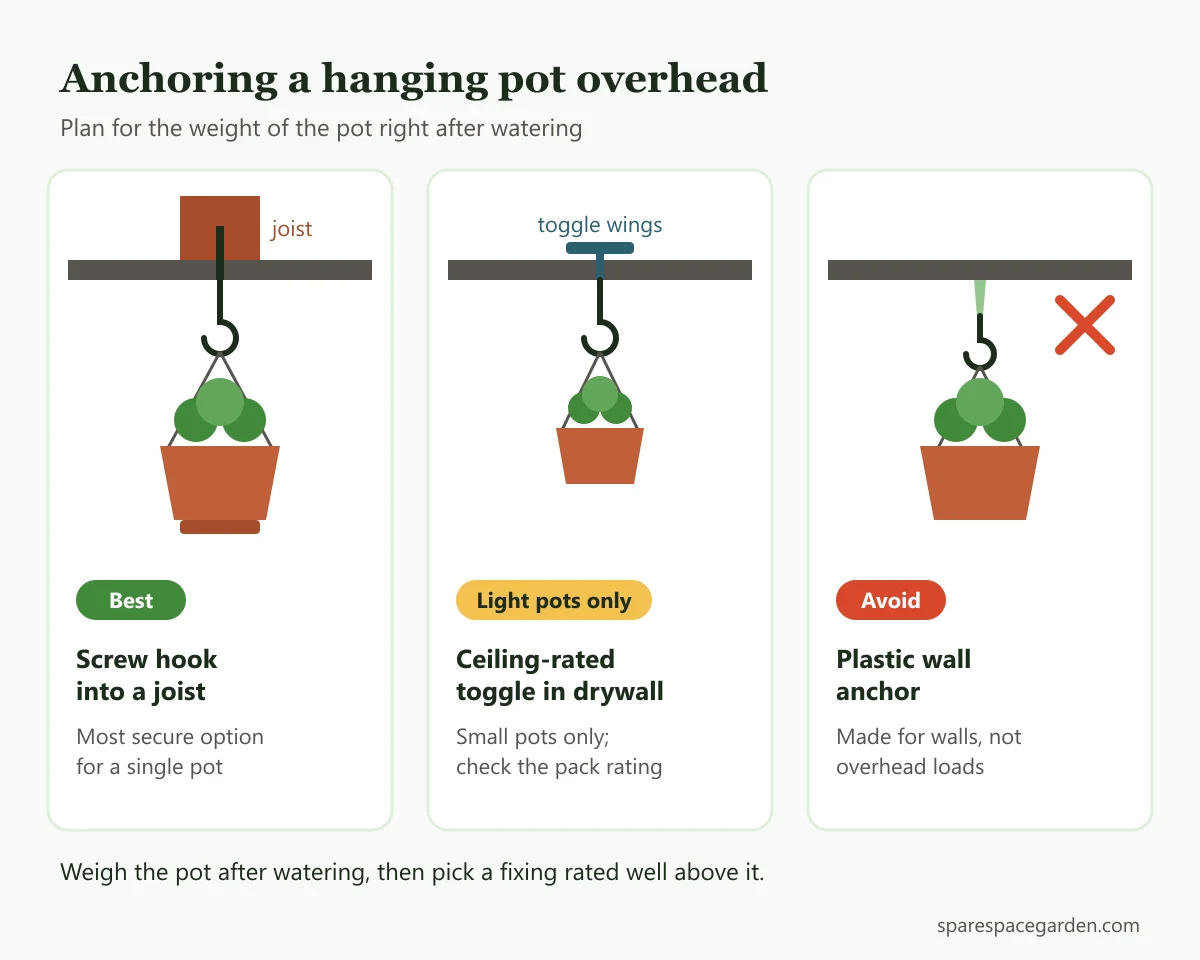 Anchor heavy pots into the framing, not just the ceiling board.
Ceiling hooks and load: anchoring safely
A hanging pot pulls straight down on its fixing all the time, and it is heaviest just after watering. That's the weight to plan for.
Weigh it wet. Water the pot until it drains, let it finish dripping, then weigh it on a bathroom scale. Choose a hook and fixing rated well above that number. Product ratings vary, so read the packaging rather than assuming.
Find a joist. Ceiling joists are the wooden (or metal) framing above the ceiling board. A screw hook driven into the center of a joist is the most secure option for a single pot. A stud finder or a small test hole helps you locate one.
Drywall alone is weak. Plastic expansion anchors are made for walls and are a poor choice overhead. If there's no joist where you need the pot, use a fixing sold specifically for ceilings, such as a toggle-style anchor, and keep the pot small and light. Plaster, concrete and suspended ceilings each need different hardware.
Renters and shared buildings. Check your lease before drilling. A rod across the window frame or a freestanding plant stand avoids ceiling holes entirely.
Watch out: None of this is a guarantee for your ceiling. If you're unsure what's above the board, or you want to hang anything heavy over a bed, crib, sofa or walkway, ask a qualified handyperson or contractor before you drill.
Which herbs suit an indoor hanging herb garden
Herbs that spill over the rim and tolerate drying out are the best match, because hanging pots dry faster and are a chore to water often. NC State Extension's Lee County office suggests creeping thyme, prostrate rosemary and prostrate sage as herbs that cascade over the sides of a hanging basket, with an upright herb such as sage or winter savory in the center.
| Herb | Growth habit | Good for hanging? |
|---|---|---|
| Oregano | Bushy to cascading; NC State lists it at 1 to 3 ft (30 to 90 cm) tall | Yes; prefers dry to medium moisture |
| Culinary thyme | Small, woody mound that spills at the edge | Yes; likes to dry between waterings |
| Creeping thyme | 2 to 3 in (5 to 8 cm) tall, spreading | Yes, but mainly ornamental |
| Prostrate rosemary | Low, trailing form of rosemary | Yes, in a bright spot |
| Mint | Vigorous and spreading | Yes, on its own; needs more water |
| Basil | Upright; NC State lists 4 in to 3 ft (10 to 90 cm) | Not ideal; tall and thirsty |
| Parsley, cilantro | Upright; like steady moisture | Not ideal; better on a sill |
Oregano. The NC State Extension plant profile for oregano describes a bushy, spreading plant tagged as cascading, and says it prefers dry to medium moisture with good drainage. It warns that wet, poorly drained soil can cause root rot.
Thyme. NC State lists creeping thyme (Thymus serpyllum) at only 2 to 3 inches (5 to 8 cm) tall and says it's primarily ornamental and rarely used in cooking. For the kitchen, plant a culinary thyme near the edge of the pot so it leans over the rim. Our guide to growing thyme in pots covers the gritty mix it prefers.
Mint. The RHS describes many mints as vigorous, spreading plants best kept in pots. A hanging pot does that job, but mint likes evenly moist mix, so give it a pot of its own rather than sharing with thyme. University of Vermont Extension also suggests growing catnip, a mint relative, in a hanging basket in a sunny window to keep it away from cats.
What to keep on the sill. Basil, parsley and cilantro grow upright and want steadier moisture. They do better in a pot you can reach and check easily, such as in an herb window garden.
Getting enough light at hanging height
Light is the biggest limit indoors. Iowa State Extension says most herbs need about 8 hours of direct light a day indoors, with some tolerating 6. A south-facing window is best in the Northern Hemisphere (north-facing in the Southern), and a bright east or west window can work.
Height changes what a pot receives:
- Hang in front of the glass, not beside it. A pot hanging off to the side of the window or deep in the room gets far less light. University of Nebraska–Lincoln Extension notes that moving a plant slightly away from a window cuts light intensity very quickly.
- Mind the top of the window. A pot hung above the top of the window frame sits in the shadow of the wall. Keep the foliage level with the glass.
- Check for shadows. Pots hung above a sill garden can shade the plants below. Hang them to one side or space them so the sill still gets sun.
- Turn the pot. Herbs lean toward the light. Turning hanging pots every few days keeps growth even, and many hangers swivel, which makes it easy.
If the window falls short, a grow light can hang alongside the pots. Iowa State suggests lights 6 to 12 inches (15 to 30 cm) above the leaves for 12 to 16 hours a day. Hang the light from its own fixing, follow the maker's safety instructions, and keep the plug, timer and cord where drips from the pots can't reach them. Taking pots down to water, as below, keeps water away from the fitting.
Watering hanging pots without drips
A pot overhead is easy to forget and awkward to water. The fix is to plan the drainage before you hang it.
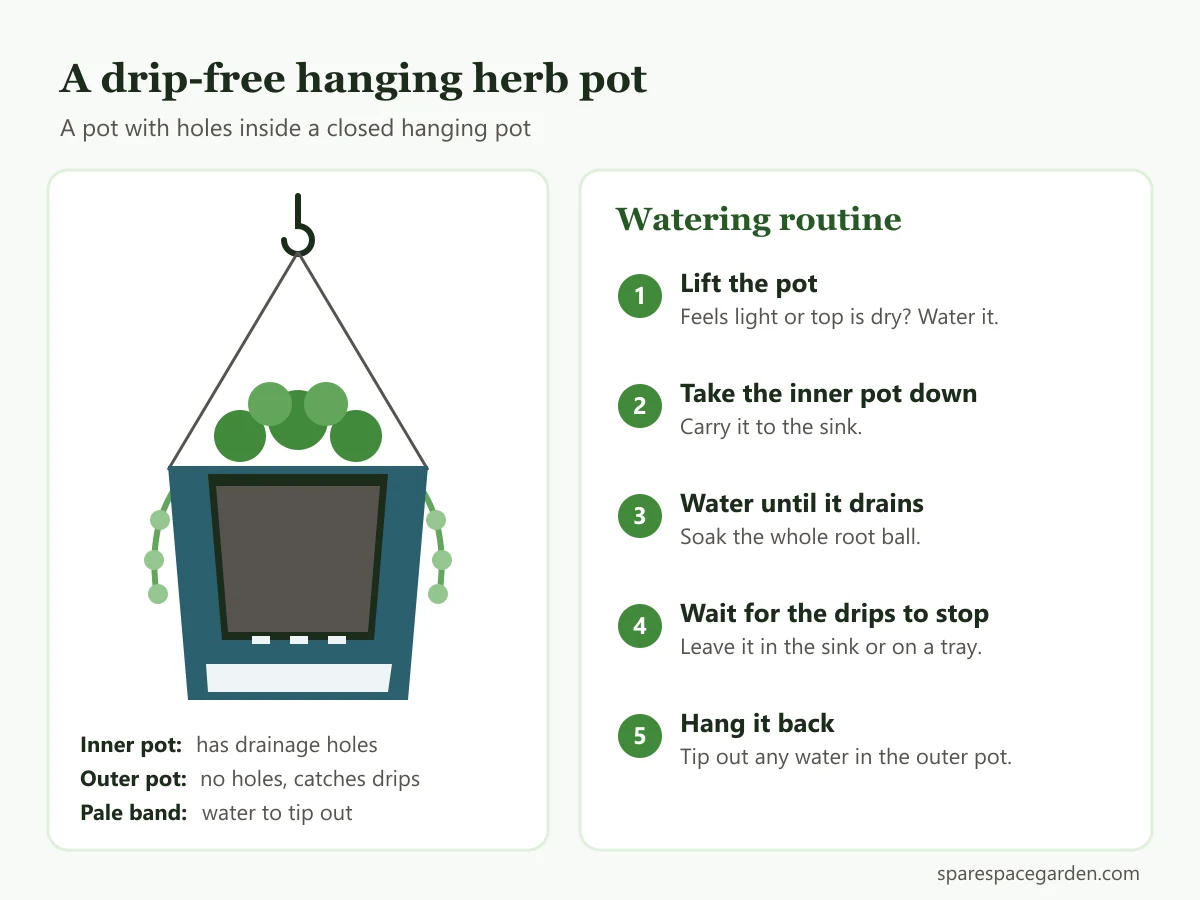 A removable inner pot lets you water at the sink and hang it back dry.
Check by lifting. The RHS guide to hanging baskets suggests gently lifting or nudging a basket to judge its weight. If it feels very light, it needs water. Indoors, a finger pushed into the mix works too.
Take it down to water. Watering overhead usually means water running out of the drainage holes onto the floor. Instead, lift the pot down, water it at the sink until it drains, let it finish dripping, then hang it back.
Use an inner pot. University of Maryland Extension describes double potting: a pot with drainage holes sits inside a decorative pot without holes, and you remove the inner pot to water, then return it after it drains. For hanging herbs, that means a plastic nursery pot inside a closed hanging pot.
Saucers and liners. If you water in place, use a hanging pot with a built-in saucer and add water slowly so it doesn't overflow. Oregon State University Extension warns against leaving drained water in the saucer, so tip it out. Wire baskets need a liner; the RHS mentions ready-made cardboard and fiber liners, and a plastic sheet with a few holes behind the liner slows drips indoors.
Pot size. University of Maryland lists small herbs such as thyme, mint and basil at a minimum of 1 to 3 gallons (4 to 11 L) of mix and 4 to 6 inches (10 to 15 cm) deep. Bigger holds water longer but weighs more, so balance the two against your hook.
Tip: A wet pot keeps dripping for a while after watering. Leave it in the sink or on a tray until the drips stop before hanging it back up.
Hanging pots lose nutrients as water flushes through. If you feed, use a diluted all-purpose fertilizer during the growing season and follow the label; our guide to fertilizer for hanging baskets explains the options.
Dry air near the ceiling
Warm air rises, so a pot hanging high in a room sits in warmer air than one on a table. That usually means the mix dries faster, especially in winter when the heating is on.
The good news is that herbs cope with dry indoor air better than many houseplants. Iowa State says herbs tolerate the low humidity found indoors. The bigger risk is a pot that dries out completely between checks.
- Hang lower if you can. A pot at eye level near the window is warmer than the floor but cooler than the ceiling, and it's easier to check.
- Keep away from heat sources. Don't hang pots directly above radiators, heat vents or a stove, where hot air dries the mix and the leaves.
- Check more often in winter. Lift-test the pots every couple of days when the heating runs.
- Mist if you like, but still water. Maryland and Vermont Extension both suggest misting to raise humidity around indoor herbs. Misting doesn't wet the mix, though, and the mix is what dries out first in a hanging pot.
Iowa State notes that some indoor herbs, such as rosemary and sage, are more prone to pests like spider mites, so look under the leaves now and then. For a fuller routine, see our guide to growing herbs indoors year-round.
Frequently asked questions
Can I hang herbs from a drywall ceiling without a joist?
Only light, small pots, and only with a fixing sold for ceiling use, such as a toggle-style anchor rated above the pot's wet weight. Plastic expansion anchors made for walls are a poor choice overhead. For anything heavier, move the hook to a joist or use a wall rail.
What herbs grow best in a hanging pot indoors?
Oregano, culinary thyme, prostrate rosemary and mint are the most practical choices. They spill over the rim, and the first three tolerate a mix that dries between waterings. Upright herbs such as basil, parsley and cilantro are easier to manage on a sill.
How often should I water a hanging herb garden indoors?
There's no fixed schedule. Lift the pot every few days, and water when it feels light or the top of the mix is dry. Pots near the ceiling and in heated rooms dry faster, so check them more often in winter.
How do I stop hanging plants dripping on the floor?
Take the pot down and water it at the sink, or use a removable inner pot inside a closed hanging pot. If you water in place, use a pot with a built-in saucer, pour slowly and empty the saucer afterward.
Do hanging herbs need a grow light?
Not if they hang in front of a sunny window that gives about 6 to 8 hours of direct light. In a dim spot or in winter, a grow light 6 to 12 inches (15 to 30 cm) above the leaves for 12 to 16 hours a day, as Iowa State suggests, fills the gap.