An herb window garden works best in a window that gets direct sun for most of the day. In the Northern Hemisphere that's a south-facing window; in the Southern Hemisphere it's a north-facing one. East and west windows can grow the more forgiving herbs, and a north window (south, below the equator) usually needs a grow light.
The window decides more than the pots or the potting mix do. Below you'll find which direction suits which herbs, how to check the light you really have, how to fit pots and shelves on a sill, when a window box outside makes sense, and how to deal with glass that bakes in summer and chills in winter.
Quick answer: Use your sunniest window: south-facing in the Northern Hemisphere, north-facing in the Southern. Iowa State Extension says most indoor herbs need about 8 hours of direct light a day, and some manage with 6. Keep leaves off cold glass in winter, shade hot glass in summer, and turn the pots every few days.
Which window direction suits which herbs
Window direction sets how many hours of direct sun reach the sill. University of Nebraska–Lincoln Extension in Lancaster County gives a useful rule of thumb: if a south window is 100% light, east and west windows get about 60% and a north window about 20%. Those figures are for the Northern Hemisphere. Below the equator, swap north and south.
Light needs vary between herbs, and so do the sources. Iowa State Extension's guide to growing herbs indoors gives about 8 hours of direct light for most herbs. University of Vermont Extension says 6 to 8 hours, and University of Maryland Extension suggests a south or west window with at least 5 hours of sun. Iowa State lists parsley, mint and chives among the easiest indoor herbs, and puts rosemary, sage, marjoram and bay in a second group, noting that some of these need more light or attract more pests.
| Window (Northern Hemisphere) | Same window (Southern Hemisphere) | Typical light | Herbs to try |
|---|---|---|---|
| South | North | Most direct sun; hottest in summer | Rosemary, thyme, oregano, sage, basil |
| West | West | Strong afternoon sun; warm | Basil, oregano, thyme, chives |
| East | East | Gentler morning sun; cooler | Parsley, chives, mint, cilantro |
| North | South | Little or no direct sun | Microgreens, or any herb under a grow light |
Treat the herb column as a starting point, not a rule. The sunny-window group are Mediterranean or heat-loving herbs, while the east-window group tolerate a cooler spot. Cilantro is one that dislikes heat: our guide to growing cilantro in pots explains why hot south-facing glass pushes it to bolt.
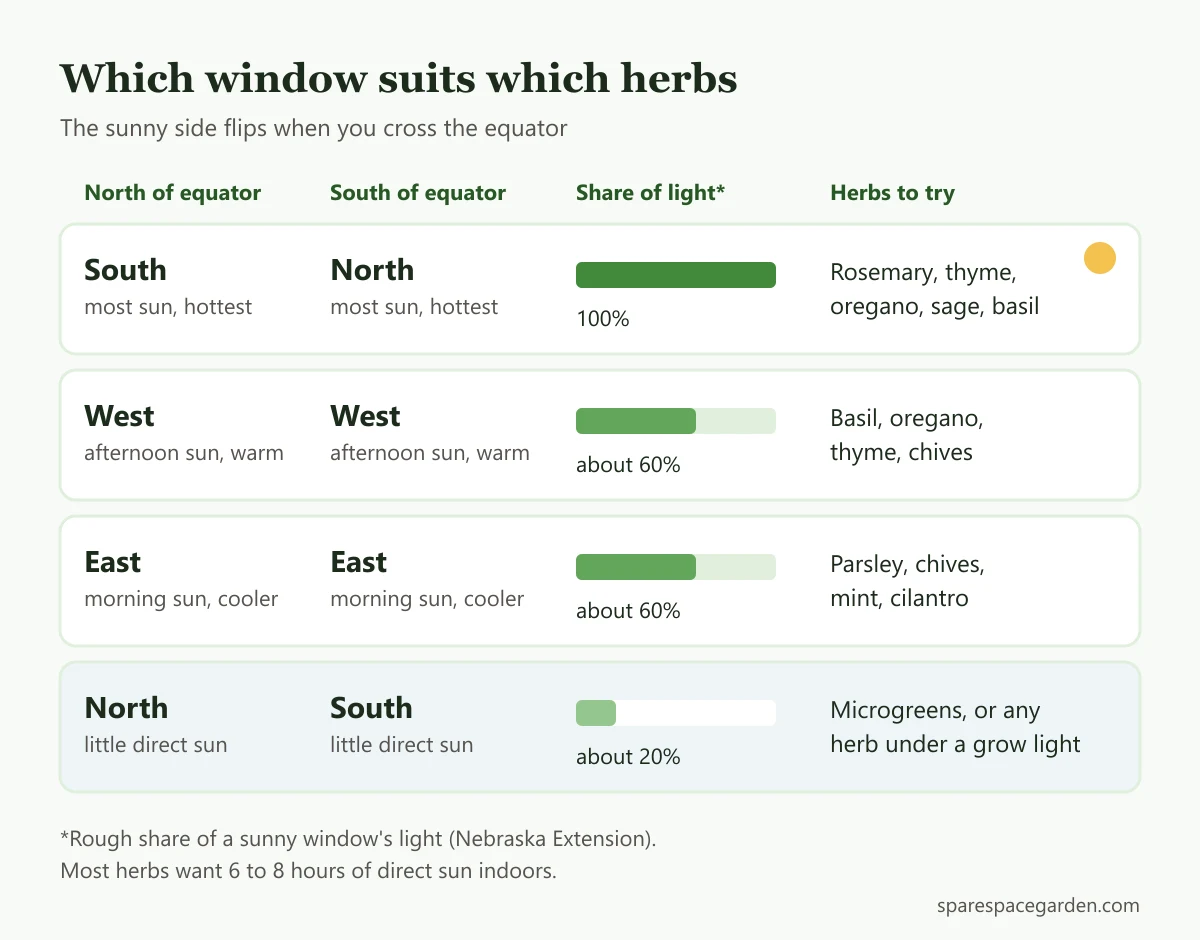 Which window to use: the sunny side flips when you cross the equator.
How to check the light in your window
Direction is only a first guess. Trees, balconies above you, neighboring buildings and tinted glass can turn a south window into a shady one.
Count the hours of direct sun. On a clear day, note when sunlight first falls directly on the sill and when it leaves. Direct sun means the beam itself lands on the spot, casting a sharp shadow. Do this again in winter if you can, because a window that's bright in June may get little sun in December.
Use a light meter or app. University of Florida IFAS suggests a handheld digital meter that reads in foot-candles or lux. It rates over 1,000 foot-candles at midday as direct sunlight, found right in front of unshaded south or southwest windows, and 500 to 1,000 as high light. UF/IFAS adds that phone apps are fine for spotting changes in light but should only be used for approximations.
Measure at the sill, then step back. Light falls off quickly as you move into the room. Nebraska Extension notes that moving a plant a little farther from the window cuts light intensity very quickly. A pot on the sill and the same pot on a table 3 feet (1 m) back are in very different conditions.
Expect a winter dip. Nebraska also notes that a plant that does well in an east window in summer may need a south window in winter. If your best window comes up short from late fall to early spring, a grow light fills the gap. Iowa State suggests lights 6 to 12 inches (15 to 30 cm) above the leaves for 12 to 16 hours a day. Keep the light's plug, cord and timer clear of the drip tray, and follow the maker's safety instructions.
Tip: Stretched stems with wide gaps between leaves are the plant telling you the window is too dim. Our guide to leggy seedlings explains the same problem in young plants.
Fitting pots on the sill and across the window
Most windowsills are narrow, so pot size is often set by the sill, not the plant. Measure the depth of your sill from the glass to the front edge before you buy anything, and leave room for a saucer.
Pot size. University of Maryland Extension lists small herbs such as basil, cilantro, thyme and mint at a minimum of 1 to 3 gallons (4 to 11 L) of mix and 4 to 6 inches (10 to 15 cm) deep. Larger herbs such as rosemary and parsley need 4 to 6 gallons (15 to 23 L) and 8 to 12 inches (20 to 30 cm) of depth, which rarely fits on a sill. Put those on a sturdy table or plant stand pressed close to the window instead.
One herb per pot. Iowa State recommends growing each herb in its own container. That lets you water thyme sparingly and parsley more often, and move each pot to the spot that suits it.
Don't let pots overhang. A pot balanced half off the sill is easy to knock down, and a window that opens inward can sweep it off. If the sill is too shallow, a sill extension or a narrow shelf bracket underneath gives you a few more inches, as long as it's screwed into solid framing and rated for the weight of wet pots.
Shelves across the window. Clear shelves fixed across the window frame let you stack two or three rows of pots without blocking much light. Put the sun-hungry herbs on the lowest shelf nearest the glass, or on the shelf that gets the longest stretch of direct sun, and check that the upper shelves don't shade the lower ones at midday. Keep heavy pots low. Use brackets rated for the load, fix them into the frame or wall framing rather than trim alone, and ask a qualified handyperson if you're unsure what the window surround can hold; renters should check the lease before drilling. For a taller setup with lights on each shelf, see our guide to a vertical herb garden indoor.
Drainage trays on a sill
Every pot needs drainage holes, and water that runs out has to go somewhere. A shallow tray running the full length of the sill catches drips from several pots at once and protects painted wood from water marks.
Oregon State University Extension calls overwatering by far the most common cause of houseplant death and warns against leaving drained water in the saucer. Water until it runs out, then tip out the tray. If you want extra humidity, University of Vermont Extension suggests a tray of pebbles with the water kept below the top of the pebbles, so pots sit above the water rather than in it.
Inside the sill or a window box outside
An outside window box gets unfiltered sun and fresh air, and frees up the inside sill. It also dries out faster, faces wind and frost, and is harder to reach in bad weather. Inside, herbs are protected and can be picked year-round, but glass filters some light.
A simple way to decide: if your climate allows, grow sun-loving herbs such as thyme, oregano and rosemary in an outside box from spring to fall, and keep a smaller indoor herb window garden for winter.
If you go outside, mounting matters more than the plants:
- Fix the box to the wall structure, not just to siding or trim, using brackets made for outdoor use and rated for the weight of a box full of wet mix. If you're unsure what's behind the wall, ask a qualified installer.
- Think about what's below. A box over a sidewalk, entrance or neighbor's balcony is a safety risk if it falls. Renters should check the lease or building rules first, since many buildings restrict window boxes.
- Fill it after it's secured, and use a lightweight potting mix rather than garden soil.
- Check drainage. Outside boxes need holes too, and water running down a wall can stain it.
Herbs that like sharp drainage do especially well in a sunny box. Our guide to growing thyme in pots covers the gritty mix it prefers.
Hot glass in summer, cold glass in winter
Glass makes a sill hotter in summer and colder in winter than the rest of the room. Both extremes cause damage.
Summer heat. The RHS describes a south-facing sill as baking hot, and notes that west-facing sills are warmer than east-facing ones. Its guide to houseplants for sunny rooms also points out that glazed or plastic pots don't dry out as quickly as unglazed terracotta in hot, dry spots. On a hot sill, check pots daily, keep leaves from pressing on the glass, and use a sheer curtain or angled blinds during the hottest hours. UF/IFAS notes that window treatments soften direct light, so open them again once the strongest sun has passed.
Winter cold. Oregon State Extension warns that many plants are sensitive to the colder air and drafts around a window, especially older windows that don't seal well, and that leaves pressed against the glass on a cold night can be damaged. It adds that cold damage can appear days after the cold night itself.
- Pull pots back from the glass so no leaves touch it.
- At night, close curtains or blinds between the glass and the room, but don't trap the plants in the cold gap behind them. Move pots onto the room side first.
- Keep pots away from heat vents and radiators below the sill, which dry the mix fast.
Oregon State's Douglas County Master Gardeners give a target of 65 to 70°F (18 to 21°C) by day and 55 to 60°F (13 to 16°C) at night for indoor herbs. Most rooms are close enough; the sill is what drifts outside that range.
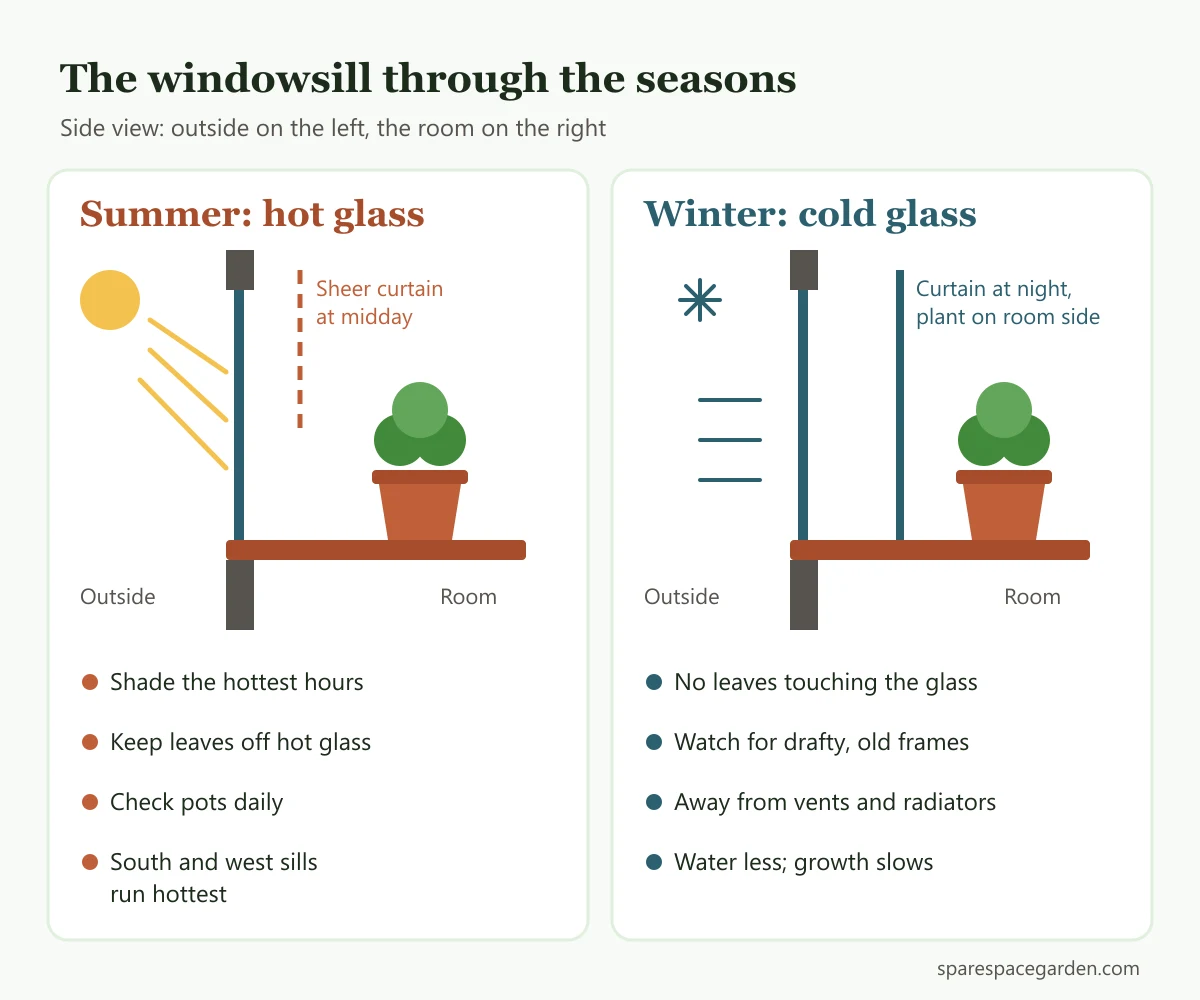 The sill changes with the seasons: shade it in summer, pull pots back in winter.
Routine care for an herb window garden
Herbs lean toward the glass. University of Vermont Extension suggests turning each pot every few days to prevent one-sided growth. A quarter turn in the same direction each time is easy to remember.
Water when the top of the mix feels dry, let it drain, then empty the tray. Iowa State recommends an all-purpose fertilizer at half or quarter strength from early spring through summer, and none in winter. If you feed, follow the label. For a fuller watering and feeding routine across the seasons, see our guide to growing herbs indoors year-round. Wipe the glass now and then, too, since an herb window garden needs every bit of light it gets.
| Problem on the sill | Likely cause | Fix |
|---|---|---|
| Tall, pale, floppy stems | Not enough direct sun | Move to a sunnier window or add a grow light |
| Plants leaning hard one way | Pots never turned | Give each pot a quarter turn every few days |
| Brown, crisp patches on leaves facing the glass | Hot summer glass or strong afternoon sun | Pull pots back; use a sheer curtain at midday |
| Dark, water-soaked spots after a cold night | Leaves touched cold glass or sat in a draft | Move pots away from the glass; close curtains on the room side |
| Wilting even though the mix is wet | Pots standing in a full tray | Empty trays after watering; water less in winter |
Frequently asked questions
Can I grow herbs in a north-facing window?
In the Northern Hemisphere, a north window gets little or no direct sun, so most herbs will grow slowly and turn leggy. Nebraska Extension puts north light at about 20% of a south window. A grow light makes it workable, or you can grow microgreens there instead; see our guide on how to grow microgreens indoors.
Which window is best for herbs in Australia or New Zealand?
A north-facing window, because the sun sits in the northern part of the sky south of the equator. East and west windows behave the same as in the Northern Hemisphere, and a south window is the shady one.
Is an east or west window better for herbs?
West windows get stronger, warmer afternoon sun, which suits basil, thyme and oregano. East windows get softer morning light and stay cooler, which suits parsley, chives and cilantro. If you only have one, pick the herbs to match it.
How far from the window should herb pots be?
As close as you can get them without leaves touching the glass. Light drops quickly as you move into the room, so a pot even a few feet back gets far less. In winter, leave a small gap so foliage stays off the cold pane.
What herbs grow best in a window?
Iowa State lists parsley, mint, chives, basil, oregano, cilantro and thyme as the best indoor herbs. For a longer comparison, see our list of the best herbs to grow indoors, or our guide to a hanging herb garden indoor setup if your sill is full.