Vegetable planters for a deck need one thing a patio pot doesn't: a gap between the container and the boards. Water trapped under a pot can keep the wood wet for days, and wood that stays wet is wood that stains and rots. Lift every planter, control the runoff, and put heavy containers where the framing can carry them, and a deck can grow tomatoes, peppers and salad all summer.
This guide covers the damage risks first, then weight, sun, planter types and depths, crop choices and a simple routine.
Quick answer: Set every container on pot feet or choose a planter on legs, empty saucers after watering, and keep heavy pots near posts and beams instead of mid-span. Give salad greens 4–6 inches (10–15 cm) of mix, medium crops 8–12 inches (20–30 cm), and full-size tomatoes 5 gallons (19 L) or more, in a spot with 6–8 hours of direct sun.
Why pots damage a wooden deck
The problem isn't a splash of water. It's water that can't dry. University of Maryland Extension warns that the water draining from containers can stain concrete and wood decking.
Rot needs more than a damp day. A review of above-ground wood decay from the USDA Forest Products Laboratory explains that decay fungi generally need wood moisture above fiber saturation, usually around 25 to 30 percent, and that untreated wood wetted for short periods and then dried does not decay. The same review puts the best growing temperatures for most decay fungi at roughly 70–90°F (21–32°C), which is a summer afternoon on a deck.
Put those together and the risk is clear. A flat-bottomed pot or a brimming saucer sitting on the boards all summer holds the wood wet and warm under it, which is exactly the condition the fungi need. Rain and watering that drain away and dry off are far less of a concern.
Lift every planter off the boards
An air gap lets the boards under a pot dry out between waterings. It's the single most useful habit for a deck garden.
Pot feet and risers
UMD suggests raising pots on bricks, scrap lumber or pot feet, and the RHS guide to growing plants in containers also recommends bricks or pot feet so drainage holes stay clear. Three or four feet under each pot is enough to break contact with the boards.
Drain holes matter too. For containers on solid surfaces, NC State Extension suggests holes along the side ¼–½ inch (6–13 mm) above the bottom, so water can escape even if the base sits low.
Planters on legs
A trough on legs keeps the whole growing area well above the deck, with open air underneath. NC State notes that raised containers can be easier to tend for gardeners with physical limitations. Legged planters suit greens and herbs best, because most are shallow; our balcony raised garden bed guide compares legged and floor-standing beds in more detail.
The trade-off is that legs focus the whole weight onto a few small points. That's covered in the weight section below.
Trays and saucers
Saucers catch runoff, but UMD says to empty them so standing water doesn't cause root rot or breed mosquitoes. The RHS suggests using saucers in summer and removing them before winter, so pots aren't left standing in water.
A saucer sitting flat on the boards can trap moisture under itself, too. Set it on feet, or use a tray with a raised base, and tip it out after watering or rain.
Watch out: Skip plastic sheeting, outdoor rugs or carpet under planters. Anything that covers the boards and stays damp works against you, because the wood under it can't dry.
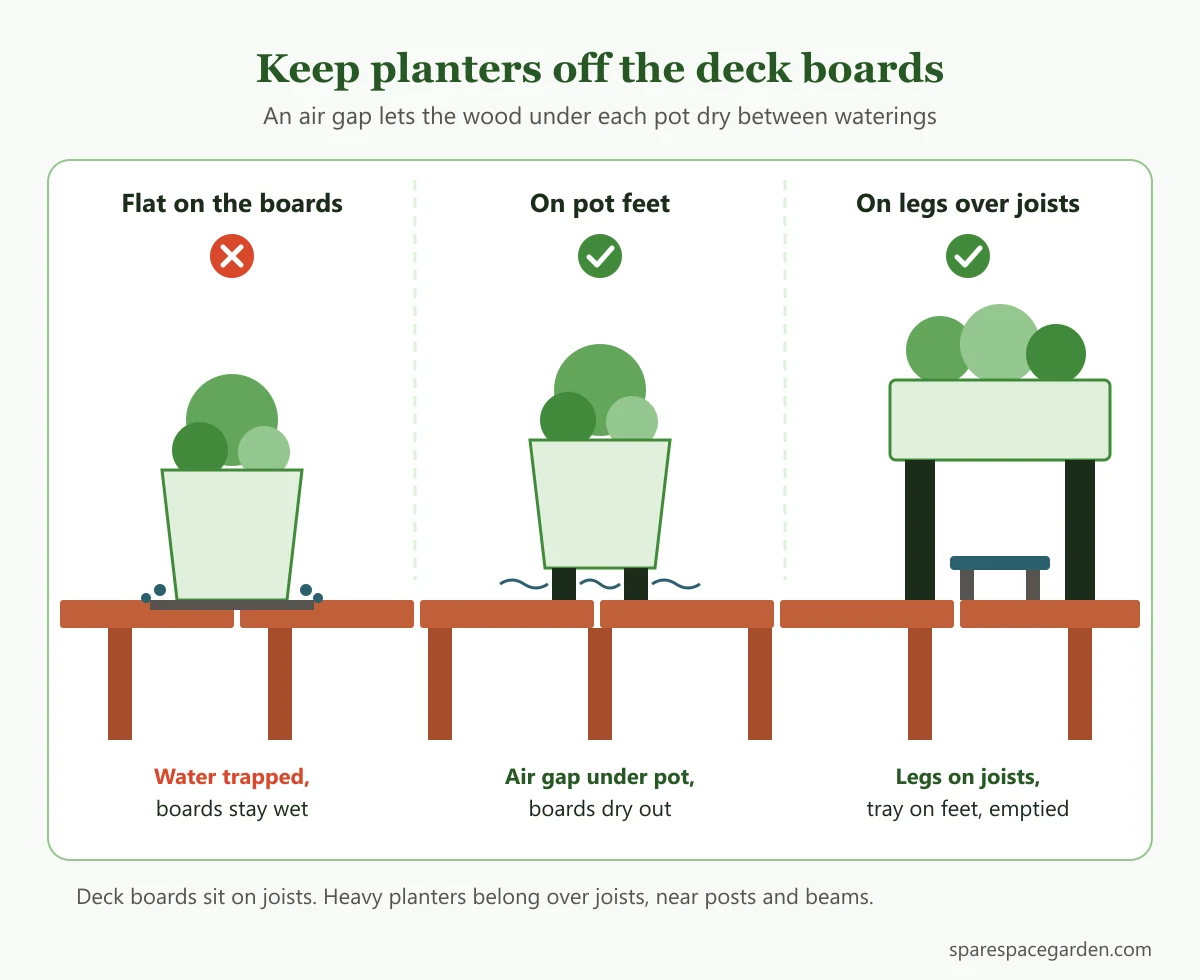 Trapped water stays under a flat pot; feet and legs leave a gap so the boards can dry.
Spread the weight over the joists
A deck is built to carry a set load spread across its surface, and the figure depends on your local code. The City of San Diego's deck bulletin, for example, sizes its framing tables for a 60-pound-per-square-foot (about 290 kg/m²) live load and says the bulletin can't be used when heavy concentrated loads, such as equipment or a hot tub, sit on the deck.
Planters are heavier than they look. UMD says a 20-inch (51 cm) container filled with moist potting mix and plants can weigh 100 pounds (45 kg). That pot covers only about 2.2 square feet (0.2 m²), so it presses down at roughly 46 pounds per square foot (about 220 kg/m²) on that one spot, before anyone stands next to it. A big raised box can concentrate far more. The raised bed guide linked above shows how to estimate wet weight from a planter's size.
General guidance, not engineering:
- Go near the supports. The RHS advises placing heavy containers over a load-bearing beam or joist, where the structure can take more weight. On a deck, that means near posts and beams, not in the middle of a span.
- Cross the joists. Joists are commonly laid 12, 16 or 24 inches (30, 41 or 61 cm) apart, the spacings San Diego's span tables use. Turn a long planter so it runs across several joists instead of along the gap between two.
- Put legs on joists. The screw or nail lines on the deck boards show where the joists run.
- Spread out. Several medium pots placed around the deck load it more evenly than one huge box.
- Ask a pro. If the deck is old, bouncy or soft in places, or you want a large raised bed, have a deck builder or structural engineer look at it first.
Map the sun on your deck
Sun decides which crops are worth growing. UMD says warm-season crops such as tomatoes, peppers, eggplant and squash need 6–8 hours of direct sun, while lettuce, spinach and other cool-season greens manage on 3–5 hours.
Decks have shade patterns that shift through the day. The house wall, railings, a pergola, an umbrella and nearby trees all cast shadows that move. Check the deck on a clear day in the morning, at midday and in late afternoon, and note where direct sun reaches the floor and for how long.
Then sort the deck into zones: the 6–8 hour spots for fruiting crops, the 3–5 hour spots for greens, and the shadiest corner for seating. UMD notes that plant caddies, low wheeled platforms, make heavy containers easier to move, which helps if your sunniest spot changes with the season. Give caddies the same air-gap thinking as pots.
Choosing vegetable planters for a deck: types and depths
Pick the container style first, then the size your crop needs.
- Planter on legs: best for salad greens, herbs and radishes. Shallow and easy on your back.
- Rectangular trough or box: good for rows of greens, beans or dwarf peppers, and a long box spreads weight across several joists. NC State says cedar and redwood resist decay and can last around 10 years without staining or painting.
- Large round pot: the standard choice for one tomato, pepper or eggplant. Plastic and fiberglass are light and, as NC State notes, lose moisture more slowly than porous materials.
- Fabric grow bag: light and cheap, but University of Illinois Extension says fabric dries out much faster than plastic. A damp bag also sits against the boards, so always put it on a raised tray.
- Self-watering container: a reservoir under the mix stretches the time between waterings. See self-watering containers for vegetables.
Pale colors help in full sun. UMD warns that dark containers can raise potting mix temperatures and injure tender roots.
UMD's guide to container types groups vegetables into three sizes:
| Crop group | Examples | Minimum mix | Minimum depth | Sun (UMD) |
|---|---|---|---|---|
| Small | Lettuce, spinach, salad greens, radishes, scallions, herbs | 1–3 gal (3.8–11 L) | 4–6 in (10–15 cm) | 3–5 hours suits leafy greens |
| Medium | Bush beans, chard, beets, carrots, dwarf tomatoes and peppers | 4–6 gal (15–23 L) | 8–12 in (20–30 cm) | 6–8 hours for dwarf fruiting crops |
| Large, one plant per pot | Tomatoes, peppers, eggplant, cucumbers | 8–10 gal (30–38 L) | 12–16 in (30–41 cm) | 6–8 hours |
Other sources set lower minimums. UMD's own vegetable container guide lists 5 gallons (19 L) for a standard tomato and 2 gallons (7.6 L) for a cherry tomato, and NC State gives 5 gallons as the minimum for tomatoes and eggplant. Bigger pots dry out more slowly but weigh more, so on a deck it's a trade-off.
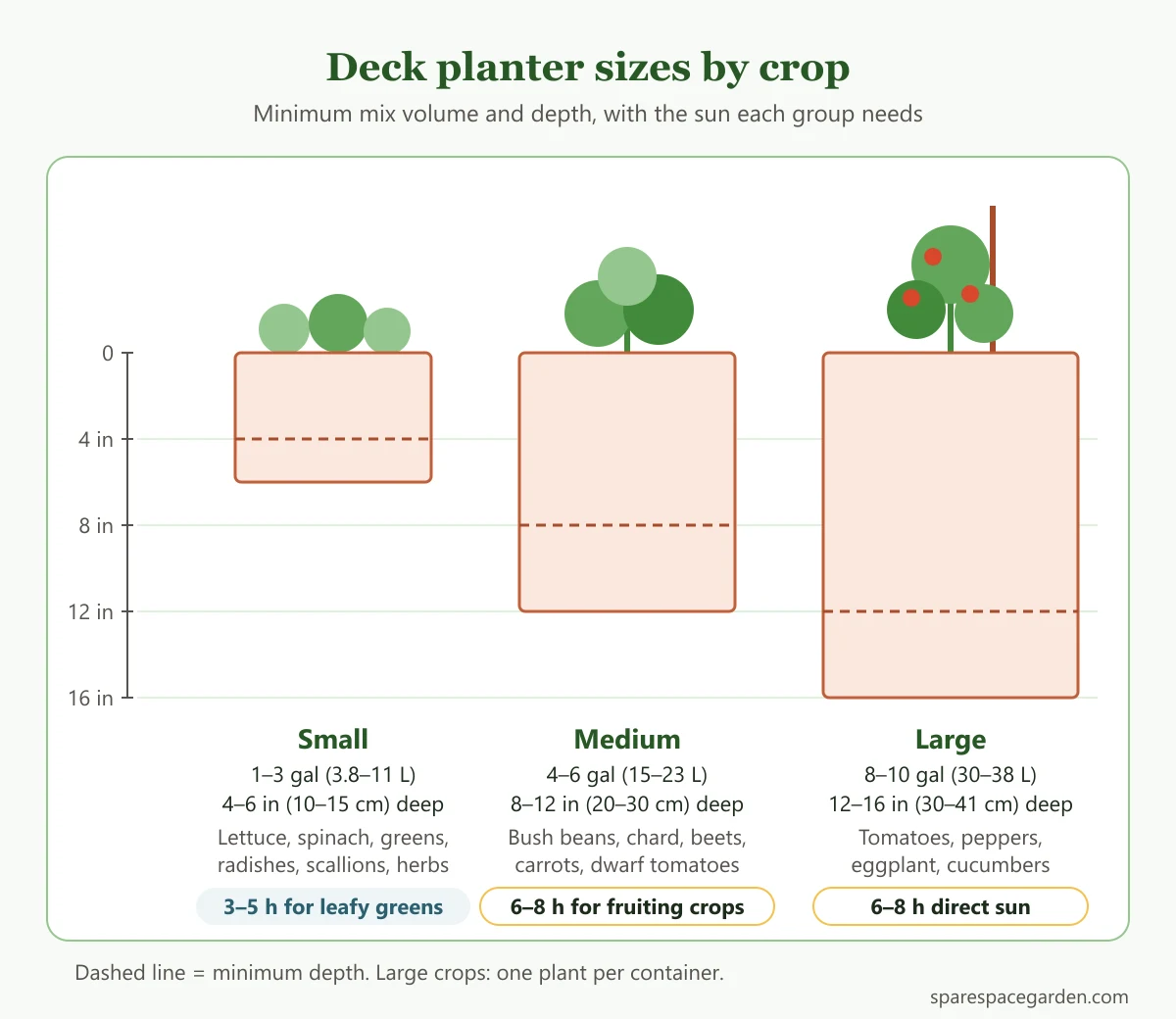 Minimum planter sizes for small, medium and large vegetables, with sun needs.
Best vegetables for deck planters
Match crops to the sun zones you mapped, and favor compact plants that stay inside their containers.
- Full-sun spots (6–8 hours): compact or dwarf tomatoes, peppers, eggplant and bush beans. Cucumbers work on a trellis fixed to the planter; see growing cucumbers vertically. For peppers, our guide on how to grow peppers in pots covers sizes and care.
- Part-sun spots (3–5 hours): lettuce, spinach, Asian greens and other salad leaves.
- By the kitchen door: herbs in small pots or a legged trough, where you'll pick them often.
- Better left off the deck: potatoes, which UMD says need 30 gallons (114 L) of potting mix, and sprawling winter squash. Both take a lot of heavy mix for the harvest.
If your deck rail gets the best light, railing boxes can add growing space; the small balcony garden ideas guide covers their limits.
A routine that keeps the deck dry
A few habits protect the boards all season.
- Water until it trickles, then stop. Illinois Extension suggests watering until water starts to drip from the drainage holes, and emptying any saucer afterward.
- Check daily in summer. UMD advises checking containers every day until you know how fast they dry out.
- Shift pots now and then. Moving a pot every few weeks lets the boards underneath dry fully and shows you any marks early.
- Keep the gaps clear. Sweep spilled mix and fallen leaves out of the spaces between boards so water can drain through.
- Pack up for winter. Remove saucers before winter, as the RHS advises. NC State says unglazed ceramic pots shouldn't stay outside over winter, because absorbed water freezes and cracks them, so bring those in.
- Inspect at season's end. Lift every planter and look for dark patches or soft wood. The Forest Products Laboratory review notes that wood wetted briefly and then dried does not decay, so the aim is to let every damp spot dry out.
Tip: Snap a photo of the deck boards before you set planters down. It makes it easy to tell new marks from old ones at the end of the season.
Frequently asked questions
Can you put planters directly on a wood deck?
It's better not to. A pot sitting flat on the boards traps water underneath, and UMD warns that drainage water can stain wood decking. Lift each container on pot feet, bricks or scrap lumber so air can reach the wood.
How do you keep potted plants from staining a deck?
Raise every pot, use saucers on feet, and empty them after watering or rain. Water until a little drains out, then stop, and move pots every few weeks so the boards can dry. The RHS suggests removing saucers before winter.
How much weight can a deck hold for planters?
It depends on how and when the deck was built and on local code, so ask a deck builder or engineer about anything heavy. For scale, UMD says a 20-inch (51 cm) pot of moist mix and plants can weigh 100 pounds (45 kg). Place heavy planters near posts and beams and spread smaller pots across the deck.
What are the best vegetable planters for a deck?
A legged trough for greens and herbs, plus pale plastic, fiberglass or cedar containers on pot feet for larger crops. Size them by crop: 4–6 inches (10–15 cm) deep for greens, 8–12 inches (20–30 cm) for medium crops, and 5 gallons (19 L) or more for tomatoes.
Can I put a raised garden bed on my deck?
A small legged bed is usually the safer choice, because it keeps air under the bed and holds less mix. A deep floor-standing bed is heavy and can trap moisture, so have the deck checked first. For rooftops and other hard surfaces, see our guide to rooftop planters.