An apartment herb garden works best when you plan it around three things you can't change much: how much sun reaches your windows or balcony, how much floor or sill space you have, and the fact that water can't drip onto a landlord's hardwood or a neighbor's balcony.
Get those right and the rest is simple. This guide covers choosing a spot, a six-herb starter set grouped by how much water each herb likes, pots and saucers that protect your home, whether to buy plants or sow seed, renter-friendly setups and a weekly care routine. For full care of each herb, follow the links to our individual guides.
Quick answer: Choose the sunniest spot you have, aiming for at least 4 to 6 hours of sun a day. Start with six herbs in two groups: a dry group (thyme, rosemary, oregano) and a moist group (parsley, basil, chives), never mixed in one pot. Use pots with drainage holes at least 6 inches (15 cm) across, set them on plastic, rubber or metal saucers, and empty the saucers after watering.
Step 1: Pick your spot first
The spot decides everything else, including which herbs will do well. Iowa State University Extension recommends at least 4 to 6 hours of sun a day for container herbs, and indoors most herbs need more, around six to eight hours of bright light.
| Spot | Best for | Watch for |
|---|---|---|
| South- or southwest-facing windowsill | Every herb in the starter set | Cold glass in winter; hot glass in summer |
| East- or west-facing windowsill | Parsley, chives, cilantro | Fewer hours of sun; stems may stretch |
| Sunny balcony | All herbs, and bigger pots | Building rules, wind, weight, dripping on neighbors |
| Kitchen counter away from a window | Only with a grow light | Too dim for most herbs on its own |
Windowsill
A Colorado State University Extension handout on indoor herbs says windows facing south or southwest are best, east or west windows will do, and north windows aren't bright enough. It suggests a simple test: on a sunny day, turn off the lights and check the spot through the day to see how much sun it really gets. Our guide to a herb window garden covers sill setups in detail.
Balcony
A balcony usually gets more light than any window, so herbs grow faster there. Check your lease or building rules before you add anything heavy or fixed to a railing, ask your landlord or building manager about the balcony's load limit, and keep pots inside the railing. The University of Maryland Extension notes that a 20-inch (51 cm) container filled with moist potting mix and plants can weigh 100 pounds (45 kg), so small herb pots are the easy choice. For layout ideas, see small balcony garden ideas.
Kitchen counter
The Colorado State handout calls the kitchen the ideal place for herbs because they're right where you cook. The catch is light: a counter a few feet from the window is much dimmer than the sill. Keep pots at the window and bring cuttings to the counter, or add a small grow light, with its plug and cord kept away from the sink and saucers. See how to grow herbs in your kitchen for counter setups.
A six-herb starter set for an apartment herb garden
Six herbs is enough to cook with often without crowding a sill. The most useful rule is to group them by water needs, because one watering habit can't suit both groups. Colorado State Extension notes that Mediterranean herbs such as sage, rosemary and thyme need less moisture, while herbs from northern Europe need more. Maryland Extension says basil, mint, parsley and cilantro need more consistent moisture than rosemary, thyme, oregano and lavender.
| Herb | Water group | Easiest start | Full guide |
|---|---|---|---|
| Thyme | Dry: let the mix dry between waterings | Nursery plant | Growing thyme in pots |
| Rosemary | Dry | Nursery plant | Water like thyme |
| Oregano | Dry (sources differ; check by feel) | Nursery plant | Water like thyme |
| Parsley | Moist: keep evenly moist, never soggy | Seed or plant | How to grow parsley in pots |
| Basil | Moist | Seed or a divided supermarket pot | How to harvest basil |
| Chives | Moist | Plant or division | Growing chives in pots |
Why not mix them? Iowa State says that when you group herbs in one container, their water requirements should be comparable. Put thyme in the same pot as basil and you'll either drown the thyme or let the basil wilt.
Mint gets its own pot. The Colorado State handout calls mint very invasive and says it needs its own container. The same handout warns against planting all your herbs in a single container, because it slows growth.
Swaps. If your sill is cool and only gets east or west light, cilantro can replace basil in the moist group; our guide to growing cilantro in pots explains its quirks. For more choices, see the best herbs to grow indoors.
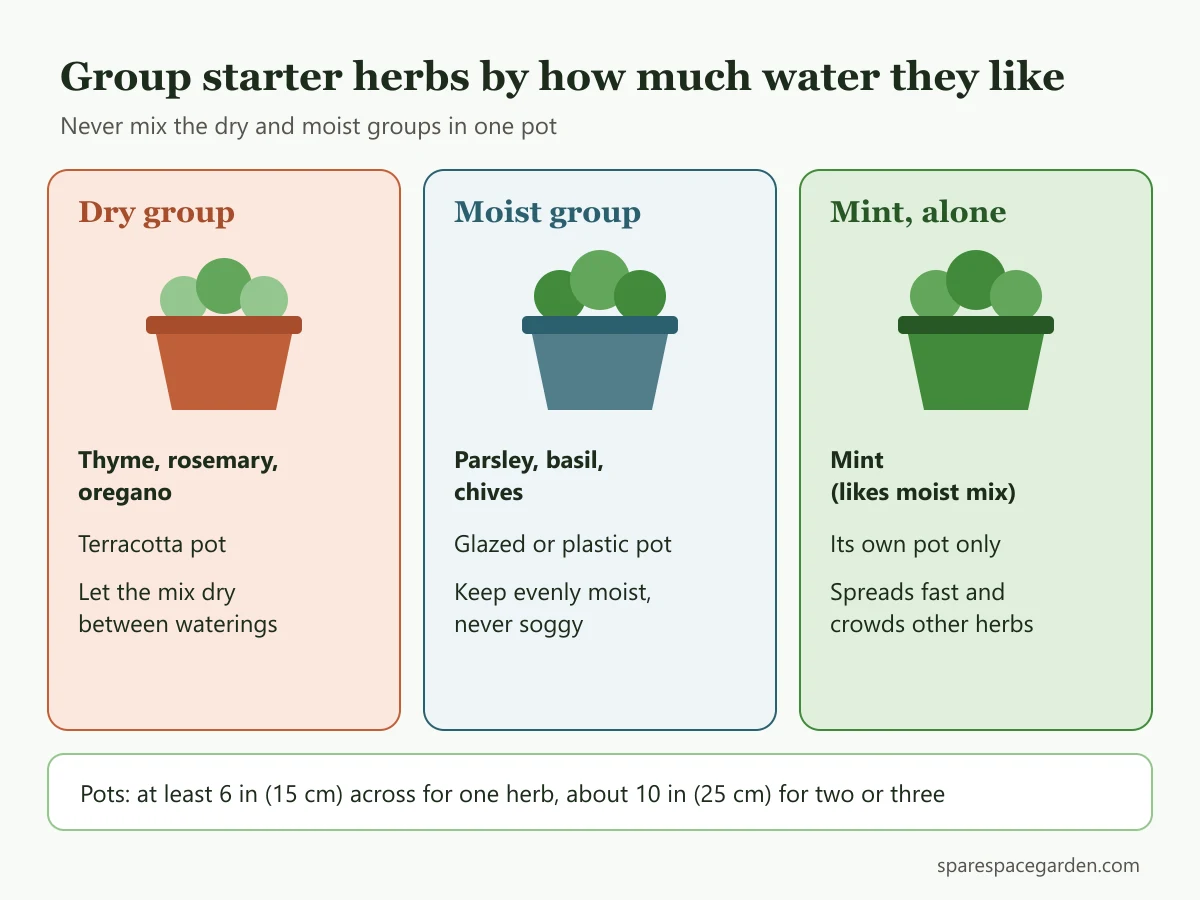 Two water groups, two kinds of pot, and mint on its own.
Pots and saucers that protect floors and furniture
In an apartment, the pot setup matters as much for your home as for the plants.
Size. The Colorado State handout says pots for single herbs should be no smaller than 6 inches (15 cm) across, and that two or three herbs can share a pot about 10 inches (25 cm) wide and 8 inches (20 cm) deep. On a balcony, where pots dry faster in sun and wind, go bigger: Maryland Extension suggests 2 to 5 gallons (about 8 to 19 L) for small herbs such as basil, thyme and oregano, and 5 gallons (19 L) or more for rosemary, sage and parsley.
Material by group. Terracotta dries out faster, which suits the dry group. Iowa State notes that herbs in clay pots may need more frequent watering for that reason. For the moist group, the Colorado State handout suggests glazed or plastic pots, which don't dry out as quickly. Plastic is also lighter, which Iowa State points out makes pots easier to move.
Drainage holes, always. Every source agrees on this. Decorative pots without holes can be used as outer covers, but set the real pot inside on a riser and tip out any water that collects.
Saucers. The Colorado State handout warns that letting a pot drain onto a tabletop or windowsill is the quickest way to ruin it, and that clay saucers let moisture pass through. It recommends plastic, rubber or metal saucers instead. Maryland Extension adds two reasons to empty saucers regularly: standing water encourages root rot and can breed mosquitoes. On a balcony above someone else's, a saucer also stops water dripping onto your neighbor.
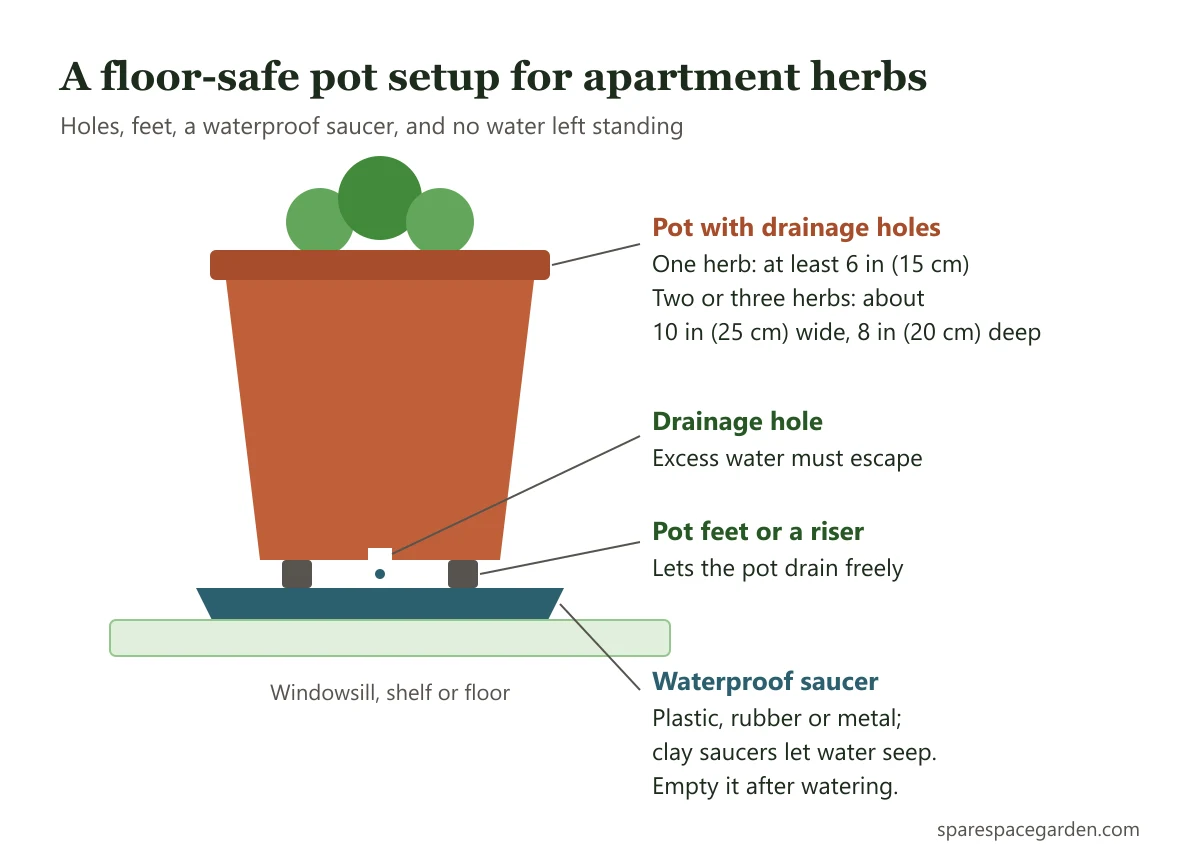 A floor-safe herb pot: holes, a waterproof saucer, and a little air underneath.
Tip: Water at the sink. The Colorado State handout suggests putting pots in the sink, soaking them, letting them drain completely, then returning them to their saucers. Nothing drips on the sill.
Plants or seed: starting on a budget
You can start an apartment herb garden cheaply, but not every herb is a good seed candidate.
Buy plants for the slow herbs. The Colorado State handout recommends buying young plants rather than seed for indoor herbs, because growing from seed is harder. That's especially true for thyme and rosemary: our thyme guide notes the RHS says seed-raised thyme can take about a year to reach harvest size. One plant each of thyme, rosemary and oregano is plenty for a small kitchen.
Sow seed for the fast herbs. Basil, parsley and cilantro are easy and cheap from seed. The RHS guide to basil says seed germinates well at about 68°F (20°C), a normal room temperature.
Split supermarket pots. The RHS describes supermarket basil pots as short-term products packed with thin, overcrowded plants, which may survive if divided up and repotted promptly. Ease the root ball apart into a few smaller clumps and pot each one separately. The RHS also notes these plants are grown under glass and are often too soft to cope outdoors, so keep them inside.
Save on the rest. Buy one bag of good potting mix rather than using garden soil, reuse pots with holes, and add herbs gradually as you learn which ones you actually cook with. If you want to blend your own mix, see how to make potting soil.
Renter-friendly setups
Most of an apartment herb garden can be set up without drilling a single hole.
- Freestanding shelves by a bright window hold more pots than a sill. Put the dry group on the top shelf, nearest the sun. Our guides to a vertical herb garden indoor and a hanging herb garden indoor cover lit shelves and hooks if you have the landlord's OK to drill.
- Trays under groups of pots catch drips from several saucers at once and are easy to carry to the sink.
- Wheeled plant caddies, which Maryland Extension suggests for heavy containers, let you roll a big balcony pot inside before a cold snap.
- Pot feet or risers keep air moving under saucers on a deck or balcony, helping avoid water marks. Our guide to apartment patio garden ideas covers stain prevention and lease rules in more depth.
- Plan for moving day. Lighter pots and a few perennials you can carry are easier to take with you than one big planter.
Watch out: If you have pets, check each herb before you buy. NC State Extension lists chives as a problem for cats and dogs, for example. Keep pots on shelves or sills pets can't reach.
A simple weekly care routine
Once the garden is set up, about ten minutes once a week covers most of the work, plus quick moisture checks in between during warm weather.
- Check moisture in every pot. Push a finger into the mix. Water the moist group when the surface starts to dry, and the dry group only once the mix has dried well below the surface.
- Water at the sink until water runs from the holes, let the pots drain, then put them back. Empty any saucer that still has water in it.
- Harvest. Snip from each herb, taking no more than a third of the plant at once, as the Colorado State handout advises. Regular cutting keeps plants bushy.
- Rotate each pot a quarter turn so the plants don't lean toward the window. The Colorado State handout suggests rotating every week.
- Look under the leaves for aphids or webbing. The handout suggests rinsing aphids off in the sink.
- Feed lightly in spring and summer. Iowa State says container herbs benefit from periodic light feeding with a dilute fertilizer. Follow the label and don't overdo it.
In summer heat, balcony pots dry much faster. Iowa State notes that container herbs may need water once or twice a day in the heat of summer. In winter, indoor pots slow down and need far less; our guide to growing herbs indoors year-round covers that seasonal shift.
Frequently asked questions
Can I grow herbs in an apartment with no balcony?
Yes. A south- or southwest-facing window is enough for most herbs, and the Colorado State handout says an east or west window suits parsley and cilantro, while chives need less light than many herbs. If your windows face north or are shaded by other buildings, add a small grow light.
What are the easiest herbs for an apartment herb garden?
Chives, parsley, mint and thyme are among the most forgiving. Iowa State Extension lists parsley, mint, chives, basil, oregano, cilantro and thyme among the easiest herbs to grow indoors. Start with plants rather than seed for the woody herbs.
Can I plant all my herbs in one long planter?
Only if they share the same water needs. Iowa State Extension advises that herbs grouped in one container should have comparable water requirements. A planter of thyme, rosemary and oregano works; adding basil or parsley to it doesn't.
How do I stop herb pots from damaging my windowsill?
Use pots with drainage holes on plastic, rubber or metal saucers, since clay saucers let moisture seep through. Water at the sink, empty saucers after watering and lift pots slightly on feet so air can move underneath.